Labour market forces and intervention
Introduced| English | Meaning |
|---|---|
| minimum wage/ˈmɪnɪməm weɪdʒ/ | The lowest wage rate that an employer is legally permitted to pay covered workers. |
| price floor/praɪs flɔː/ | A legally imposed minimum price at which a good, service or factor may be traded. |
| surplus of labour/ˈsɜːpləs ɒv ˈleɪbə/ | surplus of labour |
| monopsony/ˈmɒnəʊpsəni/ | A market with a single buyer of a good, service or factor of production. |
| trade unions/treɪd ˈjuːnɪənz/ | Organisations of workers that represent members' interests and negotiate with employers. |
| elastic/ɪˈlæstɪk/ | Describing demand or supply whose percentage response exceeds the percentage change in its determining price or income. |
When the labour market is interfered with
- Left alone, the labour market sets a wage — but governments impose minimum wages 最低工资, unions push for more, and some employers hold all the power.
- These forces push wages away from the free-market level, for better or worse.
A minimum wage set above the equilibrium wage can cause:
Difficulty 1/5 · 100 coins + a small bonus on first completion today
A binding price floor leaves quantity supplied above quantity demanded — excess labour.
A minimum wage is a price ______ in the labour market.
Difficulty 1/5 · 100 coins + a small bonus on first completion today
It sets a legal minimum (a floor) below which wages cannot fall.
Minimum wage
- A minimum wage is a price floor 价格下限 in the labour market: set above equilibrium, it raises pay for those in work.
- But it can cause a surplus of labour 劳动力过剩 (unemployment) if set too high — the classic trade-off.

A minimum wage above equilibrium lifts pay but can leave more workers seeking jobs than firms want — a surplus.
The labour market
Wages are a price too: the demand for labour meets its supply to set the wage and employment — a minimum wage or union can shift it.
A monopsony in the labour market is a single dominant:
Difficulty 1/5 · 100 coins + a small bonus on first completion today
A monopsony is one big employer; it can push wages below the competitive level.
Trade unions use collective bargaining to try to raise wages and improve conditions.
Difficulty 1/5 · 100 coins + a small bonus on first completion today
Unions bargain on behalf of members for better pay and conditions.
Unions and monopsony 买方垄断
- Trade unions 工会 bargain collectively to raise wages and improve conditions.
- A monopsony is a single dominant buyer of labour (e.g. the only big employer in a town), which can push wages below the competitive level.
- A union facing a monopsony can sometimes raise wages without cutting jobs.
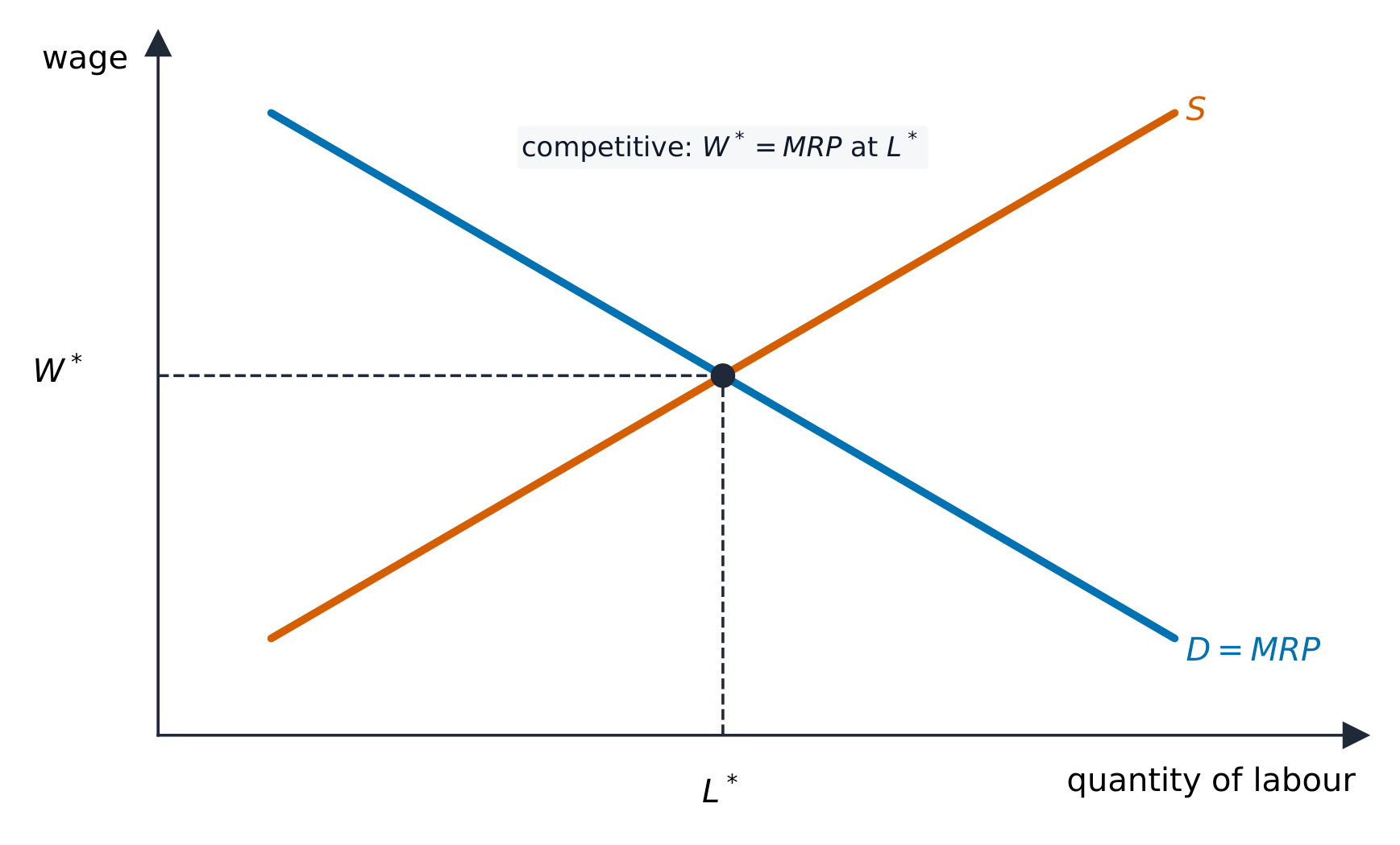
A competitive labour market sets the wage where demand meets supply
A minimum wage causes less unemployment when labour demand is:
Difficulty 1/5 · 100 coins + a small bonus on first completion today
Inelastic labour demand means firms cut few jobs when the wage rises.
Evaluating intervention
- Minimum wages reduce poverty and exploitation but risk unemployment; their effect depends on how elastic 富有弹性 labour demand is.
A minimum wage is a price floor. It only bites when set above the equilibrium wage; below it, the market wage already exceeds the minimum and nothing changes.
You've got it
- a minimum wage (price floor above equilibrium) raises pay but can cause a labour surplus
- trade unions bargain for higher wages; a monopsony (sole buyer) pushes wages down
- the employment effect depends on the elasticity of labour demand