The reasons for international trade
Introduced| English | Meaning |
|---|---|
| specialise/ˈspeʃəlaɪz/ | To concentrate on a particular product, task or area of activity. |
| comparative advantage/kəmˈpærətɪv ədˈvæntɪdʒ/ | The ability to produce a good or service at a lower opportunity cost than another producer. |
| absolute advantage/ˈæbsəluːt ədˈvæntɪdʒ/ | The ability to produce more output with the same resources, or the same output with fewer resources, than another producer. |
| opportunity cost/ɒpəˈtjuːnɪti kɒst/ | The value of the best alternative forgone when a choice is made. |
| over-specialisation/ˈəʊvə ˌspeʃəlaɪˈzeɪʃn/ | over-specialisation |
Why countries trade
- No country makes everything itself — Japan imports food, Saudi Arabia imports cars, everyone imports something.
- Trade lets each country specialise 专业化 in what it does relatively best, so the world produces more in total. The logic is comparative advantage 比较优势.
Absolute vs comparative advantage
- Absolute advantage 绝对优势: a country can produce a good using fewer resources than another.
- Comparative advantage: a country can produce a good at a lower opportunity cost 机会成本 than another — this is what drives trade, even if one country is better at everything.

A container port: international trade moves goods between countries in huge volumes
Why countries trade
Each country specialises where its opportunity cost is lowest, then trades — both can consume beyond their own frontier.
Comparative advantage is based on which country has the lower:
Difficulty 1/5 · 100 coins + a small bonus on first completion today
Comparative advantage compares opportunity costs, not absolute resource use.
A country can have a comparative advantage in a good even if another country has an absolute advantage in everything.
Difficulty 1/5 · 100 coins + a small bonus on first completion today
Comparative advantage depends on relative opportunity cost, so trade still benefits both.
Match each term to its meaning.
Difficulty 2/5 · 140 coins + a small bonus on first completion today
Absolute = fewer resources; comparative = lower opportunity cost; specialise accordingly.
Gains from specialisation
- Each country specialises where its opportunity cost is lowest, then trades.
- Total world output rises, and both countries can consume beyond their own production possibilities.
Opportunity cost. If a country can make 10 units of wheat or 5 of cloth with the same resources, the opportunity cost of 1 cloth is 2 wheat. It should specialise where its opportunity cost is lower than its trading partner's.
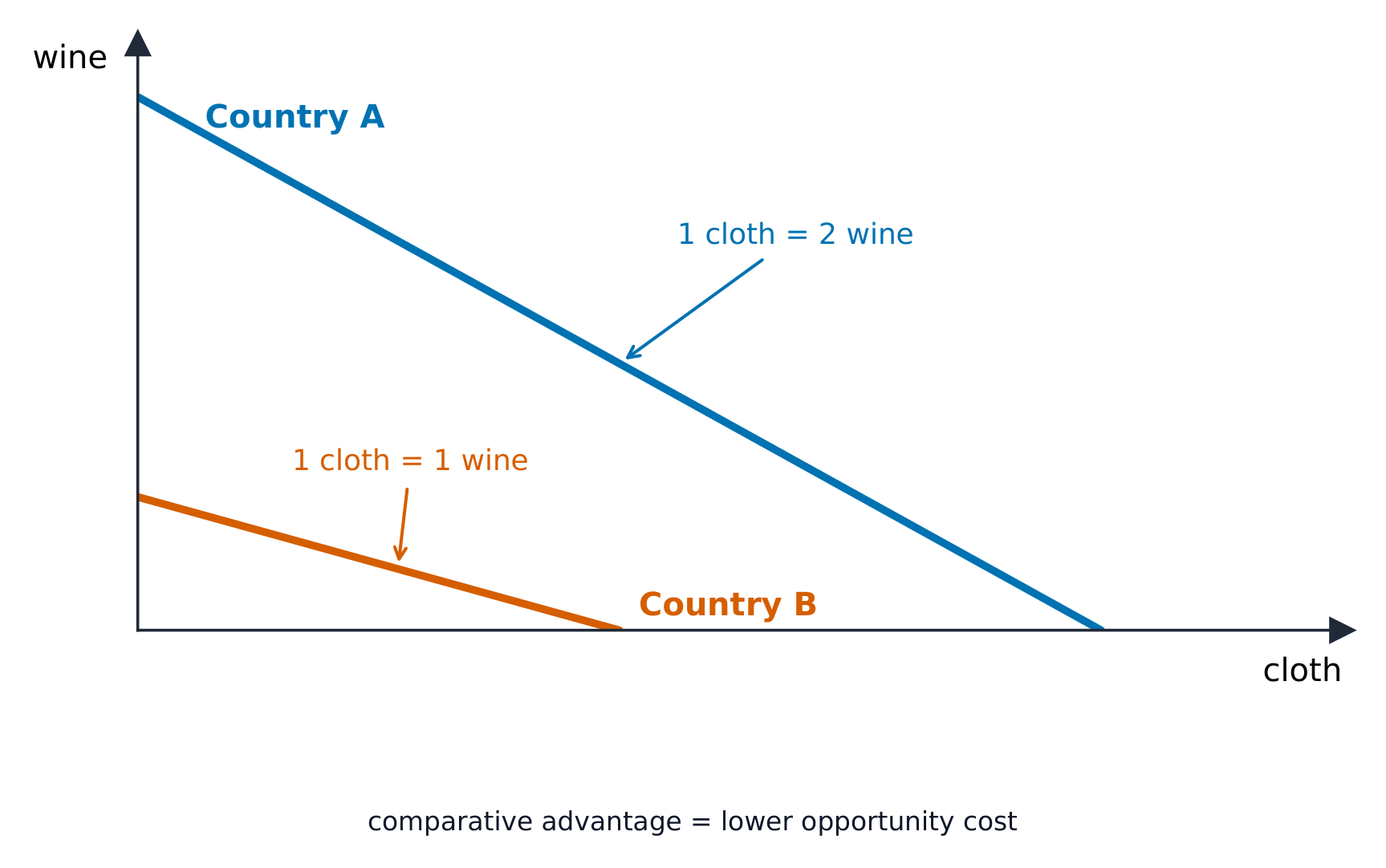
Comparative advantage from differently-sloped PPCs
A country can make 10 units of wheat OR 5 units of cloth with the same resources. What is the opportunity cost of 1 unit of cloth (in wheat)?
Difficulty 2/5 · 140 coins + a small bonus on first completion today
10 wheat ÷ 5 cloth = 2 wheat per cloth.
Countries should specialise where their ______ cost is lowest, then trade.
Difficulty 1/5 · 100 coins + a small bonus on first completion today
Specialise by comparative (opportunity-cost) advantage.
Limits and assumptions
- The gains assume no/low transport costs, few trade barriers, and that countries can actually switch resources.
- Over-specialisation 过度专业化 brings risks: dependence on one industry, and vulnerability to price swings.
You've got it
- absolute advantage = fewer resources; comparative advantage = lower opportunity cost
- countries gain by specialising where opportunity cost is lowest, then trading
- gains assume low barriers/transport costs; over-specialisation carries risk