Monetary policy
Introduced| English | Meaning |
|---|---|
| central bank/ˈsentrəl bæŋk/ | The institution responsible for a country's monetary policy and the management of its currency and banking reserves. |
| interest rates/ˈɪntrest reɪts/ | Charges for borrowing, or returns on lending, expressed as percentages of the amount over a period. |
| monetary policy/ˈmʌnɪtəri ˈpɒlɪsi/ | Actions by a monetary authority to influence interest rates, credit or money conditions in pursuit of economic objectives. |
| money supply/ˈmʌni səˈplaɪ/ | The stock of money available in an economy at a particular time, measured using a specified definition. |
| inflation target/ɪnˈfleɪʃn ˈtɑːɡɪt/ | A stated rate or range of price-level growth that monetary policy aims to achieve over a specified horizon. |
| transmission mechanism/trænˈsmɪʃn ˈmekənɪzəm/ | The channels through which a monetary-policy change affects spending, output and inflation. |
| quantitative easing/ˈkwɒntɪteɪtɪv ˈiːzɪŋ/ | quantitative easing |
The most powerful number in the economy
- When a central bank 中央银行 nudges interest rates 利率, mortgages, business loans and savings all move — and with them, spending across the whole economy.
- Monetary policy 货币政策 — controlling interest rates and the money supply 货币供给 — is the main day-to-day tool for hitting the inflation target 通胀目标.
Monetary policy is set by the central bank, whereas fiscal policy is set by the government.
Difficulty 1/5 · 100 coins + a small bonus on first completion today
Central bank = monetary (rates); government = fiscal (spending/taxes).
The central bank and interest rates
- An independent central bank sets the base interest rate to meet an inflation target (often ~2%).
- Raise rates → borrowing dearer, saving more attractive → spending falls (contractionary).
- Cut rates → borrowing cheaper → spending rises (expansionary).

A central bank, like the Bank of England, sets the interest rate, the main tool of monetary policy
Monetary policy shifts AD
Changing interest rates moves aggregate demand. Lower rates → more borrowing and spending → AD shifts right.
Monetary policy is mainly conducted by changing:
Difficulty 1/5 · 100 coins + a small bonus on first completion today
The central bank uses interest rates and the money supply; spending/taxes are fiscal policy.
Cutting interest rates tends to:
Difficulty 1/5 · 100 coins + a small bonus on first completion today
Cheaper borrowing and lower saving rewards boost consumption and investment → AD right.
To reduce high inflation, a central bank would typically:
Difficulty 1/5 · 100 coins + a small bonus on first completion today
Higher rates cool borrowing and spending, reducing demand-pull inflation.
The transmission mechanism 传导机制
- Lower rates → cheaper loans + lower saving reward → more consumption and investment → AD shifts right.
- A weaker currency (from lower rates) also boosts net exports.
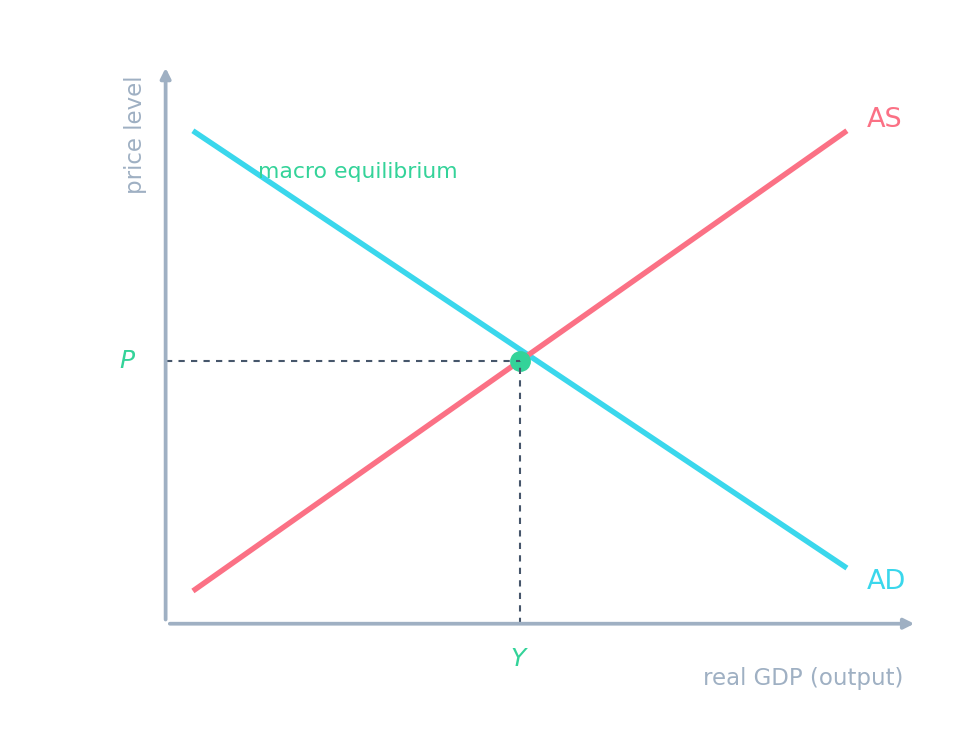
Lower interest rates raise consumption and investment, shifting AD right toward higher output.
Quantitative easing 量化宽松
- When rates are already near zero, the bank can use quantitative easing (QE) — creating money to buy bonds, lowering long-term rates and boosting lending.
Monetary ≠ fiscal. Monetary policy is the central bank (interest rates, money supply); fiscal policy is the government (spending, taxes). Exam answers must keep them separate.
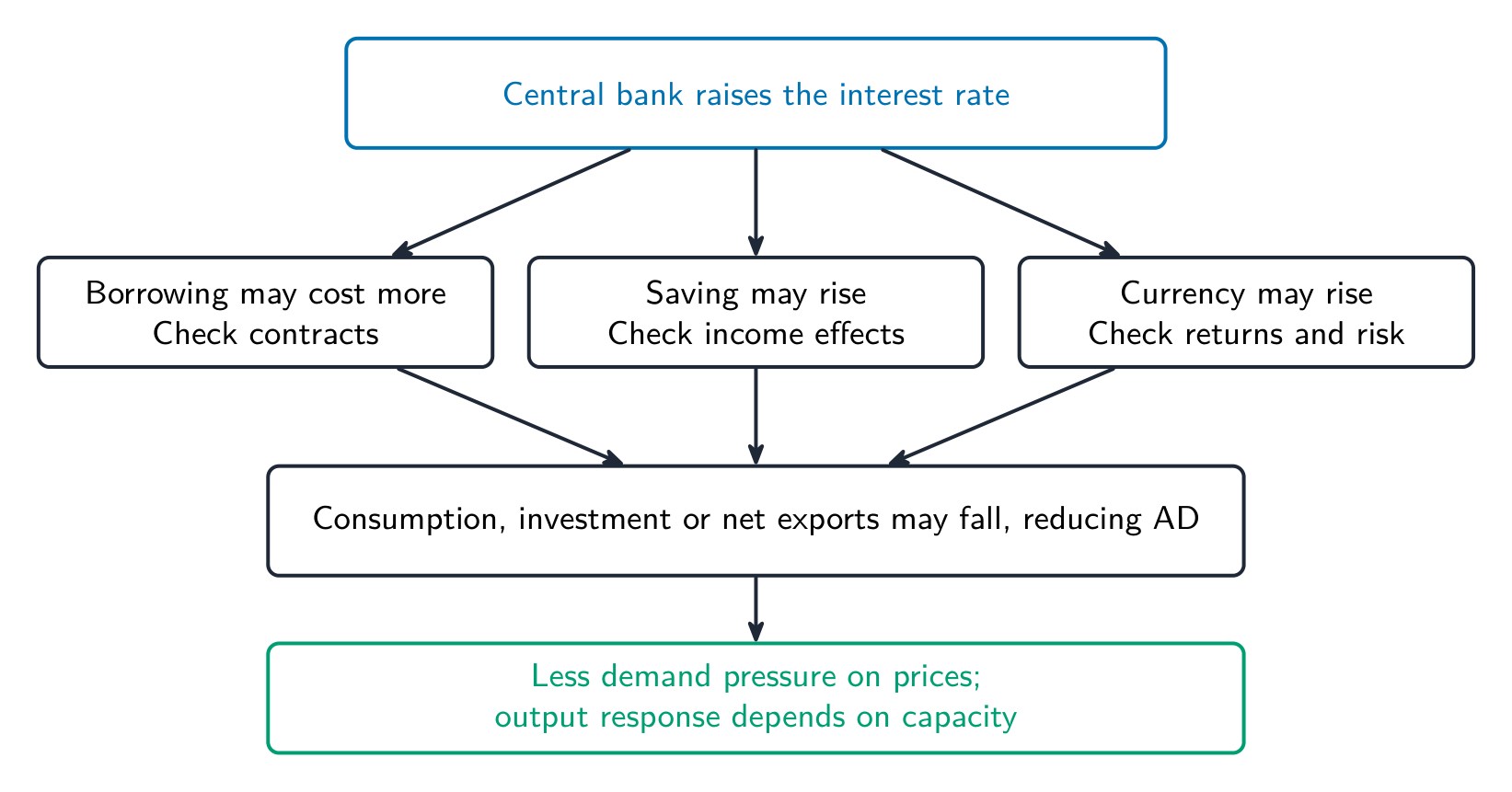
How a higher interest rate works through to slow inflation
Creating money to buy bonds when rates are near zero is called quantitative ______.
Difficulty 1/5 · 100 coins + a small bonus on first completion today
Quantitative easing (QE) lowers long-term rates and boosts lending.
You've got it
- monetary policy = the central bank setting interest rates / money supply for the inflation target
- lower rates → more borrowing/spending → AD right; higher rates restrain AD
- QE (creating money to buy bonds) is used when rates are near zero