Government macroeconomic policy objectives
Introduced| English | Meaning |
|---|---|
| conflict/ˈkɒnflɪkt/ | A disagreement or clash between incompatible interests, ideas or actions. |
| full employment/fʊl emˈplɔɪmənt/ | A situation in which available labour resources are employed at their sustainable potential, allowing normal frictional and structural unemployment. |
| price stability/praɪs stəˈbɪlɪti/ | A condition in which the general price level changes slowly and predictably rather than rising or falling substantially. |
| balance of payments/ˈbæləns ɒv ˈpeɪmənts/ | A record of economic transactions between an economy's residents and the rest of the world over a period. |
| trade-offs/treɪd ɒfs/ | A choice that involves giving up some benefit or objective to gain another. |
| Phillips curve/ˈfɪlɪps kɜːv/ | A relationship between inflation and unemployment, often represented as an inverse association in the short run. |
The government's juggling act
- Every government wants the same things: a growing economy, jobs, stable prices, and trade that pays its way.
- But these goals often conflict 冲突 — chasing one can wreck another. That tension defines macro policy.
Macro objective lab
Classify policy examples by the macroeconomic objective they target.
The four main objectives
- Other goals: a fair income distribution and protecting the environment.

Governments use fiscal policy, government spending and taxation, to steer the economy
Which is NOT one of the four main macroeconomic objectives?
Difficulty 1/5 · 100 coins + a small bonus on first completion today
The four are growth, low unemployment, price stability and a sound balance of payments.
Price stability usually means keeping inflation low and stable (around 2%), not zero.
Difficulty 1/5 · 100 coins + a small bonus on first completion today
A small positive target avoids the dangers of deflation.
Match each objective to its measure.
Difficulty 2/5 · 140 coins + a small bonus on first completion today
Each objective has its own headline indicator.
Conflicts between objectives
- Boosting growth can push up inflation and suck in imports (worsening the trade balance).
- Cutting inflation with high interest rates can raise unemployment.
- Policy is about trade-offs 权衡取舍, not perfection.
The classic conflict. Stimulating demand to cut unemployment tends to raise inflation — the short-run unemployment–inflation trade-off (the Phillips curve 菲利普斯曲线).
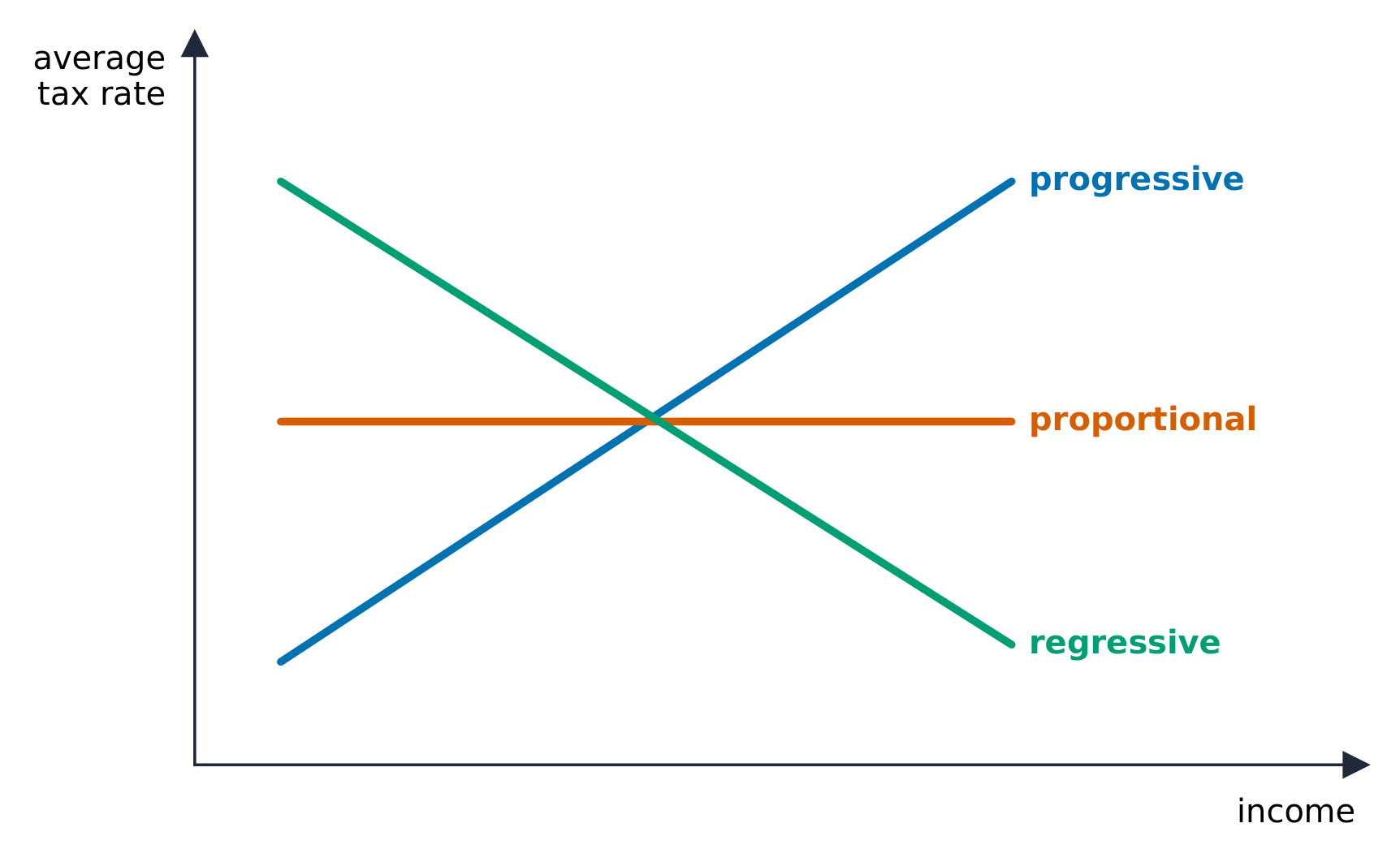
Progressive, proportional and regressive average tax rates
Stimulating demand to reduce unemployment often causes:
Difficulty 1/5 · 100 coins + a small bonus on first completion today
The unemployment–inflation trade-off: more demand → fewer jobless but rising prices.
Because objectives conflict, macro policy involves making ______ between them.
Difficulty 1/5 · 100 coins + a small bonus on first completion today
You often improve one objective at the cost of another.
Measuring each objective
- Each objective has a headline indicator: real GDP growth, the unemployment rate, CPI inflation, and the current-account balance.
- Governments track all four to judge whether policy is working.
You've got it
- four main objectives: growth, low unemployment, price stability, balance of payments
- plus equity and the environment
- objectives conflict (growth vs inflation; inflation vs unemployment) — policy means trade-offs