Sound — sampling and file size
Introduced| English | Meaning |
|---|---|
| analogue data/ˈænəlɒɡ ˈdeɪtə/ | Information represented by a continuously varying physical quantity. |
| digital data/ˈdɪdʒɪtl ˈdeɪtə/ | Information represented using discrete values, commonly encoded as binary digits. |
| sampling/ˈsæmplɪŋ/ | Measuring a signal at selected instants to produce discrete values for digital representation. |
| amplitude/ˈæmplɪtjuːd/ | The maximum displacement from an equilibrium position. |
| sampling rate/ˈsæmplɪŋ reɪt/ | The number of samples taken per second, measured in hertz. |
| sampling resolution/ˈsæmplɪŋ ˌrezəˈluːʃn/ | sampling resolution |
| quantisation noise/ˌkwɒntaɪˈzeɪʃn nɔɪz/ | quantisation noise |
Why the phone makes you sound thin
- A telephone call samples your voice 8,000 times a second. A CD samples the same voice 44,100 times a second. Your voice has not changed; the phone simply throws away everything above about 3.4 kHz.
- That is why a phone call is perfectly intelligible and unmistakably thin: speech lives below 3.4 kHz, but the sparkle of a cymbal or a hard
ssound does not. - The choice was not laziness. It was a calculation: sample fast enough to carry speech, and no faster, because every extra sample costs bandwidth on every call in the country.
- This lesson is how a continuous sound becomes numbers, the two settings that control quality and size, and the calculation the exam asks for.
Analogue and digital
- Sound in the real world is a continuous pressure wave: analogue data 模拟数据, which varies smoothly and takes infinitely many values.
- A computer stores digital data 数字数据: discrete numbers. Converting one to the other is sampling 采样.
- Sampling measures the wave's amplitude 振幅, its height, at regular time intervals, and stores each measurement as a binary number.
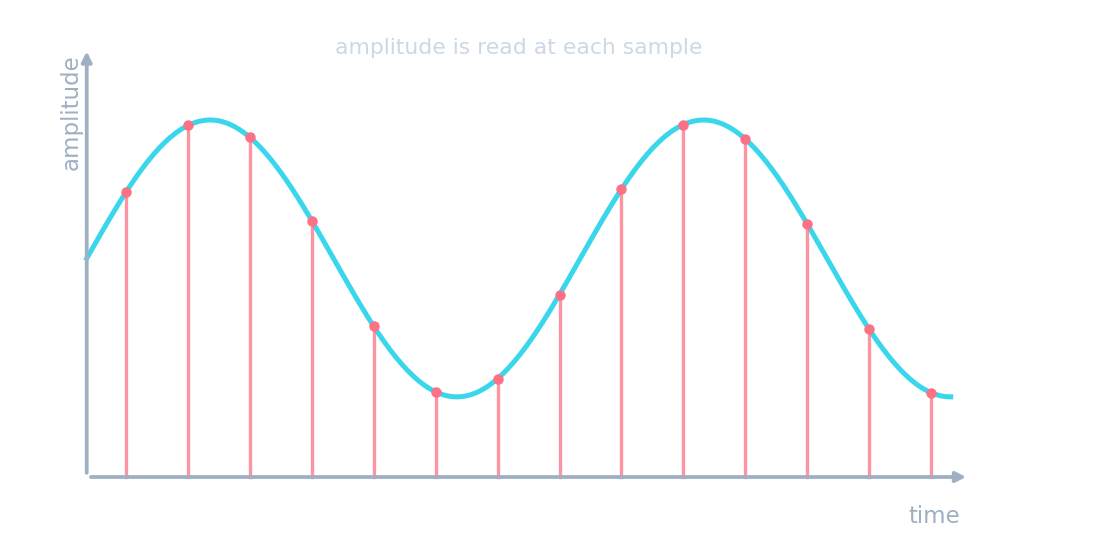
The smooth wave becomes a row of numbers
What does sampling do?
Difficulty 1/5 · 100 coins + a small bonus on first completion today
Sampling turns a continuous analogue wave into discrete digital values. Removing inaudible frequencies is lossy compression, a different step.
The two settings
- Sampling rate 采样率 is the number of samples taken per second, measured in hertz. CD quality is 44.1 kHz; a telephone uses 8 kHz.
- Sampling resolution 采样分辨率 (sample bit depth) is the number of bits used to store each sample's amplitude. CD quality is 16 bits, giving 65,536 possible levels.
- The rate controls which pitches survive; the resolution controls how precisely each measurement is stored.
Sound sampling
y = a sin(bt + c)
Sampling measures a sound wave at regular intervals — a higher rate copies it more truly.
The sampling rate of a digital sound is:
Difficulty 1/5 · 100 coins + a small bonus on first completion today
Sampling rate = samples per second (hertz). The bits per sample is the sample resolution.
Put the steps of turning a sound into a digital file in order.
Difficulty 3/5 · 200 coins + a small bonus on first completion today
Rate decides how often you measure; resolution decides how finely each measurement is rounded, and the rounding is where quantisation noise comes from.
Sound file size
- Mono is one channel; stereo is two, which doubles the size.
- A 5-second mono clip at 8 kHz and 8 bits: $8000 \times 8 \times 5 \times 1 = 320\,000$ bits, which is 40,000 bytes.
A 5-second mono clip is sampled at $8000\ \text{Hz}$ with 8-bit resolution. What is its size in bits?
Difficulty 2/5 · 140 coins + a small bonus on first completion today
size $= 8000 \times 8 \times 5 \times 1 = 320\,000$ bits.
Sound file size in bits = sampling rate x sampling resolution x duration x ____.
Difficulty 1/5 · 100 coins + a small bonus on first completion today
Mono is one channel, stereo two. Leaving the channel count out halves every stereo answer.
Worked example: a CD track
- A 10-second stereo clip is recorded at CD quality: 44.1 kHz, 16-bit. Find its size in MiB.
- $44\,100 \times 16 \times 10 \times 2 = 14\,112\,000$ bits.
- Divide by 8 for bytes: $1\,764\,000$. Divide by $1024^2$: 1.68 MiB.
- Every mark is in the working: the four factors, one division by 8, and a stated prefix. Forgetting the two channels halves the answer.
A 10-second stereo clip is sampled at 44100 Hz with 16-bit resolution. How many bits does it need?
Difficulty 2/5 · 140 coins + a small bonus on first completion today
44100 x 16 x 10 x 2 = 14,112,000 bits, about 1.68 MiB. Leaving out the two channels halves the answer.
A stereo recording is twice the size of the same mono recording at the same rate and resolution.
Difficulty 1/5 · 100 coins + a small bonus on first completion today
Channels multiply the size: two channels, twice the samples. The channel count belongs in the formula.
Changing the settings
- Higher sampling rate: higher pitches are captured, so the sound is more accurate, but the file is larger.
- Higher sampling resolution: each amplitude is stored in finer steps, so there is less quantisation noise 量化噪声, the roughness introduced when a smooth value is rounded to the nearest level; the file is larger.
- Lower of either: a smaller file and an audible loss of quality. As with images, answer in these terms, not "it sounds bad".
Increasing the sampling rate will:
Difficulty 1/5 · 100 coins + a small bonus on first completion today
A higher sampling rate captures higher frequencies (better quality) but increases the file size.
A higher sample resolution (more bits per sample) reduces quantisation noise.
Difficulty 1/5 · 100 coins + a small bonus on first completion today
More bits give finer amplitude steps, so each sample is closer to the true value — less quantisation noise (but a larger file).
Match each change to its main effect.
Difficulty 2/5 · 140 coins + a small bonus on first completion today
Rate decides which pitches survive; resolution decides how precisely each sample is stored.
Worked example: how fast must you sample?
- The sampling rate must be at least twice the highest frequency you want to keep.
- Human hearing reaches about 20 kHz. What is the minimum rate to capture it? $2 \times 20\,000 = 40\,000$ Hz, which is why CD chose 44.1 kHz, a little above the minimum.
- A telephone samples at 8 kHz. What is the highest frequency it can carry? Half of 8 kHz, so 4 kHz, and in practice about 3.4 kHz. Speech fits; music does not.
To capture frequencies up to $20\,000\ \text{Hz}$, what is the minimum sampling rate, in Hz?
Difficulty 2/5 · 140 coins + a small bonus on first completion today
The sampling rate must be at least twice the highest frequency: $2 \times 20\,000 = 40\,000\ \text{Hz}$.
A telephone samples at 8000 Hz. What is the highest frequency, in Hz, it can in principle carry?
Difficulty 2/5 · 140 coins + a small bonus on first completion today
Half the sampling rate, since the rate must be at least twice the highest frequency kept. In practice a phone carries about 3.4 kHz.
Trading quality against size
- Speech for a voice note: a low rate and resolution are enough, and the file is small.
- Music for distribution: CD settings or better, because listeners hear the difference.
- Live streaming: the rate and resolution are chosen to fit the available bandwidth, then lossy compression removes more.
- A "justify" answer names the setting, the effect on quality and the effect on size, tied to the use.
Marks that slip away
- Rate is samples per second; resolution is bits per sample. The question names one.
- Stereo is two channels. Leaving the channel count out of the formula halves every stereo answer.
- The minimum rate is twice the highest frequency wanted, not the same as it.
- Say quantisation noise, not "it sounds fuzzy". The syllabus term carries the mark.
You've got it
- sampling converts continuous analogue data into digital data by measuring the amplitude at regular intervals
- sampling rate = samples per second (CD 44.1 kHz), sampling resolution = bits per sample (CD 16)
- size in bits = rate $\times$ resolution $\times$ duration $\times$ channels; stereo doubles it
- higher rate or resolution means better accuracy, less quantisation noise and a larger file; the rate must be at least twice the highest frequency kept