Why complexes are coloured
Introduced| English | Meaning |
|---|---|
| degenerate/dɪˈdʒenəreɪt/ | Describing distinct orbitals or quantum states that have the same energy. |
| octahedral/ˌɒktəˈhiːdrəl/ | Describing six positions arranged towards the vertices of an octahedron around a central point. |
| tetrahedral/ˌtetrəˈhiːdrəl/ | Having four positions arranged towards the corners of a tetrahedron around a centre. |
| complementary colour/ˌkɒmplɪˈmentəri ˈkʌlə/ | The colour seen when part of white light is absorbed; a complex absorbing red looks cyan. |
| spectrochemical series/ˌspektrəʊˈkemɪkl ˈsɪəriːz/ | spectrochemical series |
Where the colour comes from
- In a free ion the five d orbitals are degenerate 简并 (same energy).
- Ligands split them into two sets.
- Absorbing light across the gap gives the colour we see.
Complex colour route
Follow light absorption from d-orbital splitting to observed colour.
In a free transition-metal ion, the five d orbitals are:
Difficulty 1/5 · 100 coins + a small bonus on first completion today
They are degenerate until ligands approach and split them into two sets.
Transition-metal complexes are coloured because d-electrons absorb part of the ______ spectrum.
Difficulty 1/5 · 100 coins + a small bonus on first completion today
The complementary colour is transmitted.
Splitting the d orbitals
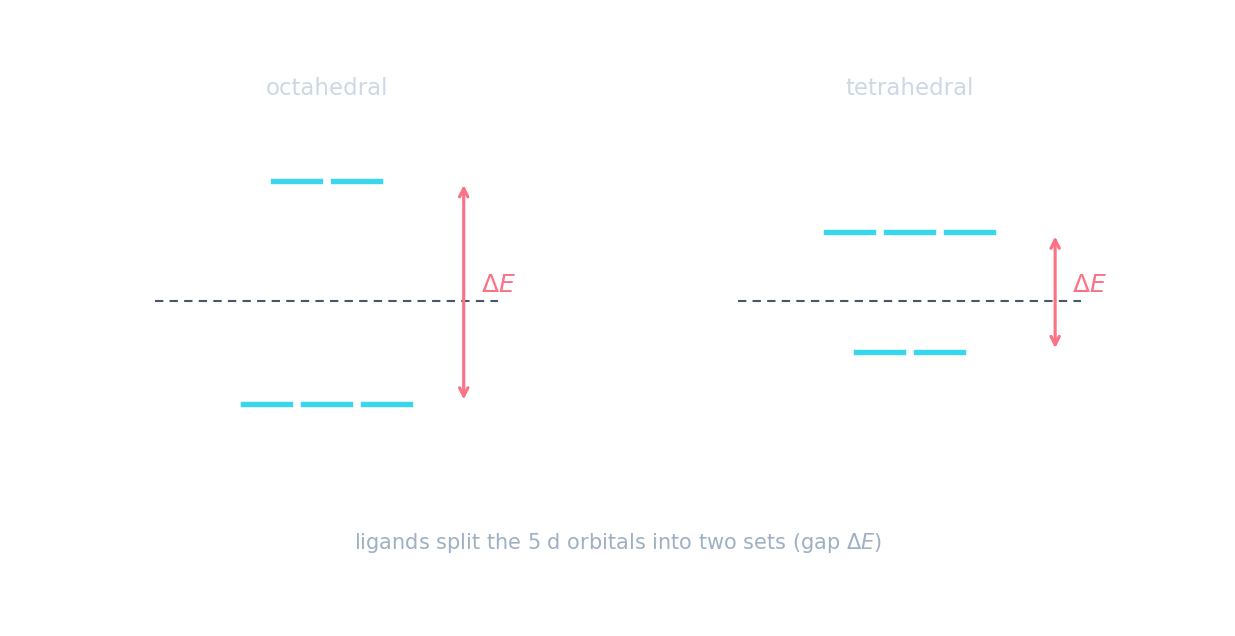
- ligands split the d orbitals, separated by an energy gap $\Delta E$:
- octahedral 八面体形: three lower + two higher.
- tetrahedral 四面体形: two lower + three higher.
In an octahedral complex, the d orbitals split into:
Difficulty 1/5 · 100 coins + a small bonus on first completion today
Octahedral: 3 lower + 2 upper; tetrahedral is the reverse (2 lower + 3 upper).
Match each colour-theory idea.
Difficulty 2/5 · 140 coins + a small bonus on first completion today
Each item links the term to its correct meaning.
The colour we see
- A complex absorbs light whose frequency matches $\Delta E$, promoting an electron to a higher d orbital.
- We see the complementary colour 互补色 of the light absorbed.
- (A d⁰ or d¹⁰ ion — like Zn²⁺ — has no possible jump, so it is colourless.)
The colour we see for a complex is:
Difficulty 1/5 · 100 coins + a small bonus on first completion today
The complex absorbs light of energy ΔE; we see the complementary colour of what was absorbed.
Ligand exchange changes the colour because different ligands:
Difficulty 1/5 · 100 coins + a small bonus on first completion today
A different ligand changes the size of the d-orbital splitting (ΔE), so a different colour is seen.
What changes the colour
- Change $\Delta E$ and you change the colour. Three things change $\Delta E$:
- the ligand (a spectrochemical series 光谱化学序列: CN⁻ > NH₃ > H₂O > Cl⁻);
- the metal's oxidation state (higher charge → bigger $\Delta E$);
- the coordination number / geometry (octahedral vs tetrahedral).
Add ammonia to pale-blue [Cu(H₂O)₆]²⁺ → deep-blue [Cu(NH₃)₄(H₂O)₂]²⁺.
Swapping H₂O for the stronger-field NH₃ widens $\Delta E$, so a different colour of light is absorbed — and the solution visibly changes colour.
You've got it
- a free ion's five d orbitals are degenerate; ligands split them by a gap $\Delta E$
- octahedral = 3 lower + 2 upper; tetrahedral = 2 lower + 3 upper
- the complex absorbs light matching $\Delta E$; we see the complementary colour
- $\Delta E$ (and the colour) changes with the ligand, the oxidation state and the geometry