Stereoisomerism
Introduced| English | Meaning |
|---|---|
| stereoisomerism/ˈsterɪəʊɪsəmərɪzəm/ | The existence of compounds with the same atom connectivity but different arrangements in space. |
| geometrical/ˌdʒiːəʊˈmetrɪkl/ | geometrical |
| restricted rotation/rɪˈstrɪktɪd rəʊˈteɪʃn/ | The inability to rotate freely about a bond, as around a C=C double bond. |
| optical isomerism/ˈɒptɪkl ˈaɪsəmərɪzəm/ | Isomerism involving non-superimposable mirror-image molecules that can interact differently with plane-polarised light. |
| chiral centre/ˈkaɪrəl ˈsentə/ | An atom, commonly carbon bonded to four different groups, around which arrangements can produce non-superimposable mirror images. |
| enantiomer/eˈnæntɪəmə/ | enantiomer |
Mirror images and rigid bonds
- In stereoisomerism 立体异构 the atoms are joined in the same order but point in different directions in space.
- Two kinds: geometrical 几何 and optical.
- Both matter a lot in real molecules.
Stereoisomerism lab
Sort stereoisomer examples by the 3D feature that creates them.
In stereoisomerism, the atoms are:
Difficulty 1/5 · 100 coins + a small bonus on first completion today
Stereoisomers share the same connectivity but differ in 3-D arrangement.
E/Z (cis-trans) isomerism arises because there is no rotation about a C=C double bond.
Difficulty 1/5 · 100 coins + a small bonus on first completion today
The restricted rotation fixes the groups' positions.
Geometrical (cis/trans)
- Happens at a C=C double bond.
- The pi bond stops the carbons rotating (restricted rotation 受限旋转), so groups are fixed:
- cis = on the same side; trans = on opposite sides.
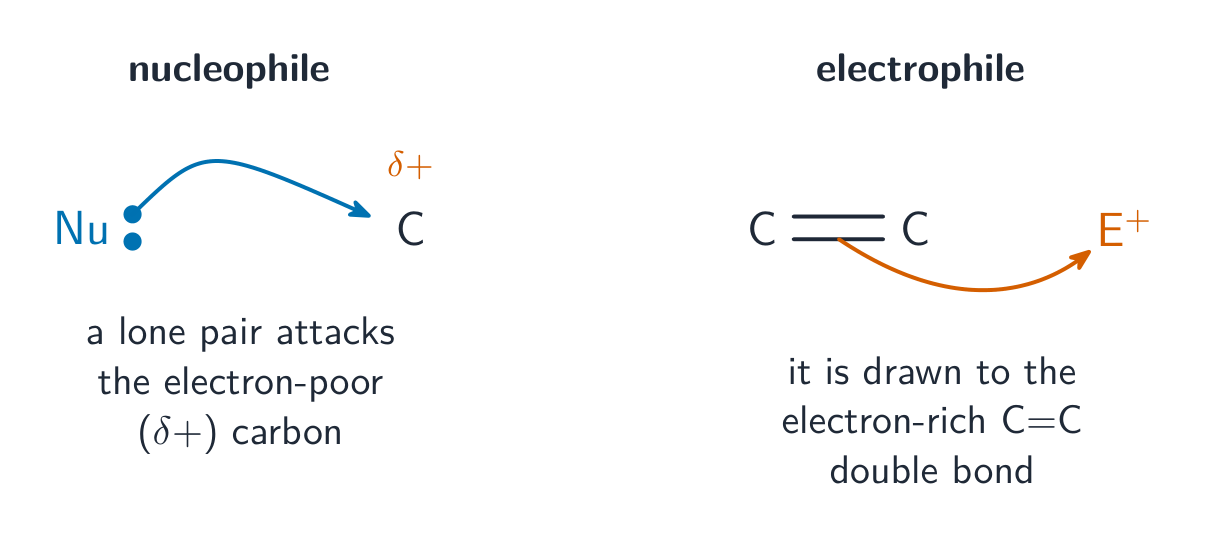
A nucleophile attacks an electron-poor centre; an electrophile is drawn to an electron-rich one
Geometrical (cis/trans) isomerism happens at a C=C bond because:
Difficulty 1/5 · 100 coins + a small bonus on first completion today
Restricted rotation about the C=C bond fixes groups cis (same side) or trans (opposite sides).
Match each stereochemistry term.
Difficulty 2/5 · 140 coins + a small bonus on first completion today
Each item links the term to its correct meaning.
Optical isomerism 旋光异构
- Happens at a chiral centre 手性中心 — a carbon with four different groups.
- It gives two mirror-image forms, enantiomers 对映体, that cannot be superimposed.
- A molecule can have more than one chiral centre.
A chiral centre is a carbon with:
Difficulty 1/5 · 100 coins + a small bonus on first completion today
A carbon bonded to four different groups is chiral and gives two mirror-image forms.
Enantiomers are:
Difficulty 1/5 · 100 coins + a small bonus on first completion today
Optical isomers (enantiomers) are mirror images that cannot be superimposed on each other.
When does E/Z isomerism occur?
- It needs a C=C double bond with two different groups on each carbon.
- If either carbon carries two identical groups, there is no E/Z isomerism.
You've got it
- stereoisomers = same order of atoms, different directions in space
- geometrical (cis/trans): at a C=C bond, restricted rotation fixes groups on the same (cis) or opposite (trans) sides
- optical: at a chiral centre (carbon with 4 different groups) → non-superimposable mirror images (enantiomers)