Bond fission and attacking species
Introduced| English | Meaning |
|---|---|
| nucleophile/ˈnjuːklɪɒfaɪl/ | An electron-pair donor that forms a covalent bond to an electron-deficient centre. |
| electrophile/ɪˌlektrəʊˈfaɪl/ | A species that accepts an electron pair to form a covalent bond. |
| heterolytic fission/ˌhetrəˈlɪtɪk ˈfɪʃn/ | Breaking a covalent bond so that both electrons in the bonding pair go to the same fragment. |
| homolytic fission/ˌhɒməˈlɪtɪk ˈfɪʃn/ | Breaking a covalent bond so that each fragment receives one electron from the bonding pair. |
| free radical/friː ˈrædɪkl/ | A species containing one or more unpaired electrons. |
Breaking bonds and attacking species
- A covalent bond can break in two ways.
- The fragments may be radicals or ions.
- Reactions are driven by nucleophiles 亲核试剂 and electrophiles 亲电试剂.
Bond fission and attack route
Watch a polar bond lead to electrophiles, nucleophiles and radicals.
Breaking a bond so each atom keeps one electron is ______ fission.
Difficulty 1/5 · 100 coins + a small bonus on first completion today
It forms free radicals.
Homolytic vs heterolytic fission 异裂
- Homolytic fission 均裂: the bond splits evenly, one electron to each atom → two free radicals 自由基 (unpaired electron).
- Heterolytic fission: the bond splits unevenly, both electrons to one atom → two ions.
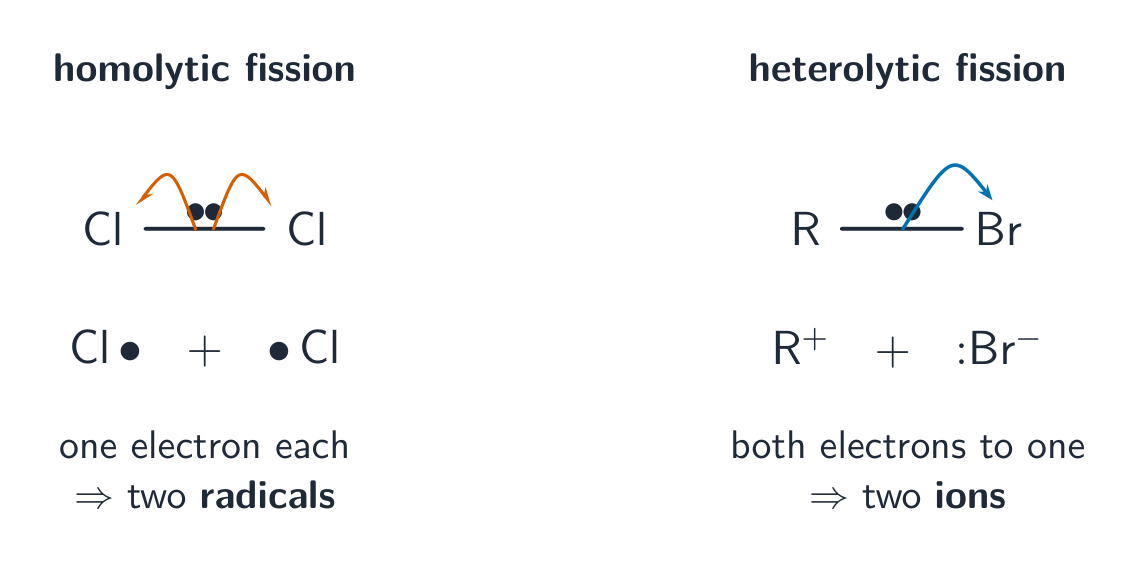
Homolytic fission gives two radicals; heterolytic fission gives two ions
Homolytic fission of a covalent bond produces:
Difficulty 1/5 · 100 coins + a small bonus on first completion today
Homolytic = even split, one electron each → two radicals; heterolytic = uneven → two ions.
Heterolytic fission produces:
Difficulty 1/5 · 100 coins + a small bonus on first completion today
In heterolytic fission both bonding electrons go to one atom, giving a positive and a negative ion.
Match each species/process to its meaning.
Difficulty 2/5 · 140 coins + a small bonus on first completion today
Each item links the term to its correct meaning.
Nucleophiles and electrophiles
- a nucleophile has a lone pair and is attracted to an electron-poor (positive) centre.
- an electrophile is attracted to an electron-rich (negative) centre, such as a C=C double bond.
A nucleophile is a species that:
Difficulty 1/5 · 100 coins + a small bonus on first completion today
Nucleophiles use a lone pair to attack electron-poor carbons; electrophiles seek electron-rich centres.
An electrophile is attracted to:
Difficulty 1/5 · 100 coins + a small bonus on first completion today
Electrophiles are electron-seeking; a C=C double bond is electron-rich and attracts them.
Two ways a bond can break
- Homolytic fission gives two radicals (each atom keeps one electron).
- Heterolytic fission gives ions (one atom keeps both electrons).
You've got it
- homolytic fission → two free radicals (one electron each); heterolytic fission → two ions
- a nucleophile (lone pair) attacks an electron-poor centre
- an electrophile is drawn to an electron-rich centre (e.g. C=C)