Sales forecasting and time-series
Introduced| English | Meaning |
|---|---|
| sales forecasting/seɪlz ˈfɔːkæstɪŋ/ | Estimating future sales using information such as past results, market research and expected conditions. |
| time series/taɪm ˈsɪəriːz/ | A sequence of observations recorded in time order, often at regular intervals. |
| trend/trɛnd/ | The general direction in which a quantity or pattern changes over time. |
| seasonal/ˈsiːzənl/ | Varying in a recurring pattern at particular times of the year. |
| moving average/ˈmuːvɪŋ ˈævrɪdʒ/ | An average calculated over a fixed-size window that moves through a sequence of observations, helping smooth short-term variation. |
| extrapolation/ekˈstræpəleɪʃn/ | Estimating a value outside the range of observed data by extending a pattern or model. |
Predicting next quarter's sales
- How many units should the factory make next quarter? Order too much and stock piles up; too little and you lose sales.
- Sales forecasting 销售预测 uses past data to predict the future.
Sales forecast lab
sales = trend + seasonal effect
Move along a sales trend and see how forecast and actual can separate.
A time series is data that is:
Difficulty 1/5 · 100 coins + a small bonus on first completion today
A time series records a variable over regular periods.
The long-run underlying direction of a time series is its ______.
Difficulty 1/5 · 100 coins + a small bonus on first completion today
The trend is what moving averages reveal.
Time-series 时间序列 analysis
- A time series is data recorded over regular intervals (e.g. quarterly sales).
- It splits into a long-run trend 趋势, seasonal 季节性 variation, and random noise.
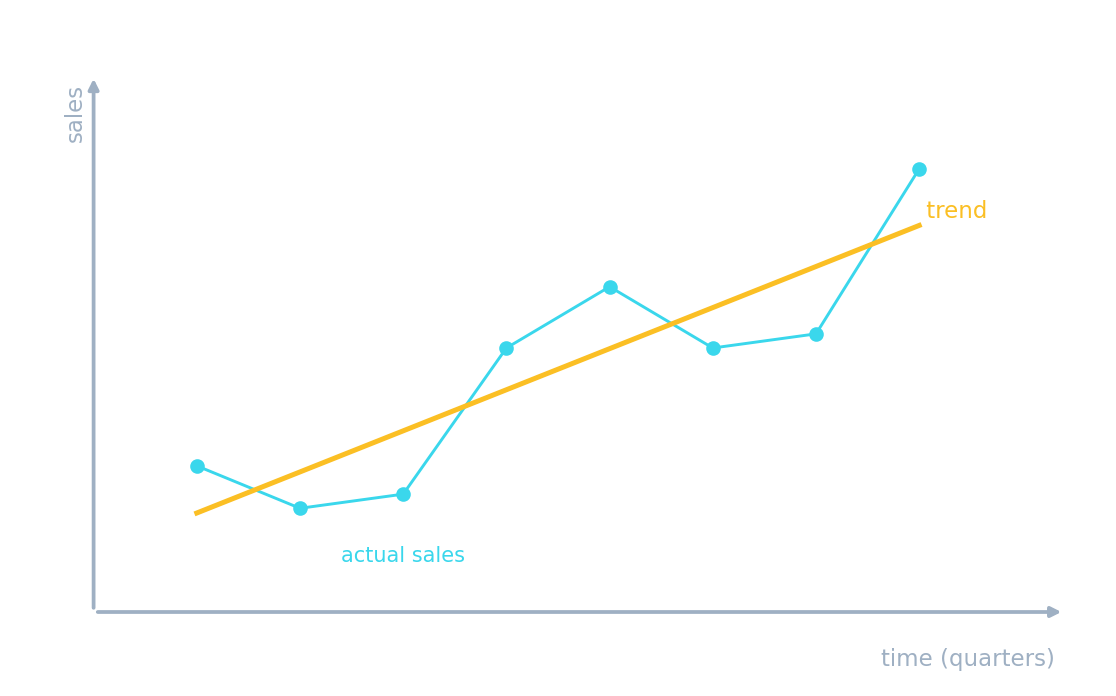
Sales wobble seasonally around an underlying upward trend.
Sales over four quarters are 30, 34, 28, 32. What is the 4-quarter moving average?
Difficulty 2/5 · 140 coins + a small bonus on first completion today
(30 + 34 + 28 + 32) ÷ 4 = 124 ÷ 4 = 31.
The main purpose of a moving average is to:
Difficulty 1/5 · 100 coins + a small bonus on first completion today
It smooths the data so the trend stands out.
Moving averages 移动平均
- A moving average smooths out short-term ups and downs to reveal the trend.
- A 4-quarter moving average averages each set of four consecutive quarters.
Worked example. Sales of 20, 24, 18, 26 over four quarters average to (20+24+18+26) ÷ 4 = 22 — the smoothed trend value, with the seasonal swings averaged out.

Sales wobble seasonally around a smooth underlying trend
Extrapolation assumes the future will follow the past trend.
Difficulty 1/5 · 100 coins + a small bonus on first completion today
That assumption fails if conditions change.
Extrapolation 外推 and its limits
- Extrapolation extends the past trend into the future to forecast.
- It assumes the future behaves like the past — risky if conditions change (a new rival, a recession).
Forecasts are not facts. Extrapolation only works while the trend holds. A sudden shock — new competitor, technology, downturn — can make a confident forecast badly wrong.
You've got it
- a time series splits into trend, seasonal variation and noise
- a moving average smooths data to reveal the underlying trend
- extrapolation projects the trend forward — risky if conditions change