Power networks and the per-unit system
도입됨| English | 의미 |
|---|---|
| per-unit | 표준화 값 |
| base value | base value |
| fault current | fault current |
Ohms at two voltages
- A grid study mixes 11 kV with 132 kV. Done in ohms, every step needs a turns ratio, and errors creep in.
- Power engineers use the per-unit 标幺值 system instead: every voltage is near 1.0, and the turns ratios disappear.
Base values
- Choose a base value 基准值 for power, $S_{base}$, once, and a base voltage $V_{base}$ at each voltage level. The rest follows:
- $Z_{base} = \dfrac{V_{base}^{2}}{S_{base}}$, $I_{base} = \dfrac{S_{base}}{\sqrt{3}\,V_{base}}$, and $Z_{pu} = Z/Z_{base}$.
The study uses 100 MVA and 33 kV. What is the base impedance, in Ω? Give 2 decimal places.
난이도 2/5 · 140코인 + 오늘 첫 완료 시 작은 보너스 추가
$Z_{base} = 33^{2}/100 = 10.89\ \Omega$ (kV squared over MVA gives ohms).
What is the base current at 33 kV on 100 MVA, in A? Give the nearest whole number.
난이도 2/5 · 140코인 + 오늘 첫 완료 시 작은 보너스 추가
$I_{base} = 100 \times 10^{6} / (\sqrt{3} \times 33\,000) = 1750$ A.
The nameplate percentage
- A transformer marked "10%" drops 10% of rated voltage inside itself at rated current. That is $Z_{pu} = 0.10$ on its own rating.
- Each voltage level has its own $Z_{base}$, so the turns ratio squared is already built in.
A transformer rated 8% drops 8% of its rated voltage inside itself when it carries rated current.
난이도 1/5 · 100코인 + 오늘 첫 완료 시 작은 보너스 추가
That is what the nameplate percentage means, and it is the same as $Z_{pu} = 0.08$ on the transformer's own rating.
Changing bases
- An impedance given on other bases moves to the study's bases by $Z_{new} = Z_{old}\,\dfrac{S_{new}}{S_{old}}\left(\dfrac{V_{old}}{V_{new}}\right)^{2}$.
- When the voltage bases already match, only the power ratio is left.
A 50 MVA transformer is rated 8%. What is its impedance on a 100 MVA base (voltage bases match), in pu?
난이도 2/5 · 140코인 + 오늘 첫 완료 시 작은 보너스 추가
$0.08 \times 100/50 = 0.16$ pu. A smaller machine looks bigger on a larger base.
Worked example: a fault at the line end
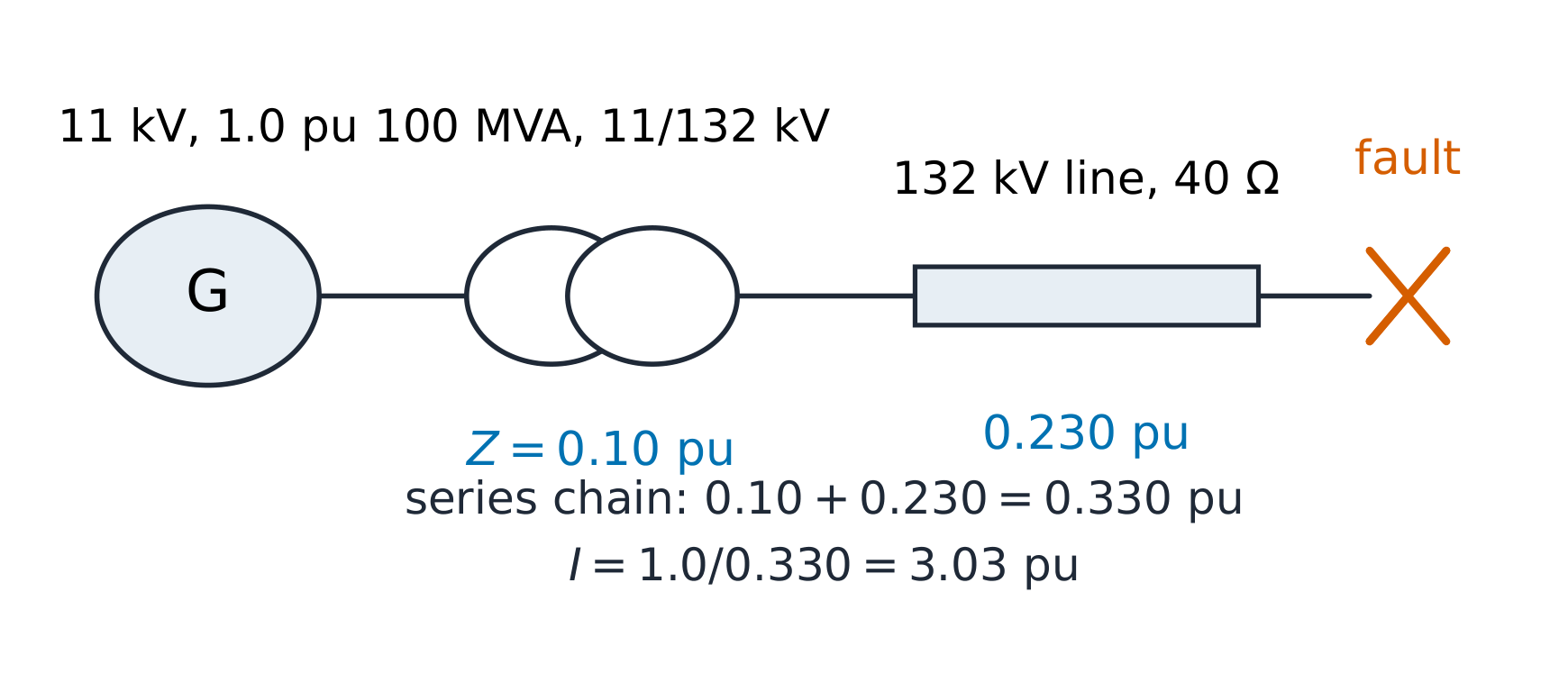
- A 100 MVA, 11/132 kV transformer (0.10 pu) feeds a 40 Ω, 132 kV line. $Z_{base} = 132^{2}/100 = 174.2\ \Omega$, so the line is 0.230 pu and the total 0.330 pu.
- The fault current 短路电流 is $1.0/0.330 = 3.03$ pu. At 132 kV, $I_{base} = 437$ A, so 1327 A flows. On the 11 kV side, the same 3.03 pu is 15 926 A.
A source at 1.0 pu feeds a fault through 0.10 pu of transformer and 0.15 pu of line. What is the fault current, in pu?
난이도 2/5 · 140코인 + 오늘 첫 완료 시 작은 보너스 추가
$1.0/(0.10 + 0.15) = 4$ pu. Multiply by each level's base current to get amperes.
Worked example: changing bases
- A generator ($X_{d} = 0.25$ pu on 80 MVA) feeds a 60 MVA, 11/66 kV transformer rated 8%. On 100 MVA: $0.25 \times 100/80 = 0.313$ and $0.08 \times 100/60 = 0.133$ pu.
- A fault on the 66 kV terminals sees 0.446 pu, so 2.24 pu flows: 1962 A at 66 kV, while the generator carries 11 780 A at 11 kV.
A fault current of 2.24 pu flows through an 11/66 kV transformer. Why are the amperes different on the two sides?
난이도 1/5 · 100코인 + 오늘 첫 완료 시 작은 보너스 추가
The per-unit value is the same on both sides; the base current changes with the voltage, just as the turns ratio would say.
Three common slips
- Mixing conventions. Use $Z_{base} = V_{LL}^{2}/S_{3\phi}$ everywhere.
- Forgetting the square. The voltage ratio is squared when bases change.
- "10% is a loss." It is a voltage drop at rated current; a 10% transformer can still be 99% efficient.
Put the steps of a per-unit fault study in order.
난이도 3/5 · 200코인 + 오늘 첫 완료 시 작은 보너스 추가
The last step is also the check that the answer makes sense in real units.
Recap
- One $S_{base}$; one $V_{base}$ for each level.
- Convert to per-unit, do the series and fault arithmetic, convert back.
- Each level converts back with its own base current.