| English | 의미 |
|---|---|
| nuclear fission/ˈnjuːklɪə ˈfɪʃn/ | 핵분열 |
| nuclear fusion/ˈnjuːklɪə ˈfjuːʒn/ | 핵융합 |
A pinch of matter, an ocean of energy
- The Sun turns four million tonnes of its matter into pure energy every second.
- A nuclear reactor powers a city from a few kilograms of fuel.
- The secret is mass turning into energy, through Einstein's $E = mc^2$.
- Because $c^2$ is enormous, a tiny mass releases a colossal amount of energy.
Mass becomes energy
- Einstein's relation $E = mc^2$ says mass and energy are two forms of the same thing.
- In a nuclear reaction, a little mass disappears and reappears as a burst of energy.
- Because $c^2 \approx 9\times10^{16}$, even a gram of mass would give a huge energy.
- Nuclear reactions release millions of times more energy per atom than chemical ones.
질량과 에너지를 연결하는 식은 무엇입니까?
난이도 1/5 · 100 코인 + 오늘 첫 완료 시 소액 보너스
아인슈타인의 $E = mc^2$은 질량과 에너지를 연결합니다.
왜 핵 반응은 화학 반응보다 훨씬 많은 에너지를 방출합니까?
난이도 1/5 · 100 코인 + 오늘 첫 완료 시 소액 보너스
미세한 질량조차 거대한 에너지를 주는 이유는 $c^2$이 매우 크기 때문입니다.
Fission: splitting big nuclei
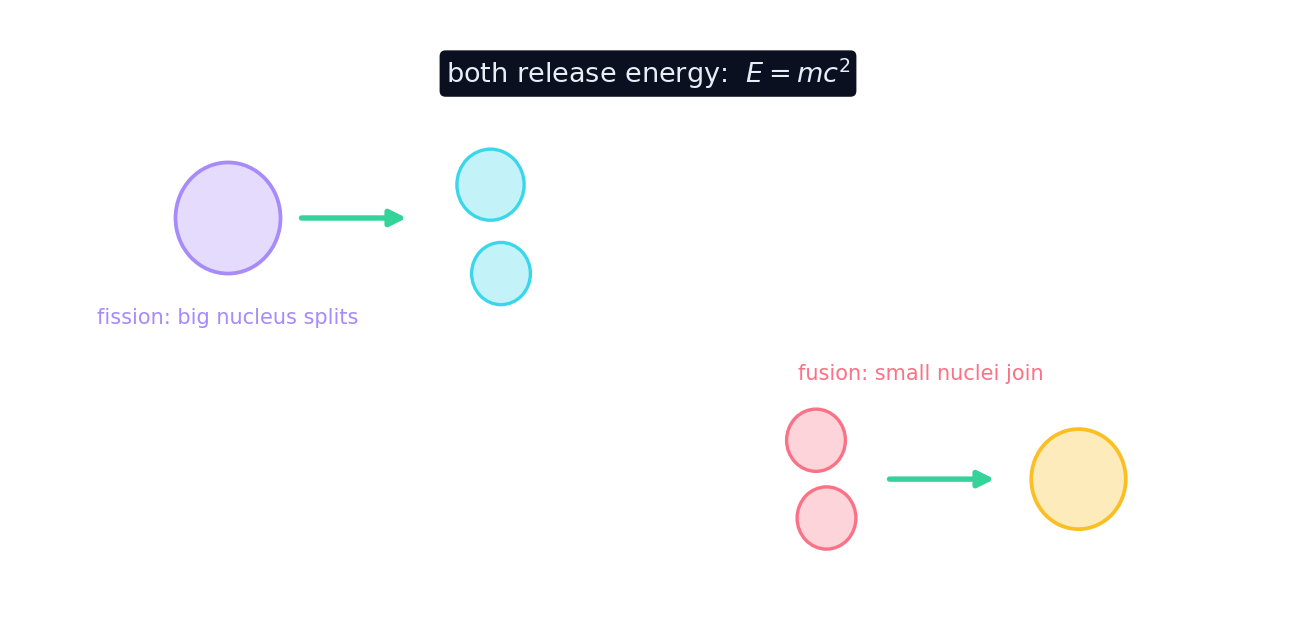
- Nuclear fission 核裂变 splits a large, heavy nucleus (like uranium) into smaller pieces.
- The fragments have slightly less total mass; the lost mass becomes energy.
- Each split also releases neutrons that can split more nuclei — a chain reaction.
- Fission powers nuclear reactors and atomic bombs.
Nuclear fission(核裂变)은:
난이도 1/5 · 100 코인 + 오늘 첫 완료 시 소액 보너스
Fission(核裂变)은 크고 무거운 핵을 작은 조각으로 나눕니다.
Fusion: joining small nuclei
- Nuclear fusion 核聚变 joins small, light nuclei (like hydrogen) into a bigger one.
- Again a little mass is lost and released as energy — even more per kilogram than fission.
- Fusion powers the Sun and the stars, welding hydrogen into helium.
- It needs extreme heat and pressure, which is why fusion power on Earth is so hard.
Fission(核裂变), fusion(核聚变) or decay(放射性衰变)?
각 핵 과정을 분류하십시오.
Nuclear fusion(核聚变)은 ____와 별의 에너지를 공급합니다.
난이도 1/5 · 100 코인 + 오늘 첫 완료 시 소액 보너스
태양은 수소를 헬륨으로 융합하여 에너지를 방출합니다.
Nuclear reaction(核反应)에 대한 모든 참인 진술을 선택하십시오.
난이도 2/5 · 140 코인 + 오늘 첫 완료 시 소액 보너스
Fission(核裂变)은 나누고, Fusion(核聚变)은 결합하며, 둘 다 잃어버린 질량에서 에너지를 방출합니다. Fusion(核聚变) 또한 에너지를 방출합니다.
Both fission (splitting) and fusion (joining) release energy, because in each the products have slightly less mass than the starting nuclei. The "lost" mass isn't destroyed — it becomes energy via $E = mc^2$. Don't assume only splitting releases energy; fusion of light nuclei releases even more.
Fission(核裂变)과 Fusion(核聚变) 모두 생성물이 약간 더 적은 질량을 가지므로 에너지를 방출합니다.
난이도 1/5 · 100 코인 + 오늘 첫 완료 시 소액 보너스
잃어진 질량은 두 과정 모두에서 $E = mc^2$을 통해 에너지로 전환됩니다.
The Sun fuses hydrogen into helium. Where does its enormous energy come from?
- The helium nucleus has slightly less mass than the hydrogen that made it.
- That tiny lost mass becomes energy via $E = mc^2$ — and with $c^2$ so large, it is immense.
Nuclear reactions convert mass into energy via $E = mc^2$, releasing millions of times more energy per atom than chemical reactions. Fission splits heavy nuclei (reactors, bombs); fusion joins light nuclei (the Sun). In both, the products have slightly less mass, and that mass becomes energy.