| English | 의미 |
|---|---|
| ideal gas law/aɪˈdɪəl ɡæs lɔː/ | 이상 기체 법칙 |
Pump up a tyre — it gets hot and hard
- Push a bike pump and the barrel warms up while the tyre grows firm.
- You squeezed the gas into less space, and its pressure and temperature climbed.
- One tidy equation ties pressure, volume, temperature and amount of gas together.
- It is the ideal gas law 理想气体定律, the workhorse of thermodynamics.
The equation
- The ideal gas law is $PV = nRT$.
- $P$ is pressure, $V$ volume, $n$ the amount of gas (in moles), $T$ the kelvin temperature.
- $R$ is the universal gas constant, the same for every ideal gas.
- Know any three of $P, V, T$ (for fixed $n$) and the fourth is fixed.
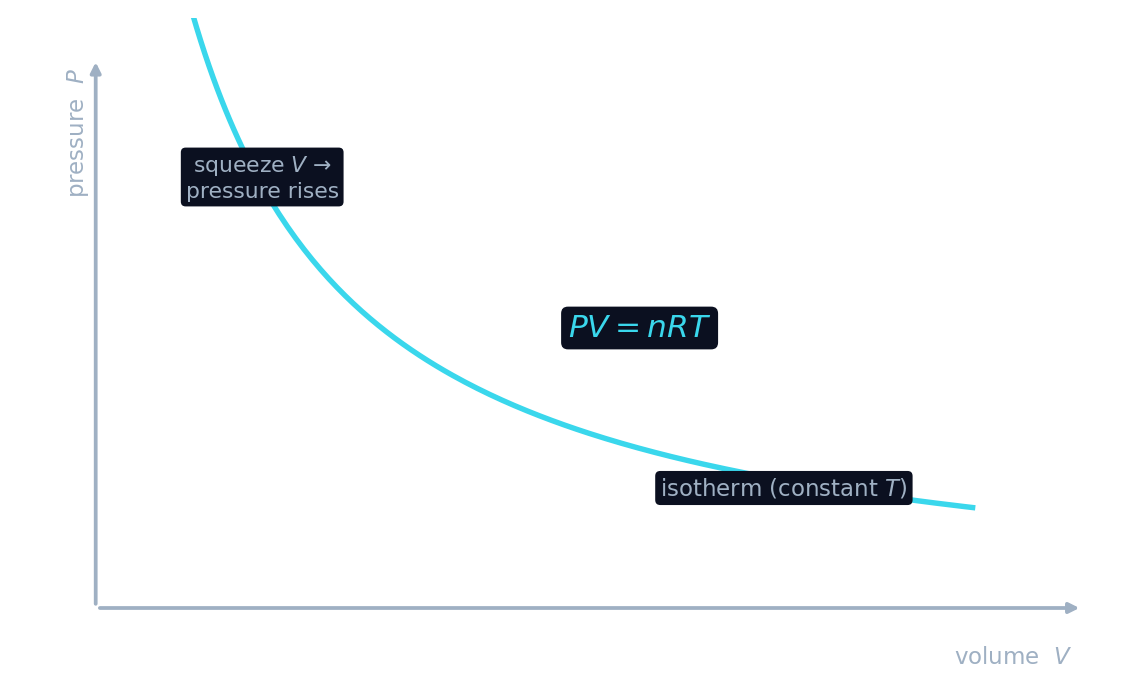
기체를 압축하십시오.
부피를 변화시키면 등온선(PV=상수)을 따라 압력이 어떻게 반응하는지 관찰하십시오.
이상 기체 법칙은 무엇입니까?
난이도 1/5 · 100 코인 + 오늘 첫 완료 시 소액 보너스
$PV = nRT$는 압력, 부피, 몰수 및 온도를 연결합니다.
$PV = nRT$에서 기호 $n$은 ____ 단위로 측정된 기체의 양을 의미합니다.
난이도 1/5 · 100 코인 + 오늘 첫 완료 시 소액 보너스
$n$는 기체의 몰 수를 나타냅니다.
The relationships inside it
- At constant temperature, $P$ and $V$ are inversely related: squeeze $V$, and $P$ rises.
- At constant volume, $P$ rises in proportion to the kelvin temperature.
- At constant pressure, volume rises in proportion to temperature.
- Each is a special case of the one master equation $PV = nRT$.
$100\ \text{kPa}$, $2\ \text{m}^3$ 상태의 기체를 등온 조건에서 $0.5\ \text{m}^3$로 압축할 때, 새로운 압력($\text{kPa}$ 단위)은 얼마인가?
난이도 2/5 · 140 코인 + 오늘 첫 완료 시 소액 보너스
$P_1V_1 = P_2V_2 \Rightarrow 200 = 0.5 P_2 \Rightarrow P_2 = 400\ \text{kPa}$.
등온 조건에서 기체의 부피를 절반으로 줄이면 압력은:
난이도 1/5 · 100 코인 + 오늘 첫 완료 시 소액 보너스
$PV$는 일정하므로 $V$을 절반으로 줄이면 $P$는 두 배가 됩니다.
$300\ \text{K}$에서 압력 $200\ \text{kPa}$인 기체가 경직된 용기에 있습니다. 이를 $600\ \text{K}$까지 가열했을 때, 새로운 압력($\text{kPa}$ 단위)은 얼마인가?
난이도 2/5 · 140 코인 + 오늘 첫 완료 시 소액 보너스
등적 조건에서 $P \propto T$: 켈빈 온도를 두 배로 하면 압력도 두 배가 되어 $400\ \text{kPa}$이 됩니다.
When it works
- The law is exact for an ideal gas — particles with no size and no forces between them.
- Real gases follow it closely at ordinary pressures and well above their boiling point.
- It breaks down near condensation, where particle forces matter.
- For AP problems, treat gases as ideal unless told otherwise.
이상 기체 법칙에서의 온도는 켈빈 단위로 표기해야 합니다.
난이도 1/5 · 100 코인 + 오늘 첫 완료 시 소액 보너스
법칙은 켈빈 기준 비례关系이며, $^\circ\text{C}$를 사용하면 잘못된 비율이 나옵니다.
Always put temperature in kelvin in $PV = nRT$. Using $^\circ\text{C}$ gives nonsense — for example, "doubling from $10\,{}^\circ\text{C}$ to $20\,{}^\circ\text{C}$" is not doubling the temperature ($283\ \text{K}$ to $293\ \text{K}$ is only a $3.5\%$ rise).
A gas at pressure $100\ \text{kPa}$ and volume $2\ \text{m}^3$ is squeezed to $0.5\ \text{m}^3$ at constant temperature. Find the new pressure.
- At constant $T$, $P_1 V_1 = P_2 V_2 \Rightarrow 100 \times 2 = P_2 \times 0.5$.
- $P_2 = \dfrac{200}{0.5} = 400\ \text{kPa}$ — four times larger, as the volume shrank fourfold.
The ideal gas law is $PV = nRT$ (temperature in kelvin). At constant $T$, $P$ and $V$ are inversely related ($P_1V_1 = P_2V_2$); at constant $V$ or $P$, the others rise with temperature. It holds well for real gases away from condensation.