| English | 의미 |
|---|---|
| mass/mæs/ | 질량 |
동일한 힘 — 깃털은 날아가지만 냉장고는 거의 움직이지 않음
- 깃털에 약간의 힘을 가하면 날아가지만, 같은 크기의 힘을 냉장고에 가해도 거의 움직이지 않는다.
- 같은 힘임에도 결과적 차이가 극명함 — 그 차이는 질량 때문이다.
- Newton's second law ties them together: force, mass and acceleration in one equation.
- 역학의 핵심 엔진이다: 힘과 질량을 주면 내가 운동 상태를 알려준다.
공식
- 합력은 질량과 가속도의 곱과 같다: $\vec F_{\text{net}} = m\,\vec a$.
- 변형하면: $\vec a = \dfrac{\vec F_{\text{net}}}{m}$ — 가속도는 합력이 생성하는 결과이다.
- 가속도는 합력과 같은 방향으로 향한다.
- 개별 힘 자체가 아니라 합력이 중요하며, 단일 힘만으로는 판단할 수 없다.
What net force gives a $2\ \text{kg}$ object an acceleration of $5\ \tfrac{\text{m}}{\text{s}^2}$? Answer in $\text{N}$.
난이도 2/5 · 140 코인 + 오늘 첫 완료 시 소액 보너스
$F = ma = 2 \times 5 = 10\ \text{N}$.
하나의 법칙 안에 두 가지 비례 관계
- 힘이 클수록 가속도도 커짐: $a \propto F$ (힘이 두 배가 되면 가속도도 두 배).
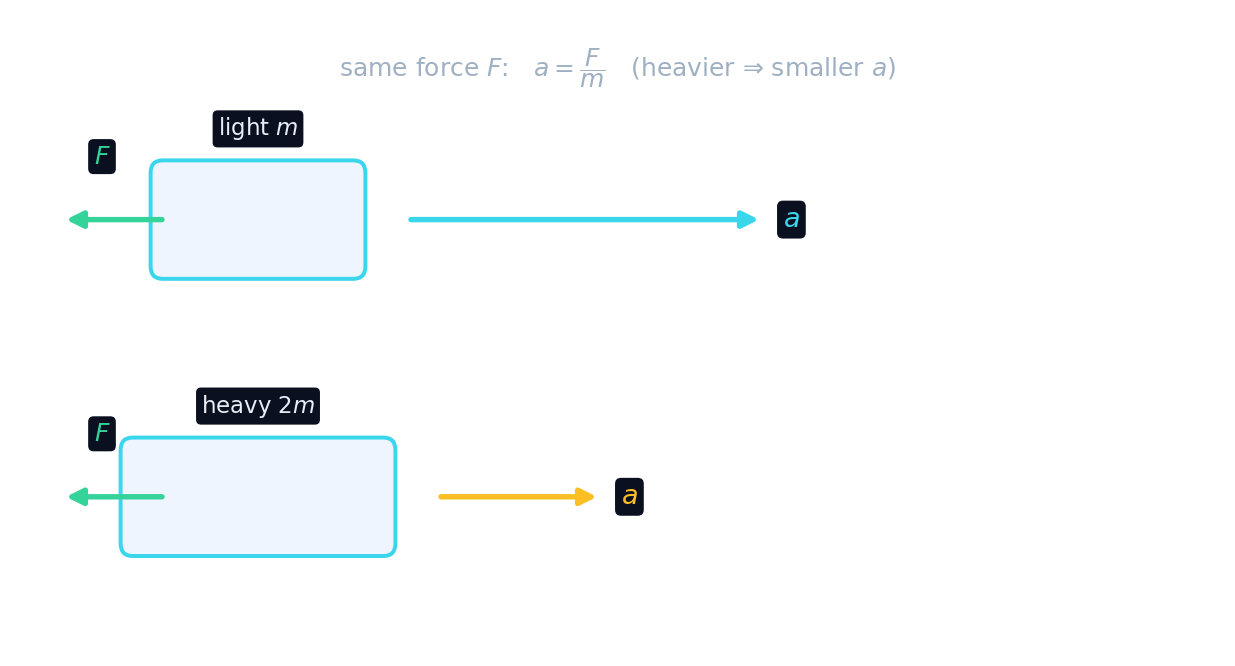
- 질량이 클수록 가속도는 작아짐: $a \propto \dfrac{1}{m}$ (질량이 두 배가 되면 가속도는 절반).
- 따라서 가벼운 카트가 밀림에 따라 앞서 나가지만 무거운 카트는 더디게移动。
- 무거운 물체가 "느리게" 움직이는 이유는 정확히 $a = F/m$이 $m$가 커질수록 작아지기 때문이다.
Net force sets the acceleration
Raise the applied force or the mass and watch how the net force and the acceleration change.
A net force of $12\ \text{N}$ acts on a $3\ \text{kg}$ trolley. What is its acceleration, in $\tfrac{\text{m}}{\text{s}^2}$?
난이도 2/5 · 140 코인 + 오늘 첫 완료 시 소액 보너스
$a = F_{\text{net}}/m = 12/3 = 4\ \tfrac{\text{m}}{\text{s}^2}$.
If you double the net force on an object but keep its mass the same, its acceleration:
난이도 1/5 · 100 코인 + 오늘 첫 완료 시 소액 보너스
Since $a = F/m$ and $m$ is fixed, $a \propto F$: doubling the force doubles the acceleration.
Doubling the mass while keeping the same net force halves the acceleration.
난이도 1/5 · 100 코인 + 오늘 첫 완료 시 소액 보너스
$a = F/m$, so $a \propto 1/m$: double the mass, half the acceleration.
단위와 무게
- $1\ \text{N} = 1\ \text{kg} \cdot \tfrac{\text{m}}{\text{s}^2}$ — 뉴턴(newton)은 이 법칙에 의해 정의된다.
- Weight is just the second law applied to gravity: $W = mg$.
- 질량($\text{kg}$)은 관성을 측정하며, 무게($\text{N}$)는 힘이다 — 이 둘을 혼동하지 말라.
- On the Moon your mass is unchanged, but your weight is about one-sixth.
Complete the definition: $1\ \text{N} = 1\ \text{kg} \cdot$ ____ (write the units).
난이도 1/5 · 100 코인 + 오늘 첫 완료 시 소액 보너스
From $F = ma$, $1\ \text{N} = 1\ \text{kg} \cdot 1\ \tfrac{\text{m}}{\text{s}^2}$.
You travel from Earth to the Moon. Which of these changes?
난이도 1/5 · 100 코인 + 오늘 첫 완료 시 소액 보너스
Mass (inertia) is unchanged; weight $W = mg$ drops because the Moon's $g$ is about one-sixth of Earth's.
$F = ma$에서 합력을 사용하되 단일 힘은 사용하지 마라. 여러 힘이 작용하면 먼저 벡터 합을 구해야 한다. 그리고 질량은 무게가 아니다: 질량은 킬로그램(kg) 단위로, 무게는 뉴턴(N) 단위의 힘($W = mg$)이다.
$12\ \text{N}$의 합력이 $3\ \text{kg}$ 카트(카)에 작용하고 있습니다.
- $a = \dfrac{F_{\text{net}}}{m} = \dfrac{12}{3} = 4\ \tfrac{\text{m}}{\text{s}^2}$.
힘은 그대로 두고 질량을 두 배로 늘리면 $6\ \text{kg}$이 되며, 가속도는 절반인 $2\ \tfrac{\text{m}}{\text{s}^2}$으로 줄어듭니다.
Newton's second law: $\vec F_{\text{net}} = m\vec a$, so $\vec a = \vec F_{\text{net}}/m$ in the direction of the net force. Acceleration grows with force ($a\propto F$) and shrinks with mass ($a\propto 1/m$). $1\ \text{N} = 1\ \text{kg}\cdot\text{m/s}^2$; weight is $W = mg$.