| English | 의미 |
|---|---|
| Coriolis effect/ˌkɒrɪˈəʊliz ɪˈfekt/ | 코리올리 효과 |
Why the wind blows
- Winds are not random — they follow steady global patterns.
- The same belts of wind have blown for millions of years.
- They decide where rainforests grow and where deserts spread.
- It all starts with the Sun heating the Earth unevenly.
Uneven heating
- The Sun heats the equator far more than the poles.
- Warm air is less dense, so it rises high into the sky.
- As it rises it cools and drops heavy rain.
- This is why lush rainforests ring the equator.
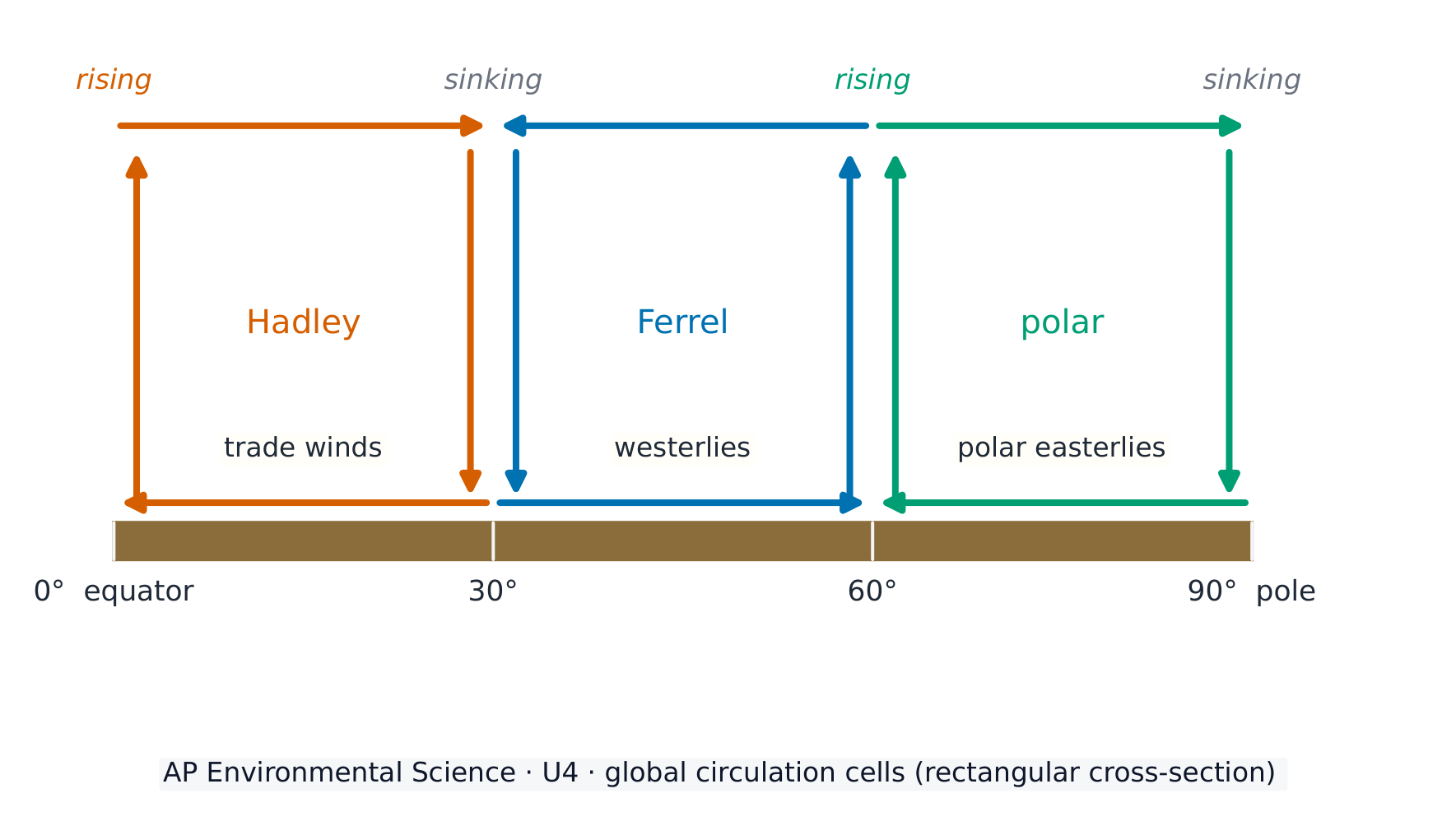
Hadley, Ferrel and polar cells drive the global wind belts
전지구적 바람 패턴을 최종적으로 구동하는 것은 무엇입니까?
난이도 1/5 · 100 코인 + 오늘 첫 완료 시 소액 보너스
태양이 극지방보다 적도를 더 많이 가열합니다; 이러한 불균일한 가열이 바람을 구동합니다.
Rising and sinking air
- The dry air, now high up, spreads away from the equator.
- Around 30 degrees latitude it cools and sinks back down.
- Sinking dry air brings little rain, creating deserts like the Sahara.
- This rising and sinking sets up huge circulation cells.
바람이 부는 이유
사이클을 단계별로 살펴보세요 - 태양이 적도를 가열하면 공기가 상승하고 순환 세포가 전지구적 바람을 구동합니다.
적도의 따뜻한 공기는…
난이도 1/5 · 100 코인 + 오늘 첫 완료 시 소액 보너스
밀도가 낮은 따뜻한 공기가 상승하여 냉각되고 비를 방출하므로 열대우림이 적도 주변을 둘러싸고 있습니다.
위도 30도 부근에서 침강하는 건조한 공기는 세계 많은 _____를 만듭니다.
난이도 1/5 · 100 코인 + 오늘 첫 완료 시 소액 보너스
30도 부근의 침강하는 건조한 공기는 비가 거의 없어 사하라 사막과 같은 사막을 형성합니다.
The winds curve
- Air flowing along the surface would blow in straight lines — but Earth is spinning.
- Earth's rotation bends the moving air (the Coriolis effect 科里奥利效应).
- This curving creates steady belts like the trade winds.
- Sailors have relied on these predictable winds for centuries.
지구의 자전은 움직이는 공기를 휘어지게 하여 바람이 곡선 경로를 따르게 합니다.
난이도 1/5 · 100 코인 + 오늘 첫 완료 시 소액 보너스
지구의 자전으로부터 발생하는 코리올리 효과가 바람을 휘어지게 하여 상풍과 같은 패턴을 만듭니다.
전지구적 바람 패턴에 대한 모든 진리 문장을 선택하십시오.
난이도 2/5 · 140 코인 + 오늘 첫 완료 시 소액 보너스
태양이 바람의 최종 구동력입니다. 나머지 세 가지 설명은 모두 맞습니다.
The whole pattern traces back to the Sun, not to random chance. Uneven heating makes air rise at the equator and sink near 30 degrees — which is why the world's great deserts and rainforests sit in predictable latitude bands, not just anywhere.
Rainforest and desert, side by side in latitude:
- At the equator, rising air dumps rain — home to the Amazon and Congo rainforests.
- Near 30 degrees north and south, sinking dry air starves the land of rain — home to the Sahara and Australian deserts.
- The same circulation makes both, just at different latitudes.
Global wind patterns are driven by the Sun's uneven heating of Earth. Warm air rises at the equator (heavy rain, rainforests) and sinks near 30 degrees (dry air, deserts). Earth's rotation bends the moving air through the Coriolis effect, creating steady wind belts like the trade winds.