| English | 의미 |
|---|---|
| iron core/ˈaɪən kɔː/ | 철심 |
| right-hand grip rule/raɪt hænd ɡrɪp ruːl/ | 오른손 법칙 |
| bar magnet/bɑː ˈmæɡnɪt/ | 막대 자석 |
| solenoid/ˈsəʊlənɔɪd/ | 솔레노이드 |
A magnet with an off switch
- A scrapyard crane picks up a tonne of steel, swings it across the yard, and drops it by flicking a switch.
- No permanent magnet can do that. What the crane carries is a coil of wire around an iron core, and its magnetism exists only while the current flows.
- Every field in this lesson comes from a current, which means every one of them can be switched, reversed or made stronger at will.
- This lesson is the field patterns that currents produce, and the forces between two currents.
The field around a straight wire
- The field forms concentric circles around the wire, in the plane perpendicular to it.
- Their spacing widens with distance, because the field weakens as you move away.
- The direction comes from the right-hand grip rule 右手定则: grip the wire with your right hand, thumb along the current, and your fingers curl the way the field points.
- For a current into the page, that gives a clockwise field.
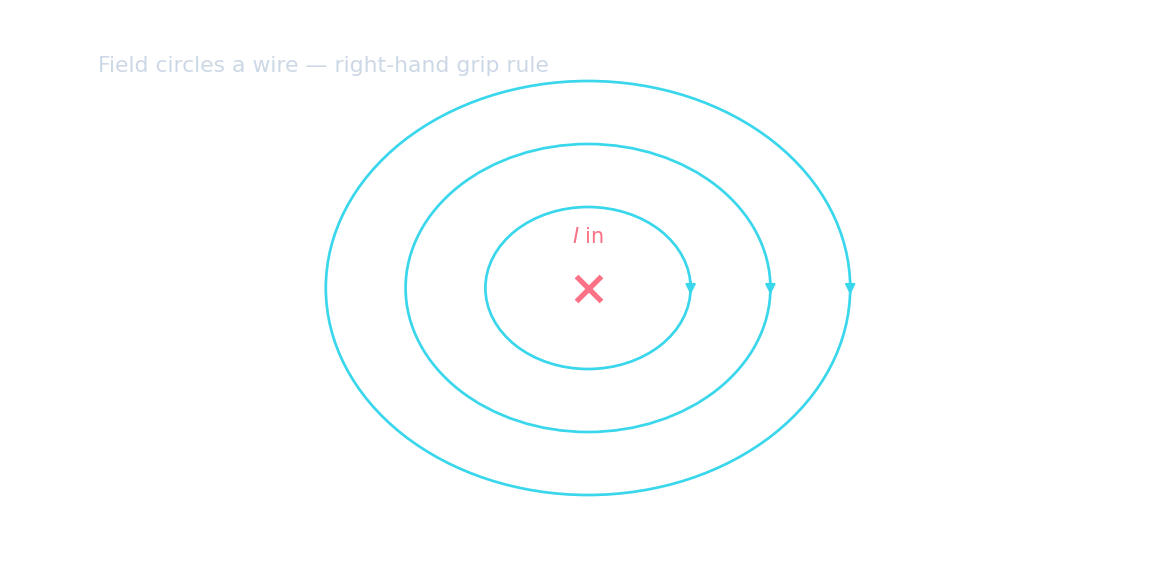
Circles, widening, each with an arrow
전류 자기장 규칙 실험
전류 방향을 도선 주변의 원형 자기장과 연결합니다.
긴 직선 도선 주변의 자기장은 다음과 같이 형성됩니다:
난이도 1/5 · 100 코인 + 오늘 첫 완료 시 소액 보너스
오른손 그립 법칙으로 방향을 정한 동심원입니다.
오른손 그립 법칙은 전류가 흐르는 도선 주변의 자기장 방향을 나타냅니다.
난이도 1/5 · 100 코인 + 오늘 첫 완료 시 소액 보너스
엄지를 전류 방향으로 하고 굽은 손가락이 원형 자기장의 방향을 가리킵니다.
The flat circular coil
- Bend the wire into a loop and the circular fields around each side reinforce through the centre.
- So the field at the centre is at right angles to the plane of the coil, and strongest there.
- Seen from one face the coil behaves as a north pole, since the field leaves it there; from the other face, a south pole. A single loop is already a small bar magnet 条形磁铁.
평면 원형 코일의 중심에 있는 자기장 방향은 무엇인가?
난이도 1/5 · 100 코인 + 오늘 첫 완료 시 소액 보너스
두 면 주위의 원형 자기장이 중심부에서 합쳐져 코일이 작은 막대 자석처럼 작용하며, 한 면은 북극(N), 다른 면은 남극(S)이 됩니다.
The solenoid
- A solenoid 螺线管 is many such loops in a row. Their fields add along the axis, so inside the field is nearly uniform and parallel to the axis, exactly like a stretched bar magnet.
- Outside it spreads out and falls off fast, and the ends behave as N and S poles.
- Three things strengthen it: more turns per unit length, a larger current, and an iron core 铁芯.

Uniform down the axis, and poles at the ends
긴 솔레노이드 내부의 자기장은 거의 ____ 입니다.
난이도 1/5 · 100 코인 + 오늘 첫 완료 시 소액 보너스
늘어난 막대 자석과 같으며, 내부 자기장은 균일하고 축(axis)과 평행합니다.
철심(iron core)을 추가하면 솔레노이드의 자기장을 크게 증가시킵니다.
난이도 1/5 · 100 코인 + 오늘 첫 완료 시 소액 보너스
철의 원자 자석들이 정렬하여 자기장에 기여하므로, 전자석과 트랜스포머에 사용됩니다.
솔레노이드 내부 자기장을 증가시키는 요인을 모두 고르십시오.
난이도 2/5 · 140 코인 + 오늘 첫 완료 시 소액 보너스
단위 길이당 권수, 전류, 그리고 자성 심(ferrous core)입니다. 도선이 두꺼워지면 저항은 줄어들이지만, 주어진 전류에서는 자기장 자체에는 영향을 주지 않습니다.
Worked example: why the core helps
- Explain why inserting an iron core greatly increases the magnetic field of a solenoid.
- The core is a ferrous material, so the solenoid's field magnetises it: its atomic magnets line up with the field.
- The magnetised core then produces its own magnetic field, which adds to the field of the current.
- The two together are far stronger than the current's field alone. Both steps, magnetised and adds its own field, are needed for the marks. "It concentrates the field lines" is not the marked answer.
철심이 솔레노이드의 자기장을 강화하는 이유에 대한 설명을 올바른 순서로 배열하십시오.
난이도 3/5 · 200 코인 + 오늘 첫 완료 시 소액 보너스
모든 중간 단계가 점수를 위해 필요합니다: '자화됨'과 '자체 자기장 추가'. "자기장을 집중시킨다"라는 표현은 채점 기준 어구가 아닙니다.
Two parallel currents
- Each wire sits in the field of the other, so each experiences a motor-effect force $F = BIL$.
- Apply the left-hand rule to each wire in turn, using the field the other one makes. The result is symmetric, as Newton's third law requires.
- Currents in the same direction attract. Currents in opposite directions repel.
- This force is the basis of the historical definition of the ampere.
전류가 같은 방향으로 흐르는 두 평행 도선:
난이도 1/5 · 100 코인 + 오늘 첫 완료 시 소액 보너스
같은 방향의 전류는 서로 끌어당기고, 반대 방향의 전류는 서로 밀어냅니다. 이것이 암페어(amperes)의 정의 기초입니다.
각 작업에 해당하는 규칙을 매칭하십시오.
난이도 2/5 · 140 코인 + 오늘 첫 완료 시 소액 보너스
평행 도선 문제는 두 가지 규칙이 모두 필요합니다: 한 도선이 만드는 자기장은 오른손, 다른 도선에 작용하는 힘은 왼손을 사용합니다.
Worked example: predicting the direction
- Two long parallel wires carry currents in the same direction. Show that they attract.
- Use the right-hand grip rule on the left wire: in the region of the right wire, its field points into the page, say.
- Now use the left-hand rule on the right wire: field into the page, current up the page, so the force on it is towards the left wire.
- Repeat for the other wire and the force is towards the first. They attract. Note that like currents attract, which is the opposite of what like charges do.
Marks that slip away
- Right hand for the field a current makes; left hand for the force on a current in a field. Both appear in a parallel-wires question and they are not interchangeable.
- The field around a wire is circles, not lines along the wire, and their spacing widens.
- The iron core is magnetised and adds its own field. Say both parts.
- Currents in the same direction attract, unlike charges of the same sign.
You've got it
- a straight wire's field is concentric circles with widening spacing, direction from the right-hand grip rule
- a flat coil gives a field at right angles through its centre and acts as a small bar magnet; a solenoid is nearly uniform inside and has poles at its ends
- more turns per unit length, a larger current and an iron core all strengthen a solenoid, the core because it is magnetised and adds its own field
- parallel currents attract when in the same direction and repel when opposite, found by using the right-hand rule for the field and the left-hand rule for the force