| English | 의미 |
|---|---|
| equilibrium/ˌiːkwɪˈlɪbrɪəm/ | 평형 |
| damping/ˈdæmpɪŋ/ | 감쇠 |
Where the energy goes at the top of a swing
- At the highest point of a swing you are, for an instant, completely still. Your kinetic energy is exactly zero.
- A moment later you are moving faster than at any other point in the arc. Nothing pushed you; the energy was never gone.
- It was in the potential store, and it came straight back out. An oscillation is that exchange, repeated for as long as friction allows.
- This lesson is the energy of an oscillator: how it swaps, why the total is constant, and why the total depends on the square of the amplitude.
The swap
- At the equilibrium 平衡 position the speed is greatest, so the kinetic energy is maximum and the potential energy is at its minimum.
- At the extremes the oscillator is momentarily at rest, so the kinetic energy is zero and the potential energy is at its maximum.
- In between, the two trade continuously. The exchange happens twice per full oscillation, since the oscillator passes through the centre twice.
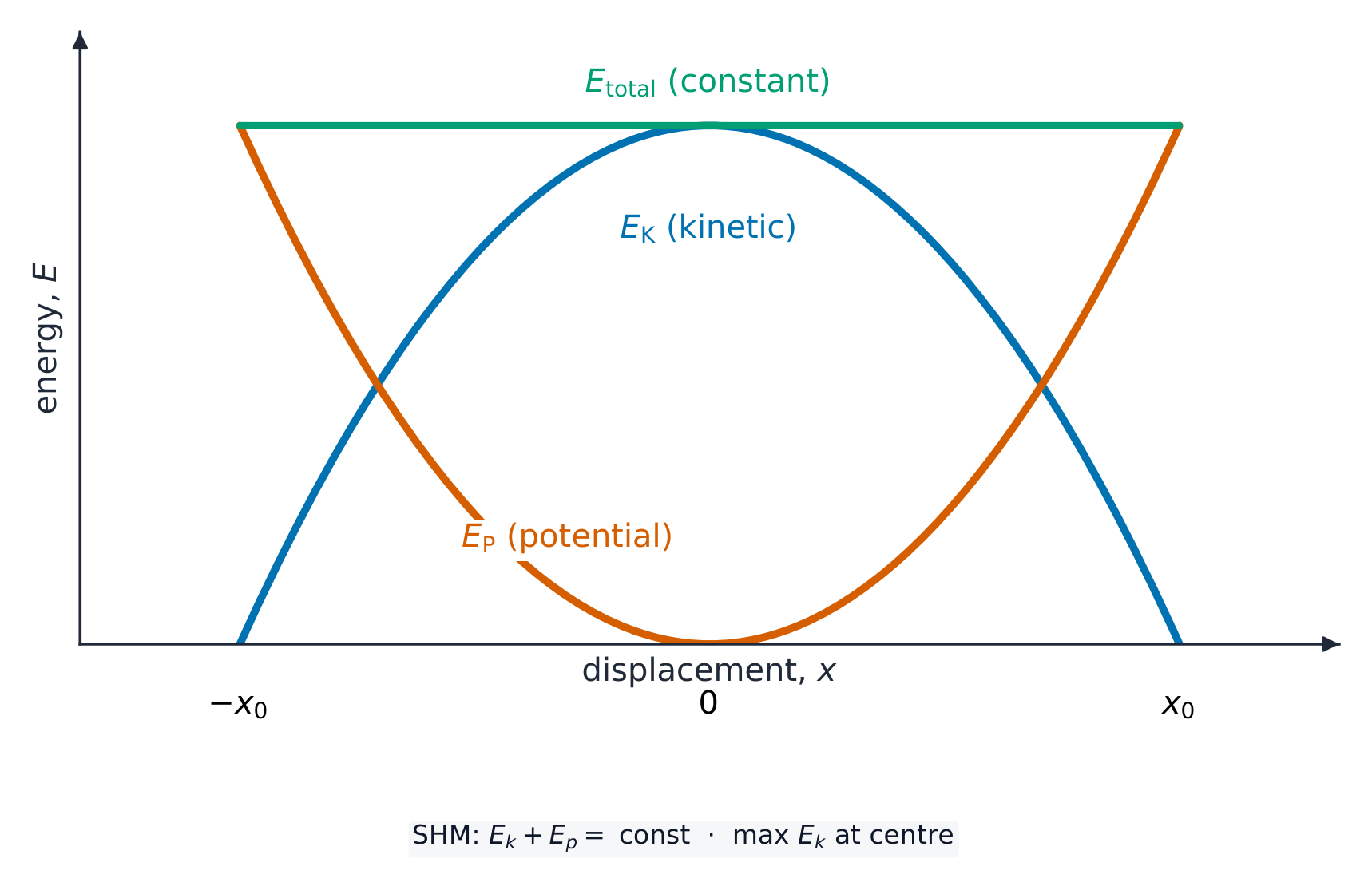
Two curves in opposite phase, and a flat line above them
진동자의 운동 에너지가 가장 클 때는?
난이도 1/5 · 100 코인 + 오늘 첫 완료 시 소액 보너스
속도가 중앙에서最大이므로,那里运动能量最大而势能最低。
운동의 끝점에서 모든 에너지는 위치 에너지입니다.
난이도 1/5 · 100 코인 + 오늘 첫 완료 시 소액 보너스
진동자가在那里 momentarily 정지하므로 KE = 0이며 모든 에너지는 위치 에너지입니다.
The total is constant
- With no damping 阻尼, no resistive force removing energy, the total energy stays constant. This is conservation of energy applied to the oscillator.
- The easiest place to evaluate it is at the centre, where all of it is kinetic and the speed is $\omega x_0$:
- On a graph against displacement, the kinetic energy is a downward parabola, the potential energy an upward one, and their sum is a horizontal line.
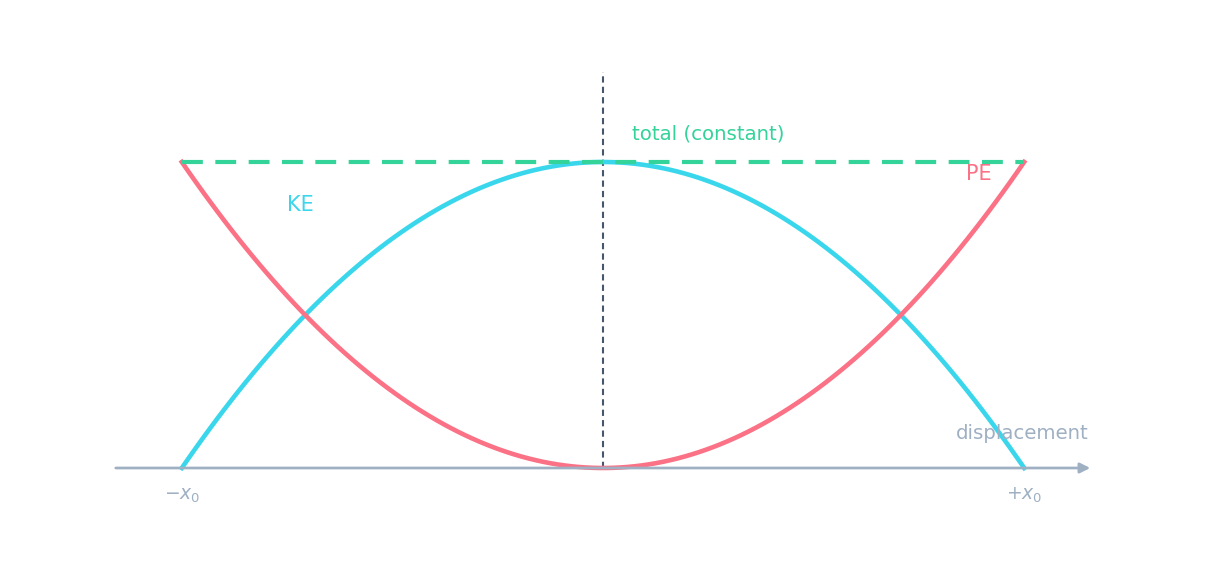
The two parabolas add to a constant at every displacement
SHM에서의 에너지
KE + PE = 상수
운동 에너지(중앙에서最快)와 위치 에너지(끝에서 최대) 사이에서 에너지가 교환됩니다.
감쇠가 없으면 진동자의 총 에너지는 일정하게 유지됩니다.
난이도 1/5 · 100 코인 + 오늘 첫 완료 시 소액 보너스
에너지는 KE와 PE 사이에서만交换됩니다;它们的总和是守恒的。
Energy and amplitude
- Because $E = \tfrac12 m\omega^2 x_0^2$, the total energy is proportional to the square of the amplitude.
- Double the amplitude and the energy is four times as large. Triple it and the energy is nine times.
- This is the relationship the exam tests most often, and answering "twice" for a doubled amplitude is the commonest error in the subtopic.
진폭이 두 배가 되면 진동자의 총 에너지는:
난이도 1/5 · 100 코인 + 오늘 첫 완료 시 소액 보너스
$E \propto x_0^{2}$이므로, $x_0$을 두 배로 하면 에너지가 $2^{2} = 4$배가 됩니다.
감쇠가 없는 진동자의 진폭이 두 배가 되었습니다. 이 경우 총 에너지는 어떻게 변합니까?
난이도 1/5 · 100 코인 + 오늘 첫 완료 시 소액 보너스
E = m omega^2 x0^2 / 2에 따라 E는 진폭의 제곱에 비례합니다. "두 배"라고 답하는 것이 이 소주제에서 가장 흔한 실수입니다.
Worked example: find the total energy
- An oscillator of mass $0.20\ \text{kg}$ has angular frequency $10\ \text{rad/s}$ and amplitude $0.050\ \text{m}$. Find its total energy and its kinetic energy at a displacement of $0.030\ \text{m}$.
- Total: $E = \tfrac12 m \omega^2 x_0^2 = \tfrac12 \times 0.20 \times 10^2 \times 0.050^2 = 0.025\ \text{J}$.
- At $x = 0.030\ \text{m}$: $v = \omega\sqrt{x_0^2 - x^2} = 10\sqrt{0.050^2 - 0.030^2} = 0.40\ \text{m/s}$, so $E_{\text{k}} = \tfrac12 \times 0.20 \times 0.40^2 = 0.016\ \text{J}$.
- The potential energy there is the difference, $0.025 - 0.016 = 0.009\ \text{J}$. Using the constant total to get the second energy is quicker and safer than a separate formula.
어떤 진동자가 $m = 0.20\ \text{kg}$, $\omega = 10\ \dfrac{\text{rad}}{\text{s}}$ 및 진폭 $0.10\ \text{m}$를 가지고 있습니다. 이 진동자의 총 에너지는 얼마입니까?
난이도 2/5 · 140 코인 + 오늘 첫 완료 시 소액 보너스
$E = \tfrac{1}{2}m\omega^{2}x_0^{2} = \tfrac{1}{2} \times 0.20 \times 10^{2} \times 0.10^{2} = 0.10\ \text{J}$.
질량 0.20 kg인 진동자가 있으며, 각진동수 omega = 10 rad/s, 진폭 0.050 m일 때, 줄(Joule) 단위의 총 에너지는 얼마입니까?
난이도 2/5 · 140 코인 + 오늘 첫 완료 시 소액 보너스
E = m omega^2 x0^2 / 2 = 0.20 x 100 x 0.0025 / 2 = 0.025 J입니다. 모든 에너지가 운동에너지인 중심점에서의 값으로 계산하는 것이 가장 빠른 방법입니다.
총 에너지가 0.025 J이고 특정 변위에서의 운동에너지가 0.016 J라면, 그 지점의 퍼텐셜 에너지는 ____ J입니다.
난이도 1/5 · 100 코인 + 오늘 첫 완료 시 소액 보너스
총 에너지는 일정하므로, 퍼텐셜 에너지를 구하기 위해 총 에너지에서 운동에너지를 빼면 됩니다. 별도의 공식보다 이 뺄셈이 더 빠르고 안전합니다.
Worked example: reading the energy graphs
- Sketch how the kinetic energy, the potential energy and the total energy of an undamped oscillator vary with displacement.
- Kinetic energy: maximum at $x = 0$, falling to zero at $x = \pm x_0$, a downward parabola.
- Potential energy: zero at $x = 0$, rising to the maximum at $x = \pm x_0$, an upward parabola, and the mirror image of the first.
- Total: a horizontal line at the value of either maximum, since the two curves always add to the same amount.
- Against time instead of displacement, both curves are still parabola-shaped in energy but now oscillate at twice the frequency of the displacement, because energy peaks twice per cycle.
감쇠가 없는 진동자의 에너지와 변위에 대한 그래프를 각각 매칭하십시오.
난이도 2/5 · 140 코인 + 오늘 첫 완료 시 소액 보너스
두 포물선은 대칭이므로 모든 변위에서 같은 값을 합산합니다. 이 수평선은 에너지 보존 법칙을 나타냅니다.
시간에 대해 표시하면, 진동자의 운동에너지는 변위 주파수의 두 배인 주파수로 반복됩니다.
난이도 1/5 · 100 코인 + 오늘 첫 완료 시 소액 보너스
진동자는 한 주기당 중심점을 두 번 통과하므로, 운동에너지는 한 주기당 두 번 최대가 되고 변위는 한 번만 최대가 됩니다.
Energy against time runs at double the frequency
- Plot the displacement against time and you get one cycle per period. Plot the kinetic energy against time and you get two.
- The reason is the square. Kinetic energy depends on $v^2$, and $v$ passes through its maximum magnitude twice in every cycle, once going each way.
- So both energy curves complete two maxima per oscillation, and their frequency is double that of the displacement.
- The two curves are exact mirrors of each other about the half-total line, and their sum is a horizontal line at the total energy.
- A sketch question here is marked on three things: the doubled frequency, the two curves being out of step by half their period, and the flat total.
진동자의 운동에너지는 변위 주파수의 두 배인 주파수로 변동합니다.
난이도 1/5 · 100 코인 + 오늘 첫 완료 시 소액 보너스
KE는 v의 제곱에 의존하며, 속도는 한 주기당 두 번(양방향 각각 한 번씩) 최대값에 도달합니다. 퍼텐셜 에너지 역시 동일한 패턴을 따르며, 두 에너지의 합은 수평선을 이룹니다.
Marks that slip away
- Energy is proportional to amplitude squared. Doubling the amplitude gives four times the energy, not twice.
- Kinetic energy is maximum at the centre, potential at the ends. Do not swap them.
- Against time, the energy curves repeat at twice the frequency of the displacement, because there are two energy peaks per oscillation.
- The total is constant only when there is no damping. Say so when the question mentions resistive forces.
You've got it
- kinetic energy is maximum at the centre and zero at the extremes; potential energy does the opposite, and they exchange twice per cycle
- with no damping the total is constant: $E = \tfrac12 m\omega^2 x_0^2$, most easily evaluated at the centre where all of it is kinetic
- against displacement the energies are two opposite parabolas whose sum is a horizontal line
- $E \propto x_0^2$: double the amplitude, four times the energy