| English | 의미 |
|---|---|
| thermometer/θɜːˈmɒmɪtə/ | 온도계 |
| thermocouple/ˈθɜːməkʌpl/ | 열전대 |
| thermodynamic/ˌθɜːməʊdaɪˈnæmɪk/ | 열역학 |
| kelvin/ˈkelvɪn/ | 켈빈 |
| absolute zero/ˈæbsəluːt ˈzɪərəʊ/ | 절대영도 |
| Celsius/ˈselsɪəs/ | 씨elsius |
How a thermometer 温度计 works
- A thermometer needs something that changes with temperature.
- A liquid expands, a metal's resistance rises, a gas swells.
- Read that change and you read the temperature.
온도 척도 실험실
켈빈 인덱스 = 셀시우스 인덱스 + 2.73
셀시우스 온도를 슬라이드하고 켈빈 척도가 273만큼 이동하는 것을 보라.
Kinds of thermometer
- Anything that changes repeatably with temperature works:
- expansion of a liquid, resistance of a metal, e.m.f. of a thermocouple 热电偶, volume of a gas.

A thermometer measures temperature on a defined scale
온도를 측정하는 데 사용할 수 있는 모든 성질을 선택하시오.
난이도 2/5 · 140 코인 + 오늘 첫 완료 시 소액 보너스
온도에 따라 반복적으로 변화하는 모든 성질은 작동한다. 케이스의 고정된 색상은 그렇지 않다.
The absolute scale
- The thermodynamic 热力学 (absolute) scale uses the kelvin 开尔文 (K) and depends on no single substance.
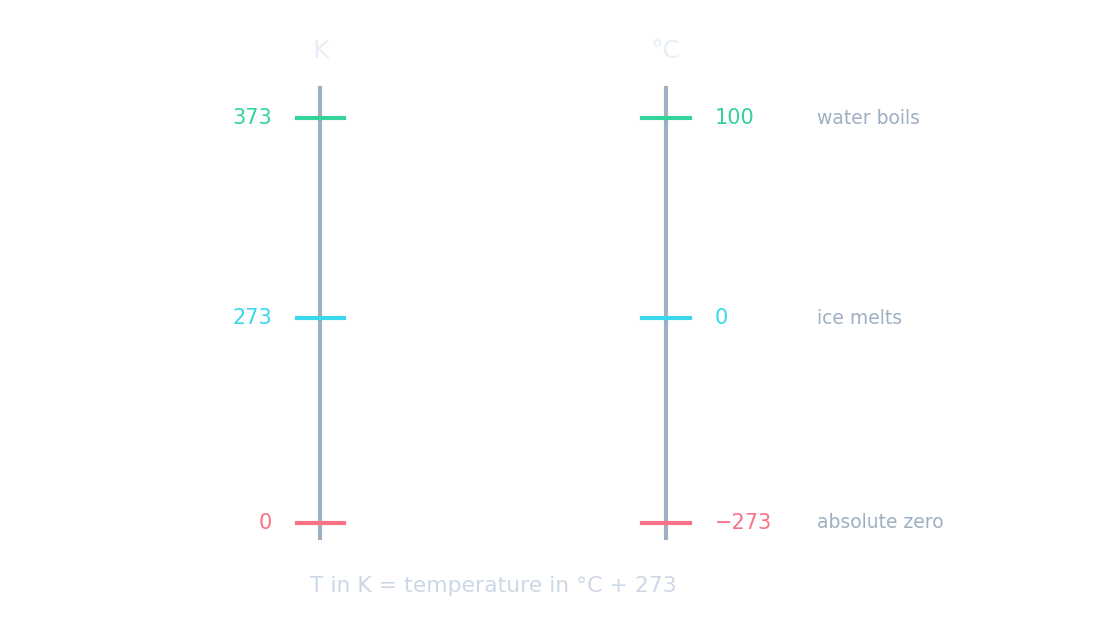
- Absolute zero 绝对零度 ($0\ \text{K}$) is the lowest possible temperature — least internal energy. Nothing is colder.
절대 영도(0 K)는:
난이도 1/5 · 100 코인 + 오늘 첫 완료 시 소액 보너스
0 K에서 시스템은 가장 적은 내부 에너지를 가지며, 더 차갑게 만들 수 있는 것은 없다.
Kelvin and Celsius 摄氏度
- $T/\text{K} = \theta/°\text{C} + 273.15$. So $0\ °\text{C} = 273\ \text{K}$.
- A kelvin and a Celsius degree are the same size, so a change of $1\ \text{K} = 1\ °\text{C}$.
- Always use kelvin in gas-law calculations.

Extrapolating the pressure-temperature line back to zero pressure gives absolute zero, about -273 degC
$27\ °\text{C}$은 켈빈(K)으로 얼마인가?
난이도 2/5 · 140 코인 + 오늘 첫 완료 시 소액 보너스
$T/\text{K} = \theta/°\text{C} + 273 = 27 + 273 = 300\ \text{K}$.
1 K의 온도 상승은 1 °C의 상승과 동일하다.
난이도 1/5 · 100 코인 + 오늘 첫 완료 시 소액 보너스
두 척도의 눈금 크기는 동일하다 — 오직 0점만 다르다(273.15만큼).
기체 법칙 계산에서 온도는 반드시 다음 단위로 표시되어야 합니다:
난이도 1/5 · 100 코인 + 오늘 첫 완료 시 소액 보너스
기체 법칙은 절대온도—켈빈(K)을 사용합니다. °C를 사용하면 잘못된 결과를 얻게 됩니다.
어떤 물체의 온도가 27°C일 때, 켈빈으로 환산하면 얼마입니까?
난이도 2/5 · 140 코인 + 오늘 첫 완료 시 소액 보너스
T = 27 + 273 = 300 K입니다. 다만, 온도 차이는 두 눈금계에서 동일한 수치를 가집니다. 즉, 27°C 상승은 27 K 상승과 같습니다.
Why the thermodynamic scale is special
- It does not depend on the property of any particular substance — it is defined from the behaviour of an ideal gas, with absolute zero and the triple point of water as its fixed points.
- A liquid-in-glass thermometer assumes its liquid expands uniformly with temperature. That is only approximately true, so it agrees with the thermodynamic scale exactly only at the points where it was calibrated.
- That is the exam's "explain why a liquid-in-glass thermometer does not measure thermodynamic temperature".
열역학적 온도가特别的한 이유는 무엇입니까? 모든 정답을 선택하십시오.
난이도 2/5 · 140 코인 + 오늘 첫 완료 시 소액 보너스
단위는 결정적 특징이 아니라 결과입니다. 수은温度计의 눈금은 수은의 팽창 특성에 따라 결정되지만, 열역학적 온도는 이러한物质特性에 전혀 의존하지 않습니다.
Choosing a thermometer
- Platinum resistance: resistance varies linearly and repeatably with temperature over a wide range — very accurate. But it has a large thermal capacity, so it is slow and cannot follow a rapidly changing temperature.
- Thermocouple: two metal junctions give an e.m.f.; tiny, fast, wide range, measures at a point — ideal for a changing temperature.
- Liquid in glass: cheap and simple; limited range, slow, and reads only where the bulb is.
각温度计를 그 주요 특징과 연결하십시오.
난이도 2/5 · 140 코인 + 오늘 첫 완료 시 소액 보너스
저항温度计는 열용량이 커서 정확하지만 반응이 느리고, 서모커플의 작은 접합부는 빠르게 반응하며, 절대 온도 scale은 물질이 아닌 이상기체 거동에 의해 정의됩니다.
각温度计를 그것이 사용하는 물성(name)과 연결하십시오.
난이도 2/5 · 140 코인 + 오늘 첫 완료 시 소액 보너스
서모커플은 열용량이 작고 반응이 빠르므로 급격히 변하는 온도를 측정할 때 선택됩니다.
Worked example: finding absolute zero, then converting
A fixed volume of gas has pressure $100\ \text{kPa}$ at $0\ °\text{C}$ and $136.6\ \text{kPa}$ at $100\ °\text{C}$. Then: a gas is heated from $27\ °\text{C}$ to $742\ °\text{C}$.
- Gradient: $\dfrac{136.6 - 100}{100} = 0.366\ \dfrac{\text{kPa}}{°\text{C}}$; pressure is a straight line in temperature.
- Extrapolate to zero pressure: $\theta = -\dfrac{100}{0.366} = -273\ °\text{C}$ — absolute zero.
- Convert: $27\ °\text{C} = 300\ \text{K}$; $742\ °\text{C} = 1015\ \text{K}$.
- Temperature change: $742 - 27 = 715\ °\text{C} = 715\ \text{K}$ — a difference is the same number on both scales.
- Check: absolute zero is where the pressure of an ideal gas would fall to zero; the gas would liquefy long before, which is why the point is found by extrapolation, not by cooling.
기체가 $20\ °\text{C}$에서 $95\ °\text{C}$까지 가열되었습니다. 온도 변화량은 켈빈(K)으로 몇 입니까?
난이도 2/5 · 140 코인 + 오늘 첫 완료 시 소액 보너스
변화는 두 척도에서 동일한 수치를 의미합니다: $95 - 20 = 75\ °\text{C} = 75\ \text{K}$. 여기서는 273을 추가하면 틀립니다.
Add $273$ to convert a Celsius temperature to kelvin, but a temperature difference is the same number on both scales — do not add $273$ to a $\Delta T$. A kelvin temperature can never be negative. And absolute zero is the temperature of minimum internal energy, not zero energy — "the molecules stop moving" is not an accepted answer.
절대 영도는 물질이 ____ 내부 에너지를 갖는 온도입니다.
난이도 1/5 · 100 코인 + 오늘 첫 완료 시 소액 보너스
에너지가 '영'이 아니라 최소값이라는 점입니다. 따라서 "분자가 움직임을 멈춘다"는 설명은 허용되지 않습니다.
You've got it
- a thermometer uses any property that changes repeatably with temperature; the thermodynamic scale depends on no substance
- absolute zero $= 0\ \text{K} = -273.15\ °\text{C}$, the lowest possible temperature (minimum internal energy)
- $T/\text{K} = \theta/°\text{C} + 273$; a difference is the same in K and °C; use kelvin in gas laws