| English | 의미 |
|---|---|
| electromagnetic waves/ɪˌlektrəʊməɡˈnetɪk weɪvz/ | 전자기파 |
| spectrum/ˈspektrəm/ | 광谱(스펙트럼) |
| vacuum/ˈvækjuːm/ | 진공 |
| microwave/ˈmaɪkrəʊweɪv/ | 마이크로파 |
| infrared/ˌɪnfrəˈred/ | 적외선 |
| ultraviolet/ˌʊltrəˈvaɪəlɪt/ | 자외선 |
| gamma/ˈɡæmə/ | 감마선 |
모두 같은 가족
- 라디오, 불에서 나오는 열, 일광 화상, 병원의 X선 — 모두 전자기파입니다.
- 이들은 파장(따라서 주파수)에서만 다릅니다.
- 하나의 가족, 하나의 스펙트럼.
그들이 공유하는 것
- 모든 전자기파는 횡파입니다.
- 진공에서 그들은 모두 같은 속도 $c = 3.00 \times 10^{8}\ \dfrac{\text{m}}{\text{s}}$로 이동합니다.
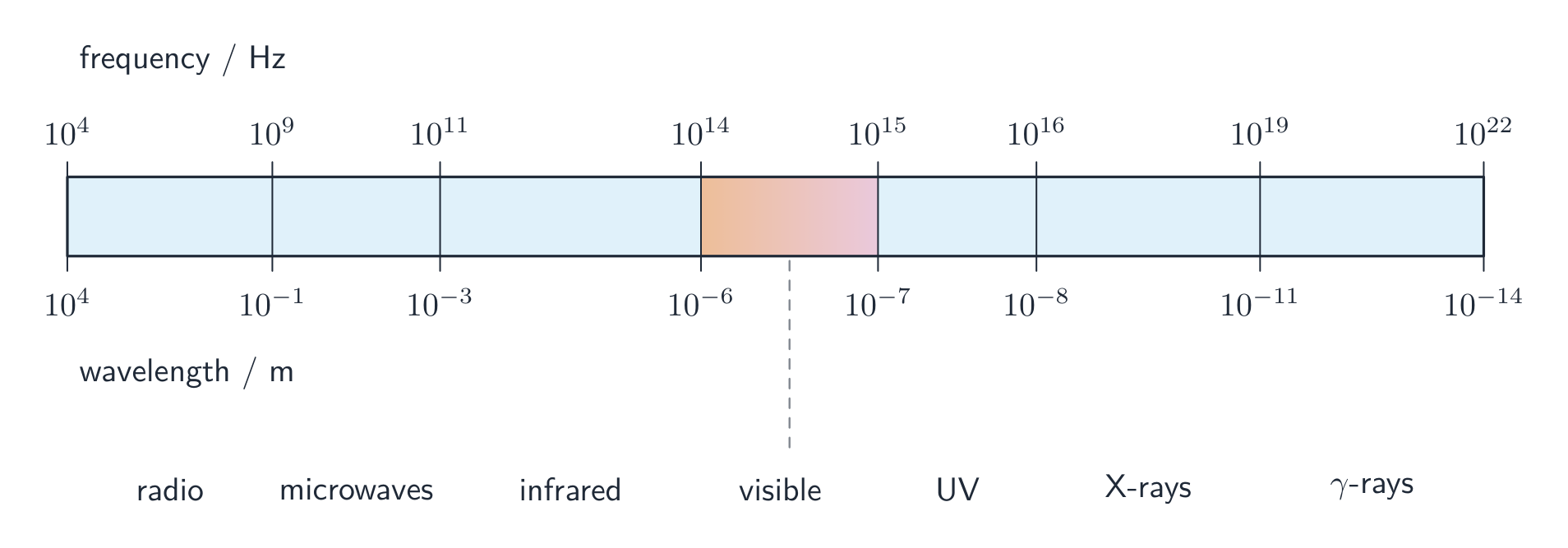
전자기 스펙트럼
Slide across the spectrum
Radio waves, visible light and gamma rays are all the same wave — only the wavelength changes, and with it the frequency, photon energy and everyday use.
All electromagnetic waves are transverse.
난이도 1/5 · 100 코인 + 오늘 첫 완료 시 소액 보너스
Yes — every EM wave is transverse, and all travel at $c$ in a vacuum.
In a vacuum, which EM wave travels the fastest?
난이도 1/5 · 100 코인 + 오늘 첫 완료 시 소액 보너스
In a vacuum every EM wave travels at $c = 3.0 \times 10^{8}\ \dfrac{\text{m}}{\text{s}}$.
What do all electromagnetic waves share? Select all that apply.
난이도 2/5 · 140 코인 + 오늘 첫 완료 시 소액 보너스
Needing no medium is exactly what lets sunlight cross space. Being transverse is what makes every one of them polarisable, unlike sound.
순서대로 본 스펙트럼
- 긴 파장에서 짧은 파장으로: 라디오 · 마이크로파 · 적외선 · 가시광선 · 자외선 · X선 · 감마선.
- 파장이 짧아질수록 주파수는 증가합니다.
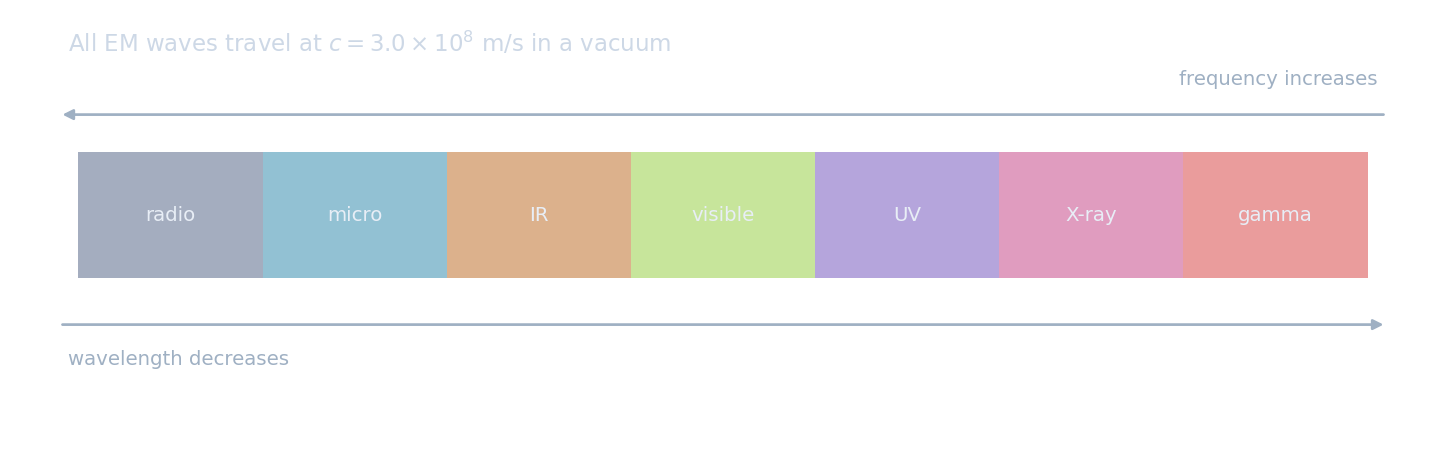
Put these in order of increasing frequency (lowest first).
난이도 3/5 · 200 코인 + 오늘 첫 완료 시 소액 보너스
Frequency rises as wavelength falls: radio (longest) → microwave → visible → X-ray (much shorter).
Put the electromagnetic spectrum in order of increasing wavelength.
난이도 3/5 · 200 코인 + 오늘 첫 완료 시 소액 보너스
Increasing wavelength is decreasing frequency and decreasing photon energy, so the same list read backwards answers all three questions.
파장과 그 연결
- 지수 단위를 기억하십시오: 라디오 $> 10^{-1}\ \text{m}$; 마이크로파 $10^{-1}$ ~ $10^{-3}\ \text{m}$; 적외선 $10^{-3}$ ~ $7 \times 10^{-7}\ \text{m}$; 가시광선 $400$~$700\ \text{nm}$; 자외선 $4 \times 10^{-7}$ ~ $10^{-8}\ \text{m}$; X선 $10^{-8}$ ~ $10^{-13}\ \text{m}$; 감마선은 약 $10^{-10}\ \text{m}$ 이하.
- 가시광선은 좁은 대역 $400$–$700\ \text{nm}$ — 짧은 쪽 끝은 보라색, 긴 쪽 끝은 빨간색입니다.
- $\lambda$와 $f$ 사이를 $c = f\lambda$로 전환하십시오.
Visible light has wavelengths of roughly:
난이도 1/5 · 100 코인 + 오늘 첫 완료 시 소액 보너스
About $400\ \text{nm}$ (violet) to $700\ \text{nm}$ (red) — a tiny slice of the whole spectrum.
A radio wave has wavelength $3.0\ \text{m}$. What is its frequency, in MHz? (Use $c = 3.0 \times 10^{8}\ \dfrac{\text{m}}{\text{s}}$.)
난이도 2/5 · 140 코인 + 오늘 첫 완료 시 소액 보너스
$f = \dfrac{c}{\lambda} = \dfrac{3.0 \times 10^{8}}{3.0} = 1.0 \times 10^{8}\ \text{Hz} = 100\ \text{MHz}$.
영역 이름 지정하기
- 시험 문제에서는 파장이나 주파수를 주어 어떤 영역인지 묻습니다. 필요하면 파장으로 변환한 후 계단에 배치하십시오.
- $400\ \text{nm}$ 바로 아래는 자외선; $700\ \text{nm}$ 바로 위는 적외선입니다.
- X선과 감마선은 파장이 겹칩니다 — 발원지에 따라 구분됩니다(X선은 전자에서, 감마선은 원핵에서), 따라서 겹치는 영역에서는 어느 이름이 맞을 수도 있습니다.
An electromagnetic wave has a wavelength of 500 nm. What is its frequency, in units of 1e14 Hz?
난이도 2/5 · 140 코인 + 오늘 첫 완료 시 소액 보너스
f = c/lambda = 3.00e8/5.00e-7 = 6.0e14 Hz, in the green of the visible band. Convert nm to m before dividing.
worked example: 어떤 영역이며, 주기는?
(a) 레이저는 파장 $8.1 \times 10^{-8}\ \text{m}$의 파를 방출합니다. (b) 위성 통신은 $12\ \text{GHz}$을 사용합니다. 각 영역을 명명하고 picosecond 단위로 위성 파의 주기를 구하십시오.
- (a) $8.1 \times 10^{-8}\ \text{m} = 81\ \text{nm}$, 이는 $400\ \text{nm}$보다 낮지만 $10^{-8}\ \text{m}$보다는 큽니다: 자외선. 이의 주파수는 $f = \dfrac{c}{\lambda} = \dfrac{3.00 \times 10^{8}}{8.1 \times 10^{-8}} = 3.7 \times 10^{15}\ \text{Hz}$입니다.
- (b) $\lambda = \dfrac{c}{f} = \dfrac{3.00 \times 10^{8}}{12 \times 10^{9}} = 0.025\ \text{m}$: 몇 센티미터이므로 마이크로파입니다.
- Period: $T = \dfrac{1}{f} = \dfrac{1}{12 \times 10^{9}} = 8.3 \times 10^{-11}\ \text{s} = 83\ \text{ps}$.
- 확인: $1\ \text{ps} = 10^{-12}\ \text{s}$이므로, $10^{-12}$로 나누어 변환하십시오 — $0.083\ \text{ps}$라는 답이 나온다면 접두사가 잘못 적용되었음을 의미합니다.
An electromagnetic wave has a wavelength of $5.0 \times 10^{-9}\ \text{m}$. Which region of the spectrum is it in?
난이도 1/5 · 100 코인 + 오늘 첫 완료 시 소액 보너스
$5.0 \times 10^{-9}\ \text{m} = 5\ \text{nm}$ — shorter than $10^{-8}\ \text{m}$ (the bottom of the ultraviolet range), so X-rays.
Microwaves in a satellite link have a frequency of $12\ \text{GHz}$. What is their period, in ps?
난이도 2/5 · 140 코인 + 오늘 첫 완료 시 소액 보너스
$T = \dfrac{1}{f} = \dfrac{1}{12 \times 10^{9}} = 8.3 \times 10^{-11}\ \text{s}$, and $1\ \text{ps} = 10^{-12}\ \text{s}$, so $T = 83\ \text{ps}$.
$c = 3.00 \times 10^{8}\ \dfrac{\text{m}}{\text{s}}$는 진공에서의 속도입니다(공기는 충분히 가깝습니다). 유리나 물 안에서는 파동이 느려지고 파장은 짧아지지만, 주파수는 그대로 유지됩니다 — 주파수는 발원체에 의해 고정되기 때문입니다. 그리고 주파수에 따른 스트럼의 순서는 파장에 따른 순서와 반대입니다.
When light passes from air into glass, its speed and wavelength both decrease but its ____ does not change.
난이도 1/5 · 100 코인 + 오늘 첫 완료 시 소액 보너스
Frequency is set by the source. Since $v = f\lambda$, a smaller $v$ with the same $f$ means a smaller $\lambda$.
용도에 의해 인식하기
- 라디오: 방송. 마이크로파: 휴대폰, 위성 통신, 오븐. 적외선: 리모컨, 열화상, 난방.
- 가시광선: 시각, 광섬유 신호. 자외선: 형광, 살균, 일광 화상.
- X선: 의료 영상. 감마: 기기 살균, 암 치료.
이해했습니다
- 모든 전자기파는 횡파이며 진공에서 $c = 3.0 \times 10^{8}\ \dfrac{\text{m}}{\text{s}}$로 이동합니다.
- 파장에 따른 순서: 라디오 → 마이크로파 → IR → 가시광선 → UV → X선 → 감마 (주파수는 반대 방향입니다).
- 가시광선은 $400$–$700\ \text{nm}$; $c = f\lambda$와 $T = \dfrac{1}{f}$을 사용하여 영역을 명명하십시오.