| English | 의미 |
|---|---|
| transverse/trænsˈvɜːs/ | 횡파 |
| longitudinal/ˌlɒŋɡɪˈtjuːdɪnl/ | 종파 |
| perpendicular/ˌpɜːpənˈdɪkjʊlə/ | 수직 |
| electromagnetic waves/ɪˌlektrəʊməɡˈnetɪk weɪvz/ | 전자기파 |
| compressions/kəmˈpreʃnz/ | 압축 |
| rarefactions/ˌreərɪˈfækʃnz/ | 신축 |
| energy transfer/ˈenədʒi ˈtrænsfɜː/ | 에너지 전달 |
| propagation/ˌprɒpəˈɡeɪʃn/ | 전파 |
Two ways to make a wave
- Shake a rope up and down — the wiggle runs along it.
- Push and pull a slinky end-on — a squash runs along it instead.
- Both carry energy, but the particles move in different directions.
Transverse 横波 waves
- The particles vibrate perpendicular 垂直 to the direction the energy travels.
- Examples: a wave on a rope, all electromagnetic waves 电磁波, ripples on water.
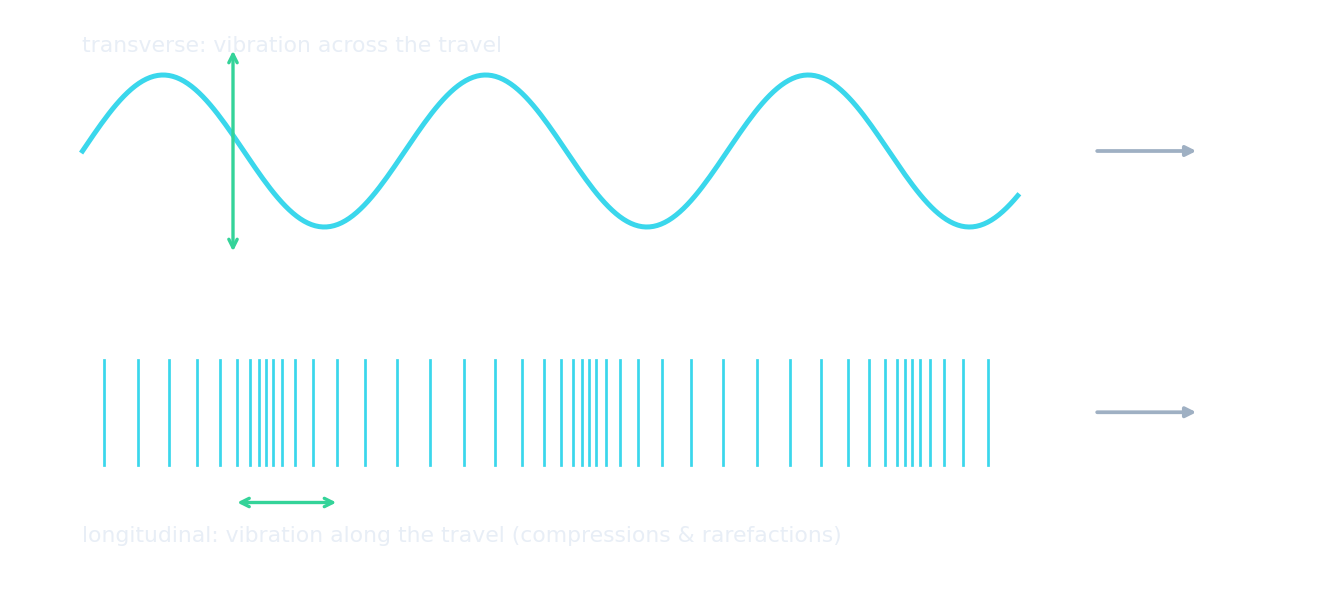

Transverse wave on a rope
횡파
y = a sin(bx + c)
파동의 진폭과 파장을 변경하십시오.
횡파에서 입자는 다음과 같이 진동합니다:
난이도 1/5 · 100 코인 + 오늘 첫 완료 시 소액 보너스
횡파 = 에너지 흐름과 직각으로 진동하는 파동(로프 파동, 빛, 물결).
Longitudinal 纵波 waves
- The particles vibrate parallel to the direction of travel.
- Made of compressions 压缩 (squashed together) and rarefactions 稀疏 (spread out). Sound is longitudinal.

Longitudinal wave on a slinky spring
공기 중을 전파하는 소리는 종파입니다.
난이도 1/5 · 100 코인 + 오늘 첫 완료 시 소액 보너스
네 — 공기 입자가 전파 방향을 따라 앞뒤로 진동하여 압축부 및 희박부를 만듭니다.
모든 횡파인 파동을 선택하십시오.
난이도 2/5 · 140 코인 + 오늘 첫 완료 시 소액 보너스
빛, 물결, 로프 파동은 횡파입니다. 소리 및 스프링의 끝 밀림 파동은 종파입니다.
종파는 압축부와 ____로 이루어져 있습니다.
난이도 1/5 · 100 코인 + 오늘 첫 완료 시 소액 보너스
압축부는 입자가 뭉친 곳이고, 희박부는 입자가 퍼진 곳입니다.
Say it the way the examiner wants
- The mark is for two directions in one sentence: the direction the particles vibrate, and the direction of energy transfer 能量传递 (the direction of propagation 传播).
- Transverse: "the vibrations are perpendicular to the direction of energy transfer."
- Longitudinal: "the vibrations are parallel to the direction of energy transfer."
- "The particles move up and down" scores nothing on its own — up and down relative to what?
각 용어를 감점 기준에 맞는 정의와 매칭하십시오.
난이도 2/5 · 140 코인 + 오늘 첫 완료 시 소액 보너스
이것들은 모두 고정된 문구로 표시되어 있습니다. "파동의 운동" 대신 "에너지 전달"이 두 파동 유형 정의에 사용된 구문입니다.
Reading a longitudinal wave's graph
- The graph plots displacement along the direction of travel: positive means the particle has moved forward, negative means back.
- Two particles exactly one wavelength apart have the same displacement and move the same way.
- A compression sits where the particle behind has moved forward and the one ahead has moved back — the graph crosses zero going downwards.
- Which way is a particle moving now? Look at the graph just behind it (the side the wave comes from): that displacement is where it is heading.
종파가 오른쪽으로 진행하고 있습니다. 변위-거리 그래프에서 입자 P는 왼쪽에서 오른쪽으로 오르는 곡선 부분에서 변위가 0에 있습니다. 현재 P는 어느 방향으로 움직이고 있습니까?
난이도 1/5 · 100 코인 + 오늘 첫 완료 시 소액 보너스
P 바로 뒤(왼쪽)를 확인하십시오:那里的变位是负的,所以P正在向负变位移动——向后运动。变位이 0인 입자는 절대 정지하지 않으며, 가장 빠른 속도에 있습니다.
Two graphs
- Displacement–distance (a snapshot of the whole wave) → read the wavelength.
- Displacement–time (one point over time) → read the period.
- Both look like sine curves, for either type of wave.
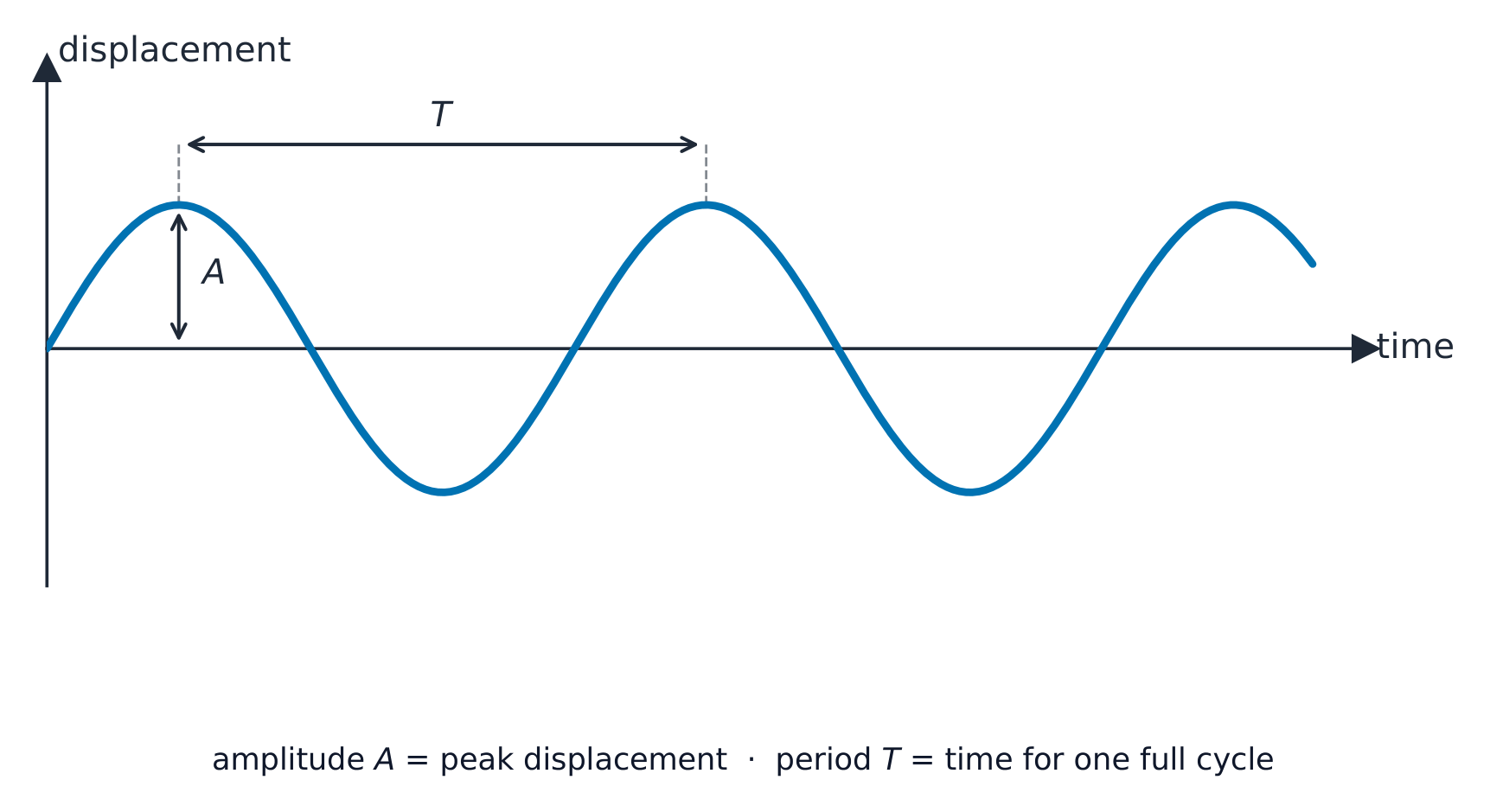
A displacement-time graph shows the wave's amplitude and period
각 그래프를 그 그래프에서 읽을 수 있는内容与 짝지어 보십시오.
난이도 2/5 · 140 코인 + 오늘 첫 완료 시 소액 보너스
거리에 대한 스냅샷은 파장을 보여주며, 시간에 걸쳐 한 점을 관찰하면 주기를 보여줍니다.
변위-거리 그래프에서 읽을 수 있는 것은 무엇입니까? 적용되는 모든 것을 선택하십시오.
난이도 2/5 · 140 코인 + 오늘 첫 완료 시 소액 보너스
주기는 변위-시간 그래프에서 얻습니다. 시간 그래프에서 파장을 읽는 것은 이 주제에서 가장 흔한 오류 중 하나입니다.
파동의 진폭이 두 배가 되었습니다. 강도는 몇 배 증가합니까?
난이도 2/5 · 140 코인 + 오늘 첫 완료 시 소액 보너스
강도는 진폭의 제곱에 비례하므로 진폭을 두 배로 하면 강도는 네 배가 됩니다. 강도는 전파 방향과 수직인 단위 면적당 전력이기도 합니다.
Worked example: a sound wave on a graph
A displacement–distance graph of a sound wave (travelling to the right) shows particles X and Y $1.5$ wavelengths apart, separated by $0.24\ \text{m}$. The frequency is $2.0\ \text{kHz}$. Particle Z sits at zero displacement on a part of the graph that falls from left to right.
- Wavelength: $1.5\lambda = 0.24$, so $\lambda = 0.16\ \text{m}$.
- Speed: $v = f\lambda = 2000 \times 0.16 = 320\ \dfrac{\text{m}}{\text{s}}$.
- Z now: just behind Z (to its left) the displacement is positive, so Z is moving forward, in the direction of travel.
- Z a quarter of a period later: the whole pattern has moved on by $\dfrac{\lambda}{4}$, so Z takes the displacement that was $\dfrac{\lambda}{4}$ behind it — a crest, $+A$. Sketch the new graph as the old one shifted right by $\dfrac{\lambda}{4}$.
- Check: a particle at zero displacement is passing through its rest position, which is where it moves fastest — so it makes sense that it reaches maximum displacement a quarter period later.
변위-거리 그래프에서 파장이 정확히 두 개 떨어진 두 입자는 $0.68\ \text{m}$만큼 떨어져 있습니다. 이 파동의 주파수는 $1.0\ \text{kHz}$입니다. 속도는 m/s 단위로 얼마입니까?
난이도 2/5 · 140 코인 + 오늘 첫 완료 시 소액 보너스
$2\lambda = 0.68$이므로, $\lambda = 0.34\ \text{m}$과 $v = f\lambda = 1000 \times 0.34 = 340\ \dfrac{\text{m}}{\text{s}}$ — 공기 중의 음속입니다.
The displacement graph of a longitudinal wave looks exactly like a transverse wave, but the particles are not moving up and down. The vertical axis is displacement along the line of travel. Say "forward and back", and remember that the wave travels while the particles only oscillate about fixed positions.
You've got it
- transverse: vibration perpendicular to the energy transfer (rope, light, ripples)
- longitudinal: vibration parallel to the energy transfer — compressions & rarefactions (sound)
- on a longitudinal wave's graph, positive = forward; look just behind a particle to see where it is going
- displacement–distance shows $\lambda$; displacement–time shows $T$