| English | 의미 |
|---|---|
| terminal velocity/ˈtɜːmɪnl vəˈlɒsɪti/ | 한계 속도 |
| air resistance/eə rɪˈzɪstəns/ | 공기 저항 |
| friction/ˈfrɪkʃn/ | 마찰력 |
| drag/dræɡ/ | 저항력 |
| viscous/ˈvɪskəs/ | 점성 |
| fluid/ˈfluːɪd/ | 유체 |
| upthrust/ˈʌpθrʌst/ | 浮력 |
| resultant force/rɪˈzʌltənt fɔːs/ | 합력 |
| thermal energy/ˈθɜːml ˈenədʒi/ | 열에너지 |
| power/ˈpaʊə/ | 일률 |
Why a skydiver stops speeding up
- Jump from a plane and you accelerate — but not forever.
- Soon you fall at a steady speed, the terminal velocity 收尾速度, even though gravity still pulls.
- The reason is air resistance 空气阻力 growing with speed.
Friction 摩擦力 and drag 阻力
- Friction acts between two solid surfaces, opposing the sliding.
- Drag (a viscous 黏性 force) is the resistance from a fluid 流体 — a liquid or gas.
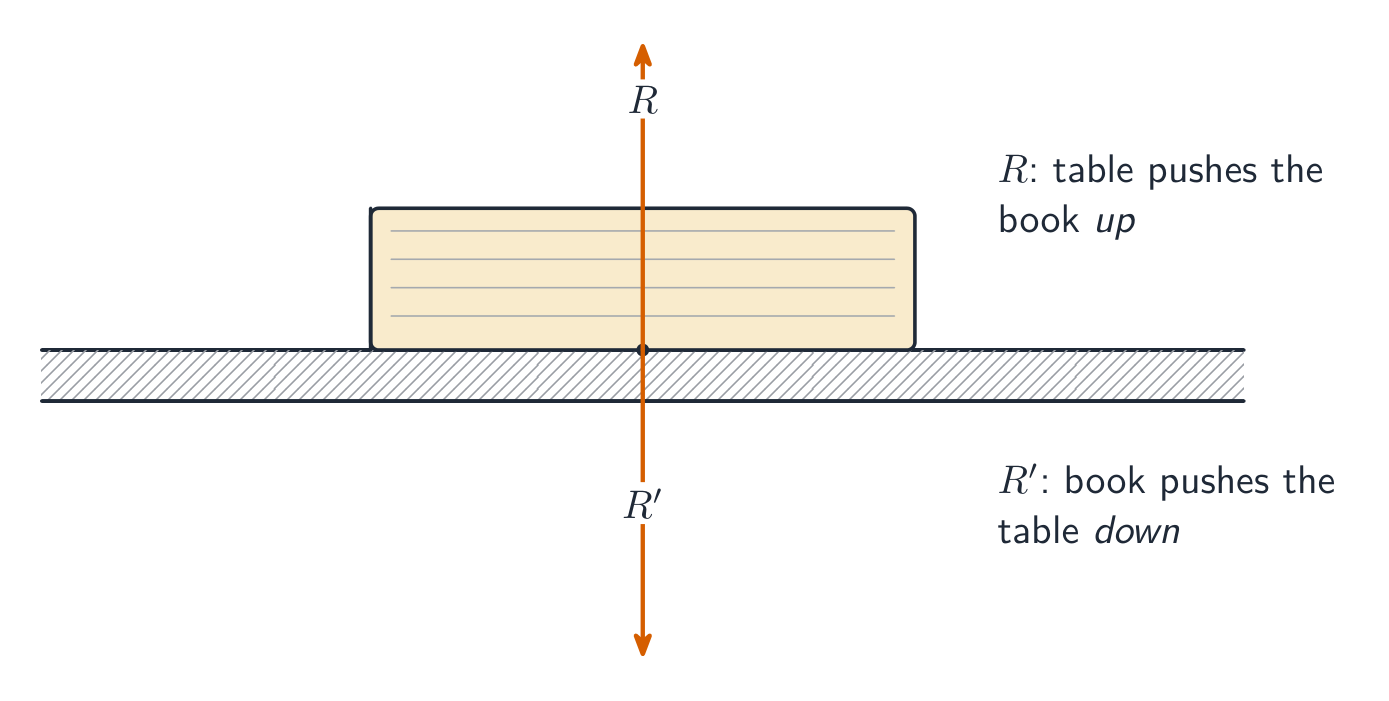
Newton's third-law pair: R on the book (up) and R-prime on the table (down)
자동차 정지하기
마찰이 자동차를 정지시키는 원천입니다. 속도를 설정하고 브레이크를 밟으면, 운전자가 반응할 동안 자동차는 계속 움직인 후 마찰에 의해 느려집니다. 속도를 두 배로 늘리면 제동 거리가 네 배가 됩니다.
항력(점성력)을 가장 잘 설명하는 것은 무엇입니까?
난이도 1/5 · 100 코인 + 오늘 첫 완료 시 소액 보너스
항력은 유체(액체 또는 기체)가 물体内를 이동하는 것에 대해 발하는 저항입니다. 마찰은 고체-고체 경우입니다.
Drag grows with speed
- At rest there is no drag.
- The faster you go, the bigger the drag force becomes.
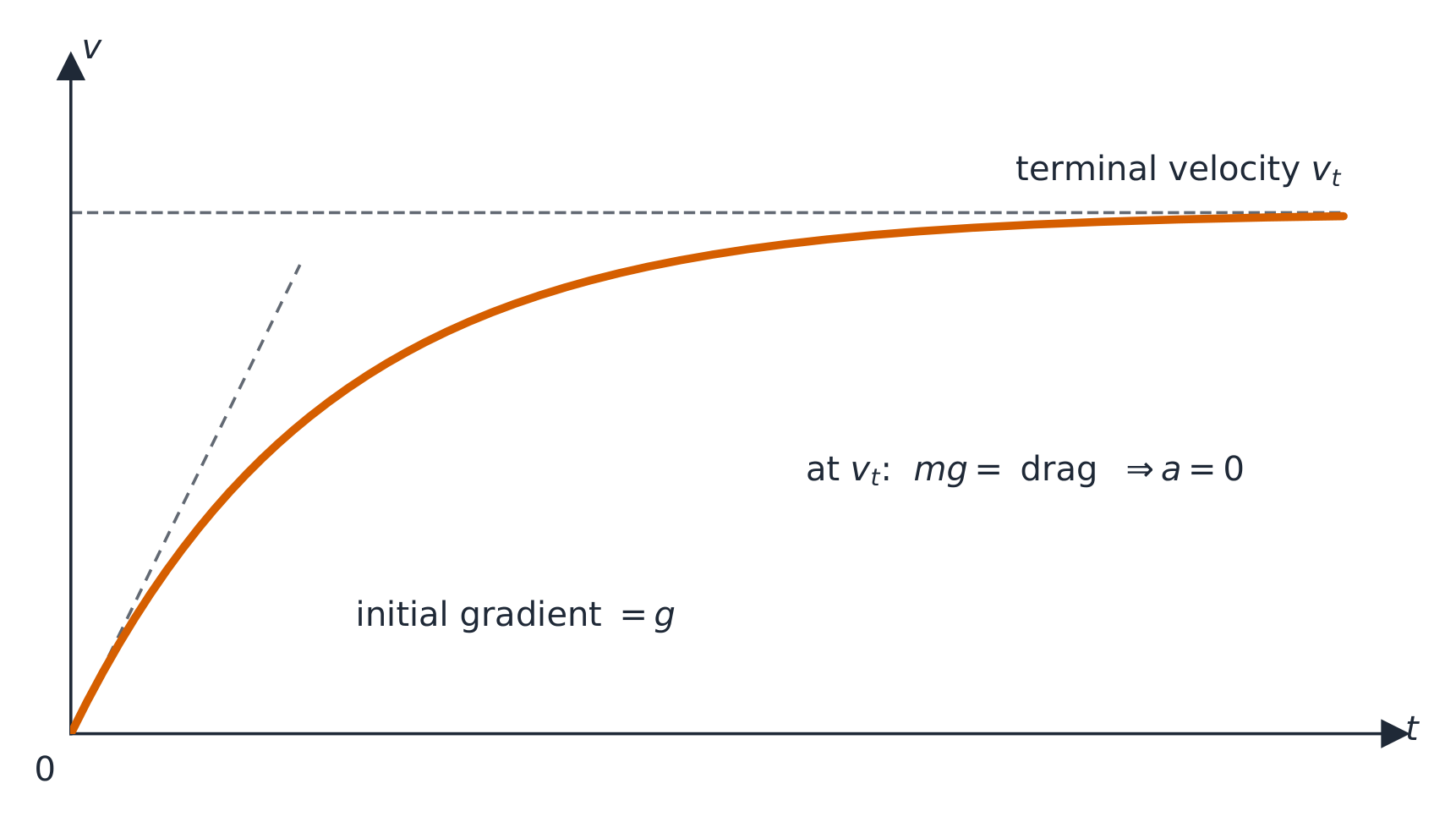
Velocity-time graph for an object falling through air
falling object의 항력은 속도가 증가함에 따라 커집니다.
난이도 1/5 · 100 코인 + 오늘 첫 완료 시 소액 보너스
네 — 정지 상태에서는 항력이 0이며, 속도에 따라 증가합니다. 이것이 결국 무게와 균형을 이룹니다.
Three forces on a ball falling in a liquid
- Weight $W$ — down, always the same.
- Upthrust 浮力 $U$ — up, the same at every speed (it depends only on the liquid pushed aside).
- Drag $F$ — up, opposite to the motion, and growing as the ball speeds up.
- Exam habit: draw each force as a labelled arrow from the ball, and never add a "motion" arrow.

A free-body diagram shows only the forces on the object — the same idea for a falling ball
강철 공이 오일 안을下落中입니다. 공에 어떤 힘이 작용합니까? 적용되는 것을 모두 선택하십시오.
난이도 2/5 · 140 코인 + 오늘 첫 완료 시 소액 보너스
세 가지 힘: 아래쪽 무게, 위쪽 부력, 그리고 운동과 반대인 위쪽 항력. 별개의 운동 힘은 존재하지 않습니다 — 공은 속도에 의해 움직이지, 힘을 받아 밀려서 움직이는 것이 아닙니다.
Falling to terminal velocity
- Start: only weight (and upthrust) act, so the resultant force is largest and the acceleration is largest.
- Middle: drag grows, the resultant force 合力 shrinks, so the acceleration falls.
- End: upward forces equal the weight → zero resultant force → constant speed.

종단速度到达
뛰어 올라가서 공기저항 화살표가 무게와 균형을 이루며 속도가 일정해지기를 기다리십시오. 낙하산으로Fall을 열면 훨씬 더 큰 항력이 낙하자를 느리고 안전한 종단속도로 내립니다.
공기 중 낙하 단계를 방출 순간부터 순서대로 나열하십시오.
난이도 3/5 · 200 코인 + 오늘 첫 완료 시 소액 보너스
항력은 0에서 시작하여 속도에 따라 증가하여 무게를 상쇄하고 가속도를 멈춥니다.
종단 속도에서 항력은 ____과 같습니다.
난이도 1/5 · 100 코인 + 오늘 첫 완료 시 소액 보너스
항력 = 무게이므로 합성 힘은 0이고 속도는 일정하게 유지됩니다.
At terminal velocity the acceleration is zero — not the velocity. The object is still moving, and it still loses height. A common exam error is "the forces are balanced so it stops".
Worked example: terminal speed in oil
A small steel ball of weight $0.050\ \text{N}$ falls through oil. The upthrust on it is $0.010\ \text{N}$, and the drag is $F = kv$ with $k = 0.080\ \dfrac{\text{N s}}{\text{m}}$. Find the terminal speed.
- At terminal speed the resultant force is zero: $W = U + F$.
- So $F = 0.050 - 0.010 = 0.040\ \text{N}$.
- Then $kv = 0.040$, giving $v = \dfrac{0.040}{0.080} = 0.50\ \dfrac{\text{m}}{\text{s}}$.
- Check: in a liquid, forgetting the upthrust gives $v = 0.63\ \dfrac{\text{m}}{\text{s}}$ — the wrong answer, and a lost mark.
무게가 $0.12\ \text{N}$ N인 공이 액체를 통과하여 낙하합니다.浮力(upthrust)은 $0.030\ \text{N}$ N이고, 항력(drag)은 $F = kv$ N이며 유속은 $k = 0.30\ \dfrac{\text{N s}}{\text{m}}$ m/s입니다. 이 공의 종단 속도(terminal speed)는 m/s 단위로 몇 입니까?
난이도 2/5 · 140 코인 + 오늘 첫 완료 시 소액 보너스
종단 속도 $W = U + kv$에서, 따라서 $kv = 0.12 - 0.030 = 0.090\ \text{N}$이며 $v = \dfrac{0.090}{0.30} = 0.30\ \dfrac{\text{m}}{\text{s}}$입니다.
Energy at terminal velocity
- The kinetic energy is now constant, but the object keeps losing height.
- That lost gravitational PE turns mainly into thermal energy 热能 of the fluid — not into extra speed.
낙하 parachutist가 종단 속도로 떨어질 때 손실된 중력 포텐셜 에너지는 주로 다음 중 어디로 전환되나요?
난이도 1/5 · 100 코인 + 오늘 첫 완료 시 소액 보너스
운동 에너지가 일정하므로 falling PE는 KE가 될 수 없습니다 — 항력을 통해 공기(및 parachutist)를 가열합니다.
Cruising at constant speed
- A car at steady speed has zero resultant force: driving force = total resistance.
- On a slope, the driving force must also balance the component of the weight along the slope, $W\sin\theta$.
- Going faster means more drag, so more driving force — and more power 功率, since $P = Fv$.
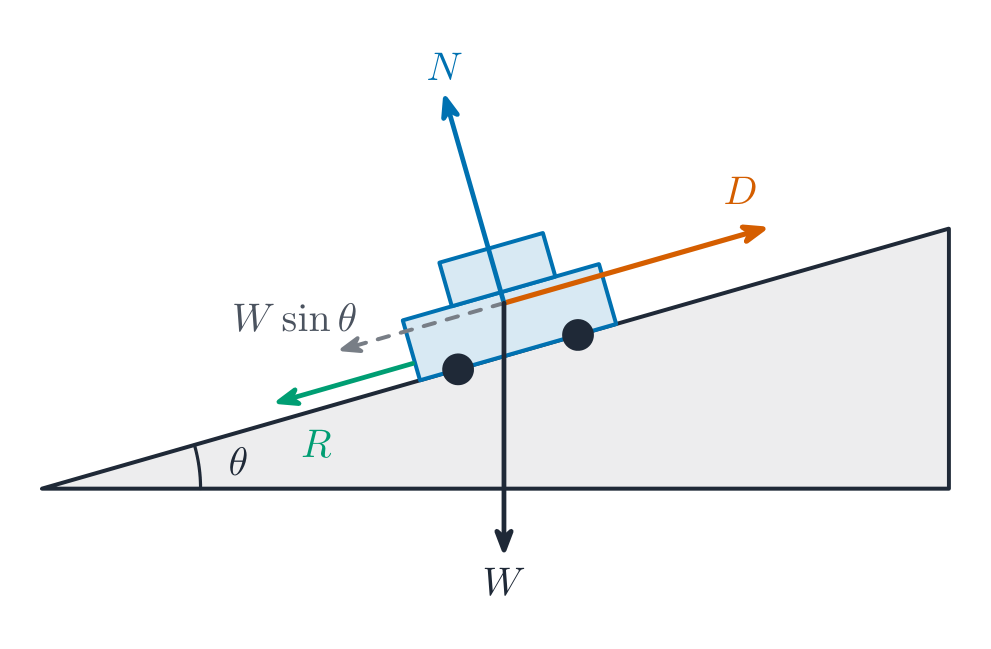
On a slope the driving force works against drag and against part of the weight
더 높은 일정한 속도로 주행하는 자동차는 항력이 더 크기 때문에 더 많은 동력이 필요합니다.
난이도 1/5 · 100 코인 + 오늘 첫 완료 시 소액 보너스
높은 속도 → 큰 항력 → 더 큰 구동력이 필요함 → 더 많은 동력 (동력 = 힘 × 속도).
Worked example: power up a slope
A car of mass $1200\ \text{kg}$ climbs a slope of $5.0^\circ$ at a steady $25\ \dfrac{\text{m}}{\text{s}}$. The total resistive force is $900\ \text{N}$. Find the useful output power of the engine.
- Steady speed → the driving force $D$ balances everything pulling back.
- Weight component down the slope: $mg\sin\theta = 1200 \times 9.81 \times \sin 5.0^\circ = 1030\ \text{N}$.
- So $D = 900 + 1030 = 1930\ \text{N}$.
- Power: $P = Dv = 1930 \times 25 = 4.8 \times 10^{4}\ \text{W}$ (about $48\ \text{kW}$).
- Check: using $mg$ instead of $mg\sin\theta$ would give a driving force bigger than the car's whole weight — impossible on a gentle slope.
트럭이 일정한 $20\ \dfrac{\text{m}}{\text{s}}$ 속도로 경사면을 등판합니다. 총 저항력은 $2000\ \text{N}$이고 무게의 경사면 방향 성분은 $3000\ \text{N}$입니다. 엔진이 제공하는 유효 출력은 kW로 얼마입니까?
난이도 2/5 · 140 코인 + 오늘 첫 완료 시 소액 보너스
일정한 속도이므로 구동력은 $2000 + 3000 = 5000\ \text{N}$입니다. 동력 $P = Fv = 5000 \times 20 = 1.0 \times 10^{5}\ \text{W} = 100\ \text{kW}$입니다.
You've got it
- drag grows with speed; friction is between solids, drag is from a fluid
- terminal velocity: upward forces (drag + upthrust) = weight, so zero resultant force and constant speed — zero acceleration, not zero motion
- the lost gravitational PE becomes thermal energy of the fluid, not kinetic energy
- steady speed on a slope: driving force = resistance + $W\sin\theta$, and $P = Fv$