| English | 의미 |
|---|---|
| horizontal/ˌhɒrɪˈzɒntl/ | 수평 |
| vertical/ˈvɜːtɪkl/ | 수직 |
| gravity/ˈɡrævɪti/ | 중력 |
| projectile/prəˈdʒektaɪl/ | 포사체 |
| parabola/pəˈræbələ/ | 포물선 |
| range/reɪndʒ/ | 사거리 |
| greatest height/ˈɡreɪtɪst haɪt/ | 최대 높이 |
The cannonball problem
- Fire a ball at an angle and it traces a smooth arch, then lands. Where, and how high?
- Galileo's insight: treat the horizontal 水平 and vertical 竖直 motions completely separately — they only share the clock.
Two independent motions
- Launched at speed $u$ and angle $\alpha$:
- Horizontal: constant velocity $u\cos\alpha$ (no force sideways).
- Vertical: gravity 重力 only, acceleration $g$ downward.

Water jets follow parabolic paths, the classic projectile 抛射体 motion under gravity
포물선 발사하기
공을 발사한 후 각도와 속도를 변경하십시오. 수직 방향의 운동은 일정하게 유지되지만 중력이 아래로 당깁니다 — 이 둘이 합쳐져 포물선을 그립니다. 가장 긴 사거리를 내는 각도를 구하고, 달에서 시도해 보십시오.
비행 중 포물선의 수직 속도(공기 저항 무시 시):
난이도 1/5 · 100 코인 + 오늘 첫 완료 시 소액 보너스
수직 방향에 힘이 없으므로 u cos α는 전체 비행 중 일정합니다.
속도 u와 각도 α로 발사된 포물선의 초기 수직 속도는 u ______ α입니다.
난이도 1/5 · 100 코인 + 오늘 첫 완료 시 소액 보너스
수직 성분 = u cos α; 수직 성분 = u sin α.
The parabola 抛物线
- Eliminating $t$ leaves $y$ as a quadratic in $x$ — so the path is a parabola.
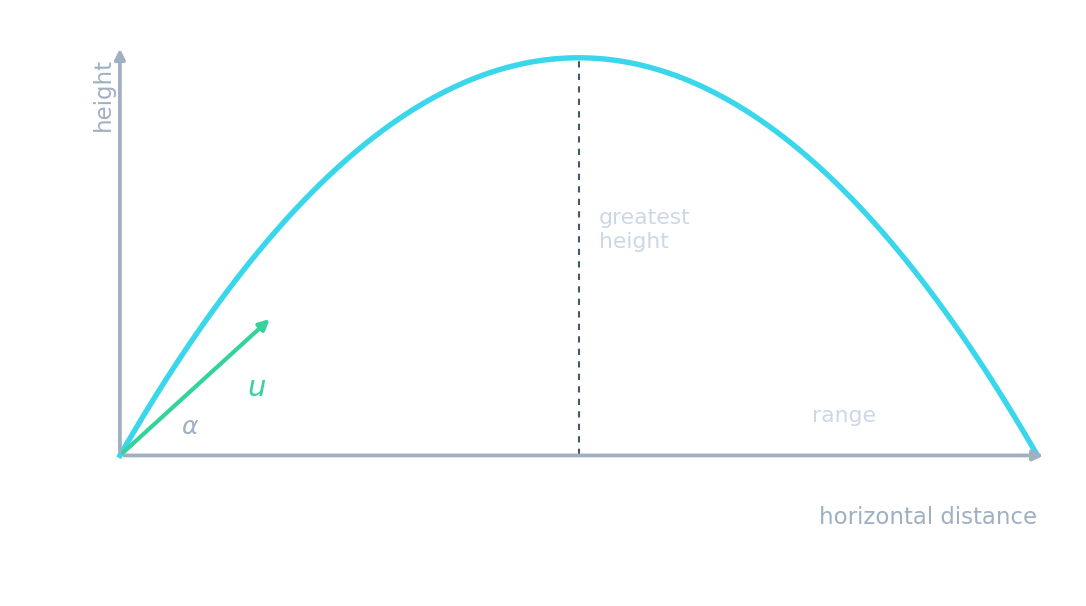
Horizontal speed stays constant; gravity bends the vertical motion into a parabola.
포물선의 경로(空气阻力忽略时)는:
난이도 1/5 · 100 코인 + 오늘 첫 완료 시 소액 보너스
t를 소거하면 y는 x에 대한 이차함수인 포물선이 됩니다.
Range 射程 and greatest height 最大高度
- At the top, the vertical velocity is momentarily zero. The key results:
Worked example. $u = 20\ \tfrac{\text{m}}{\text{s}}$, $\alpha = 30^\circ$, $g = 10$. Greatest height $= \dfrac{400 \times 0.25}{20} = 5\ \text{m}$.
공을 u = 20 m/s의 속도로 30° 각도에 던졌습니다. 높이 공식 height = u²sin²α/(2g)에 g = 10을 대입하여 최대 높이(m)를 구하십시오.
난이도 2/5 · 140 코인 + 오늘 첫 완료 시 소액 보너스
400 × sin²30° / 20 = 400 × 0.25 / 20 = 5 m.
사거리가 가장 길어지는 발사 각도(도)는 무엇인가?
난이도 2/5 · 140 코인 + 오늘 첫 완료 시 소액 보너스
Range ∝ sin 2α이며, 이는 2α = 90°, 즉 α = 45°일 때 최대값을 가집니다.
비행의 최고점에서 수직 속도 성분이 0입니다.
난이도 1/5 · 100 코인 + 오늘 첫 완료 시 소액 보너스
최고점에 도달하면 수직 속도가 0으로 감소한 뒤 음수가 됩니다(아래 방향).
Common trap
Range is maximised at $45^\circ$, not $90^\circ$. $\sin 2\alpha$ peaks when $2\alpha = 90^\circ$. Firing straight up gives zero range — all the speed goes into height.
- Eliminating time gives the Cartesian equation of the path; all trajectories lie under a bounding parabola.
You've got it
- resolve into horizontal ($u\cos\alpha$, constant) and vertical ($u\sin\alpha$, gravity) parts
- the path is a parabola
- range $= \dfrac{u^2\sin 2\alpha}{g}$ (max at $45^\circ$); greatest height $= \dfrac{u^2\sin^2\alpha}{2g}$