
범위 및 전제 조건
ACT 프레임워크, 2월 2026 개정판. 여기서의 교실 사례는 공식 ACT 형식이 아니다.
- 합과 무리수를 Defaults their sums retain type를 가정하지 않고 구분함
- 허용된 영역에서 지수 및 근사 규칙을 적용함
- i²=-1 및 켤레复数를 사용하여 복소수 계산
필요 조건: 분배 법칙; 주근호; $i^2=-1$.
방법 설명 및 선택
A rational number is a ratio of integers with nonzero denominator; a terminating or repeating decimal is rational. An irrational real number is not such a ratio. Closure of rational numbers under addition and multiplication does not imply closure of irrational numbers. Exact roots may simplify: √18=3√2 remains irrational, whereas √16=4 is rational.
For a positive base, a^(m/n) combines an nth root and an integer power. A negative exponent forms a reciprocal and requires a nonzero base. Distinguish √(x²)=|x| from x. When an even root is involved, respect the real domain and the principal nonnegative root. Distribute powers across products, not across sums: (a+b)² includes the cross term.
Complex arithmetic uses i²=-1. Add real parts and imaginary parts separately, and multiply by distribution before reducing i². To divide by a+bi, multiply numerator and denominator by a-bi; the resulting denominator is a²+b² when the original is nonzero. Complex roots permit solutions to equations such as x²=-9 that have no real roots.
Enhanced ACT still includes selected advanced topics, and no formula sheet is supplied. Build familiarity with the defining rules rather than guessing from a calculator display. Check whether the question asks for real or complex solutions, an exact radical or a decimal approximation. The local checks here are formative, not an official scored form.
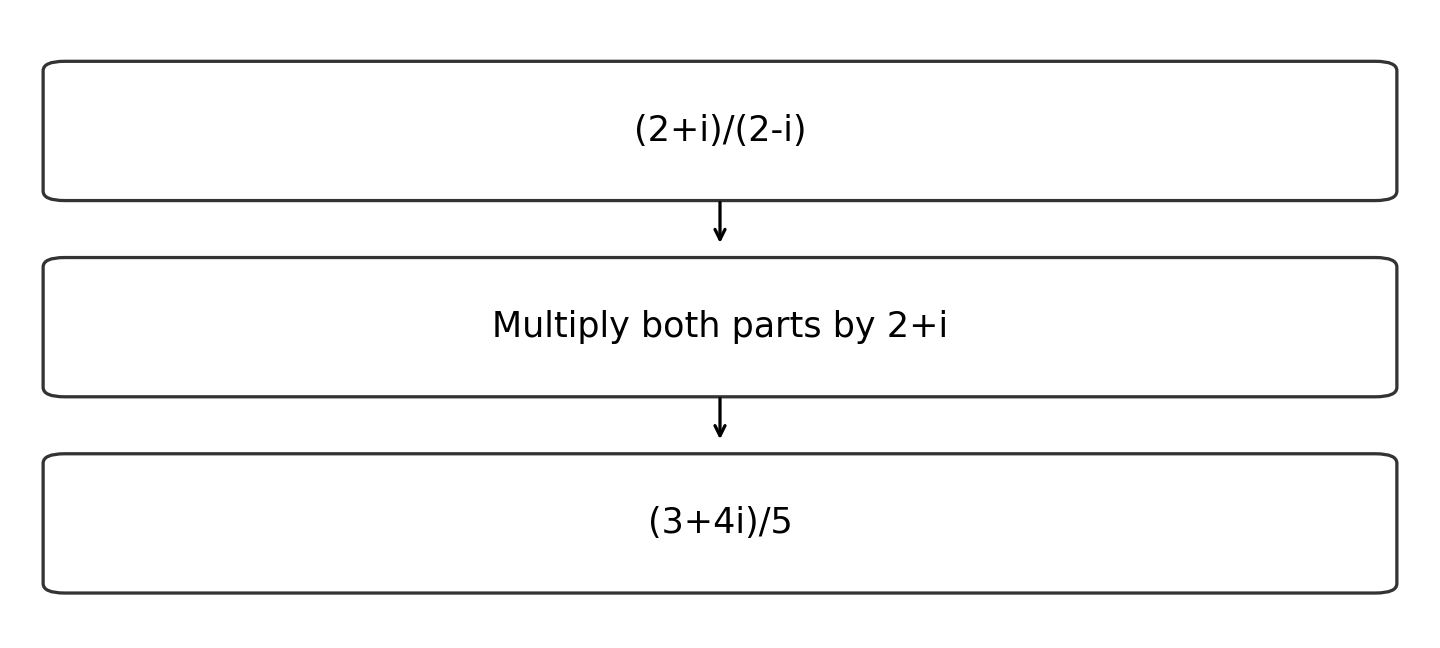
복소 레는 허수 부호를 바꿉니다. $(a+bi)(a-bi)=a^2+b^2$을 실수 $a,b$에 대해. 따라서 $(2+i)/(2-i)=(2+i)^2/5=(3+4i)/5$. The denominator is nonzero; distinguish an exact value from its decimal approximation.
작업 예시. 16^(3/4)=2³=8. (2+3i)(1-2i)=2-4i+3i-6i²=8-i. (1+i)/(1-i)에 대해, 1+i를 곱하면 (1+i)²/2=2i/2=i가 된다. x²+9=0의 해는 ±3i이며, 둘 다 실수가 아니다.
연습 자료
아래 각 연습 문제에서는 필요한 모든 데이터를 명시하고 있습니다.
추론 연습
연습 1
$(3-2i)/(1+i)$를 $a+bi$ 형태로 계산하십시오.
해설. 양변에 $1-i$을 곱합니다. 분자는 $(3-2i)(1-i)=3-5i+2i^2=1-5i$입니다. 분모는 2입니다. 정답은 $1/2-(5/2)i$입니다. 다시 $1+i$을 곱하면 $3-2i$이 됩니다.
연습 2
$32^{2/5}$과 $\sqrt{(-7)^2}$을 평가하십시오. 복소수 영역에서 $z^2+16=0$을 구하십시오.
해설. 32의 5차근은 2이므로, $32^{2/5}=2^2=4$입니다. 주 제곱근은 $|-7|=7$입니다. 방정식에 대해, $z^2=-16$은 $z=4i,-4i$을 주며, 둘 다 허수입니다.
연습 3
무리수의 곱이 유리가 될 수 있음을 보여주는 예시 하나와, 무리가 될 수 있음을 보여주는 예시 하나를 제시하십시오.
Reasoning. $\sqrt2\sqrt2=2$ is rational. $\sqrt2\sqrt3=\sqrt6$ is irrational. Neither closure nor nonclosure for all products follows from the label irrational alone.
연습 4
Classify $\sqrt{50}$ and $\sqrt{50}\sqrt2$ as rational or irrational. Evaluate $32^{2/5}$ and $2^{-3}$. Use $\sqrt2$ and $-\sqrt2$ to test whether a sum of irrational numbers must be irrational.
Reasoning. $\sqrt{50}=5\sqrt2$ is irrational, while $\sqrt{50}\sqrt2=\sqrt{100}=10$ is rational. $32^{2/5}=(\sqrt[5]{32})^2=2^2=4$ and $2^{-3}=1/2^3=1/8$. The two irrational numbers sum to zero, which is rational; irrational numbers are not closed under addition. These even-root products use nonnegative real radicands.
한계 및 향후 활용법
두 무리항이 반드시 무리합을 가져야 한다고 추단하거나, 제곱을 합에 대해 분포시키거나, x가 음수일 수 있을 때 √(x²)를 x로 교체하지 마라.
이것들은 이 과정을 위해 작성된 원본 연습 문제이지 공식 시험 문제가 아닙니다.