Scope and prerequisites
ACT framework, February 2026 revision. Original classroom cases are not an official form; preserve the scored/field-test boundaries of each source form.
- Apply number and quantity, algebra and functions
- Use coordinate and Euclidean geometry and trigonometry
- Interpret statistics, probability and essential-skill models
Prerequisites: Distributive law; principal roots; $i^2=-1$.
Explain and choose the method
Preparing for higher mathematics covers number, algebra, functions, geometry and statistics/probability. Essential skills combine rates, units and proportions.
For a function, track the input and output. Composition 函数复合 applies the inner function first.
Coordinate geometry links slopes, distances and equations. Right-triangle ratios require the correct reference angle.
Model a context with stated assumptions, then check whether the result is sensible. A calculator supports computation but cannot choose a model for you.
A complex conjugate 复共轭 changes the imaginary sign. $(a+bi)(a-bi)=a^2+b^2$ for real $a,b$. Thus $(2+i)/(2-i)=(2+i)^2/5=(3+4i)/5$. The denominator is nonzero; distinguish an exact value from its decimal approximation.
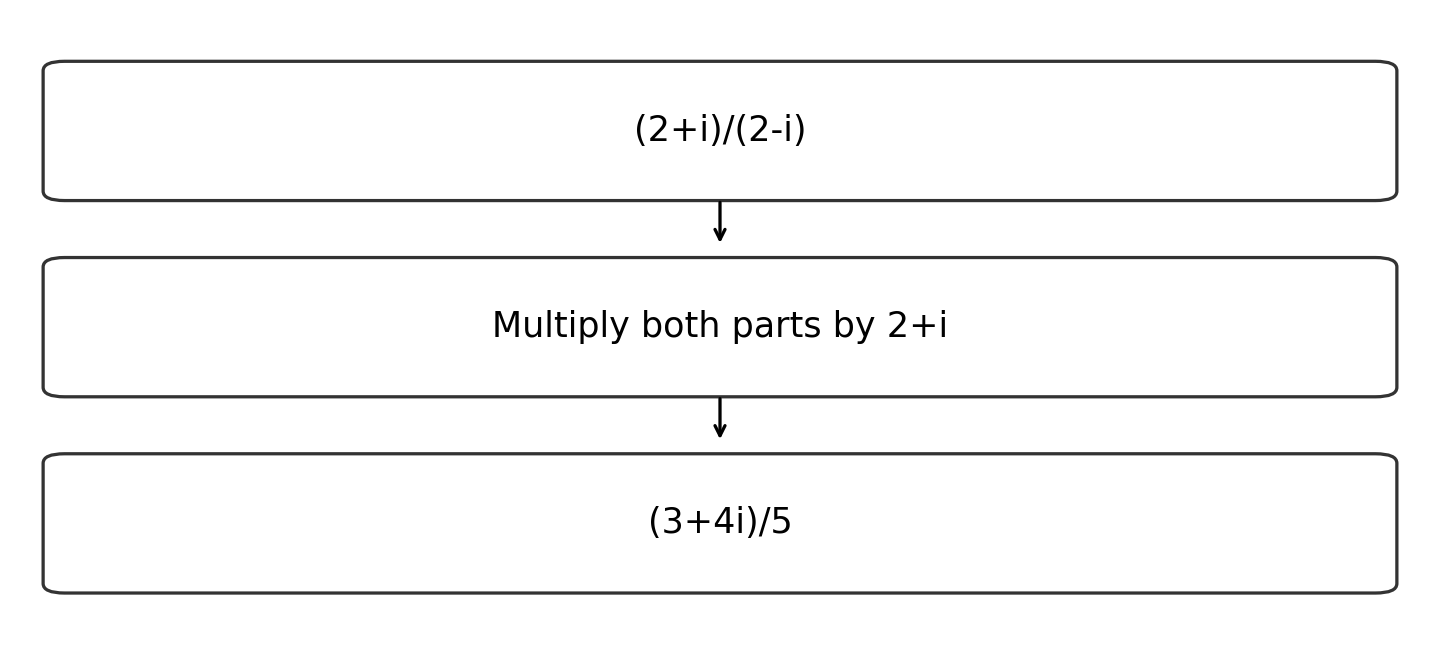
Existing worked example: If f(x)=2x+1 and g(x)=x², then f(g(3))=f(9)=19. But g(f(3))=g(7)=49. Order matters. For a probability check, two independent 独立的 fair coin tosses give P(two heads)=1/2×1/2=1/4.
Complete original context
Every transfer question states all data it needs.
Independent practice and checked reasoning
This overview is completed through the detailed skill sequence: 7, 8, 9, 10, 11, 12, 13, 14, 15, 16, 17, 18. Work those references and sheets in order; this orientation does not replace them.
Transfer 1
Calculate $(3-2i)/(1+i)$ in form $a+bi$.
Reasoning: Multiply both parts by $1-i$. Numerator is $(3-2i)(1-i)=3-5i+2i^2=1-5i$. Denominator is 2. The answer is $1/2-(5/2)i$. Multiplying back by $1+i$ returns $3-2i$.
Transfer 2
Evaluate $32^{2/5}$ and $\sqrt{(-7)^2}$. Solve $z^2+16=0$ over the complex numbers.
Reasoning: The fifth root of 32 is 2, so $32^{2/5}=2^2=4$. The principal square root is $|-7|=7$. For the equation, $z^2=-16$ gives $z=4i,-4i$, both nonreal.
Transfer 3
Give one example showing that the product of two irrational numbers can be rational, and one where it is irrational.
Reasoning: $\sqrt2\sqrt2=2$ is rational. $\sqrt2\sqrt3=\sqrt6$ is irrational. Neither closure nor nonclosure for all products follows from the label irrational alone.
Transfer 4
Classify $\sqrt{50}$ and $\sqrt{50}\sqrt2$ as rational or irrational. Evaluate $32^{2/5}$ and $2^{-3}$. Use $\sqrt2$ and $-\sqrt2$ to test whether a sum of irrational numbers must be irrational.
Reasoning: $\sqrt{50}=5\sqrt2$ is irrational, while $\sqrt{50}\sqrt2=\sqrt{100}=10$ is rational. $32^{2/5}=(\sqrt[5]{32})^2=2^2=4$ and $2^{-3}=1/2^3=1/8$. The two irrational numbers sum to zero, which is rational; irrational numbers are not closed under addition. These even-root products use nonnegative real radicands.
Limits and next use
Enhanced ACT maths uses four answer choices. A five-choice older item can teach a skill but should not define current test pacing.
All tasks here are public original practice with authored guidance. They are not official questions or fresh diagnostics. Existing protected tests and mocks remain separate.