Skip to content
English Grammar · B2

The causative

  • 9 The causative
    9.1

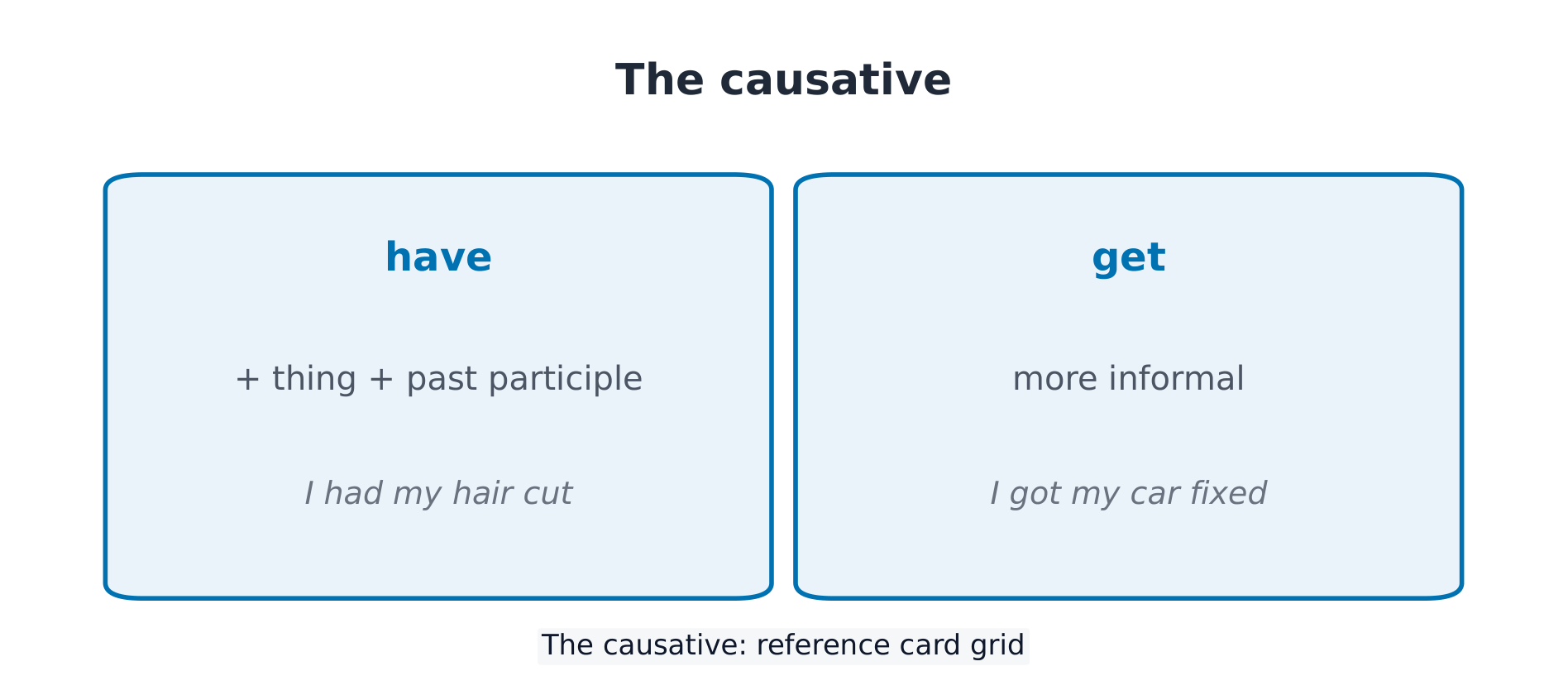
    have something done

    Causative structure: have/get something done

    The causative structure expresses having someone else do something for you, rather than doing it yourself.

    Structure: have + 宾语 + 过去分词

    我I (使役)had 我的my 头发hair 剪cut 昨天yesterday.

    I got my hair cut yesterday. (Not by myself)

    我们We (be)are (使役)having 我们的our 房子house 粉刷painted.

    We are getting the house painted. (By someone else)

    Note: Pay attention to word order: have + object + past participle. I had my car repaired. (I sent it to be fixed) differs from I repaired my car. (I did it myself).

    9.2

    get something done

    get + object + past participle functions similarly to have, but is more informal.

    我I 需要need to (使役)get 我的my 手机phone 修理fixed.

    *I need to get my phone repaired.

    她She (使役)got 她的her 照片photo 拍taken.

    She got a photo taken. (By someone else)

    Note: In causative structures, have and get are largely interchangeable; get carries a more casual, conversational tone.

    Common Errors

    • ❌ ~~I cut my hair yesterday.~~ (Actually at the salon) → ✓ I had my hair cut yesterday. — Using the active voice implies you cut it yourself with scissors.
    • ❌ Incorrect word order: ~~I had cut my hair~~ is the past perfect tense ("I had already cut it before then"), not causative; the causative form is have + object + past participle: I had my hair cut.
    • ❌ ~~I had my hair cutted.~~ → ✓ …cut. — The past participle in the causative structure must also be correct: cut–cut–cut remains unchanged.
    • To ask someone to do it: have + person + base form, get + person + to do: I'll have John fix it. / I'll get John to fix it.

All topics · English Grammar · B2

Log in or create account

IGCSE, A-Level & AP