Skip to content
Subjects

英语语法 · B2

  • 1 叙事时态
    1.1

    一般过去时与过去进行时

    叙事时态:背景、事件、更早

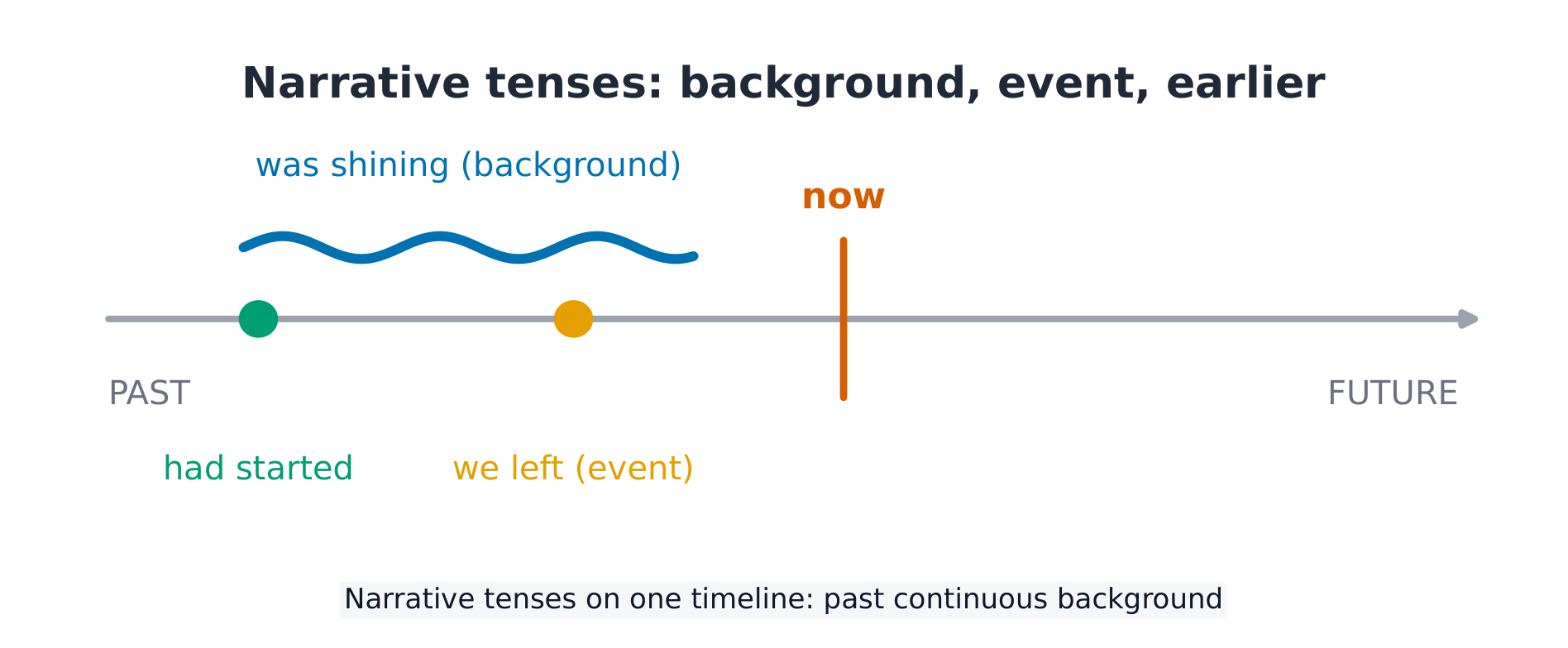
    讲故事时,英语用一组叙事时态 (narrative tenses) 配合使用。最基础的两个是:

    • 一般过去时:推进情节的主要动作(一件接一件)。
    • 过去进行时:设置背景,描述当时正在进行的事。

    (冠词)The 太阳sun (过去进行)was 照耀shining 当...时when 我们we 出发left.

    我们出发时,阳光正灿烂。(背景 + 主要动作)

    She (过去进行)was 做饭cooking 当...时when (冠词)the 电话phone 响了rang.

    她做饭时电话响了。

    注意 长的背景动作用过去进行时(was cooking);打断它的短动作用一般过去时(rang)。

    1.2

    过去完成时表更早的过去

    当需要表示一个动作发生在另一个过去动作之前,用过去完成时 (had + 过去分词)。

    当...时When 我们we 到达arrived (冠词), the 电影film (过去完成)had 已经already 开始started.

    我们到时,电影已经开始了。(先开始,后到)

    叙事中的配合:

    • 最早 → 过去完成时(had started)。
    • 之后 → 一般过去时(arrived)。
    • 背景 → 过去进行时(was raining)。

    注意 这三种时态一起,能把一个故事的时间层次讲清楚。

    1.3

    过去完成进行时

    过去完成进行时 (had been + V-ing) 强调在某个过去时间点之前一直持续的动作。

    She (过去)was tired 因为because she (过去完成)had (进行)been 工作working 一整天all day.

    她很累,因为她一整天都在工作。

    与过去完成时的区别:

    • 过去完成进行时:强调持续的过程 / 时长(had been working — 一直在干)。
    • 过去完成时:强调完成 / 结果(had finished — 干完了)。

    注意 状态动词(know、be)不用进行时:用 had known,不用 ~~had been knowing~~。

    常见错误

    • ❌ ~~When the phone rang, she cooked dinner.~~(想说"正在做饭")→ ✓ …she was cooking dinner. — 用一般过去时,意思会变成"电话响了之后她才开始做饭"。
    • ❌ ~~While I walked home, I was meeting a friend.~~ → ✓ While I was walking home, I met a friend. — 长的背景动作用进行时,短动作用过去时,别颠倒。
    • ❌ ~~She had finished the report, then she had sent it.~~ → ✓ She finished the report, then sent it. — 按发生顺序叙述时,一般过去时就够了;过去完成时只在"倒回去补充更早的事"时用。
    • ❌ ~~It was the first time I saw snow.~~ → ✓ It was the first time I had seen snow. — 过去叙事里的"第一次"用过去完成时。
  • 2 将来进行时与将来完成时
    2.1

    将来进行时 (will be + V-ing)

    将来进行时与将来完成时

    将来进行时 (future continuous) 表示在将来某个时刻正在进行的动作。

    结构: will be + 动词-ing

    这个时候This time 明天tomorrow , I will (进行)be flying to 巴黎Paris.

    明天这个时候,我将在飞往巴黎的途中。

    不要Don't 打电话call at 八点eight 我们; we will (进行)be having 晚饭dinner.

    八点别打电话,我们那时在吃晚饭。

    注意 也常用来礼貌地询问别人的安排:Will you be using the car tonight?(你今晚会用车吗?)

    2.2

    将来完成时 (will have + 过去分词)

    将来完成时 (future perfect) 表示在将来某个时刻之前已经完成的动作。

    结构: will have + 过去分词,常和 by + 将来时间 连用。

    到...时By 明年next year , I will (完成)have 完成finished 我的my 学业studies.

    到明年,我就会完成学业了。

    他们They will (完成)have 离开left 在...之前by ...时候the time you 到达arrive.

    你到的时候,他们已经走了。

    注意 常见搭配 by + 时间点(by 2030、by then、by the time …),表示"到那时为止"。

    常见错误

    • ❌ ~~By 2030, I will finish my degree.~~ → ✓ By 2030, I will have finished my degree. — by + 将来时间点是将来完成时的强信号。
    • ❌ ~~This time tomorrow I will fly to Paris.~~ → ✓ …I will be flying to Paris. — "将来某刻正在进行"用 will be + -ing;will fly 只是陈述决定。
    • ❌ ~~I will have finish it by Friday.~~ → ✓ I will have finished it. — will have 后面是过去分词。
    • ❌ ~~When you will arrive, I will have cooked dinner.~~ → ✓ When you arrive, I will have cooked dinner. — 时间从句照旧用一般现在时,再高级的主句也不例外。
  • 3 第三与混合条件句
    3.1

    第三条件句

    第三与混合条件句

    第三条件句 (third conditional) 谈论过去——一个没有发生的假设,以及它本会带来的结果。

    结构: If + 过去完成时, would have + 过去分词

    如果If I (过去完成)had 学习studied , I would (完成)have 通过passed.

    如果我当时学习了,就会通过了。(其实没学,也没通过)

    注意 它表示与过去事实相反的假设;常含遗憾或责备。缩写:I'd have、would've。

    3.2

    混合条件句

    混合条件句 (mixed conditional) 把不同的时间混在一起。最常见的是:过去的原因 → 现在的结果

    结构: If + 过去完成时, would + 动词原形

    如果If I (过去完成)had saved money , I would (是)be 富有rich 现在now.

    如果我当初存了钱,现在就富有了。(过去的原因,现在的结果)

    注意 注意主句用 would + 动词原形(指现在),不是 would have(那指过去)。

    3.3

    条件句总览

    把四种条件句放在一起对比:

    • 零条件:If + 现在, 现在。(普遍真理)
    • 第一条件:If + 现在, will + 原形。(真实将来)
    • 第二条件:If + 过去, would + 原形。(现在不真实)
    • 第三条件:If + 过去完成, would have + 过去分词。(过去不真实)

    如果If I were you , I would 道歉apologize.

    我要是你,就会道歉。(第二条件句)

    注意 关键看 if 从句的时态:现在 / 过去 / 过去完成,决定了是哪一类条件句。

    常见错误

    • ❌ ~~If I would have known, I would have come.~~ → ✓ If I had known, I would have come. — if 从句里永远没有 would;这是口语里(尤其受美剧影响)最高频的错误。
    • ❌ ~~If I had studied, I would pass the exam yesterday.~~ → ✓ …I would have passed the exam. — 过去的结果要用 would have + 过去分词。
    • 混合条件句不是"随意混搭":只有过去的原因 → 现在的结果(If I had saved money, I would be rich now)这类才成立,前后要讲得通。
    • 解码缩写 I'd:后面跟 have + 过去分词 → I'd = I would;后面直接跟过去分词 → I'd = I had。I'd have helped(would)vs I'd finished(had)。
  • 4 wish 与 if only
    4.1

    wish + 过去时(对现在的遗憾)

    wish / if only

    wish 用来表达愿望遗憾。对现在情况不满意时,wish 后面用一般过去时(虚拟)。

    结构: wish + 一般过去时

    I 但愿wish I had 更多more 时间time.

    但愿我有更多时间。(其实没有)

    She 但愿wishes she lived by (冠词)the 海边sea.

    她希望自己住在海边。(其实没有)

    注意 和第二条件句一样,be 动词常用 were:I wish I were taller.(但愿我更高些。)

    4.2

    wish + 过去完成时 / would

    两种进阶用法:

    • 过去的遗憾:wish + 过去完成时(本该……却没有)。
    • 别人行为的不满 / 希望改变:wish + 主语 + would

    I 但愿wish I (过去完成)had 学习studied 更努力harder.

    但愿我当初更努力学习。(过去的遗憾)

    I 但愿wish you would listen.

    我希望你能听一听。(对别人行为的不满)

    注意 if only 和 wish 用法相同,但语气更强:If only I had known!(我要是早知道就好了!)

    常见错误

    • ❌ ~~I wish I have more time.~~ → ✓ I wish I had more time. — wish 后面时态必须"后退一步"。
    • ❌ ~~I wish I studied harder last year.~~ → ✓ I wish I had studied harder last year. — 对过去的遗憾要退到过去完成时。
    • ❌ ~~I wish I would be taller.~~ → ✓ I wish I were taller. — wish + would 只能对别人的行为表达不满,不能用在自己身上。
    • ❌ ~~I wish you will pass the exam.~~ → ✓ I hope you pass the exam. — 真实可能发生的祝愿用 hope;wish + 从句表示"与事实相反"(固定祝福语 I wish you good luck 除外)。
  • 5 高级被动语态
    5.1

    各种时态的被动

    各时态的被动

    被动语态 (the passive) 可以用在任何时态——只要改变 be 的形式,后面始终跟过去分词

    时态 被动结构
    一般现在 am / is / are + 过去分词
    一般过去 was / were + 过去分词
    现在完成 has / have been + 过去分词
    将来 will be + 过去分词
    情态 can / must be + 过去分词

    (冠词)The bridge (完成)has (被动)been 修理repaired.

    这座桥已经修好了。(现在完成被动)

    (冠词)The 工作work will (被动)be 完成done 很快soon.

    工作很快就会完成。(将来被动)

    注意 不论时态,被动的核心都是 be(变化)+ 过去分词(不变)

    5.2

    被动转述 (it is said that…)

    当转述大家的看法 / 传闻、却不想指明是谁说时,常用被动转述结构:

    • It is said / believed / thought that + 句子。
    • 主语 + is said / believed to + 动词原形 / 不定式。

    (形式主语)It (被动)is said (连词)that he is 非常very 富有rich.

    据说他很有钱。

    He (被动)is said (不定式)to be 非常very 富有rich.

    据说他很有钱。(同义,主语提前)

    注意 这类结构在新闻和正式写作里很常见,能客观地转述未经证实的信息。

    常见错误

    • ❌ ~~The bridge has repaired.~~ → ✓ The bridge has been repaired. — 完成时被动最容易丢 been;没有 been 就成了"桥修理了(别的东西)"。
    • ❌ ~~The problem must be solve.~~ → ✓ The problem must be solved. — 情态被动 = 情态动词 + be + 过去分词。
    • ❌ ~~He is said that he is rich.~~ → ✓ It is said that he is rich. / He is said to be rich. — 两种"据说"结构不能拼在一起。
    • 补充:进行时也有被动 — am / is / are being + 过去分词:The road is being repaired.(路正在被修。)
  • 6 间接疑问句与命令
    6.1

    间接疑问句

    间接疑问句与命令

    转述问题时,语序要变回陈述句语序(主语 + 动词),并去掉问号。

    • Yes/No 问句 → 用 if / whether 引导。
    • 特殊疑问句 → 用原来的疑问词(what、where…)引导。

    She asked 哪里where I lived.

    她问我住在哪里。(原话:"Where do you live?")

    He asked 是否if I (过去)was busy.

    他问我忙不忙。(原话:"Are you busy?")

    注意 间接疑问句里不用助动词 do / does / did,也不倒装:~~where did I live~~ ✗ → where I lived ✓。

    6.2

    间接命令与请求

    转述命令、请求或建议时,用 tell / ask / advise + 某人 + (not) to + 动词原形

    She told me (不定式)to wait.

    她叫我等一下。(原话:"Wait.")

    He asked me 不要not to (是)be 迟到late.

    他请我别迟到。(原话:"Please don't be late.")

    注意 否定命令用 not to:asked me not to go(请我别去)。

    常见错误

    • ❌ ~~He asked me am I busy.~~ → ✓ He asked me if I was busy. — 不能把原话直接塞进去,要变成 if + 陈述语序。
    • ❌ ~~She said me to wait.~~ → ✓ She told me to wait. — 转述命令用 tell / ask / advise + 人 + to do;say 不能这样接。
    • ❌ ~~He told me don't be late.~~ → ✓ He told me not to be late. — 否定命令变 not to,don't 不能原样搬进转述。
    • ❌ ~~She suggested me to go home.~~ → ✓ She suggested that I (should) go home. / She suggested going home. — suggest 后面不能接"人 + to do"。
  • 7 过去情态动词
    7.1

    must have / can't have(推测)

    过去情态动词:推测/遗憾/可能

    谈论对过去的推测时,用情态动词 + have + 过去分词。很确定时:

    • must have + 过去分词:一定(过去)是……。
    • can't have + 过去分词:不可能(过去)是……。

    He 一定must (完成)have 忘记forgotten.

    他一定是忘了。(对过去很确定的肯定推测)

    She 不可能can't (完成)have 看见seen 我们us.

    她不可能看见我们了。

    注意 否定推测用 can't have,不用 mustn't have。

    7.2

    should have(遗憾、批评)

    should have + 过去分词 表示"本该……却没做"——常含遗憾或批评。

    I 本该should (完成)have 学习studied 更努力harder.

    我本该更努力学习的。(遗憾)

    You 本不该shouldn't (完成)have said that.

    你本不该说那句话。(批评)

    注意 它说的是过去没做(或做了)、现在后悔的事。

    7.3

    could have / might have(可能)

    could have / might have + 过去分词 表示过去**有可能(但不确定)**发生的事。

    他们They 可能might (完成)have 错过missed (冠词)the 火车train.

    他们可能错过了火车。

    (它)It 本可能could (完成)have been 更糟worse.

    情况本可能更糟的。

    注意 could have 也可表示"本来能做却没做":I could have helped, but I didn't.(我本可以帮忙,但没有。)

    常见错误

    • ❌ ~~He must forgot.~~ → ✓ He must have forgotten. — 对过去的推测必须是"情态 + have + 过去分词",没有 must forgot 这种形式。
    • ❌ ~~I should have went.~~ / 听音误写 ~~should of gone~~ → ✓ I should have gone. — have 后面是过去分词;口语连读听着像 of,写出来必须是 have。
    • ❌ ~~I could help you yesterday, but I was busy.~~ → ✓ I could have helped you yesterday… — "本可以却没做"用 could have done;could + 原形只表示过去的一般能力。
    • ❌ ~~You should had called.~~ → ✓ You should have called. — 情态动词后面永远是原形 have,不是 had。
  • 8 限制性与非限制性定语从句
    8.1

    限制性 vs 非限制性

    限制性 vs 非限制性定语从句

    定语从句分两种,区别在于信息是否必不可少:

    • 限制性 (defining):提供必要信息,告诉你"是哪一个",不加逗号
    • 非限制性 (non-defining):提供额外信息,去掉也不影响识别,用逗号隔开。

    (冠词)The 男人man (关系代词)who 打电话called is 我的my 老板boss.

    打电话来的那个男人是我老板。(限制性:指明是哪个男人)

    我的My 老板boss (关系代词), who is 非常very 友善kind 打电话, called me.

    我老板打电话给我,他人非常好。(非限制性:补充信息)

    注意 看到逗号就知道是非限制性,里面的信息是"顺便一提"。

    8.2

    逗号与 which

    两种从句在关系代词的选择上也有区别:

    • 限制性:人用 who / that,物用 which / that;作宾语时可省略。
    • 非限制性:人用 who,物用 which;不能用 that,不能省略

    This book (关系代词), which I read 去年last year , is 优秀excellent.

    这本书我去年读过,非常好。(非限制性,用 which)

    注意 非限制性从句里绝不用 that:~~My boss, that is kind, …~~ ✗ → My boss, who is kind, … ✓。

    常见错误

    • ❌ ~~My mother who lives in Beijing is a teacher.~~ → ✓ My mother**, who** lives in Beijing**,** is a teacher. — 独一无二的人 / 物(妈妈、北京、太阳)只能带非限制性从句;不加逗号等于暗示"你有好几个妈妈"。
    • ❌ ~~He failed the exam, it made his parents angry.~~ → ✓ …the exam**, which** made his parents angry. — 逗号不能直接连两个句子;逗号 + which 可以指代前面整件事
    • ❌ ~~My boss, I met yesterday, is kind.~~ → ✓ My boss, who(m) I met yesterday, is kind. — 非限制性从句的关系代词不能省略
    • 逗号要成对:从句插在句中时前后都要有:My boss, who is kind, called me.
  • 9 使役结构
    9.1

    have something done

    使役结构:have/get something done

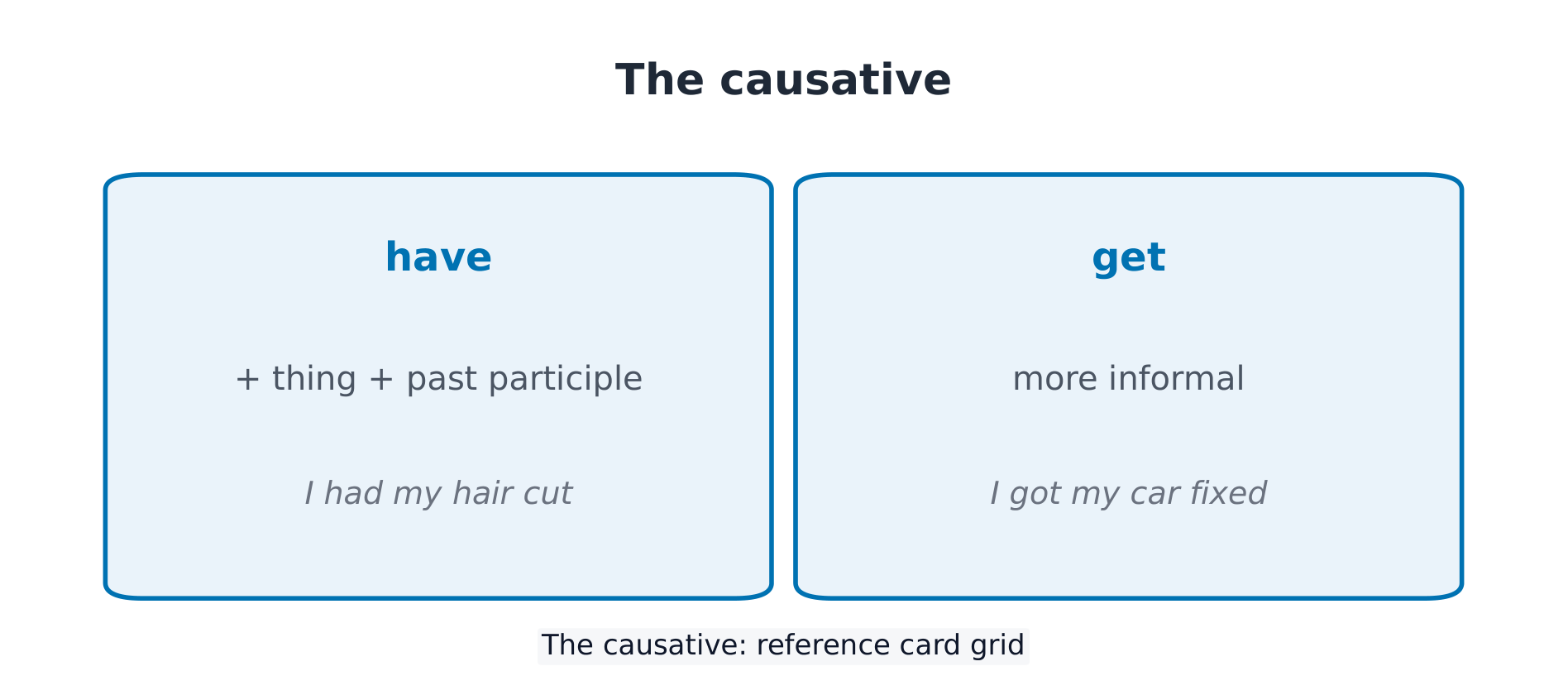
    使役结构 (the causative) 表示"让别人替你做某事",而不是自己做。

    结构: have + 宾语 + 过去分词

    I (使役)had 我的my 头发hair cut 昨天yesterday.

    我昨天(请人)剪了头发。(不是自己剪的)

    我们We (be)are (使役)having 我们的our 房子house 粉刷painted.

    我们正在(请人)粉刷房子。

    注意 注意语序:have + 东西 + 过去分词I had my car repaired.(我把车送去修了。)和 I repaired my car.(我自己修的)意思不同。

    9.2

    get something done

    get + 宾语 + 过去分词 和 have 用法基本相同,但更口语化

    I 需要need to (使役)get 我的my 手机phone 修理fixed.

    我得把手机拿去修。

    She (使役)got 她的her 照片photo taken.

    她(请人)拍了张照片。

    注意 have 和 get 在使役结构里多数情况可互换;get 语气更随意、更口语。

    常见错误

    • ❌ ~~I cut my hair yesterday.~~(其实是理发店剪的)→ ✓ I had my hair cut yesterday. — 说成主动,意思就是你自己拿剪刀剪的。
    • ❌ 语序弄反:~~I had cut my hair~~ 是过去完成时("在那之前我已剪过"),不是使役;使役是 had + 宾语 + 过去分词:I had my hair cut。
    • ❌ ~~I had my hair cutted.~~ → ✓ …cut. — 使役里的过去分词也要用对:cut–cut–cut 不变形。
    • 某个人做:have + 人 + 原形,get + 人 + to do:I'll have John fix it. / I'll get John to fix it.
  • 10 表示对比的连接词
    10.1

    although, though, even though

    对比连接词:although/despite/however

    这些连接词表示转折 / 让步("虽然……但是……")。它们后面跟一个完整的句子(主语 + 动词)。

    • although / though:虽然。even though:语气更强,"尽管"。

    虽然Although (天气it)it (过去)was 下雨raining 我们, we went 外出out.

    虽然在下雨,我们还是出门了。

    He 通过passed 尽管, even though he 没有hadn't 学习studied.

    尽管他没学习,还是通过了。

    注意 though 还能放在句末,表示"不过"(口语):It's expensive. I like it, though.

    10.2

    despite, in spite of

    despitein spite of 意思和 although 一样,但后面跟名词 / 动名词,不跟完整句子

    尽管Despite (冠词)the rain 我们, we went 外出out.

    尽管下着雨,我们还是出门了。

    尽管In spite of being tired , she 继续kept 工作working.

    尽管很累,她还是继续工作。

    注意 关键区别:although + 句子;despite / in spite of + 名词 / -ing。~~despite it was raining~~ ✗ → despite the rain ✓。

    10.3

    however, nevertheless

    howevernevertheless连接副词,连接两个句子,常放在句首并加逗号

    (它)It (过去)was expensive 然而. However 我们, we bought it.

    它很贵。然而,我们还是买了。

    注意 however 通常单独成句、用逗号隔开;别用它像 but 一样直接连接两个分句。

    常见错误

    • ❌ ~~Although it was raining, but we went out.~~ → ✓ 只留一个:Although it was raining, we went out. / It was raining, but we went out. — 中文"虽然……但是……"成对,英语只能选一边。
    • ❌ ~~Despite of the rain…~~ → ✓ despite the rain / in spite of the rain — despite 从不带 of;in spite 必须带 of;两个别杂交。
    • ❌ ~~Even he studied hard, he failed.~~ → ✓ Even though he studied hard… — even 单独不是连词,要用 even though / even if。
    • ❌ ~~It was expensive, however we bought it.~~ → ✓ It was expensive. However, we bought it.(或用分号:…expensive**; however,** we…)— however 不能像 but 一样用逗号连接两个分句。
  • 11 冠词(进阶)
    11.1

    泛指 vs 特指

    选择冠词:a/an · the · 零冠词

    到了 B2,冠词的难点在于区分泛指特指:

    • 泛指(整类事物):复数 / 不可数名词,不加 the
    • 特指(具体的那些):加 the

    老虎Tigers are 危险dangerous.

    老虎很危险。(泛指所有老虎,不加 the)

    (特指)The 老虎tigers at (冠词)the 动物园zoo are 困倦sleepy.

    动物园里的那些老虎很困。(特指,加 the)

    注意 抽象名词泛指时也不加 the:Love is important.(爱很重要。)但 the love of a mother(母爱)特指时加 the。

    11.2

    固定搭配

    很多搭配里冠词的用法是固定的,要整体记:

    • 不加冠词:go to bed / school / work,by car / bus,at home,have breakfast。
    • 加 the:in the morning,play the piano,the same,listen to the radio。

    I go (介词)to 上班work by 公交bus.

    我坐公交车上班。(go to work、by bus 都不加冠词)

    注意 这些搭配没有太多道理,当作固定短语背下来最有效。

    常见错误

    • ❌ ~~the China / the Japan~~ → ✓ China / Japan;但 ✓ the US、the UK、the Netherlands、the Philippines — 复数形式或"组织式"国名才带 the。
    • ❌ ~~Most of people agree.~~ → ✓ Most people agree. / Most of the people in this room agree. — most 直接加名词;most of 后面必须有 the / my / these 等限定。
    • 区分(英式):be in hospital(住院,当病人)vs go to the hospital(去医院那栋楼,比如探望)。in prison / at school 同理。
    • the + 形容词指一类人:The rich should help the poor.(富人应该帮助穷人。)
  • 12 强调
    12.1

    so 与 such 表强调

    强调:so / such / do

    sosuch 用来加强语气("如此……以至于……"),后面常接 that 引出结果。

    • so + 形容词 / 副词(+ that …)。
    • such + (a/an) + 形容词 + 名词(+ that …)。

    (它)It (过去)was 如此so cold 以至于that (冠词)the lake 结冰froze.

    天太冷了,湖都结冰了。

    (它)It (过去)was 如此such 一个a good 电影film 以至于that I 哭了cried.

    那电影太好了,我都哭了。

    注意 so 后面跟形容词(so cold);such 后面跟名词词组(such a good film)。

    12.2

    so do I, neither do I

    表示"我也是 / 我也不是",英语用倒装的简短结构,助动词要和前句呼应:

    • 肯定附和:So + 助动词 + 主语(So do I / So am I / So can I)。
    • 否定附和:Neither + 助动词 + 主语(Neither do I / Neither am I)。

    "I like tea." — So (助动词)do I.

    "我喜欢茶。""我也是。"

    "I can't swim." — 也不Neither (助动词)can I.

    "我不会游泳。""我也不会。"

    注意 助动词要和前句时态 / 动词一致:前句 are → So are they;前句 don't → Neither do I。

    常见错误

    • ❌ "I love this song." — ~~So am I.~~ → ✓ So do I. — 附和的助动词要和前句呼应:实义动词 → do / does / did;be → am / is;can → can。
    • ❌ "I don't like it." — ~~Me too.~~ → ✓ Me neither. / Neither do I. — 否定句的附和不能用 too。
    • ❌ "I can't swim." — ~~So can't I.~~ → ✓ Neither can I. — 否定倒装用 neither / nor 开头,不说 so + 否定。
    • 强调"真的"别再用 very + 动词:❌ ~~I very like it.~~ → ✓ I do like it. / I really like it. — 助动词 do 放在动词前就是强调。

Log in or create account

IGCSE & A-Level