Skip to content
English Grammar · A2

Present simple

  • 1 Present simple
    1.1

    Habits & Facts

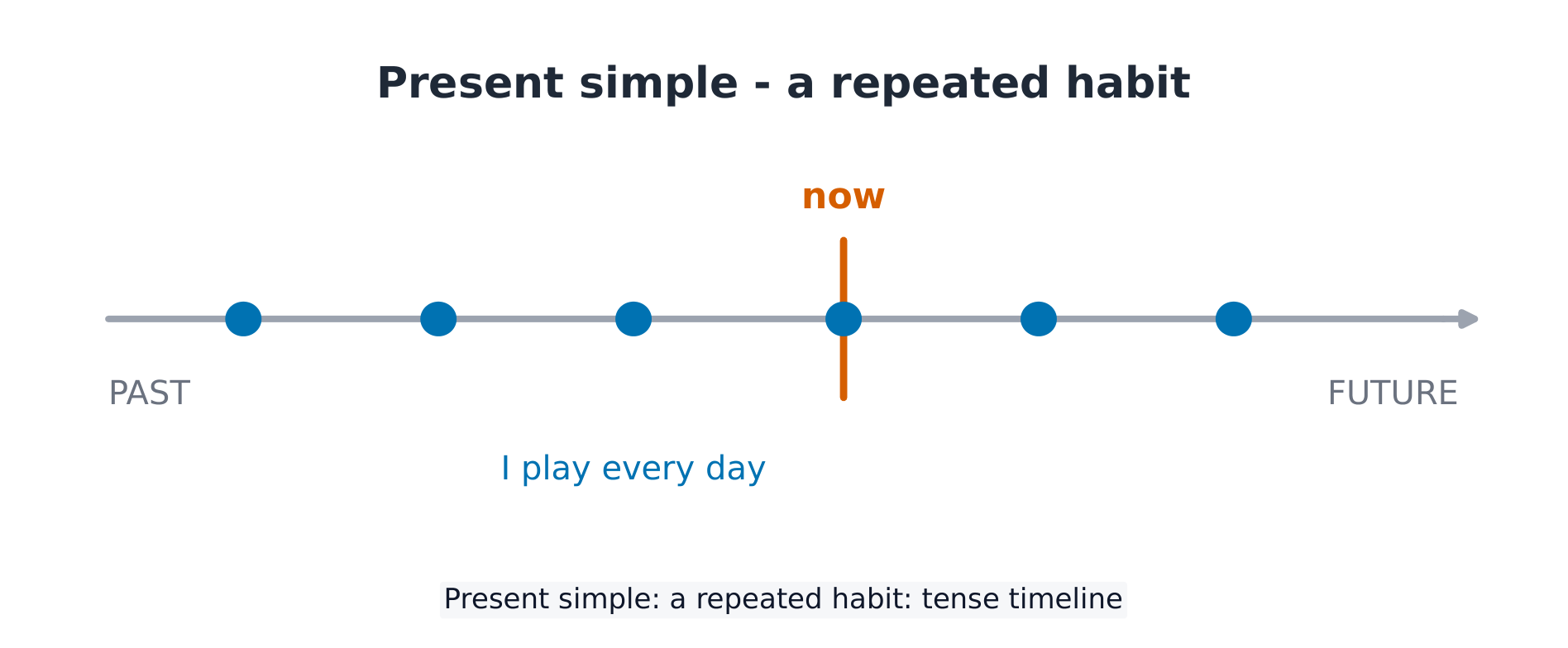
    Present Simple: Repeated habits

    The present simple tense is used to talk about things that happen regularly and facts that are always true: daily habits, schedules, scientific facts.

    Structure: 主语 + 动词原形

    我I 喝drink 咖啡coffee 每every 早上morning.

    I drink coffee every morning.

    我们We 住live 在in 上海Shanghai.

    We live in Shanghai.

    Scientific facts also use the present simple:

    水Water 沸腾boils 在at 一one 百hundred 度degrees.

    Water boils at one hundred degrees Celsius.

    It is often used with adverbs of frequency: always, usually, often, sometimes, never.

    她She 总是always 乘坐takes (冠词)the 公交车bus.

    She always takes the bus.

    Note

    • When talking about current habits, do not add a be verb: ~~I am drink coffee~~ ✗ → I drink coffee ✓.
    • Adverbs of frequency usually go before the main verb, but after the be verb: She is often late.
    1.2

    Third person singular -s

    When the subject is he / she / it (third person singular), the verb takes -s or -es.

    Structure: He / She / It + 动词 + -s

    他He 工作works 在in 一家a 银行bank.

    He works at a bank.

    我的My 姐姐sister 喜欢likes 音乐music.

    My sister likes music.

    Spelling rules:

    • Generally add -s directly: work → works, play → plays.
    • Ends in -s / -sh / -ch / -x / -o, add -es: watch → watches, go → goes.
    • Consonant letter + -y ending, change y to i and add -es: study → studies, fly → flies.

    她She 看watches 电视TV 在at 晚上night.

    She watches TV at night.

    Note

    • Only he / she / it takes -s; I / you / we / they do not take it: ~~They likes~~ ✗ → They like ✓.
    • have is special: he / she / it uses has (not ~~haves~~).
    1.3

    Negatives & questions

    For negative and interrogative forms in the Present Simple, use the auxiliary verb do / does. Use does for he / she / it, and do for other subjects.

    Negative structure: 主语 + don't / doesn't + 动词原形

    我I 不don't 吃eat 肉meat.

    I don't eat meat.

    他He 不doesn't 喜欢like 咖啡coffee.

    He doesn't like coffee.

    Interrogative structure: Do / Does + 主语 + 动词原形 ?

    (助动词)Do 你you 说speak 英语English?

    Do you speak English?

    (助动词)Does 她she 工作work 这里here?

    Does she work here?

    Short answers: Yes, I do. / No, he doesn't.

    Note

    • After using do / does, the verb returns to its base form (no longer adds -s): ~~He doesn't likes~~ ✗ → He doesn't like ✓.
    • Don't forget the auxiliary verb: in formal contexts say Do you…?, not just ~~You speak English?~~.

    Common Errors

    • ❌ ~~She don't like it.~~ → ✓ She doesn't like it. — For third-person singular negatives, use doesn't, not don't.
    • ❌ ~~Does he has a car?~~ → ✓ Does he have a car? — When using does, even has reverts to the base form have.
    • ❌ ~~Everyone know the answer.~~ → ✓ Everyone knows the answer. — everyone / everybody / nobody are treated as singular, so add -s to the verb.
    • ❌ ~~I am usually going to school by bike.~~ → ✓ I usually go to school by bike. — Repeated habits use the Present Simple, not the continuous tense.

All topics · English Grammar · A2

Log in or create account

IGCSE, A-Level & AP