Skip to content
Subjects

英语语法 · A2

  • 1 一般现在时
    1.1

    习惯与事实 (Habits & facts)

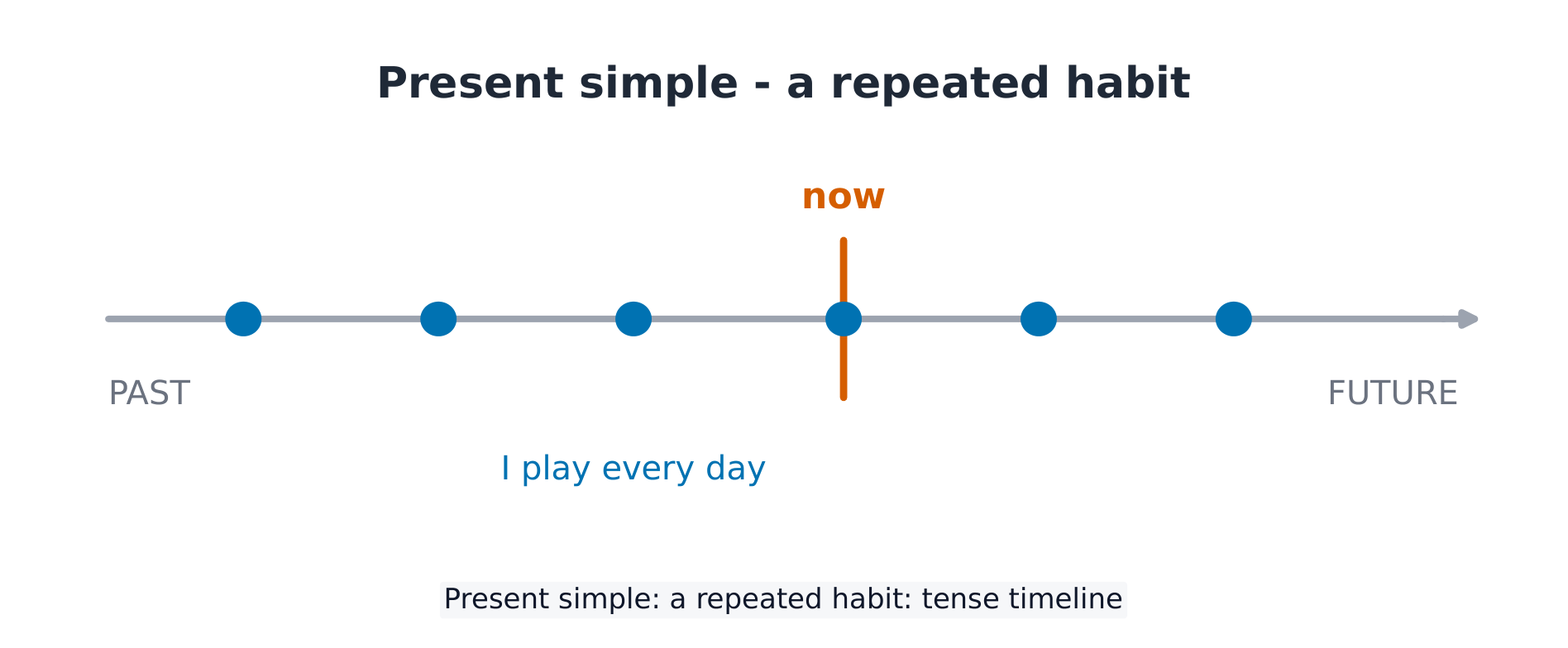
    一般现在时:反复的习惯

    一般现在时 (present simple) 用来谈论经常发生的事一直为真的事实:每天的习惯、时间表、科学常识。

    结构: 主语 + 动词原形

    I drink 咖啡coffee every 早上morning.

    我每天早上喝咖啡。

    我们We live in 上海Shanghai.

    我们住在上海。

    科学事实也用一般现在时:

    Water 沸腾boils at one hundred degrees.

    水在一百度时沸腾。

    常和频率副词 (adverbs of frequency) 一起用:always(总是)、usually(通常)、often(经常)、sometimes(有时)、never(从不)。

    She 总是always 乘坐takes (冠词)the 公交车bus.

    她总是乘公交车。

    注意

    • 谈论现在的习惯,不要加 be 动词:~~I am drink coffee~~ ✗ → I drink coffee ✓。
    • 频率副词通常放在主要动词前,但放在 be 动词:She is often late.(她经常迟到。)
    1.2

    第三人称单数 -s (Third person -s)

    当主语是 he / she / it(第三人称单数)时,动词要加 -s-es

    结构: He / She / It + 动词 + -s

    He 工作works in 一家a 银行bank.

    他在一家银行工作。

    我的My 姐姐sister 喜欢likes 音乐music.

    我姐姐喜欢音乐。

    拼写规则:

    • 一般直接加 -s:work → works,play → plays。
    • -s / -sh / -ch / -x / -o 结尾,加 -es:watch → watches,go → goes。
    • 辅音字母 + -y 结尾,把 y 变 i 再加 -es:study → studies,fly → flies。

    She watches 电视TV at 晚上night.

    她晚上看电视。

    注意

    • 只有 he / she / it 加 -s;I / you / we / they 不加:~~They likes~~ ✗ → They like ✓。
    • have 很特殊:he / she / it 用 has(不是 ~~haves~~)。
    1.3

    否定与疑问 (Negatives & questions)

    一般现在时的否定和疑问,要用助动词 do / does。he / she / it 用 does,其他主语用 do

    否定结构: 主语 + don't / doesn't + 动词原形

    I don't eat meat.

    我不吃肉。

    He doesn't 喜欢like 咖啡coffee.

    他不喜欢咖啡。

    疑问结构: Do / Does + 主语 + 动词原形 ?

    (助动词)Do you speak 英语English?

    你会说英语吗?

    (助动词)Does she 工作work 这里here?

    她在这里工作吗?

    简短回答:Yes, I do. / No, he doesn't.

    注意

    • 用了 do / does 之后,动词回到原形(不再加 -s):~~He doesn't likes~~ ✗ → He doesn't like ✓。
    • 别忘了助动词:正式场合要说 Do you…?,不能只说 ~~You speak English?~~

    常见错误

    • ❌ ~~She don't like it.~~ → ✓ She doesn't like it. — 第三人称单数的否定用 doesn't,不是 don't。
    • ❌ ~~Does he has a car?~~ → ✓ Does he have a car? — 用了 does,has 也要回到原形 have。
    • ❌ ~~Everyone know the answer.~~ → ✓ Everyone knows the answer. — everyone / everybody / nobody 都当单数,动词加 -s。
    • ❌ ~~I am usually going to school by bike.~~ → ✓ I usually go to school by bike. — 反复的习惯用一般现在时,不用进行时。
  • 2 现在进行时
    2.1

    结构 (be + V-ing)

    She is reading a book — an action happening right now.

    现在进行时 (present continuous) 表示此刻正在发生的动作。

    结构: 主语 + am / is / are + 动词-ing(I → am;he / she / it → is;you / we / they → are)

    I 正在am reading 一本a book.

    我正在读一本书。

    他们They 正在are playing 足球football.

    他们正在踢足球。

    -ing 的拼写:

    • 一般直接加 -ing:read → reading。
    • 以不发音的 -e 结尾,去 e 加 -ing:make → making,write → writing。
    • 重读闭音节(辅音 + 元音 + 辅音),双写末尾辅音:run → running,sit → sitting。

    She 正在is writing 一封an 电子邮件email.

    她正在写一封电子邮件。

    注意

    • 别忘了 be 动词:~~I reading~~ ✗ → I am reading ✓。
    • 状态动词(like、know、want、have = 拥有)一般不用进行时:~~I am knowing~~ ✗ → I know ✓。
    2.2

    现在进行时 vs 一般现在时

    两个时态都和"现在"有关,但意思不同:

    • 一般现在时:习惯、反复发生的事。
    • 现在进行时:此刻正在做的事。

    He 通常usually 步行walks to 上班work.

    他通常步行上班。(习惯 → 一般现在时)

    今天Today he 正在is 乘坐taking (冠词)the 公交车bus.

    今天他在坐公交车。(此刻 → 现在进行时)

    时间词帮你判断:

    • 一般现在时:every day、usually、often、always。
    • 现在进行时:now、right now、at the moment、today。

    注意

    • 临时的情况用进行时:She is living with her aunt this month.(这个月她暂时住在姑姑家。)
    • 长期的事实用一般现在时:She lives in Beijing.(她住在北京。)

    常见错误

    • ❌ ~~They are play football now.~~ → ✓ They are playing football now. — 有了 be,动词还要加 -ing,两样缺一不可。
    • ❌ ~~She is cooking every day.~~ → ✓ She cooks every day. — every day 是习惯的信号,用一般现在时。
    • ❌ ~~Where is Tom? — He plays football.~~ → ✓ He is playing football. — 回答"此刻在干什么"要用进行时。
    • ❌ ~~He is writeing a letter.~~ → ✓ He is writing a letter. — 以不发音 -e 结尾的动词,去 e 再加 -ing。
  • 3 一般过去时
    3.1

    规则动词 (-ed)

    一般过去时:已结束的动作

    一般过去时 (past simple) 表示过去已经结束的动作或状态。规则动词在词尾加 -ed

    结构: 主语 + 动词-ed(所有人称都一样)

    I watched 一部a 电影film 昨天yesterday.

    我昨天看了一部电影。

    我们We played 篮球basketball last week.

    我们上周打了篮球。

    -ed 的拼写:

    • 一般直接加 -ed:work → worked,play → played。
    • 以 -e 结尾,只加 -d:like → liked,live → lived。
    • 辅音 + -y 结尾,把 y 变 i 再加 -ed:study → studied,try → tried。
    • 重读闭音节,双写末尾辅音:stop → stopped,plan → planned。

    注意

    • 过去时的动词形式不随人称变化:I worked, she worked(没有 -s)。
    • 常和过去时间词连用:yesterday、last week、in 2019、two days ago。
    3.2

    不规则动词

    很多常用动词是不规则的,过去式要单独记,不加 -ed。

    I went (介词)to 北京Beijing last month.

    我上个月去了北京。

    She 看见saw 她的her 朋友friends.

    她见到了她的朋友。

    一定要背的高频不规则动词:

    • go → went,have → had,do → did,make → made
    • see → saw,come → came,get → got,take → took
    • eat → ate,buy → bought,think → thought,say → said

    我们We (吃了)had 一顿a 丰盛的big 晚餐dinner.

    我们吃了一顿丰盛的晚餐。

    注意 这些没有规律,只能多读多记。

    3.3

    否定与疑问 (did)

    过去时的否定和疑问,用助动词 did(过去式)。后面的动词回到原形

    否定结构: 主语 + didn't + 动词原形

    I 没有didn't go (介词)to 上学school.

    我没去上学。

    疑问结构: Did + 主语 + 动词原形 ?

    (助动词)Did you 看见see (冠词)the 电影film?

    你看那部电影了吗?

    简短回答:Yes, I did. / No, I didn't.

    注意

    • 用了 did / didn't,动词一定要用原形:~~I didn't went~~ ✗ → I didn't go ✓。
    • be 动词(was / were)的过去时不用 did:Were you tired?(你累了吗?)

    常见错误

    • ❌ ~~I go to Beijing last month.~~ → ✓ I went to Beijing last month. — 中文动词不变形,英语一到过去时间就必须换过去式,这是最容易带错的习惯。
    • ❌ ~~She buyed a new phone.~~ → ✓ She bought a new phone. — 不规则动词不能硬加 -ed。
    • ❌ ~~I didn't was hungry.~~ → ✓ I wasn't hungry. — be 动词的否定直接用 wasn't / weren't,不用 didn't。
    • ❌ ~~yesterday night~~ → ✓ last night — 固定说法:昨晚是 last night,不是 yesterday night(但 yesterday morning / afternoon 是对的)。
  • 4 过去进行时
    4.1

    结构 (was / were + V-ing)

    过去进行时:was / were + V-ing

    过去进行时 (past continuous) 表示过去某个时刻正在进行的动作。

    结构: 主语 + was / were + 动词-ing(I / he / she / it → was;you / we / they → were)

    At 八点eight I (过去进行)was 做饭cooking.

    八点的时候我正在做饭。

    他们They (过去进行)were watching 电视TV.

    他们当时正在看电视。

    注意

    • was 和 were 别用错:I / he / she / it 用 was;you / we / they 用 were
    • 否定:wasn't / weren't + V-ing。疑问:Was / Were + 主语 + V-ing?
    4.2

    when 与 while

    过去进行时常和一般过去时一起用,描述"一件事发生时,另一件正在进行"。

    • while + 过去进行时(较长的背景动作)。
    • when + 一般过去时(突然发生的短动作)。

    当...时While I (过去进行)was 睡觉sleeping (冠词), the 电话phone 响了rang.

    我睡觉的时候,电话响了。

    She (过去进行)was 做饭cooking 当...时when I 到达arrived.

    我到的时候她正在做饭。

    对比两个时态:

    • 正在进行的背景 → 过去进行时(was cooking)。
    • 打断它的短动作 → 一般过去时(arrived)。

    注意

    • 两个同时进行的长动作,都用过去进行时:While I was reading, she was writing.(我在看书,她在写字。)
    • when 后面也可接过去进行时,但意思会变,初学先记上面的常见搭配。

    常见错误

    • ❌ ~~I was watch TV when he called.~~ → ✓ I was watching TV when he called. — was / were 后面必须是 -ing 形式。
    • ❌ ~~They was playing games.~~ → ✓ They were playing games. — you / we / they 用 were。
    • ❌ ~~When I was arriving, she was cooking.~~ → ✓ When I arrived, she was cooking. — 到达是一瞬间的短动作,用一般过去时;长的背景动作才用进行时。
    • ❌ ~~I was knowing the answer.~~ → ✓ I knew the answer. — 状态动词(know、like、want)在过去时里同样不用进行时。
  • 5 现在完成时
    5.1

    结构 (have / has + 过去分词)

    现在完成时:连接过去与现在

    现在完成时 (present perfect) 把过去和现在联系起来:过去做过的事,对现在有影响,或者是一种经验。

    结构: 主语 + have / has + 过去分词(he / she / it → has)

    I (完成时)have 完成finished 我的my 作业homework.

    我已经做完作业了。(所以现在我有空)

    She (完成时)has 丢失lost 她的her 钥匙keys.

    她把钥匙弄丢了。(现在还没找到)

    过去分词 (past participle):

    • 规则动词 = -ed:work → worked,finish → finished。
    • 不规则要背:go → gone,see → seen,do → done,be → been,eat → eaten

    注意 完成时常不说具体时间;要说具体过去时间(yesterday、in 2019),就用一般过去时。

    5.2

    ever / never / just / already / yet

    这几个词常和现在完成时连用:

    • ever:疑问句里表示"曾经"。never:"从未"。
    • just:"刚刚"。already:"已经"。yet:用在否定 / 疑问句末,"还(没)"。

    (完成时)Have you 曾经ever 去过been (介词)to 伦敦London?

    你去过伦敦吗?

    I (完成时)have 刚刚just 吃过eaten 午饭lunch.

    我刚吃过午饭。

    He 还没hasn't 完成finished (句末"还没")yet.

    他还没做完。

    5.3

    for 与 since

    说一件事"持续了多久",用 forsince:

    • for + 一段时间:for three years(三年),for a week(一周)。
    • since + 起点:since 2020(从 2020 年起),since Monday(从周一起)。

    I (完成时)have lived 这里here (持续)for five years.

    我在这里住了五年了。(现在还住着)

    我们We (完成时)have 认识known 彼此each other 自从since 2018年2018.

    我们从 2018 年就认识了。

    注意 for 接"多长",since 接"从何时";别混用:~~for 2018~~ ✗ → since 2018 ✓。

    常见错误

    • ❌ ~~I have seen him yesterday.~~ → ✓ I saw him yesterday. — 一说出具体过去时间(yesterday、last week、in 2019),就改用一般过去时。
    • ❌ ~~I live here for ten years.~~ → ✓ I have lived here for ten years. — "住了十年、现在还住着"要用现在完成时;中文没有这个区分,特别容易漏。
    • ❌ ~~She has go home.~~ → ✓ She has gone home. — have / has 后面是过去分词,不是原形。
    • ❌ ~~Have you ever went to Beijing?~~ → ✓ Have you ever been to Beijing? — "去过某地"用 have been to。
    • 区分 gone 和 been:He has gone to Beijing.(去了,人还没回)vs He has been to Beijing.(去过,人已回来)。
  • 6 谈论将来
    6.1

    will

    将来:will / going to

    will 用来谈论将来,尤其是当场的决定预测承诺

    结构: 主语 + will + 动词原形(所有人称都一样;will not = won't)

    I will 打电话call (给你)you 今晚tonight.

    我今晚给你打电话。

    (天气it)It will 下雨rain 明天tomorrow.

    明天会下雨。

    注意

    • will 后面用动词原形:~~will to go~~ ✗ → will go ✓。
    • 否定用 won't:I won't be late.(我不会迟到。)
    6.2

    be going to

    be going to 用来谈论计划根据现状的预测

    结构: 主语 + am / is / are + going to + 动词原形

    我们We (be)are 打算going to 拜访visit 我们的our 奶奶grandma.

    我们打算去看奶奶。(已有计划)

    Look (介词)at (冠词)the clouds (天气it)! It (be)is 将要going to 下雨rain.

    看那些云!要下雨了。(有现状作依据)

    will 还是 going to?

    • 当场决定 → will:The phone is ringing. I'll get it.(电话响了,我去接。)
    • 早就计划好 → going to:I'm going to study tonight.(我今晚打算学习。)
    6.3

    现在进行时表将来计划

    现在进行时也能表示已经安排好的将来(尤其有明确时间 / 地点时)。

    结构: 主语 + am / is / are + 动词-ing + 将来时间

    I (be)am 见面meeting 汤姆Tom 明天tomorrow.

    我明天要见汤姆。(已约好)

    我们We (be)are flying to 东京Tokyo on 周五Friday.

    我们周五飞东京。(机票已订)

    注意 这种用法强调"已经安排好",和 be going to 很接近;关键是有确定的将来时间

    常见错误

    • ❌ ~~I go to Shanghai tomorrow.~~ → ✓ I am going to Shanghai tomorrow. / I will go… — 中文"我明天去上海"没有将来标记,英语必须加(will / going to / 进行时)。
    • ❌ ~~We will going to visit grandma.~~ → ✓ We are going to visit… / We will visit… — will 和 be going to 是两套,不能叠在一起。
    • ❌ ~~She will comes tomorrow.~~ → ✓ She will come tomorrow. — will 后面用原形,任何人称都不加 -s。
    • 例外:时刻表(火车、航班、课程)可以用一般现在时表将来:The train leaves at 9.(火车九点开。)
  • 7 比较级与最高级
    7.1

    比较级 (Comparatives)

    比较级 → 最高级

    比较级用来比较两样东西,常和 than(比)连用。

    短形容词 + -er;长形容词more + 形容词

    我的My bag is 更大bigger than 你的yours.

    我的包比你的大。

    This book is more 有趣interesting than 那本that one.

    这本书比那本有趣。

    构成规则:

    • 单音节:加 -er → tall → taller,fast → faster。
    • 以辅音 + y 结尾:y 变 i 加 -er → happy → happier,easy → easier。
    • 两个及以上音节:用 more → expensive → more expensive。
    • 不规则:good → better,bad → worse,far → further

    注意 不要"双重比较":~~more bigger~~ ✗ → bigger ✓。

    7.2

    最高级 (Superlatives)

    最高级表示"最……"(三者或以上),前面加 the

    短形容词 + -est;长形容词the most + 形容词

    He is (冠词)the 最高tallest in (冠词)the 班级class.

    他是班里最高的。

    This is (冠词)the most expensive 手机phone.

    这是最贵的手机。

    构成规则:

    • 单音节:the + -est → fast → the fastest。
    • 长形容词:the most → the most beautiful。
    • 不规则:good → the best,bad → the worst

    注意 最高级前别忘了 the:~~he is tallest~~ → he is the tallest。

    7.3

    as ... as

    as + 形容词 + as 表示"和……一样……"。

    She is as tall 一样as her 妈妈mother.

    她和她妈妈一样高。

    否定 not as ... as 表示"不如……":

    今天Today (是)is not as hot 一样as 昨天yesterday.

    今天没有昨天热。

    注意 中间放形容词原级(不是比较级):~~as taller as~~ ✗ → as tall as ✓。

    常见错误

    • ❌ ~~It is more cheap.~~ → ✓ It is cheaper. — 单音节形容词用 -er,不用 more。
    • ❌ ~~He is taller than me a lot.~~ → ✓ He is much taller than me. — "高很多"的"很多"是 much,放在比较级前面
    • ❌ ~~My bag is bigger than your.~~ → ✓ …bigger than yours. — than 后面用 yours / mine / hers(名词性物主代词)。
    • ❌ ~~Beijing is bigger than any city in China.~~ → ✓ …than any other city in China. — 别忘 other,否则就变成"和自己比"了。
  • 8 冠词
    8.1

    a / an

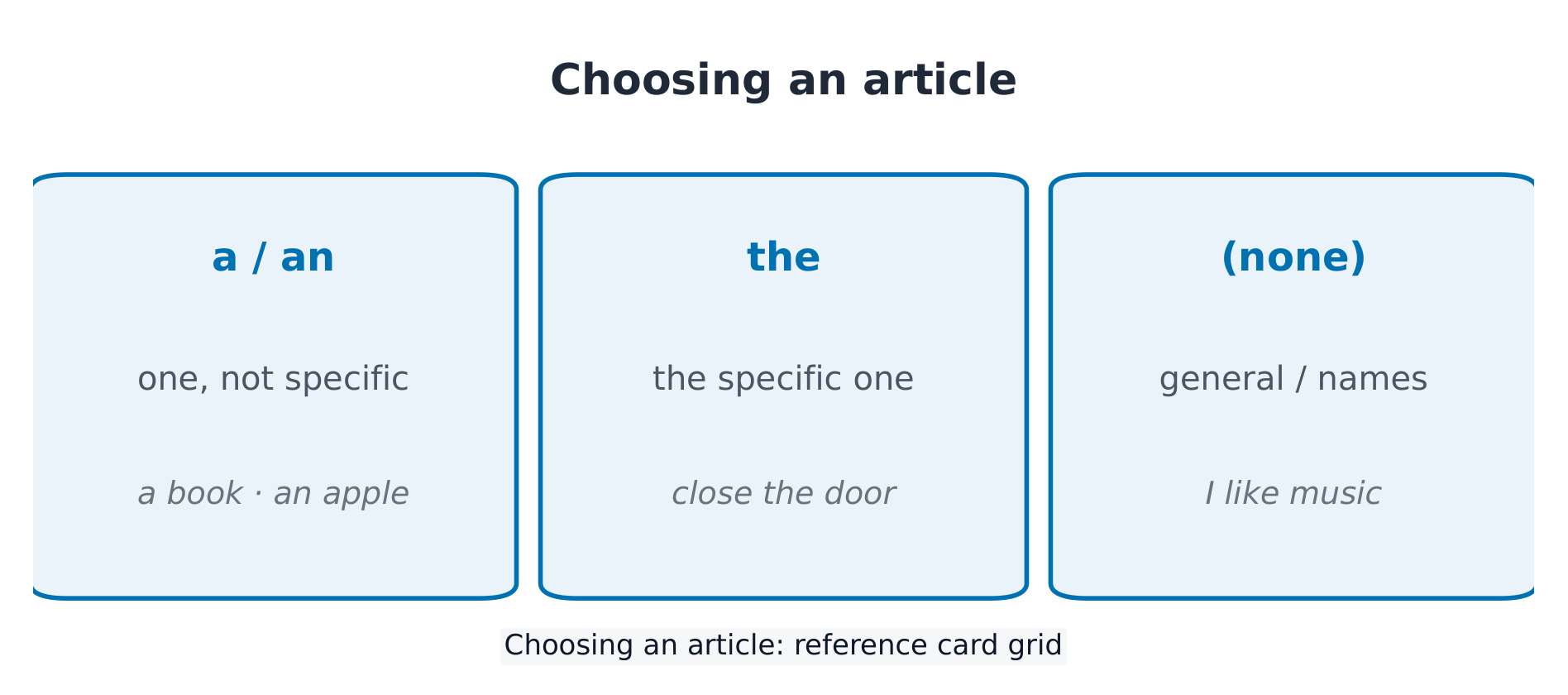
    选择冠词:a/an · the · 零冠词

    aan 是不定冠词,用在单数可数名词前,表示"一个(不特指)"。

    • a 用在辅音音前:a book,a car,a university(发 /j/ 音)。
    • an 用在元音音前:an apple,an hour(h 不发音)。

    I have 一个a 问题question.

    我有一个问题。

    She is 一名an 工程师engineer.

    她是一名工程师。

    注意读音而不是字母:an hour(h 不发音 → an),a university(发 /j/ → a)。

    8.2

    the

    the 是定冠词,表示特指——说话双方都知道是哪一个。

    Please close (这扇)the door.

    请关上(这扇)门。

    常用 the 的情况:

    • 前面提过、再次提到时:I saw a cat. The cat was black.(我看见一只猫,那只猫是黑的。)
    • 世界上独一无二的:the sun(太阳),the moon(月亮)。
    • 最高级前:the best,the tallest。

    (那个)The 太阳sun is 非常very 明亮bright 今天today.

    今天太阳很亮。

    8.3

    零冠词 (Zero article)

    有时名词前不加冠词(零冠词):

    • 复数 / 不可数名词表示泛指:I like music.(我喜欢音乐。)Cats are cute.(猫很可爱。)
    • 专有名词:人名、大多数国家、城市:China,Tom,Beijing。
    • 一些固定搭配:go to school / bed / work(表示目的,不加 the)。

    I go (介词)to 上学school by 自行车bike.

    我骑自行车上学。

    Water is 重要important.

    水很重要。

    注意 泛指复数 / 不可数名词时不加 the:~~I like the music~~(泛指时)✗ → I like music ✓。

    常见错误

    • ❌ ~~I want to be teacher.~~ → ✓ I want to be a teacher. — 职业前要加 a / an,中文"当老师"直译最容易丢。
    • ❌ ~~I went to home.~~ → ✓ I went home. — home 是副词用法:go home、get home,前面不加 to,也不加 the。
    • ❌ ~~He plays the football.~~ → ✓ He plays football. — 运动前不加 the;但乐器要加:play the piano / violin。
    • 区分:go to school(上学,目的)vs go to the school(去学校这栋楼,比如家长开会)。bed / hospital / work 同理。
  • 9 可数与不可数名词
    9.1

    可数与不可数 (Countable vs uncountable)

    可数 vs 不可数名词

    英语名词分两类:

    • 可数名词 (countable):能数,有单复数。a book → two books。
    • 不可数名词 (uncountable):不能直接数,没有复数。water,music,money,information。

    I 买了bought three 苹果apples.

    我买了三个苹果。(可数)

    I 需要need 一些some water.

    我需要一些水。(不可数,没有 ~~waters~~)

    注意

    • 不可数名词用单数动词:The news is good.(消息是好的。)
    • 想数不可数名词,要借助单位:a glass of water,a piece of information。
    9.2

    some 与 any

    可数名词:水果可以一个一个地数。

    someany 表示"一些",用在复数或不可数名词前:

    • some:用于肯定句(也用于客气的请求 / 邀请)。
    • any:用于否定句疑问句

    (有)There are 一些some 鸡蛋eggs in (冠词)the 冰箱里fridge.

    冰箱里有一些鸡蛋。

    (有)There 没有isn't 任何any 牛奶milk.

    没有牛奶了。

    (助动词)Do you have 任何any 问题questions?

    你有什么问题吗?

    注意 请别人喝东西时,常用 some 表示客气:Would you like some tea?(要喝点茶吗?)

    9.3

    much / many / a lot of

    表示"很多":

    • many + 可数复数:many books。
    • much + 不可数:much water(多用于否定 / 疑问)。
    • a lot of + 两者都行(肯定句最常用)。

    (有)There are 许多many people 这里here.

    这里有很多人。

    我们We 没有don't have 多少much 时间time.

    我们没多少时间了。

    She has 许多a lot of 朋友friends.

    她有很多朋友。

    注意 肯定句里 much 较少用,多用 a lot of:~~I have much money~~ → I have a lot of money。

    常见错误

    • ❌ ~~informations / advices / homeworks / furnitures~~ → ✓ information / advice / homework / furniture — 这些词在英语里不可数(虽然中文能说"几条建议、几件家具"),永远没有复数。
    • ❌ ~~a bread / a paper~~ → ✓ a piece of bread / a piece of paper — 不可数名词要借单位词来数。
    • ❌ ~~How much apples do you want?~~ → ✓ How many apples…? — 可数复数用 many,不可数才用 much。
    • ❌ ~~There aren't some eggs.~~ → ✓ There aren't any eggs. — 否定句里 some 换成 any。
  • 10 情态动词
    10.1

    can 与 could (能力、请求)

    情态动词:能力/建议/义务

    can 表示能力可能;could 是 can 的过去式,也用于更客气的请求。情态动词后面都跟动词原形

    I can 游泳swim.

    我会游泳。

    She could read at 四岁four.

    她四岁就会读书了。(过去的能力)

    Could you help me , please?

    请问你能帮我一下吗?(客气请求)

    注意

    • 情态动词后用原形:~~can to swim~~ ✗ → can swim ✓。
    • 否定:cannot / can't,could not / couldn't。
    10.2

    should (建议)

    should 表示建议或"应该"。

    You 应该should see 一位a 医生doctor.

    你应该去看医生。

    我们We 不应该shouldn't 浪费waste water.

    我们不该浪费水。

    注意 should 给的是建议,语气比 must 委婉;后面同样跟动词原形

    10.3

    must 与 have to (义务)

    两者都表示"必须":

    • must:多表示说话人觉得很重要,或规则。
    • have to:多表示外部要求(规定、客观需要)。

    You 必须must wear (冠词)a 安全带seatbelt.

    你必须系安全带。

    I 不得不have to 起床get up early.

    我得早起。

    注意

    • mustn't = "禁止":You mustn't smoke here.(这里禁止吸烟。)
    • don't have to = "不必":You don't have to come.(你不用来。)
    • 注意两者意思完全不同:一个是"禁止",一个是"不必"。

    常见错误

    • ❌ ~~You must to wear a helmet.~~ → ✓ You must wear a helmet. — 所有情态动词(can / could / should / must)后面直接跟原形,永远不加 to。
    • ❌ ~~She musts study harder.~~ → ✓ She must study harder. — 情态动词没有第三人称 -s。
    • ❌ 想说"你不必来"却说 ~~You mustn't come.~~ → ✓ You don't have to come. — mustn't 是"禁止",don't have to 才是"不必",意思正好相反。
    • ❌ ~~Yesterday I must work late.~~ → ✓ Yesterday I had to work late. — must 没有过去式,过去的义务用 had to。
  • 11 介词
    11.1

    时间介词 (at / in / on)

    时间介词:at / on / in

    表示时间时,at / in / on 各有分工:

    • at + 具体时刻 / 节点:at 7 o'clock,at night,at the weekend。
    • on + 具体某天 / 日期:on Monday,on May 1st,on my birthday。
    • in + 较长时间段:in the morning,in July,in 2020,in winter。

    (冠词)The class 开始starts at 九点nine.

    这节课九点开始。

    我们We 见面met on 周五Friday.

    我们周五见的面。

    我的My 生日birthday is in 五月May.

    我的生日在五月。

    注意 范围由小到大:at(点)→ on(天)→ in(月 / 年 / 段)。

    11.2

    地点介词 (at / in / on)

    表示地点时:

    • at + 某一点 / 场所:at the bus stop,at home,at school。
    • in + 空间内部:in the room,in China,in a box。
    • on + 表面 / 线上:on the table,on the wall,on the second floor。

    She is (在)at home.

    她在家。

    (冠词)The book is on (冠词)the 桌子上table.

    书在桌子上。

    (有)There are fish in (冠词)the 河里river.

    河里有鱼。

    11.3

    移动介词 (Prepositions of movement)

    表示方向 / 移动:

    • to:朝向某地。into:进入里面。out of:从里面出来。
    • up(向上)/ down(向下)/ across(穿过)/ through(穿越内部)。

    I go to 上班work by 公交车bus.

    我坐公交车上班。

    (冠词)The cat jumped 进入into (冠词)the 箱子box.

    猫跳进了箱子里。

    注意 to 表示"去某地",别和 at(在某地)弄混:go to school(去学校)vs be at school(在学校)。

    常见错误

    • ❌ ~~in Monday~~ → ✓ on Monday;❌ ~~at July~~ → ✓ in July — 具体某天用 on,月份 / 年份用 in。
    • ❌ ~~in the morning of Monday~~ → ✓ on Monday morning — 说到具体某天的早上 / 晚上,介词升级成 on。
    • ❌ ~~I arrived to Beijing.~~ → ✓ I arrived in Beijing. / I arrived at the station. — arrive 不接 to;大地方用 in,小地点用 at。
    • ❌ ~~listen music / look the picture / wait him~~ → ✓ listen to music / look at the picture / wait for him — 中文这些动词不带介词,英语的介词不能丢。
  • 12 连接句子
    12.1

    and / but / or / so / because

    连接词:连接想法

    连词把两个想法连起来:

    • and(和):并列、相加。but(但是):转折、相反。
    • or(或者):选择。so(所以):结果。because(因为):原因。

    I (过去)was tired 所以, so I went (介词)to 睡觉bed.

    我累了,所以去睡觉了。

    She 留在stayed home 因为because (天气it)it (过去)was 下雨raining.

    她待在家里,因为在下雨。

    注意 so 引出结果,because 引出原因;别用反了:累了 → so 去睡;睡了 → because 累。

    12.2

    零条件句与第一条件句

    条件句讲"如果……就……":

    • 零条件句(普遍事实):If + 一般现在时, 一般现在时
    • 第一条件句(将来可能):If + 一般现在时, will + 动词原形

    如果If you 加热heat ice (它), it 融化melts.

    如果你加热冰,它就会化。(普遍事实 → 零条件句)

    如果If (天气it)it 下雨rains 我们, we will stay home.

    如果下雨,我们就待在家。(将来可能 → 第一条件句)

    注意 if 引导的句子里用一般现在时,即使讲将来:~~If it will rain~~ ✗ → If it rains ✓。

    12.3

    频率副词 (Adverbs of frequency)

    频率副词表示"多久一次":always(100%)> usually > often > sometimes > rarely > never(0%)。

    位置规则:

    • 放在主要动词前面
    • 但放在 be 动词后面

    I 总是always brush 我的my teeth.

    我总是刷牙。(实义动词前)

    He (be)is 从不never 迟到late.

    他从不迟到。(be 动词后)

    注意 频率副词在实义动词、be 动词:I often read;She is often busy。

    常见错误

    • ❌ ~~Because it was raining, so we stayed home.~~ → ✓ Because it was raining, we stayed home. / It was raining, so we stayed home. — 中文"因为……所以……"成对出现,英语 because 和 so 只能留一个
    • ❌ ~~Although he is rich, but he is not happy.~~ → ✓ Although he is rich, he is not happy. — 同理,"虽然……但是……"里 although 和 but 也只能选一个。
    • ❌ ~~I like apples and I like bananas and I like oranges.~~ → ✓ I like apples, bananas and oranges. — 并列多项用逗号隔开,最后一项前才用 and。
    • ❌ ~~I play sometimes football.~~ → ✓ I sometimes play football. / I play football sometimes. — 副词不能插在动词和宾语中间。

Log in or create account

IGCSE & A-Level