
Scope and prerequisites
IB classical languages first assessment 2024; Latin focus. This supplementary reference covers only the outcomes listed below. Your school's text choices, the full guide's procedures and any required live or recorded performance are handled separately.
- Use cases and agreement to identify grammatical roles
- Translate meaning accurately before refining English expression
Prerequisites: Subject and object in English; basic present-tense verb endings.
Explain and choose the method
Puella is nominative singular and acts as subject; poetam is accusative singular and acts as object. Laudat is third-person singular present.

Inflection carries grammatical information: first identify the finite verb 限定动词, then its subject and complements.
Latin case 格 shows a noun's role. With these first-declension forms, -a is nominative singular and -am accusative singular. Use the supplied vocabulary: puella (girl), poeta (poet), fabula (story); laudat (praises), legit (reads), audit (hears). “Poetam puella laudat” has object poetam and subject puella: the girl praises the poet. “Poeta puellam laudat” reverses the roles: the poet praises the girl. Poeta is masculine despite its -a ending. First find the finite verb , then nouns agreeing with its number and the required cases. Do not apply these endings to every declension.
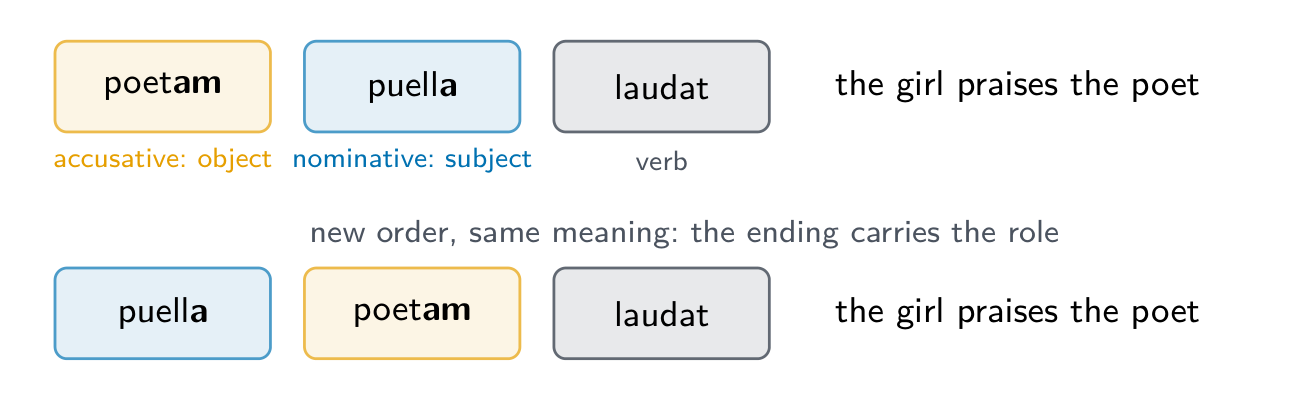
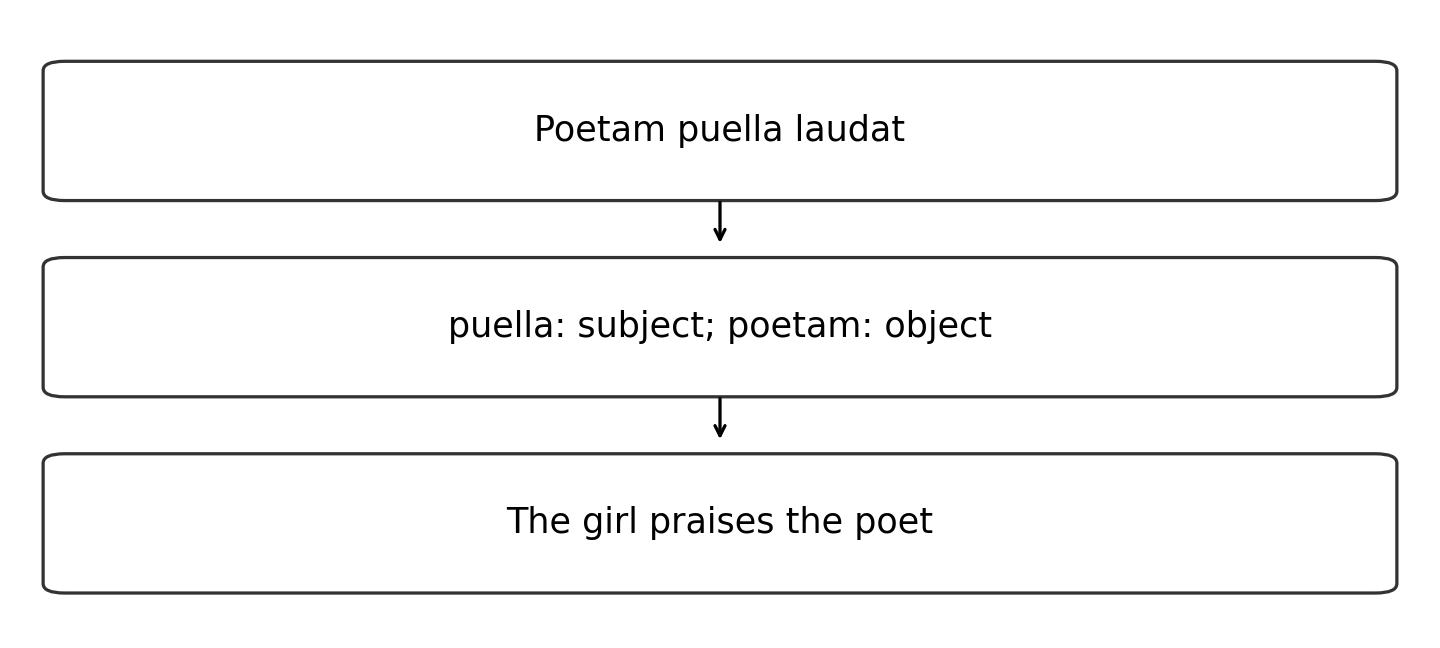
Worked example. Poetam puella laudat keeps the same grammatical roles despite the new order. Translate as the girl praises the poet, then consider whether the changed position gives emphasis in a real passage.
Practice material
Latin mini-passage. Puella fabulam legit. Poeta puellam audit. Puella poetam laudat. Poeta fabulam laudat. Vocabulary is supplied in the worked section. All four verbs are third-person singular present. No historical setting or emphasis is stipulated.
Practice with reasoning
Practice 1
Translate every sentence, identifying each subject and object.
Reasoning. The girl reads the story (puella subject, fabulam object). The poet hears the girl (poeta subject, puellam object). The girl praises the poet (puella subject, poetam object). The poet praises the story (poeta subject, fabulam object). Retain all four relationships rather than making the first noun an automatic subject.
Practice 2
Translate “Fabulam poeta legit”. Explain what changes and what does not if the order becomes “Poeta fabulam legit”.
Reasoning. Both mean “The poet reads the story”. Nominative poeta and accusative fabulam retain their roles. Word order may influence emphasis in a fuller context, but no specific emphatic effect can be certified from this isolated exercise.
Practice 3
A student translates “Poeta puellam audit” as “The girl hears the poet”. Diagnose and correct the error, then explain why poeta is not evidence 证据 that every -a noun is feminine.
Reasoning. The student reversed grammatical roles. Poeta is nominative subject, puellam accusative object, so “The poet hears the girl”. Poeta is a masculine first-declension noun; grammatical gender must be learned with the noun, not inferred universally from the ending.
Limits and next use
Do not assume the first noun is the subject or invent a pronoun not implied by the verb. A dictionary entry is a starting point; case, number, tense and context determine the actual meaning.
These are original practice tasks written for this course, not official exam questions.
Vocabulary card meanings
case: A grammatical category showing a noun or pronoun's job in the sentence, not merely an ending.
declension: The family of forms a noun takes through its cases; first declension is the -a / -am pattern used here.
grammatical gender: A noun's fixed class — poeta is masculine despite its -a — learned with the noun, never inferred from the ending.
agreement: The matching of adjective to noun in case, number and gender, and of verb to subject in number and person.
nominative: The case of the subject — the doer whose number the finite verb must match.
accusative: The case of the direct object — the receiver of the action, marked -am in this declension.
finite verb: The verb form carrying person, number and tense; find it first, then read the nouns against its number.