An aqueous salt solution can produce different electrode products from the molten salt. Water introduces competing species into the system.
English narration · English + 中文 subtitles burned in
20.1
Scope and prerequisites
This handout teaches Reactivity 3.2, Electron transfer reactions, for the course first assessed in 2025. Sections marked AHL are for Higher Level only.
Prerequisites: ions and ionic formulas from Structure 2.1, alcohols and other functional groups from Structure 3.2, and amounts in moles from Structure 1.4. Numerical examples use supplied classroom data. Use the stated conditions rather than assuming every predicted reaction must be rapid or observable.
20.2
Oxidation and reduction
What do rusting, batteries and breathalysers share?
An iron nail rusts, a phone battery powers a screen, and a traditional chemical breath-test example uses an orange-to-green dichromate change. Modern instruments need not use that reaction. Redox involves electron transfer or a change in formal oxidation states; covalent reactions need not release free electrons into the solution. These are redox reactions: reduction and oxidation always happen together.
Rusting is the oxidation of iron by oxygen.Electrons pass from the substance that is oxidised (loses them) to the one that is reduced (gains them) — the two always happen together
Electrons and oxidation states
Oxidation 氧化 is loss of electrons, or an increase in oxidation state.
Reduction 还原 is gain of electrons, or a decrease in oxidation state.
Up the ladder is oxidation (electrons lost); down is reduction (electrons gained)
A memory aid: OIL RIG, "oxidation is loss, reduction is gain" of electrons.
The oxidation state 氧化态 of an atom is the charge it would have if all its bonds were ionic. Use these rules in order:
An element on its own is 0 ($\text{Fe}$, $\text{O}_2$, $\text{Cl}_2$).
A simple ion has its charge ($\text{Na}^+$ is +1, $\text{O}^{2-}$ is $-2$).
The oxidation states in a compound add up to 0; in an ion they add up to the charge.
F is $-1$ in its compounds; elemental F₂ follows rule 1. O is usually $-2$ (but $-1$ in peroxides). H is usually +1 (but $-1$ in metal hydrides such as NaH).
Worked example. Find the oxidation state of Mn in $\text{MnO}_4^-$ and of Cr in $\text{Cr}_2\text{O}_7^{2-}$.
$\text{MnO}_4^-$: $x + 4(-2) = -1$, so $x = +7$.
$\text{Cr}_2\text{O}_7^{2-}$: $2x + 7(-2) = -2$, so $2x = +12$ and $x = +6$.
Oxidation states are written with the sign first (+7), and they appear in names as Roman numerals: manganate(VII), dichromate(VI), iron(III) chloride.
Oxidation state is a formal electron-accounting model, not necessarily the actual atomic charge. In H₂O the hydrogen oxidation state is +1, but the molecule does not contain two free H⁺ ions bonded to an O²⁻ ion. For a non-metal with several atoms in different environments, a formula can give an average rather than every atom’s individual state.
Oxygen gain and hydrogen loss often indicate oxidation; oxygen loss and hydrogen gain often indicate reduction. The electron/oxidation-state definition is more general. Carbon has oxidation states −4, −2, 0, +2 and +4 respectively in CH₄, CH₃OH, HCHO, HCOOH and CO₂. This connects organic functional-group changes to the same accounting used for metal ions. FeCl₂ and FeCl₃ contain iron(II) and iron(III); sulfur has +4 in SO₂ and +6 in SO₄²⁻. Do not assume main-group non-metals have only one oxidation state.
Oxidizing and reducing agents
An oxidizing agent 氧化剂 oxidizes another substance, so it is itself reduced. It gains electrons.
A reducing agent 还原剂 reduces another substance, so it is itself oxidized. It loses electrons.
In $\text{Zn} + \text{Cu}^{2+} \rightarrow \text{Zn}^{2+} + \text{Cu}$, zinc is oxidized (0 to +2) and is the reducing agent; $\text{Cu}^{2+}$ is reduced (+2 to 0) and is the oxidizing agent.
Balancing a half-equation in acid: atoms, then O with water, H with H⁺, charge with electrons
Combining half-equations
Multiply the half-equations so the electrons lost equal the electrons gained, then add them and cancel. With iron(II), $\text{Fe}^{2+} \rightarrow \text{Fe}^{3+} + \text{e}^-$, multiply by 5:
Check: the charges are equal on both sides (+17 and +17).
Half-equations when the medium is not acidic
Do not leave a large net supply of H⁺ in an equation intended for neutral or alkaline conditions. An oxygen-reduction example is:
Rewrite a half-equation for neutral or alkaline conditions
$$\mathrm{O_2+2H_2O+4e^-\rightarrow4OH^-}.$$
Atoms balance (O₄H₄ on each side) and charge is −4 on each side. It can be obtained from O₂ + 4H⁺ + 4e⁻ → 2H₂O by adding 4OH⁻ to both sides, forming water and cancelling. Calling the starting bulk solution neutral does not mean local pH stays seven: electrode reactions can produce OH⁻ or H⁺ nearby.
For the supplied neutral/alkaline reduction product MnO₂, the half-equation is MnO₄⁻ + 2H₂O + 3e⁻ → MnO₂ + 4OH⁻. The same element can have a different reduction product in a different medium. State the product and conditions before balancing. When adding half-equations, cancel electrons completely; they cannot remain in the final overall equation for a closed redox reaction.
In an acidified manganate(VII)/iron(II) titration, purple MnO₄⁻ is consumed while Fe²⁺ remains. A small excess gives a persistent faint colour, so the reagent can act as its own indicator. This is an observed endpoint, not a new definition of equivalence. Such demonstrations follow the school’s approved procedure.
Explore
Two electrons per copper ion, at either cathode
Reducing 0.050 mol Cu²⁺ to copper requires 0.100 mol electrons. Track copper and electron amounts, then compare cathode signs while keeping reduction and the 2:1 ratio unchanged.
Metals react by losing electrons, so a more reactive metal is a stronger reducing agent. Use supplied displacement observations to infer an activity series 活动性顺序 for the metals being compared. A subset is Mg > Zn > Fe > Cu > Ag. The syllabus supplies appropriate metal/ion data; a long memorized list is not a substitute for interpreting them.
An activity series: a metal higher in the list is more easily oxidized and can displace a metal below it from a solution of its ions
A metal displaces a less active metal from a solution of its ions. In this displacement 置换 reaction the more active metal is oxidized:
The blue colour fades and a brown-pink coating of copper forms on the zinc. Copper does not displace zinc from zinc sulfate under this simple aqueous model. A protective oxide film or slow kinetics can hide a thermodynamically favoured change; no visible reaction alone is not a universal proof of relative potential.
Halogens
Halogens react by gaining electrons, so they are oxidizing agents. Their strength falls down the group: $\text{Cl}_2 > \text{Br}_2 > \text{I}_2$. A halogen displaces a less reactive halogen from its halide ions:
Formation of dissolved bromine gives an orange/yellow-brown colour under the stated aqueous conditions. Colour intensity also depends on concentration and solvent. Down group 17, halogens generally become less readily reduced; the halide ions show the opposite trend as reducing agents. In main-group metals, electron loss generally becomes easier down a group, but observed water-reaction rates and aqueous standard potentials are not identical rankings.
Metals and acids
Suitable reactive metals with dilute non-oxidizing acids such as HCl or dilute H₂SO₄ can form a salt and hydrogen. Oxide passivation and kinetics can affect the observation; oxidizing acids such as nitric acid need separate predictions. The metal is oxidized and $\text{H}^+$ is reduced:
When zinc directly contacts copper(II) sulfate, the coupled redox reaction releases energy largely as heat rather than useful electrical work. A voltaic cell separates the half-reactions and provides an external conducting path: chemical energy can supply electrical work. A primary cell 一次电池 is designed for discharge without routine recharging; a rechargeable secondary cell is also voltaic while discharging.
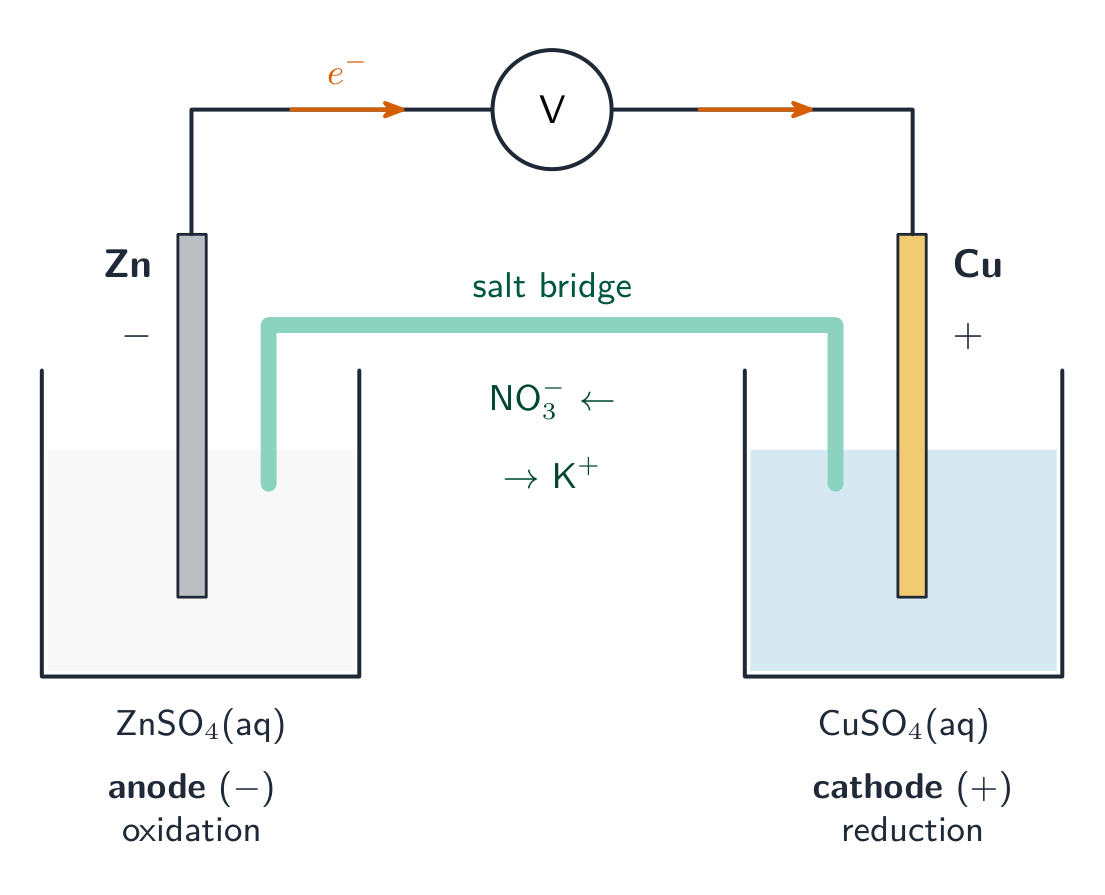
A battery uses redox reactions to push electrons round a circuit.A simple cell: two half-cells joined by a salt bridge, with a voltmeter. Electrons flow from the negative (Zn) electrode to the positive (Cu)Electrons flow through the wire from the anode to the cathode
At the anode 阳极, oxidation happens: $\text{Zn} \rightarrow \text{Zn}^{2+} + 2\text{e}^-$. In a primary cell the anode is the negative electrode.
At the cathode 阴极, reduction happens: $\text{Cu}^{2+} + 2\text{e}^- \rightarrow \text{Cu}$. In a primary cell the cathode is the positive electrode.
Electrons flow through the external wire from anode to cathode.
The salt bridge 盐桥, for example filter paper soaked in $\text{KNO}_3(\text{aq})$, lets ions move between the solutions. Without it, charge builds up and the current stops. In this Zn/Cu cell, nitrate anions move towards the zinc compartment as Zn²⁺ accumulates; potassium cations move towards the copper compartment as Cu²⁺ is removed. This maintains approximate bulk electrical neutrality, not necessarily pH seven. Electrons travel in the external metallic path, not through the salt bridge. Choose bridge ions that do not significantly react with either solution.
For the simple metal/metal-ion displacement cells here, the more readily oxidized metal is the anode under the stated conditions. A ranking alone does not give a numerical voltage or make an equal number of list positions correspond to equal voltage intervals. A high-resistance voltmeter measures the potential difference with very little current; appreciable energy delivery requires a conducting load. During sustained Zn/Cu discharge, zinc loses mass, copper gains mass and Cu²⁺ concentration decreases in the simple model.
Secondary cells
A secondary cell 二次电池 is rechargeable. During discharge it operates in voltaic mode; its rechargeable design does not change it into a primary cell. To recharge it, an external supply pushes current the other way and reverses the reactions.
Cell
Used in
Note
lead–acid
cars
heavy; lead is toxic; sulfuric acid is corrosive
lithium-ion
phones, laptops, electric cars
light, stores a lot of energy; $\text{Li}^+$ ions move between the electrodes
nickel–metal hydride
rechargeable AA cells
energy density and performance depend on the particular design
A fuel cell 燃料电池 is different: it is fed continuously with fuel (such as hydrogen) and oxygen, so it is not recharged. The ideal hydrogen/oxygen cell’s net chemical product is water; the source of the hydrogen and electricity used to produce it still affects wider environmental impacts.
Reverse a supplied secondary-cell reaction
For a lead–acid discharge model:
A lead-acid cell: discharge and charge are the same equation reversed
Charging reverses that overall equation. Reversing each supplied half-equation swaps its electrons between reactant and product sides. Oxidation still defines the anode in each operating mode; the physical electrode undergoing oxidation changes when the reaction is reversed. An external charging source must provide a suitable potential and practical energy losses are unavoidable. Do not infer that every primary-cell chemistry can be recharged safely simply because a balanced equation can be reversed on paper.
Primary cells are convenient without charging equipment but need replacement after their useful discharge. Secondary cells can reduce repeated replacement and be used for many cycles, but require charging infrastructure and deteriorate. Fuel cells continue while reactants are supplied, but need fuel storage, delivery and suitable catalysts. Compare the actual application rather than assigning an unconditional “safest” or “best” label to every battery type.
For an ideal acidic hydrogen fuel cell, anode 2H₂ → 4H⁺ + 4e⁻ and cathode O₂ + 4H⁺ + 4e⁻ → 2H₂O combine to 2H₂ + O₂ → 2H₂O. Hydrogen is oxidized, oxygen reduced; external electrons flow from fuel anode to oxygen cathode. An alkaline version uses different half-equations but has the same net equation.
An electrolytic cell 电解池 uses electrical energy to drive a redox reaction that would not happen on its own. This is electrolysis 电解. The electrolyte 电解质 must contain mobile ions. In the molten/aqueous examples studied here, melting or dissolving allows ion migration; other technologies can use ion-conducting membranes or solids.
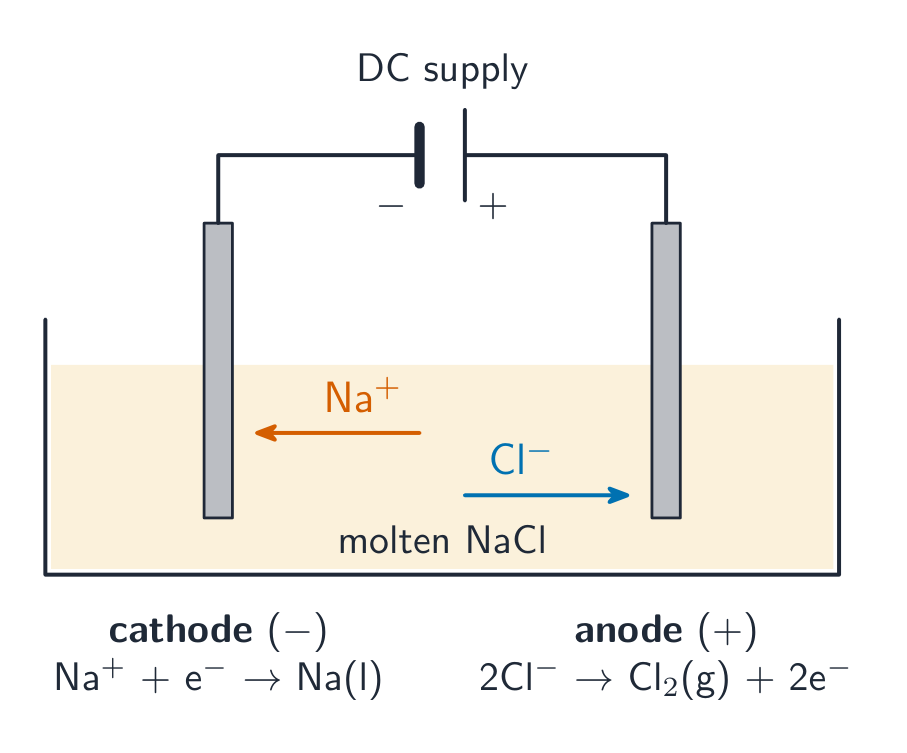
In electrolysis the cathode is negative and the anode positive
The names follow the same rule as in every cell: oxidation at the anode, reduction at the cathode. But the signs are reversed: in an electrolytic cell the cathode is negative because the power supply pushes electrons onto it.
Molten lead(II) bromide gives lead at the cathode and bromine at the anode. Electrons travel through the wires and power supply; ions carry charge through the electrolyte. Individual Na⁺ and Cl⁻ ions do not carry electrons across the liquid as free electronic charge carriers. Predict products on paper; chlorine and bromine demonstrations remain teacher-controlled under the school procedure.
Predict products and use an approved setup
A molten salt contains its own ions. In an aqueous electrolyte, water-related species also compete: hydrogen or oxygen may form instead of a metal or halogen. Specify the electrolyte, its concentration and the electrode material before predicting products; an electrode can itself react. For example, CuSO₄(aq) with an inert anode gives oxygen there, whereas a copper anode can dissolve to Cu²⁺.
Electrolysis: the DC supply drives positive ions to the cathode (reduction) and negative ions to the anode (oxidation)
Use a low-voltage direct-current supply and approved electrodes under the school risk assessment. Collect gases only by an approved method. Chlorine and bromine demonstrations remain teacher-controlled; do not generate these gases independently.
The required syllabus focus is functional-group changes, equations, distillation/reflux and the role of hydride ions. The named reagents below give useful laboratory examples; memorizing particular oxidizing/reducing reagent names and their mechanisms is not required for these objectives.
Oxidation of alcohols
The usual oxidizing agent is acidified potassium dichromate(VI). It changes from orange ($\text{Cr}_2\text{O}_7^{2-}$) to green ($\text{Cr}^{3+}$) as it oxidizes the alcohol. In equations we write [O] for the oxygen it supplies.
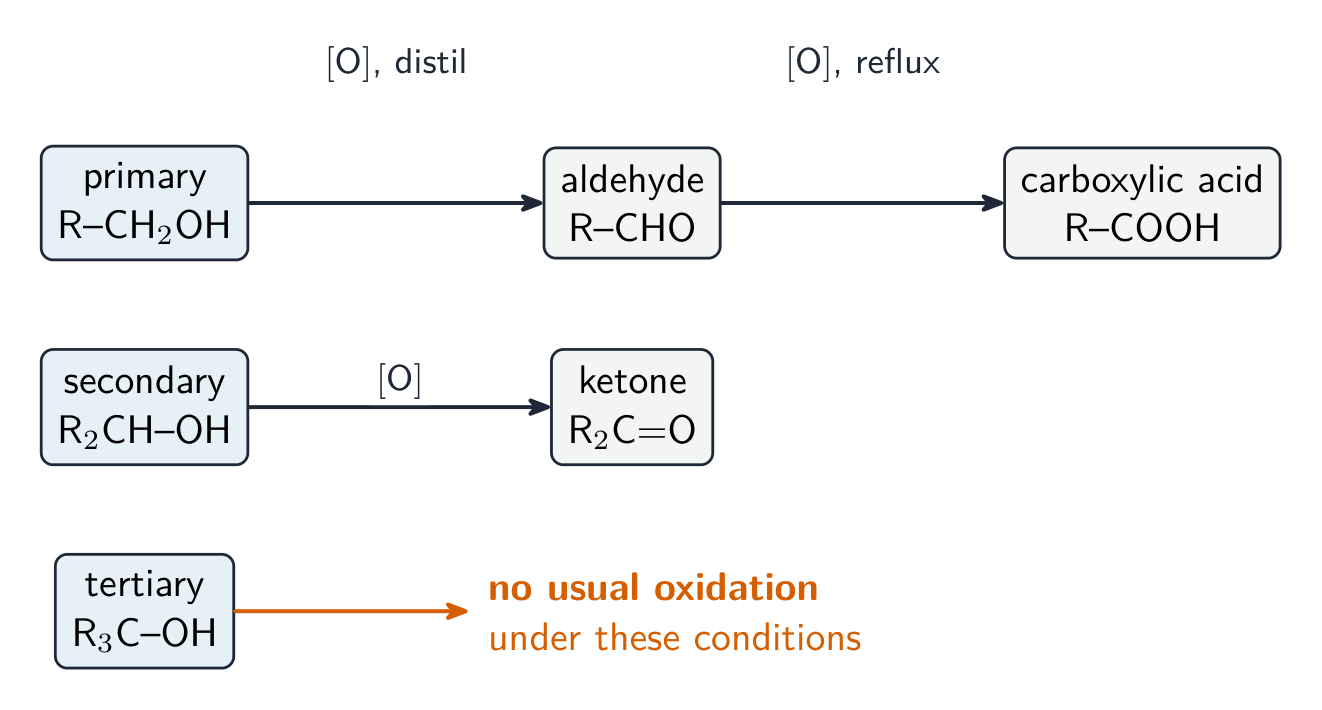
What an alcohol oxidizes to depends on its class
A primary alcohol gives an aldehyde. To stop there, distillation 蒸馏 removes the aldehyde as soon as it forms: $\text{CH}_3\text{CH}_2\text{OH} + [\text{O}] \rightarrow \text{CH}_3\text{CHO} + \text{H}_2\text{O}$.
Heating under reflux 回流 keeps the aldehyde in the flask, so it is oxidized further to a carboxylic acid: $\text{CH}_3\text{CH}_2\text{OH} + 2[\text{O}] \rightarrow \text{CH}_3\text{COOH} + \text{H}_2\text{O}$.
A secondary alcohol gives a ketone: propan-2-ol gives propanone.
A tertiary alcohol has no H on its C–OH carbon, so it is not oxidized by the usual mild alcohol-oxidation conditions. Harsh oxidation can break carbon–carbon bonds; “never oxidized” is too broad. In the stated dichromate test it does not give the usual orange-to-green alcohol reaction.
Distillation directs vapour through a condenser into a separate receiver, removing the more volatile aldehyde as it forms under suitable controlled conditions. Reflux uses a vertical condenser to return condensed vapour to the same flask, allowing sustained heating with excess oxidant for the acid product. Neither arrangement is a sealed pressure vessel; cooling water enters the condenser at the lower connection and leaves at the upper one. “Heat” alone does not specify which product is being collected.
Reduction of carbonyl compounds
Reducing reagents can transfer hydride, H⁻: a hydrogen nucleus with two electrons. In a simple aldehyde/ketone reduction, hydride supplies an electron pair to the electron-deficient carbonyl carbon; subsequent protonation gives an alcohol. This is not adding bare H⁺ alone or transferring a single radical electron. The [H] notation below is a stoichiometric reducing equivalent, not an assertion that free hydrogen atoms are bottled reagents.
Which reducing agent, which alcohol
A carboxylic acid is reduced to a primary alcohol by lithium aluminium hydride, $\text{LiAlH}_4$, in dry ether. The aldehyde forms on the way but cannot be isolated.
An aldehyde is reduced to a primary alcohol, and a ketone to a secondary alcohol, by sodium borohydride, $\text{NaBH}_4$, or by $\text{LiAlH}_4$.
For example, CH₃COOH + 2[H] → CH₃CHO + H₂O and CH₃CHO + 2[H] → CH₃CH₂OH sum to CH₃COOH + 4[H] → CH₃CH₂OH + H₂O. Count four reducing hydrogen equivalents for acid-to-alcohol, versus two for aldehyde/ketone-to-alcohol.
Hydrogenation
Hydrogenation 氢化 adds hydrogen across a C=C or C≡C bond, using an appropriate metal catalyst and stated conditions. A common classroom example uses nickel with heating; exact conditions depend on the substrate and catalyst. An alkyne gives an alkene and then an alkane:
Hydrogenation can make oils more saturated and raise their melting range. Partial hydrogenation can also produce mixtures and cis/trans changes; there is no universal one-step product for every oil. One H₂ equivalent removes one degree of unsaturation: an alkyne requires two H₂ equivalents for complete conversion to the alkane. An alkene need not be cleanly isolated during an unrestricted alkyne hydrogenation.
This extension uses standard Gibbs energy from Reactivity 1.4 and reduction-potential data from the booklet.
The standard hydrogen electrode
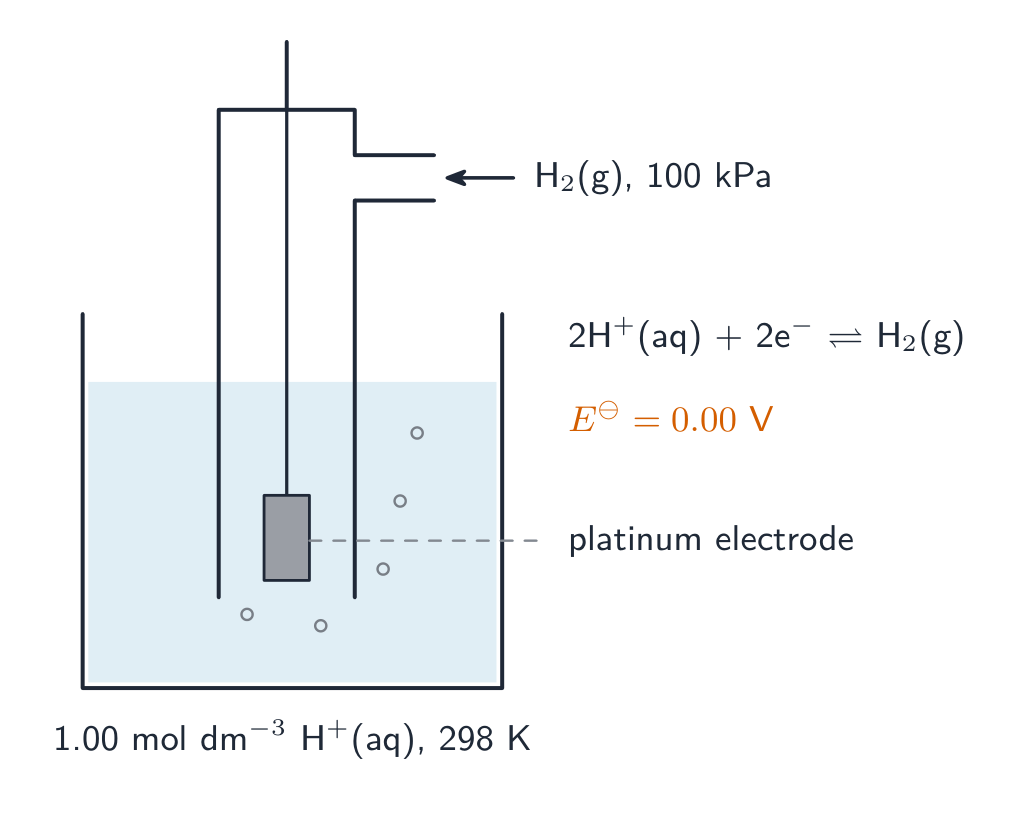
We cannot measure the potential of one half-cell on its own, only the difference between two. So every half-cell is measured against one reference: the standard hydrogen electrode 标准氢电极, which is defined as 0.00 V.
The reference half-cell: hydrogen gas over platinum in 1.00 mol dm⁻³ acid
The standard electrode potential 标准电极电势, $E^{\ominus}$, of a half-cell is the voltage it gives when joined to the standard hydrogen electrode at a specified temperature with standard activities and gas pressure 100 kPa. Booklet examples commonly use 298 K and approximate unit ionic activities by concentrations of 1.00 mol dm⁻³; actual activities can differ from raw concentrations. Pure solids have unit activity. Standard state does not mean every measurement at any temperature must equal the 298 K tabulated number. Values are listed as reductions, in the data booklet.
Reading the series
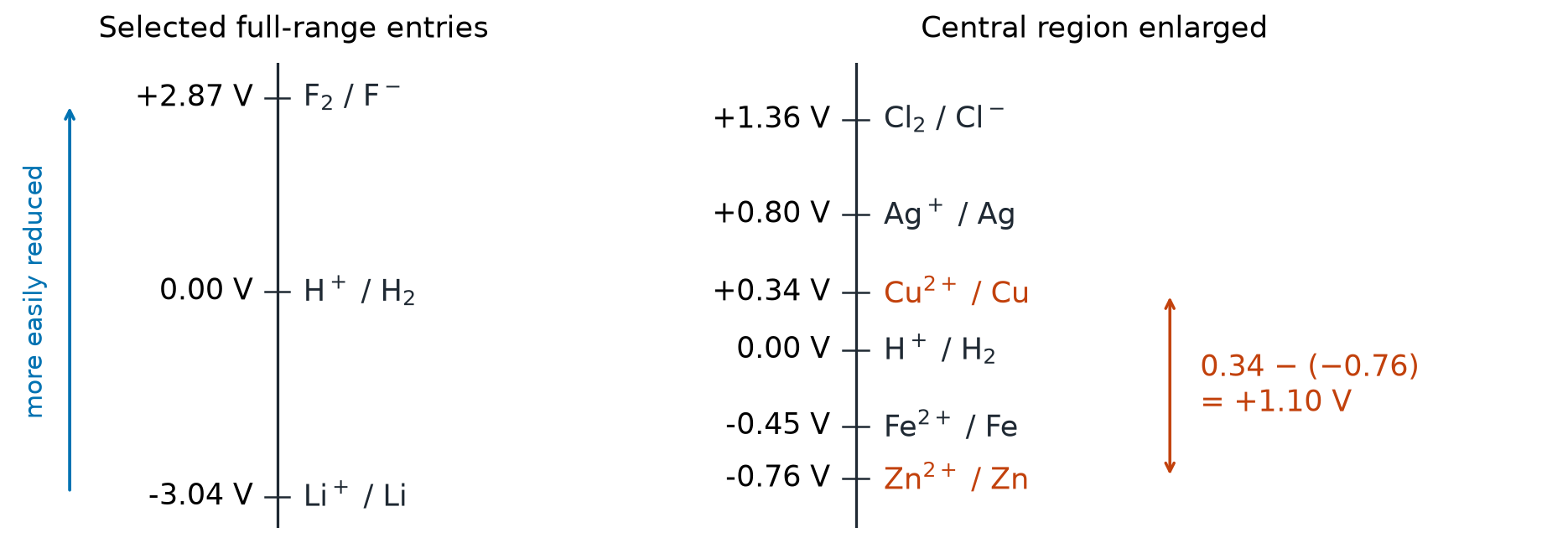
The more positive $E^{\ominus}$, the more easily the oxidized form is reduced
A more positive $E^{\ominus}$ means the oxidized form (left side) gains electrons more easily: it is a stronger oxidizing agent. $\text{F}_2$ is the strongest oxidizing agent among the species listed in this figure.
A more negative $E^{\ominus}$ means the reduced form (right side) loses electrons more easily: it is a stronger reducing agent. Li is the strongest reducing agent among the reduced forms listed. Its very negative aqueous potential does not mean an aqueous lithium-metal electrode can ignore lithium’s reaction with water.
Match the exact half-equation: Fe²⁺/Fe at a supplied −0.45 V is not Fe³⁺/Fe²⁺ at +0.77 V. They connect different oxidation states.
Cell potentials
In a cell, the half-cell with the more positive $E^{\ominus}$ is reduced (the cathode). The cell potential 电池电势 is:
The electrochemical series: a more positive $E^{\ominus}$ (top) is a stronger oxidising agent; a more negative $E^{\ominus}$ (bottom) is a stronger reducing agent
For the Zn/Cu cell: $E^{\ominus}_{\text{cell}} = +0.34 - (-0.76) = +1.10$ V.
A reaction is spontaneous 自发的 under standard conditions if $E^{\ominus}_{\text{cell}}$ is positive. Do not multiply $E^{\ominus}$ values when you multiply a half-equation: they do not depend on the amount.
Worked example. Will $\text{Cl}_2$ oxidize $\text{Fe}^{2+}$ to $\text{Fe}^{3+}$? $E^{\ominus}(\text{Cl}_2/\text{Cl}^-) = +1.36$ V and $E^{\ominus}(\text{Fe}^{3+}/\text{Fe}^{2+}) = +0.77$ V.
$\text{Cl}_2$ is reduced (cathode), $\text{Fe}^{2+}$ is oxidized (anode).
$E^{\ominus}_{\text{cell}} = 1.36 - 0.77 = +0.59$ V.
Positive, so the forward reaction is thermodynamically favoured under the stated standard conditions: $\text{Cl}_2 + 2\text{Fe}^{2+} \rightarrow 2\text{Cl}^- + 2\text{Fe}^{3+}$.
A positive standard cell potential predicts thermodynamic direction at standard activities, not reaction speed. Non-standard concentrations and gas pressures can alter the actual cell potential; passivation and kinetic barriers can prevent an obvious reaction. Conversely, a negative standard value is not a proof that no forward reaction is possible under every composition. Distinguish a thermodynamic prediction from an observed rate.
Here $n$ is the number of moles of electrons transferred in the equation and $F$ is the Faraday constant 法拉第常量, $9.65 \times 10^4$ C mol⁻¹. A positive $E^{\ominus}_{\text{cell}}$ gives a negative $\Delta G^{\ominus}$: both mean the reaction is spontaneous.
Doubling every coefficient doubles $n$ and ΔG°, but leaves E° unchanged. Thus 2Zn + 2Cu²⁺ → 2Zn²⁺ + 2Cu has $n=4$ and ΔG° ≈ −425 kJ per mole of the doubled equation. Potential is intensive; reaction energy is extensive.
standard hydrogen electrode/ˈstændəd ˈhaɪdrədʒn ɪˈlektrəʊd/
standard electrode potential/ˈstændəd ɪˈlektrəʊd pəˈtenʃl/
cell potential/sel pəˈtenʃl/
spontaneous/spɒnˈteɪnɪəs/
Faraday constant/ˈfærədeɪ ˈkɒnstənt/
20.9
AHL: Electrolysis of aqueous solutions
Water competes
In an aqueous solution, water-related species compete with dissolved ions. The following two tabulated standard half-reactions use different reference pH conditions:
In concentrated sodium chloride solution, $\text{H}^+$ is discharged instead of $\text{Na}^+$, and $\text{Cl}^-$ instead of $\text{OH}^-$A Hofmann voltameter for the electrolysis of water: the power supply drives current through two electrodes, and the gas made at each one collects in its side tube
$$\text{anode: } 2\text{H}_2\text{O} \rightarrow \text{O}_2 + 4\text{H}^+ + 4\text{e}^- \qquad E^{\ominus} = +1.23 \text{ V (for the reduction)}$$
The −0.83 V reduction assumes unit OH⁻ activity; +1.23 V is for oxygen reduction at unit H⁺ activity, opposite to the displayed anode direction. These unmatched pH references do not imply a universal 2.06 V minimum. At matched pH and standard gas activities, the equilibrium gap is about 1.23 V at 298 K. Practical overpotentials and resistance require extra voltage. No Nernst calculation is needed here.
At the cathode, compare reduction potentials under consistent conditions as a thermodynamic starting point. $\text{Cu}^{2+}$ (+0.34 V) and $\text{Ag}^+$ (+0.80 V) are reduced to metal. $\text{Na}^+$ ($-2.71$ V) and $\text{K}^+$ are not: hydrogen forms instead.
At an inert anode, oxygen can form from water-related species. Concentrated chloride can instead give chlorine: concentration affects the potential and competing reaction rates, and electrode kinetics matter. These common predictions are not obtained reliably from unmatched standard numbers alone.
Electrolyte (inert electrodes)
Cathode
Anode
concentrated NaCl(aq)
$\text{H}_2$
$\text{Cl}_2$
dilute NaCl(aq)
$\text{H}_2$
mainly $\text{O}_2$
$\text{CuSO}_4$(aq)
Cu
$\text{O}_2$
dilute $\text{H}_2\text{SO}_4$(aq)
$\text{H}_2$
$\text{O}_2$
An inert electrode 惰性电极 conducts without being a main stoichiometric reactant in the model. Its surface still affects rates and overpotential; graphite can sometimes be consumed. A copper anode in CuSO₄ commonly dissolves by Cu → Cu²⁺ + 2e⁻ instead of giving O₂. Specify electrode material, electrolyte and concentration.
For acidic water electrolysis at inert electrodes, cathode 4H⁺ + 4e⁻ → 2H₂ and anode 2H₂O → O₂ + 4H⁺ + 4e⁻ give 2H₂O → 2H₂ + O₂. Gas volumes are 2:1 at matched temperature/pressure without loss or side reactions. Pure water conducts poorly; an appropriate electrolyte carries charge without necessarily being a net reactant.
Electroplating
In electroplating 电镀 a thin layer of metal is put on an object by electrolysis.
Electrolysis is used to electroplate an object with a thin, shiny layer of metal such as chromium
The object is the cathode: $\text{Cu}^{2+} + 2\text{e}^- \rightarrow \text{Cu}$.
The anode is the plating metal, which dissolves: $\text{Cu} \rightarrow \text{Cu}^{2+} + 2\text{e}^-$.
The electrolyte supplies metal ions, for example CuSO₄(aq). Matching Cu dissolution and deposition transfer equal Cu²⁺ amounts per charge: well-mixed bulk concentration stays approximately constant at fixed volume. Side reactions and poor mixing can change this. With an inert anode, dissolved metal ions need replenishment.
Use supplied idealized conditions; state any extra assumption.
Give the oxidation state of: (a) S in $\text{H}_2\text{SO}_4$ (b) N in $\text{NH}_4^+$ (c) Cl in $\text{ClO}_3^-$ (d) O in $\text{H}_2\text{O}_2$.
In $\text{Fe}_2\text{O}_3 + 3\text{CO} \rightarrow 2\text{Fe} + 3\text{CO}_2$, identify the oxidizing agent and the reducing agent, with oxidation states.
Balance the half-equation for $\text{Cr}_2\text{O}_7^{2-}$ being reduced to $\text{Cr}^{3+}$ in acid.
Combine your answer to 3 with $\text{Fe}^{2+} \rightarrow \text{Fe}^{3+} + \text{e}^-$ to give the overall equation.
Predict whether a reaction happens, and write an ionic equation if it does: (a) Mg + $\text{FeSO}_4$(aq) (b) Cu + $\text{ZnSO}_4$(aq) (c) $\text{Br}_2$(aq) + KI(aq).
For aqueous Mg/Mg²⁺ and Cu²⁺/Cu half-cells, identify anode/cathode, write their half-equations and give external electron-flow direction.
Explain the role of the salt bridge.
Compare the cell in question 6 with molten PbBr₂ electrolysis: energy direction and electrode signs.
Name the product when each is treated under the usual alcohol-oxidation conditions with acidified $\text{K}_2\text{Cr}_2\text{O}_7$: (a) propan-1-ol, distilled (b) propan-1-ol, under reflux (c) butan-2-ol (d) 2-methylpropan-2-ol.
State the reducing agent and the product when propanone is reduced.
Reverse Pb + PbO₂ + 2H₂SO₄ → 2PbSO₄ + 2H₂O for charging. Does discharge make a secondary cell primary?
AHL. (a) Calculate $E^{\ominus}_{\text{cell}}$ for a cell made from $\text{Ag}^+/\text{Ag}$ (+0.80 V) and $\text{Zn}^{2+}/\text{Zn}$ ($-0.76$ V). Write the overall equation. (b) Calculate $\Delta G^{\ominus}$ for the silver/zinc cell in (a). (c) Use $E^{\ominus}$ values to decide whether $\text{I}_2$ (+0.54 V) can oxidize $\text{Fe}^{2+}$ to $\text{Fe}^{3+}$ (+0.77 V). State the conditions and a kinetic limitation.
AHL. (a) Predict the products at each electrode for concentrated KCl(aq) and $\text{AgNO}_3$(aq), using inert electrodes. (b) For CuSO₄(aq), contrast inert and copper anodes. (c) Explain why the −0.83 and +1.23 V water half-cell values cannot be combined without considering their pH references.
AHL. (a) Describe how to silver-plate a spoon. (b) Give half-equations for water electrolysis and predict the gas-volume ratio under matched collection conditions.
Worked answers
(a) +6 (b) $-3$ (c) +5 (d) $-1$.
Fe goes from +3 to 0, so $\text{Fe}_2\text{O}_3$ is reduced: it is the oxidizing agent. C goes from +2 to +4, so CO is oxidized: it is the reducing agent.
Charging: 2PbSO₄ + 2H₂O → Pb + PbO₂ + 2H₂SO₄. Discharge is voltaic operation; the design remains secondary.
AHL.$E^{\ominus}_{\text{cell}} = 0.80 - (-0.76) = +1.56$ V. $\text{Zn} + 2\text{Ag}^+ \rightarrow \text{Zn}^{2+} + 2\text{Ag}$. (b) $n = 2$: $\Delta G^{\ominus} = -2 \times 96\,500 \times 1.56 = -3.01 \times 10^5$ J mol⁻¹ $= -301$ kJ mol⁻¹. (c) $\text{I}_2$ would be reduced: $E^{\ominus}_{\text{cell}} = 0.54 - 0.77 = -0.23$ V. Thus Fe²⁺ oxidation by I₂ is unfavoured under standard conditions; reverse Fe³⁺ oxidation of I⁻ is favoured. Actual conditions can alter direction; kinetic barriers can slow a favoured reaction.
AHL. (a) KCl: cathode H₂, anode Cl₂. AgNO₃: cathode Ag, anode O₂. (b) Cu²⁺ + 2e⁻ → Cu occurs at the cathode; an inert anode gives O₂, a copper anode dissolves to Cu²⁺. (c) −0.83 V assumes unit OH⁻ activity, +1.23 V unit H⁺ activity: unmatched pH references.
AHL. (a) Spoon: cathode; silver: anode; AgNO₃(aq) electrolyte, direct current. (b) Cathode 4H⁺ + 4e⁻ → 2H₂; anode 2H₂O → O₂ + 4H⁺ + 4e⁻. Net 2H₂O → 2H₂ + O₂. H₂:O₂ = 2:1 by volume at matched temperature/pressure without loss or side reactions.
20.11
Exam tips
Balance atoms, charge and electrons; define agents and electrodes by their reactions. State organic reaction conditions.
AHL.$E^{\ominus}_{\text{cell}} = E^{\ominus}_{\text{cathode}} - E^{\ominus}_{\text{anode}}$; never multiply $E^{\ominus}$ by the coefficients.
AHL.$\Delta G^{\ominus}=-nFE^{\ominus}$ gives J mol⁻¹; divide by 1000 for kJ.