Functional groups: classification of organic compounds
Two compounds can have the same molecular formula but different structures. Their functional groups 官能团 help predict which reactions they undergo.
English narration · English + 中文 subtitles burned in
11.1
Scope and prerequisites
This handout teaches Structure 3.2, Functional groups: classification of organic compounds, for the course first assessed in 2025. Sections marked AHL are for Higher Level only.
Prerequisites: covalent bonding and molecular shapes from Structure 2.2, intermolecular forces and hydrogen bonding, and the mole and empirical formulae from Structure 1.4.
11.2
Representing organic molecules
Same formula, different substances
Ethanol and methoxymethane both have the formula C₂H₆O. Ethanol is the liquid in alcoholic drinks and boils at 78 °C; methoxymethane is a gas used in aerosol sprays and boils at −24 °C. The atoms are the same, but they are joined in a different order. In organic chemistry the formula alone is not enough: you need to show the structure.
Types of formula
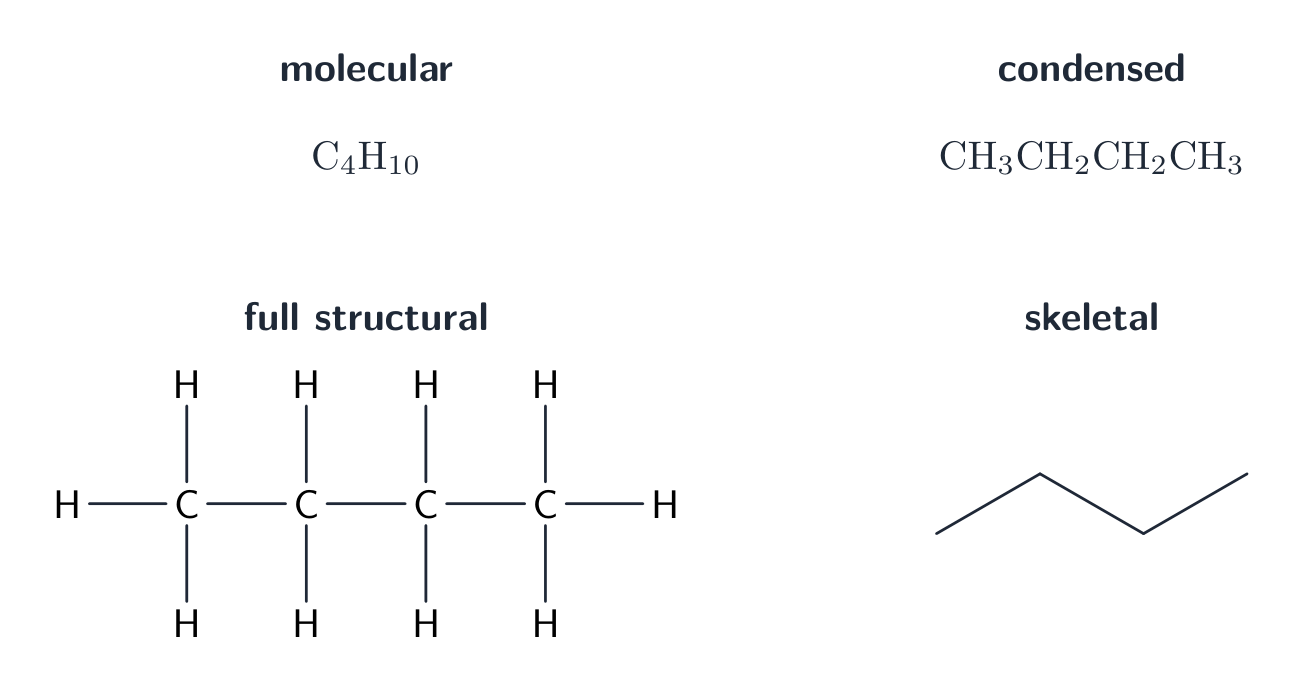
A molecular formula gives atom counts; connectivity needs a structural formula. A skeletal drawing keeps bond connectivity while omitting carbon labels and carbon-bound hydrogens.
Formula
What it shows
Butan-1-ol
molecular
the number of atoms of each element
C₄H₁₀O
empirical
the simplest whole-number ratio
C₄H₁₀O
condensed structural
the atoms on each carbon, in order
CH₃CH₂CH₂CH₂OH
full structural
every atom and every bond
all 15 atoms and 14 bonds drawn
skeletal
carbon chain as a zigzag; C and H on carbon left out
4 carbons at two corners and two ends, with OH at one end
In a skeletal formula 骨架式 each corner and each line end is a carbon atom, and each carbon has enough hydrogen atoms to make four bonds. Atoms other than carbon, and hydrogens attached to them such as O–H, are shown explicitly. Carbon-bound H atoms are normally omitted.
A full displayed formula is still a two-dimensional representation: it need not show the true three-dimensional bond angles. Build a simple carbon model with four tetrahedral bond directions, approximately 109.5° for an isolated sp³ centre. Around a C=C, each carbon is approximately trigonal planar; a C≡C region is linear. In wedge-dash notation, a solid tapered wedge comes towards the viewer, a dashed wedge goes away and ordinary lines lie approximately in the paper’s plane. Model kits or a labelled drawing can reveal connections hidden by a flat formula; model colours and stick lengths are conventions, not literal atom surfaces.
A benzene ring, C₆H₆, is drawn as a hexagon with a circle inside, which shows the delocalized electrons. A benzene ring attached to a chain is a phenyl 苯基 group, C₆H₅–.
A functional group 官能团 is the atom or group of atoms that gives a compound its typical reactions. Compounds with the same functional group react in similar ways.
Crude oil is a mixture of hydrocarbons, mostly members of the alkane homologous seriesThe coloured atoms define each class; R stands for the rest of the molecule.
Class
Functional group
Suffix or prefix
Example
alkane
C–C/C–H single bonds
-ane
propane, CH₃CH₂CH₃
alkene
C=C
-ene
propene, CH₂=CHCH₃
alkyne
C≡C
-yne
ethyne, HC≡CH
halogenoalkane
–X (F, Cl, Br, I)
fluoro-, chloro-, bromo-, iodo-
bromoethane, CH₃CH₂Br
alcohol
–OH (hydroxyl)
-ol
ethanol, CH₃CH₂OH
aldehyde
–CHO (carbonyl at the chain end)
-al
ethanal, CH₃CHO
ketone
C=O inside the chain (carbonyl)
-one
propanone, CH₃COCH₃
carboxylic acid
–COOH (carboxyl)
-oic acid
ethanoic acid, CH₃COOH
ether
C–O–C (ether)
alkoxy-
methoxymethane, CH₃OCH₃
ester
–COO– (ester)
-yl -oate
methyl ethanoate, CH₃COOCH₃
amine
N bonded to carbon; –NH₂ is a primary example
-amine
ethylamine, CH₃CH₂NH₂
amide
carbonyl bonded to N; –CONH₂ is a primary example
-amide
ethanamide, CH₃CONH₂
nitrile
–C≡N
-nitrile
ethanenitrile, CH₃CN
A saturated carbon framework has no C=C or C≡C bonds; an unsaturated framework has a carbon–carbon multiple bond. Do not call a carbonyl compound an alkene merely because it contains a double bond: the atoms of the functional group matter. Alkoxy is R–O– as a group attached through oxygen; phenyl is the C₆H₅– ring group. An amide’s nitrogen is attached directly to a carbonyl carbon; an ordinary amine lacks that defining connection.
Recognize reactions by the bonds that change
Trace the structural formula before and after reaction; the reagent and conditions belong on the reaction arrow.
A map of the AS reactions: each arrow turns one functional group into another. Work backwards from your target to plan a route
Addition:$\mathrm{CH_2{=}CH_2+H_2\xrightarrow{Ni,\ heat}CH_3CH_3}$. The C=C becomes C–C and two C–H bonds form; both carbons remain.
Substitution:$\mathrm{CH_3CH_2Br+OH^-\xrightarrow{aqueous,\ heat}CH_3CH_2OH+Br^-}$. A C–Br bond is replaced by C–O; the two-carbon skeleton stays intact. Ethanolic hydroxide favours elimination instead, so the solvent matters.
Oxidation:$\mathrm{CH_3CH_2OH+[O]\xrightarrow{acidified\ dichromate,\ distil}CH_3CHO+H_2O}$. Here [O] represents oxidizing oxygen, not a free oxygen atom in the mechanism. The alcohol carbon loses a C–H bond and gains a second bond to O. Distilling the aldehyde limits further oxidation; reflux with excess oxidant gives ethanoic acid.
Addition polymerization:$\mathrm{nCH_2{=}CH_2\rightarrow[-CH_2-CH_2-]_n}$ under suitable initiator/catalyst conditions. Each C=C opens and new C–C links join monomers; no small molecule is lost in this repeating-unit model.
AHL synthesis route. Ethene → ethanol → ethanoic acid retains two carbons at every stage. Hydrate ethene with steam using a phosphoric-acid catalyst at elevated temperature and pressure; then oxidize ethanol under reflux with excess acidified dichromate. The second step is $\mathrm{CH_3CH_2OH+2[O]\rightarrow CH_3COOH+H_2O}$. Write each reagent and condition above its own arrow; a hydrogenation catalyst would instead turn ethene into ethane.
Homologous series
A homologous series 同系列 is a family of compounds with the same functional group and the same general formula.
Each member differs from the next by CH₂.
They have similar chemical properties.
Physical properties, such as boiling point, change gradually along the series.
Series
General formula
alkanes
C$_n$H$_{2n+2}$
alkenes
C$_n$H$_{2n}$
alcohols
C$_n$H$_{2n+1}$OH
carboxylic acids
C$_n$H$_{2n}$O₂
Here n counts all carbon atoms. These formulas describe the stated simple acyclic series: alkenes have one C=C, alcohols one OH and no other functional group, and carboxylic acids one COOH. A ring or an extra multiple bond changes the general formula.
Trends in boiling point
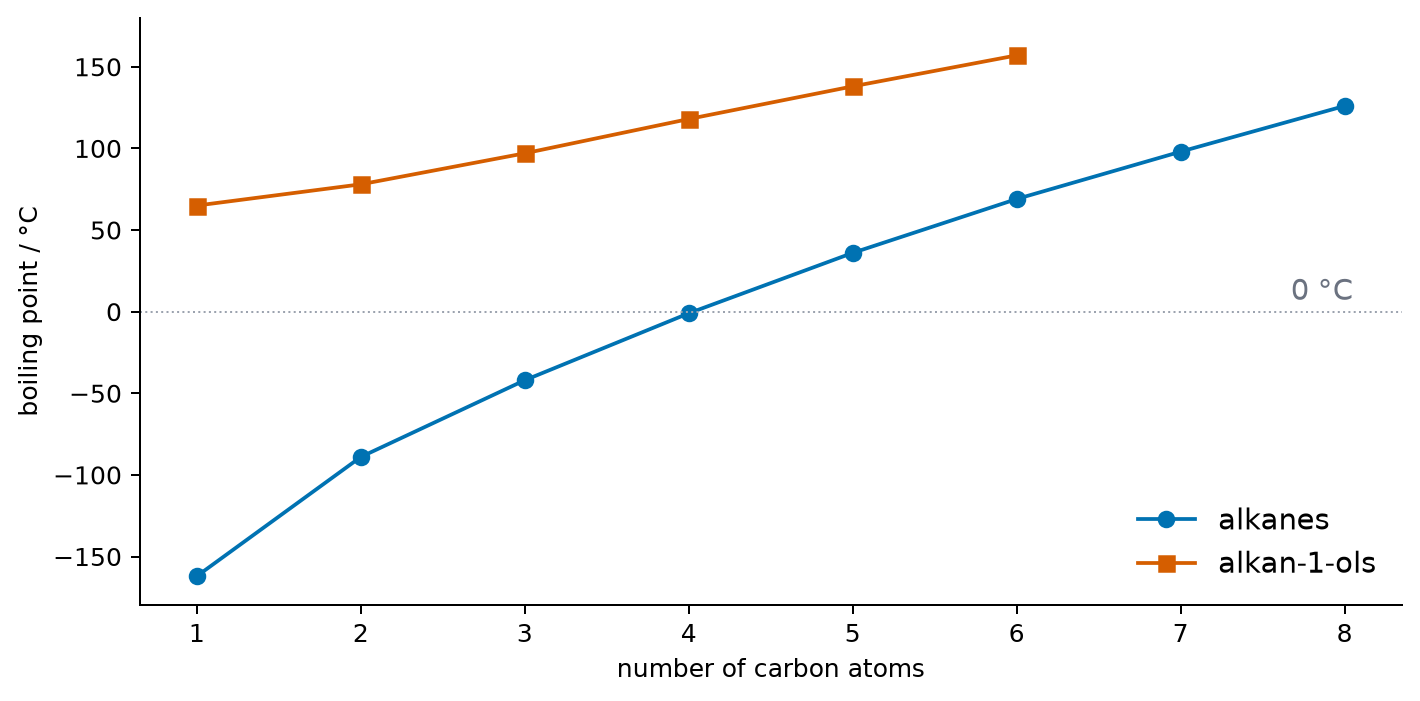
Rounded normal boiling points for the named unbranched series, at comparable pressure. Greater dispersion raises the general trend; alcohol hydrogen bonding adds an important interaction.
Each extra CH₂ adds electrons and surface area, so London forces between molecules get stronger and the boiling point rises.
More compact branching commonly lowers boiling points among comparable alkane isomers by reducing effective intermolecular contact. This is a trend, not a universal ranking of every functionalized molecule.
Alcohols and carboxylic acids boil much higher than alkanes of similar mass because their molecules form hydrogen bonds.
Melting points require packing as well as attraction
Increasing chain length often raises melting temperatures over a sufficiently broad range, but successive values can alternate or show irregularities because symmetry and crystal packing matter. Branching can reduce surface contact yet improve packing for a sufficiently symmetrical isomer. Do not copy a boiling-point trend mechanically into an exact melting-point order. Use supplied measurements and explain both intermolecular attractions and the solid arrangement.
IUPAC rules build systematic names using a parent, substituents and a suffix. Preferred names follow a defined convention, but accepted alternatives can exist; a molecular formula alone need not identify one compound.
The alkanes are a homologous series: each member has one more $\text{CH}_2$ unit (general formula $\text{C}_n\text{H}_{2n+2}$)
Carbons
1
2
3
4
5
6
Stem
meth-
eth-
prop-
but-
pent-
hex-
Find the longest carbon chain that contains the functional group. Its length gives the stem.
Add the suffix of the main functional group (-ene, -ol, -al, -one, -oic acid).
Number the chain from the end that gives the functional group the lowest number. Put the number before the suffix: but-1-ene, propan-2-ol.
Name side chains (methyl-, ethyl-) and halogens (chloro-, bromo-) as prefixes with their position numbers, in alphabetical order.
Use di-, tri- for repeated groups: 2,2-dimethylpropane.
Worked examples
CH₃CH(OH)CH₃: 3 carbons, –OH on carbon 2 → propan-2-ol.
CH₂=CHCH₂CH₃: 4 carbons, C=C starting at carbon 1 → but-1-ene.
CH₃CHBrCH₃: 2-bromopropane.
CH₃CH₂COOH: 3 carbons including the COOH carbon → propanoic acid.
In these simple open-chain mono-aldehyde and mono-carboxylic-acid examples, the terminal characteristic carbon is carbon 1 and its locant is normally omitted.
11.5
Structural isomers
Same molecular formula, different structure
Structural isomers 结构异构体 have the same molecular formula but a different structural formula: the atoms are joined in a different order.
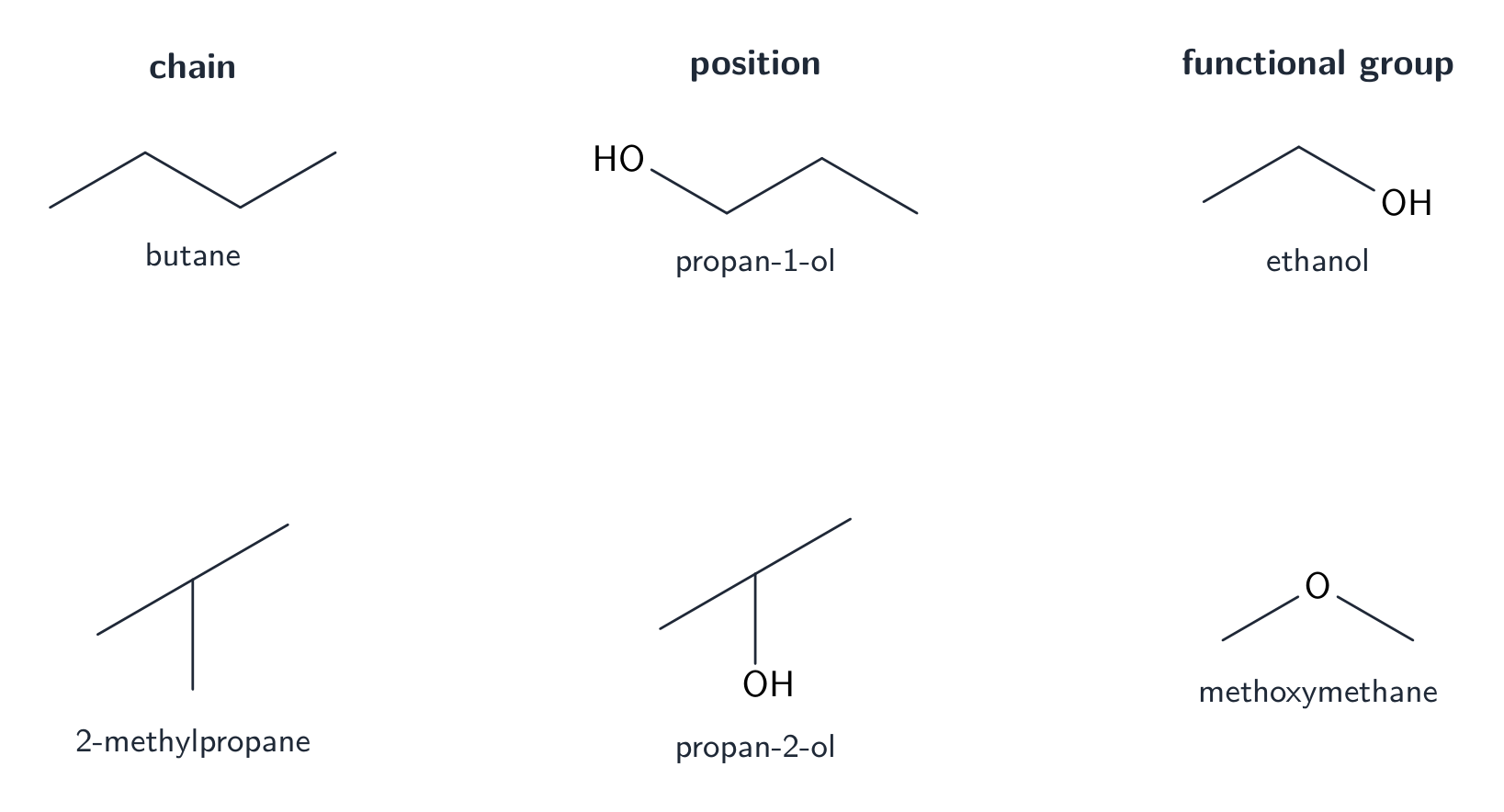
Structural isomers differ in their chain, in the position of a group, or in the functional group itself
Type
What changes
Example, C$_n$…
chain
the carbon skeleton is branched differently
butane and 2-methylpropane, C₄H₁₀
position
the functional group sits on a different carbon
propan-1-ol and propan-2-ol, C₃H₈O
functional group
the atoms form a different functional group
ethanol and methoxymethane, C₂H₆O
Alcohols are classified by the carbon that holds the –OH: primary 伯 (that carbon has one other carbon attached), secondary 仲 (two) or tertiary 叔 (three). Propan-1-ol is primary; propan-2-ol is secondary; 2-methylpropan-2-ol is tertiary. Halogenoalkanes use the number of carbon neighbours of the carbon bonded to the halogen. Methanol and methyl halides have no carbon neighbour and need separate treatment rather than forcing the usual alkyl examples onto them.
For amines, count carbon-containing groups directly bonded to nitrogen, not neighbours of a carbon next to N: CH₃NH₂ is primary, (CH₃)₂NH secondary and (CH₃)₃N tertiary. The last has no N–H bond but still has a lone pair. This is a different counting centre from alcohol or halogenoalkane classification. A compound can also contain more than one functional group; identify every connection before choosing a class.
Organic MS, IR and proton-NMR interpretation belong to the additional Higher-Level scope in the 2025 course. Use the supplied data booklet.
An infrared spectrometer shines infrared through a sample and records which wavenumbers its bonds absorb
Index of hydrogen deficiency
As supporting structure analysis, the index of hydrogen deficiency 缺氢指数 (IHD) counts how many rings and π bonds a molecule has. Each ring or double bond counts 1; a triple bond counts 2. For a compound C$_c$H$_h$N$_n$O$_o$X$_x$ (X = halogen):
$$\text{IHD} = \frac{2c + 2 + n - h - x}{2}$$
This formula assumes the usual neutral closed-shell valences for these elements; it is not a universal rule for arbitrary ions or unusual valences. Oxygen does not affect the IHD. For C₃H₆O: $(6 + 2 - 6)/2 = 1$, so one C=C, one C=O or one ring. Benzene, C₆H₆: $(12 + 2 - 6)/2 = 4$ (one ring and three double bonds).
Mass spectrometry
In an electron-impact mass spectrometer 质谱仪, molecules can form radical cations and fragment. Ionization method and conditions affect the spectrum. The spectrum shows each ion's mass-to-charge ratio, $m/z$.
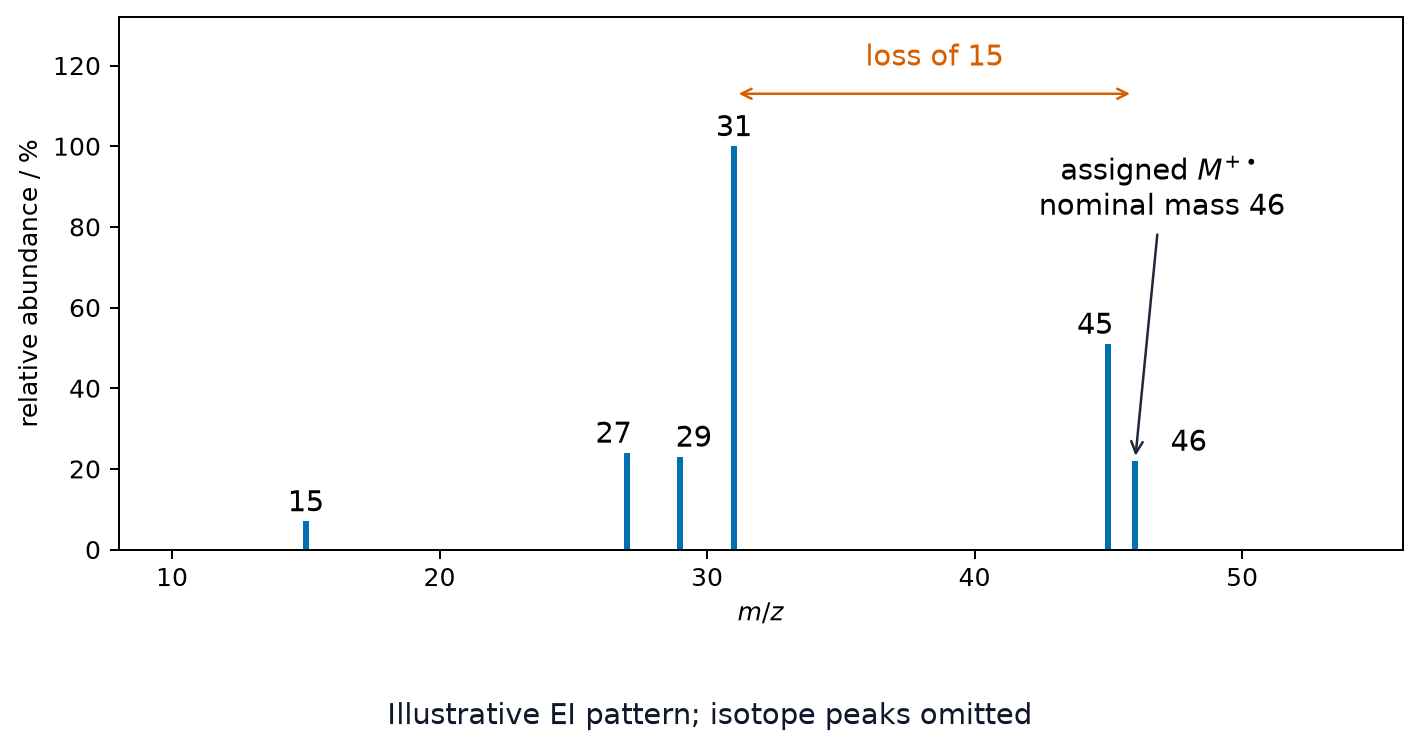
Rounded ethanol EI pattern, not a newly measured spectrum. An assigned singly charged molecular ion helps establish molecular mass; fragment differences support proposed losses.
An assigned singly charged molecular ion 分子离子 at nominal m/z 46 is consistent with ethanol’s nominal molecular mass. It can be weak or absent; isotope peaks such as M+1 and M+2 can lie above it, so “highest peak position” is not a universal identification rule. The tallest peak is the base peak, not necessarily the molecular ion.
Compare assigned parent and fragment masses to propose a neutral loss, retaining charge on the detected fragment. A difference of 15 can support loss of a methyl radical; nominal masses alone need not distinguish different formulas or prove a unique pathway. Use the supplied fragment table and the molecular composition.
For ethanol, 31 is CH₂OH⁺: the molecule lost CH₃ (46 − 15).
Infrared spectroscopy
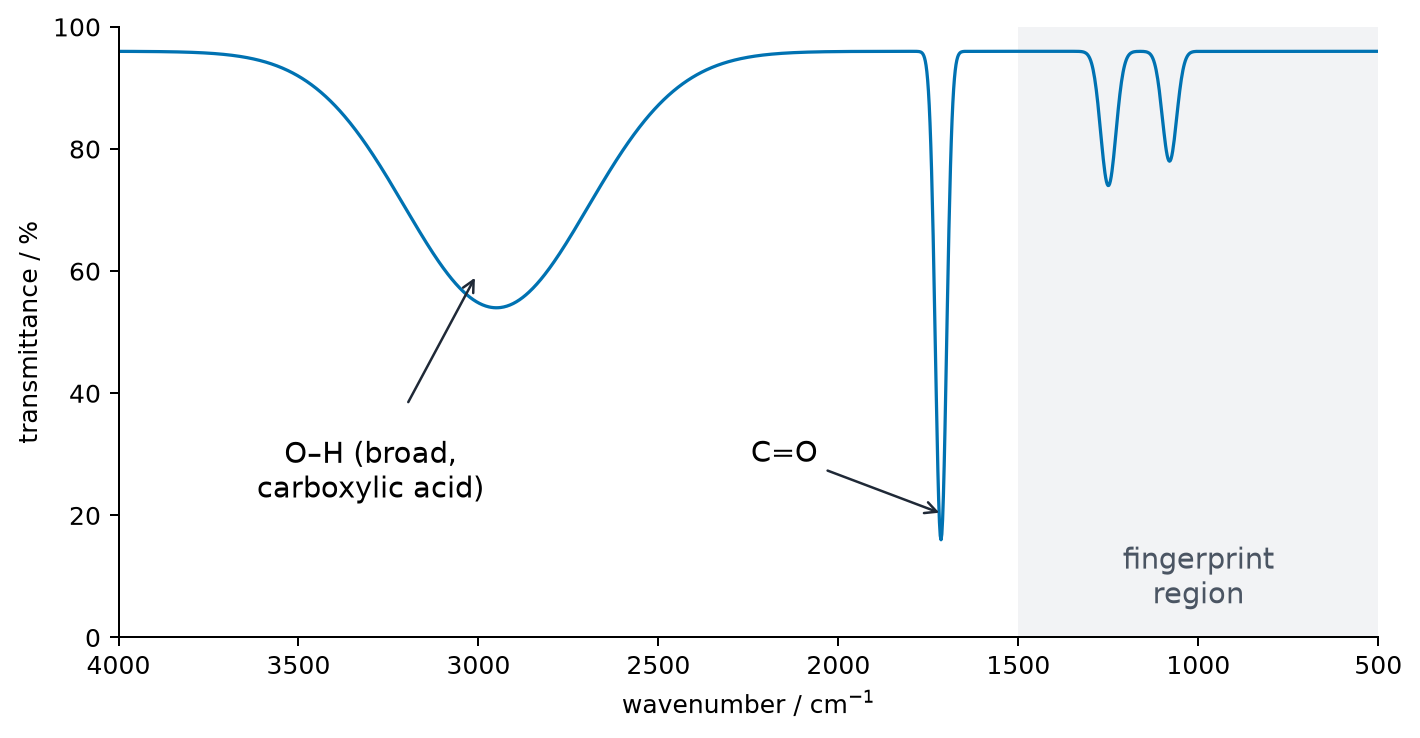
Bonds absorb infrared radiation at frequencies that make them vibrate. Each type of bond absorbs in its own range, so an IR spectrum shows which bonds, and so which functional groups, are present. The x-axis is the wavenumber 波数 in cm⁻¹; absorptions appear as dips in transmittance.
A deliberately schematic transmittance spectrum. A very broad acid O–H band together with C=O supports a carboxylic-acid assignment; combine evidence rather than treating one dip as unique proof.
Bond
Approximate wavenumber / cm⁻¹
Look
O–H in alcohols
3200–3600
broad
O–H in carboxylic acids
roughly 2500–3300; use the supplied table
very broad
N–H
3300–3500
medium
many sp³/sp² C–H
about 2850–3100
common; terminal alkyne C–H is nearer 3300
C=O
broadly 1650–1850, depending on the group
strong, sharp
C=C
1620–1680
medium
C–O
1050–1410
strong
These are approximate orientation ranges, not an exhaustive transcription of the IB booklet; use the table supplied in the question. Carbonyl position changes with the functional group and environment. (Instrument reference)
Below about 1500 cm⁻¹ lies the fingerprint region 指纹区: a complex pattern useful for comparison with reference spectra under comparable conditions. A partial match, an overlapping mixture or limited resolution is not absolute proof of purity or identity.
An IR-active vibration changes the molecule’s dipole moment. CO₂ has IR-active bending and asymmetric-stretching modes despite having no permanent dipole; N₂ and O₂ do not absorb ordinary IR through their fundamental homonuclear stretching vibrations. Greenhouse-gas absorption depends on active vibrational modes, wavelength and abundance, not simply on the presence of any bond.
index of hydrogen deficiency/ˈɪndeks ɒv ˈhaɪdrədʒn dɪˈfɪʃənsi/
mass spectrometer/mæs spekˈtrɒmɪtə/
molecular ion/məˈlekjʊlə ˈaɪɒn/
wavenumber/ˈweɪvnʌmbə/
fingerprint region/ˈfɪŋɡəprɪnt ˈriːdʒn/
11.7
AHL: ¹H NMR spectroscopy
What the spectrum shows
In ¹H nuclear magnetic resonance 核磁共振 (NMR) spectroscopy, hydrogen nuclei in a strong magnetic field absorb radio waves. Hydrogen atoms in different surroundings absorb at slightly different frequencies.
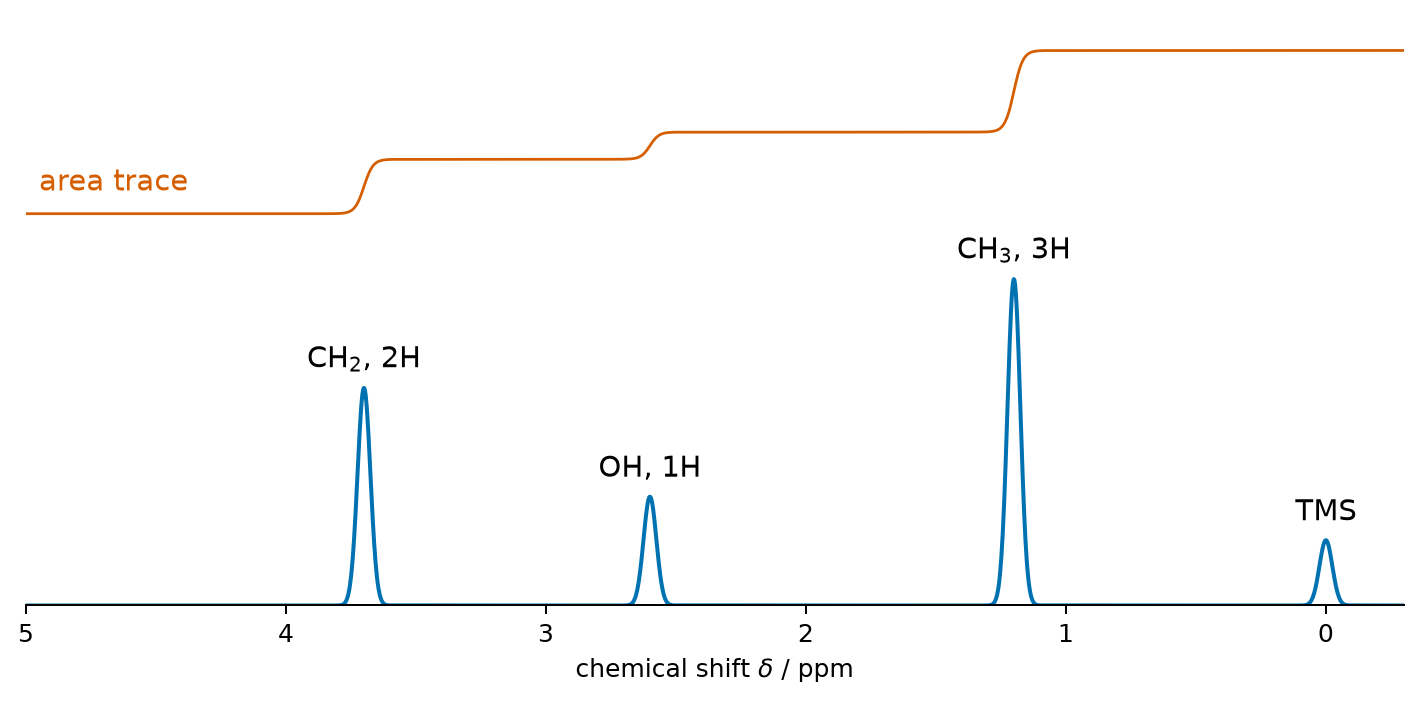
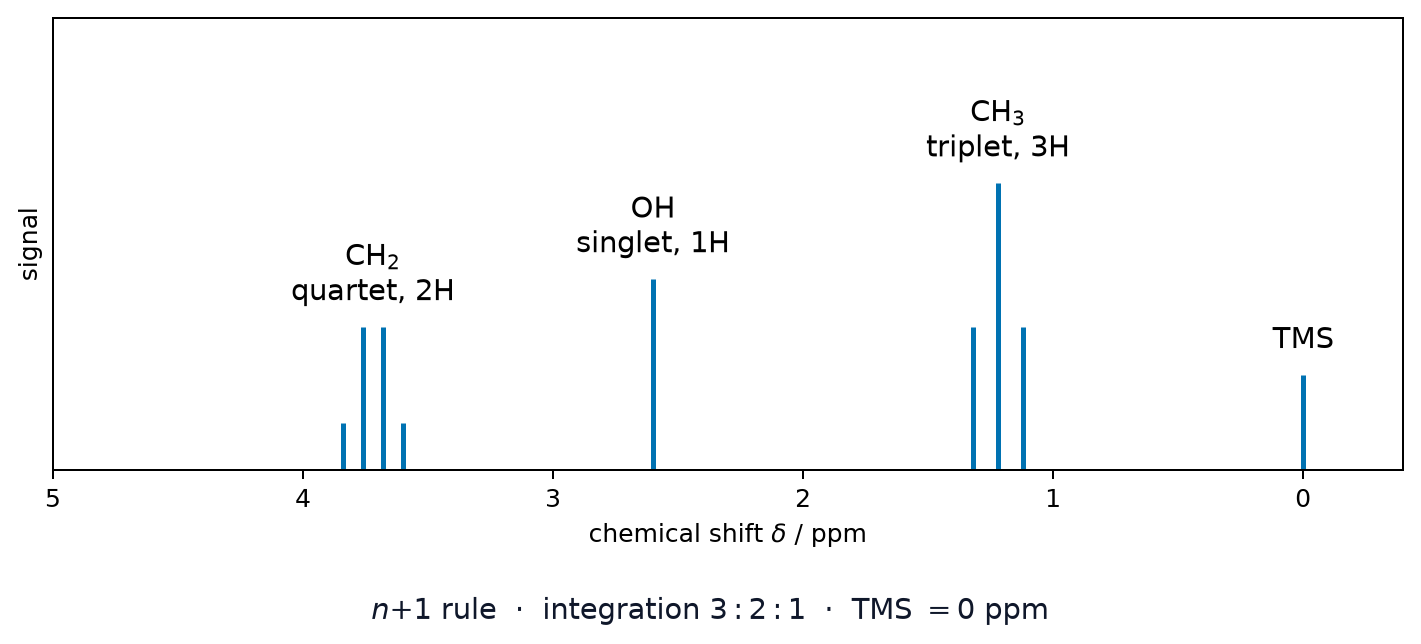
An NMR spectrometer: the large cylinder holds a superconducting magnet that makes the very strong magnetic field the technique needsSchematic low-resolution signals for ethanol under stated example conditions. Integration compares total areas, not individual line heights; the exchangeable OH shift can vary with solvent, concentration and temperature.
Number of signals corresponds to distinguishable proton environments under the measurement conditions. Ethanol has three in this simple achiral-solution example; a signal can split into several lines at high resolution. Do not count those lines as additional environments.
Chemical shift 化学位移, $\delta$ in ppm, tells you what each hydrogen is near. Electronegative atoms nearby move the peak to a higher shift.
Integration 积分: the area under each peak is proportional to the number of hydrogen atoms in that environment: 2 : 1 : 3 for ethanol.
TMS, tetramethylsilane, Si(CH₃)₄, is the reference at $\delta = 0$. It gives one strong peak away from most others, and it is inert.
Hydrogen type
Illustrative $\delta$ / ppm range
R–CH₃
0.9–1.0
CH next to C=O (–CH₂–CO–)
2.2–2.7
CH next to O (–O–CH₂–)
3.3–3.7
CH next to the O of an ester (–COO–CH₂–)
3.7–4.8
R–OH
1.0–6.0
on a benzene ring
6.9–9.0
–CHO
9.4–10.0
–COOH
9.0–13.0
These selected shift ranges are guides, not fixed constants for every molecule. Solvent, substitution and hydrogen bonding affect them; use the supplied data for an assessment. (NMR reference and solvent examples)
Worked example: using several techniques
For this combined-data exercise, a compound has molecular formula C₄H₈O₂.
Combining formula, IR, MS and NMR evidence
IHD $= (8 + 2 - 8)/2 = 1$: one C=O, C=C or ring before the other evidence is used.
IR: strong peak at 1740 cm⁻¹ (C=O), no broad band at 2500–3600 cm⁻¹, so no O–H: not an acid. An ester is likely.
MS: an assigned singly charged molecular ion at m/z 88, matching the nominal mass 4(12) + 8(1) + 2(16) = 88. The NMR integrations sum to eight H, not six.
¹H NMR: three peaks at 3.7 (3H), 2.3 (2H) and 1.1 (3H). The 3.7 peak is CH₃ next to O; the 2.3 peak is CH₂ next to C=O.
nuclear magnetic resonance/ˈnjuːklɪə mæɡˈnetɪk ˈrezənəns/
chemical shift/ˈkemɪkl ʃɪft/
integration/ˌɪntɪˈɡreɪʃn/
11.8
AHL: Stereoisomers
What stereoisomers are
Stereoisomers 立体异构体 have the same structural formula (the same atoms joined in the same order) but a different arrangement of the atoms in space.
Cis–trans isomers
Ordinary rotation does not freely interconvert these forms while the π bond remains intact; suitable reactions or photochemical excitation can enable isomerization.
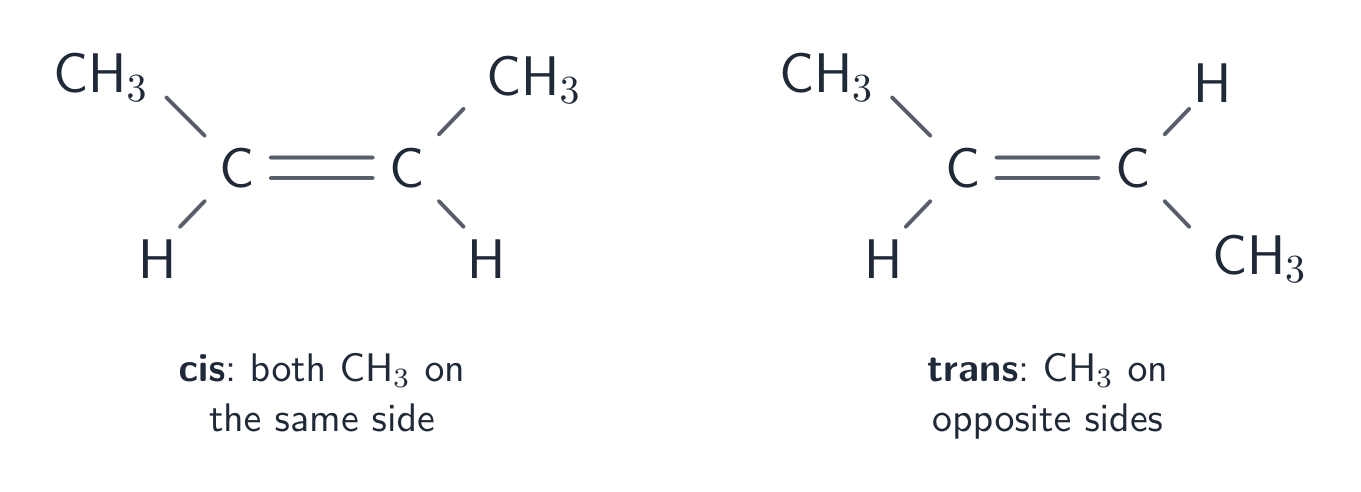
A C=C double bond cannot rotate, because rotation would break the π bond.
Different groups on each C=C carbon permit geometric stereoisomerism. Cis–trans isomers 顺反异构体 use an identical reference group on the two carbons to define same or opposite sides, as in but-2-ene; four different substituents need a different naming convention, outside this assessment requirement.
Cis: the same groups on the same side. Trans: on opposite sides.
Small rings constrain interchange of substituent faces: cis groups lie on the same ring face, trans on opposite faces. Examples include 1,2-dichlorocyclopropane and 1,2-dimethylcyclobutane. Cyclobutane can pucker without thereby converting cis to trans.
Cis and trans isomers often have different physical properties. Cis-but-2-ene boils at 4 °C and trans-but-2-ene at 1 °C.
Optical isomers
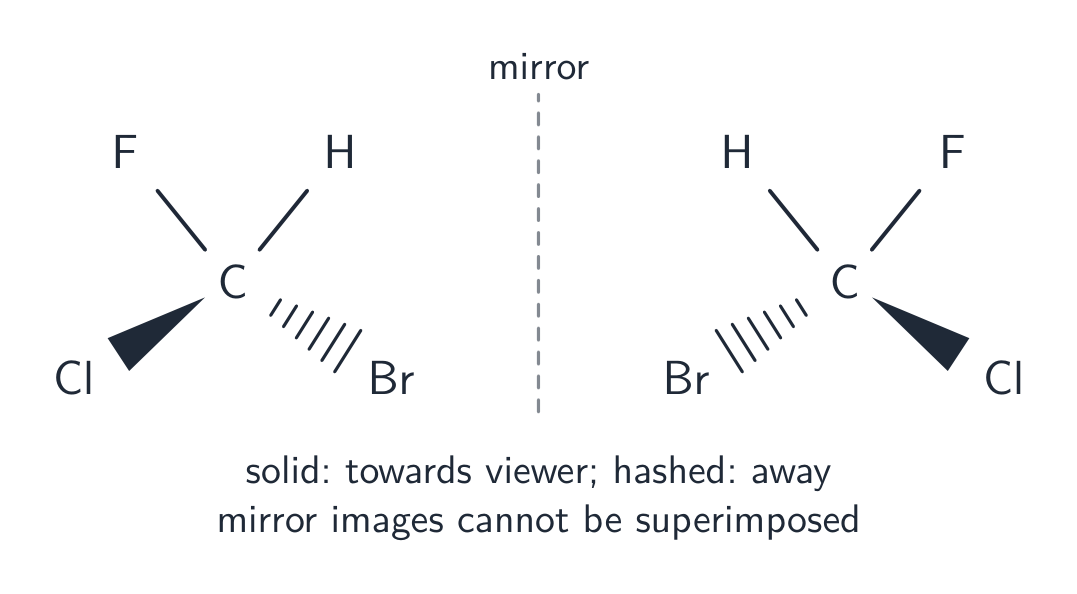
A carbon with four different groups has two mirror-image forms
A chiral 手性 carbon atom (a stereocentre) has four different atoms or groups attached.
A molecule with one chiral carbon exists as two enantiomers 对映异构体: mirror images that cannot be superimposed, like a left and a right hand.
Enantiomers have the same ordinary properties in achiral environments, apart from equal and opposite optical rotation under identical measurement conditions. They can interact differently with chiral reagents or biological environments.
Enantiomers rotate plane-polarized light 平面偏振光 by the same angle in opposite directions. A polarimeter measures this rotation.
A racemic mixture 外消旋混合物 has equal amounts of the two enantiomers. Their rotations cancel under the same conditions. Optical inactivity alone does not prove an absence of chiral molecules: a racemate is a counterexample.
Example: butan-2-ol, CH₃CH(OH)CH₂CH₃. Carbon 2 carries H, OH, CH₃ and C₂H₅, four different groups, so it is chiral. Many drugs are chiral, and the two enantiomers can act very differently in the body.
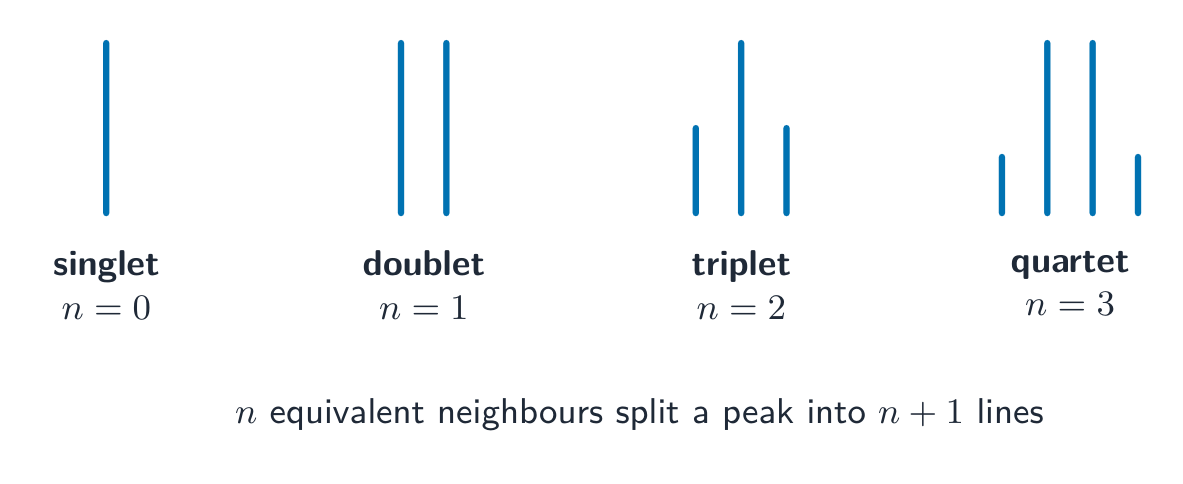
In a high-resolution spectrum each peak can be split into several lines. In the simple first-order examples, splitting comes from spin–spin coupling to appropriate nearby nuclei, commonly hydrogens on an adjacent carbon. It is not an unrestricted count of every hydrogen anywhere in the molecule.
A first-order signal coupled to one set of n equivalent neighbouring protons gives n + 1 lines. More complex coupling lies beyond this simple pattern.
Neighbouring H
Lines
Name
Line heights
0
1
singlet
1
1
2
doublet
1 : 1
2
3
triplet
1 : 2 : 1
3
4
quartet
1 : 3 : 3 : 1
Equivalent protons do not split one another in the simple first-order examples here; a signal can still be split by a different coupled set.
With rapid proton exchange, O–H commonly appears as a broad unsplit signal. Slower exchange under suitable dry conditions can reveal coupling, so the singlet is not an unconditional property of every alcohol spectrum.
Reading a high-resolution spectrum
CH₃ next to CH₂ gives a triplet; CH₂ next to CH₃ gives a quartet
In ethanol, CH₃ has 2 neighbouring H (on CH₂), so it is a triplet; CH₂ has 3 neighbouring H (on CH₃), so it is a quartet. A 3H triplet paired with a 2H quartet at compatible shifts supports an ethyl group, CH₃CH₂–; multiplicity alone is not proof of the whole molecule.
In methyl propanoate from the worked example, the 3.7 peak (O–CH₃) is a singlet, because its carbon is joined to O, which carries no H; the CH₂ is a quartet and the CH₃ at 1.1 is a triplet.
11.10
Practice
Draw pentan-2-ol as a skeletal and a condensed structural formula. State how many carbons are at corners and ends.
Name (a) CH₃CH₂CH₂CHO, (b) CH₃COCH₂CH₃, (c) (CH₃)₃CBr; draw 2-methylbutane.
Give the general formula for simple acyclic monoalkenes and an example with five carbons. Would the formula alone distinguish it from a cycloalkane?
Explain why butan-1-ol (117 °C) boils higher than pentane (36 °C) at comparable pressure despite similar relative molecular masses.
Draw and classify all alcohol constitutional isomers of C₄H₁₀O.
Classify CH₃NH₂, (CH₃)₂NH and (CH₃)₃N. Explain how this differs from classifying 2-bromopropane.
Identify the characteristic groups in CH₃COOH, CH₃COOCH₃, CH₃CONH₂ and CH₃OCH₃. Explain why C=O alone does not make a compound an alkene.
Explain why increasing chain length often raises boiling point, while successive melting points can be less smooth. Must every branched isomer have a lower melting point?
Butan-1-ol has C₄H₁₀O. Give its empirical formula, atom count and bond count in a full single-bond structural drawing. Explain one limitation of a flat drawing compared with a 3D model.
Explain what a homologous series shares and how adjacent members differ. Give formulas of methanoic and ethanoic acids using a general formula in which n counts all carbon atoms.
Draw an alcohol and an ether with formula C₂H₆O. Explain why molecular formula alone cannot determine connectivity or hydrogen bonding between their pure molecules.
AHL. For C₄H₈O₂ data, an assigned singly charged molecular ion is at 88, IR has C=O at 1740 cm⁻¹ and no broad O–H, and low-resolution NMR signals are 3.7 (3H), 2.3 (2H), 1.1 (3H). Calculate IHD and mass, identify a consistent structure and state a limit of each individual technique. Explain IR-active CO₂ despite its lack of permanent dipole.
AHL. Predict the simple splitting/integration of CH₃CH₂Cl. Explain TMS’s reference signal, rapid-exchange OH behaviour and why a quartet is not four environments. For ethanol EI, assign a plausible 31 fragment from 46 and the neutral loss.
AHL. Explain cis/trans in but-2-ene but not but-1-ene, and in a disubstituted small ring. Identify the stereocentre of 2-chlorobutane; explain tapered wedges, enantiomer rotation and a racemic mixture.
Worked answers.
CH₃CH(OH)CH₂CH₂CH₃; a five-carbon open zigzag has three internal corners and two ends. Place OH on carbon 2 and retain its H explicitly in the OH label.
(a) Butanal; (b) butan-2-one; (c) 2-bromo-2-methylpropane. 2-Methylbutane is CH₃CH(CH₃)CH₂CH₃, with a four-carbon parent chain and a methyl substituent at carbon 2.
CₙH₂ₙ, e.g. pent-1-ene C₅H₁₀. A simple cycloalkane can share that formula; connectivity is still needed.
Both have dispersion attractions; the alcohol additionally forms intermolecular hydrogen bonds. Stronger overall attractions require more energy for vaporization. Similar mass is a useful comparison, not proof that all dispersion contributions are identical.
Butan-1-ol CH₃CH₂CH₂CH₂OH, primary; butan-2-ol CH₃CH(OH)CH₂CH₃, secondary; 2-methylpropan-1-ol (CH₃)₂CHCH₂OH, primary; 2-methylpropan-2-ol (CH₃)₃COH, tertiary. These are four alcohol constitutional isomers, not the complete set including ethers or separate enantiomers.
Respectively primary, secondary and tertiary: nitrogen has one, two or three carbon groups attached. For 2-bromopropane, count the two carbon neighbours of the carbon bonded to Br: secondary halogenoalkane.
Carboxyl; ester; amido; alkoxy/ether linkage. An alkene needs a carbon–carbon double bond, not a carbon–oxygen double bond. The full group’s connections distinguish an acid, ester and amide.
Larger comparable chains have greater polarizability and usually stronger dispersion. Melting also depends on crystal packing and symmetry, so branching does not impose one universal lower-melting order.
C₄H₁₀O has no common divisor, so its empirical formula is unchanged. There are 4 + 10 + 1 = 15 atoms and 14 single bonds in the connected acyclic structure. A flat drawing can show connectivity without the actual tetrahedral angles; a 3D model can show those directions.
The same characteristic group and a common general formula, with adjacent members typically differing by CH₂. For simple monocarboxylic acids CₙH₂ₙO₂ gives CH₂O₂ (HCOOH) and C₂H₄O₂ (CH₃COOH). Here n includes the carboxyl carbon.
Ethanol CH₃CH₂OH and methoxymethane CH₃OCH₃. Only ethanol has O–H donors for hydrogen bonding between its pure molecules; an ether can accept hydrogen bonds from water without donating one itself. The shared molecular formula does not specify these connections.
AHL. IHD = (8 + 2 − 8)/2 = 1; nominal mass = 4(12) + 8(1) + 2(16) = 88. Methyl propanoate, CH₃CH₂COOCH₃, fits all the data: OCH₃ 3H, CH₂CO 2H, terminal CH₃ 3H. The integrations total eight H. A molecular-ion mass alone does not identify connectivity; IR groups do not prove a unique molecule; NMR assignments need formula and other evidence. CO₂’s asymmetric stretch and bending change dipole moment and can absorb IR.
AHL. CH₃ is a triplet (2 adjacent H), CH₂ a quartet (3 adjacent H), total areas 3:2 under simple first-order conditions. TMS has twelve equivalent H and defines 0 ppm. Rapid exchange commonly suppresses OH coupling; slower exchange can change this. A quartet is four lines within one signal. Ethanol can give CH₂OH⁺ at nominal 31 with loss of a CH₃ radical: 46 − 15 = 31.
AHL. Each but-2-ene C=C carbon has H and CH₃, allowing the identical methyl groups on the same or opposite sides; but-1-ene has two H on one carbon. Small-ring substituents can occupy the same or opposite faces. C2 of 2-chlorobutane has H, Cl, CH₃ and C₂H₅. Solid tapered wedges point towards the viewer, dashed wedges away. A pure enantiomer pair rotates polarized light equally and oppositely under identical conditions; a 1:1 racemate cancels the rotations without removing the chiral molecules.
11.11
Exam tips
Count corners and ends, complete carbon valences, and retain heteroatoms and their attached H.
Give the parent chain and locants; for amines classify at nitrogen, for alcohols/halides at the attached carbon.
AHL. Separate signals, split lines and integrated areas. Check formula, mass and H count together; label data and qualify a structural deduction.
AHL. Use an identical reference group for cis/trans and tapered wedges for tetrahedral stereochemistry. Optical inactivity can result from a racemate.