This handout covers D1.3: molecular changes in genes, their causes, inheritance and role in variation.
Prerequisites: complementary DNA bases, gene expression, mRNA codons and the distinction between body cells and gametes.
IB Biology SL · Topic 26
This handout covers D1.3: molecular changes in genes, their causes, inheritance and role in variation.
Prerequisites: complementary DNA bases, gene expression, mRNA codons and the distinction between body cells and gametes.
Two cells can have different DNA sequences yet make the same amino-acid sequence. Another single-base change can introduce an early stop. The size of a DNA change alone therefore does not tell us the size of its effect.
A mutation 突变 is a change in the DNA base sequence. Once copied, a sequence change can pass to descendant cells. DNA damage is not automatically a lasting mutation: repair may restore the original sequence before it becomes established. A change in gene activity without a change in DNA sequence is also a different process.
Deliberately changing a chosen DNA sequence is gene editing 基因编辑. Both spontaneous mutations and targeted changes must be understood through their actual sequence and biological context. The Higher Level sections examine how targeted editing can test gene function.
A gene mutation changes sequence within a gene; larger chromosome changes can involve many genes. Always identify the scale in the question. Here the main molecular changes are base substitutions, insertions and deletions. A change may affect a protein-coding region, RNA processing or a sequence controlling expression.
| English |
|---|
| mutation/mjuːˈteɪʃn/ |
| gene editing/dʒiːn ˈedɪtɪŋ/ |

A substitution 替换 replaces one base with another. DNA still contains the same number of bases, so a simple substitution inside a coding region does not by itself shift subsequent codon boundaries. However, the new triplet may have a different meaning.
For the following example, the coding DNA strand is written in the same direction as its mRNA; replace T with U to obtain the RNA. The original coding DNA is ATG GAA GCT TAA. Its mRNA is AUG GAA GCU UAA, specifying Met–Glu–Ala, followed by a stop. The stop specifies no amino acid.
| Coding DNA change | Corresponding mRNA | Consequence in this example |
|---|---|---|
| GAA becomes GAG | GAA becomes GAG | Both specify Glu: synonymous |
| GAA becomes GTA | GAA becomes GUA | Glu becomes Val: amino-acid replacement |
| GAA becomes TAA | GAA becomes UAA | A stop replaces Glu: early termination |
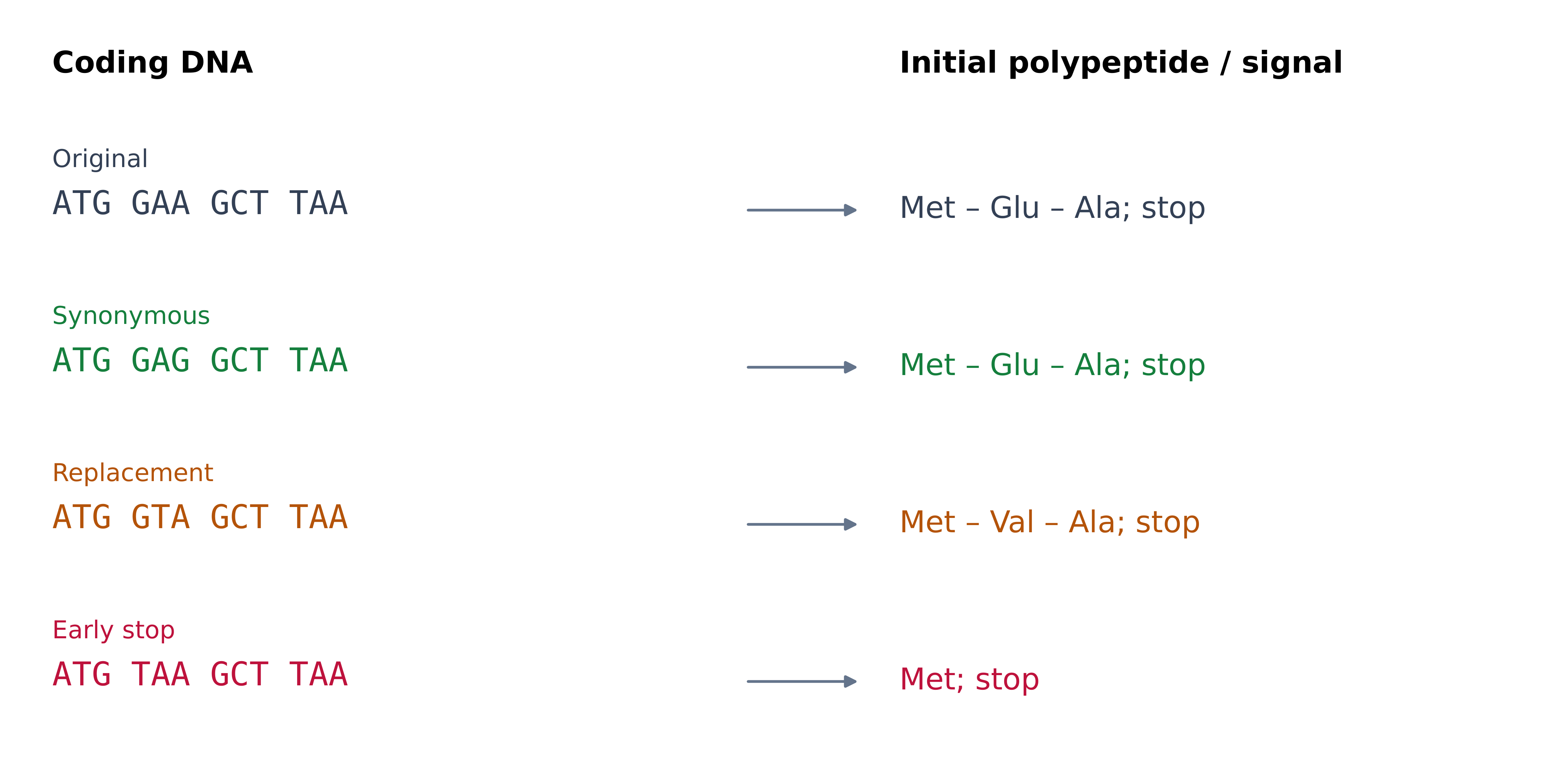
The genetic code is degenerate: several codons can specify one amino acid. A synonymous change leaves that amino acid unchanged. This is narrower than proving that every aspect of gene expression and cell function is unaffected. Sequence context can also influence processing or expression.
An amino-acid replacement may alter charge, bonding, folding, a binding site or stability. Its effect depends on the residue and its role. Some replacements have little detectable effect; others have large effects. An early stop often shortens the translated chain, but the observed amount of product may also be affected by RNA quality-control mechanisms. Do not assume every altered gene produces an abundant shortened protein.
A single-nucleotide polymorphism, or SNP, is variation at one nucleotide position among individuals. Such variation can arise through base substitution mutations. An observed base difference is not automatically disease-causing. Population variation, molecular consequence and effect on a person's traits are separate questions.
| English |
|---|
| substitution/ˌsʌbstɪˈtjuːʃn/ |

The reading frame 阅读框 is the grouping of successive bases into codons from a defined starting position. An insertion adds bases; a deletion removes them. Within a translated region, a change whose length is not a multiple of three shifts the grouping downstream of the change.

Delete base 4, the first G after AUG, from the mRNA sequence AUGGAAGCUUAA. The sequence becomes AUGAAGCUUAA. Regrouping from the same start gives AUG AAG CUU AA: Met–Lys–Leu and an incomplete final group. The original stop is no longer a complete stop codon in this displayed frame. More downstream sequence is needed to predict where translation ends.
This is not evidence that every later amino acid must differ or that translation stops immediately. Chance agreement and degeneracy can preserve some residues. The frame changes at the edited position; the actual new codons determine the consequences.
Deleting the complete GAA codon instead gives AUG GCU UAA: Met–Ala, then stop. The downstream frame is preserved and one amino acid is lost. A three-base deletion that crosses a codon boundary can also change the newly joined codon. Preserving the downstream frame does not guarantee normal protein function. A large insertion or deletion can disrupt a whole functional domain, including a binding or catalytic region, even when its length is a multiple of three.
| Change inside a coding region | Downstream frame | What still needs checking? |
|---|---|---|
| Add 1 base | Shifted | New codons and location of a stop |
| Remove 2 bases | Shifted | New sequence and product |
| Remove 3 bases | Preserved downstream | Missing residue(s), joined codon and function |
| Add 6 bases | Preserved downstream | Added sequence, junctions and function |
Mutations outside translated sequence can also matter. A promoter change can alter transcription; a change at a splice-related sequence can alter which RNA sequence is retained. A non-coding change is therefore not automatically harmless, and it need not act by directly replacing an amino acid in a codon.
Compare the reference's AUG CCU GGA UAA with a base-5 substitution to CAU and a base-4 deletion. Track original base positions through regrouping, compare one- and three-base deletions, and test a silent substitution or early stop without assuming a full peptide length beyond the shown fragment.
| English |
|---|
| reading frame/ˈriːdɪŋ freɪm/ |

DNA replication and repair are accurate but not perfect. An incorrectly incorporated base or an error during repair can establish a new sequence. A spontaneous mutation does not require a known external mutagen.

A mutagen increases the frequency of mutations under stated conditions. Examples include some chemicals and radiation. Ultraviolet radiation can damage neighbouring pyrimidine bases; ionizing radiation can damage DNA directly or through reactive products. Some chemicals alter bases or interfere with normal copying. For example, metabolic products of benzo[a]pyrene, found in tobacco smoke, can bind to DNA and interfere with accurate copying or repair. Damage may be repaired, cause cell death or become a lasting sequence change.
In a fair comparison, control the starting population, growth conditions, exposure measurement, number of generations and detection method. A larger fraction of mutant colonies after treatment is evidence to investigate. It is not automatically a measured mutation rate: survival, selection and multiplication of an early mutant can change that fraction.
For example, a sample contains 24 resistant colonies among 12,000 viable colonies. The observed resistant fraction is $24/12000=0.002$, or $0.20\%$. This counts a phenotype in the final sample. It does not tell us that 0.20% of DNA-copying events produced resistance.

A new mutation is not normally directed to the exact useful base because an organism needs a particular adaptation. Changes can occur in many genome regions, including changes with no benefit. However, random with respect to need does not mean every position, base change or environment has the same mutation probability. Sequence hotspots, copying processes, repair and exposure can produce biases.
Consider bacteria exposed to an antibiotic. Resistant variants may already exist before exposure. The antibiotic removes susceptible competitors and resistant lineages become more common. This is selection acting on variation. Observing more resistant cells after exposure does not by itself show that the antibiotic instructed susceptible cells to make the needed mutation.
Independent cultures started before selection can produce very different resistant counts if mutations arise at different times: an early event leaves many descendants, a late event few. Such a pattern is consistent with pre-existing mutation and clonal growth. Interpretation still requires suitable controls, repeated cultures and a model accounting for growth and survival.
Mutation creates new alleles. Recombination and sexual reproduction can rearrange existing alleles into new combinations. Both contribute to variation, but shuffling existing alleles is different from the origin of a new sequence variant.
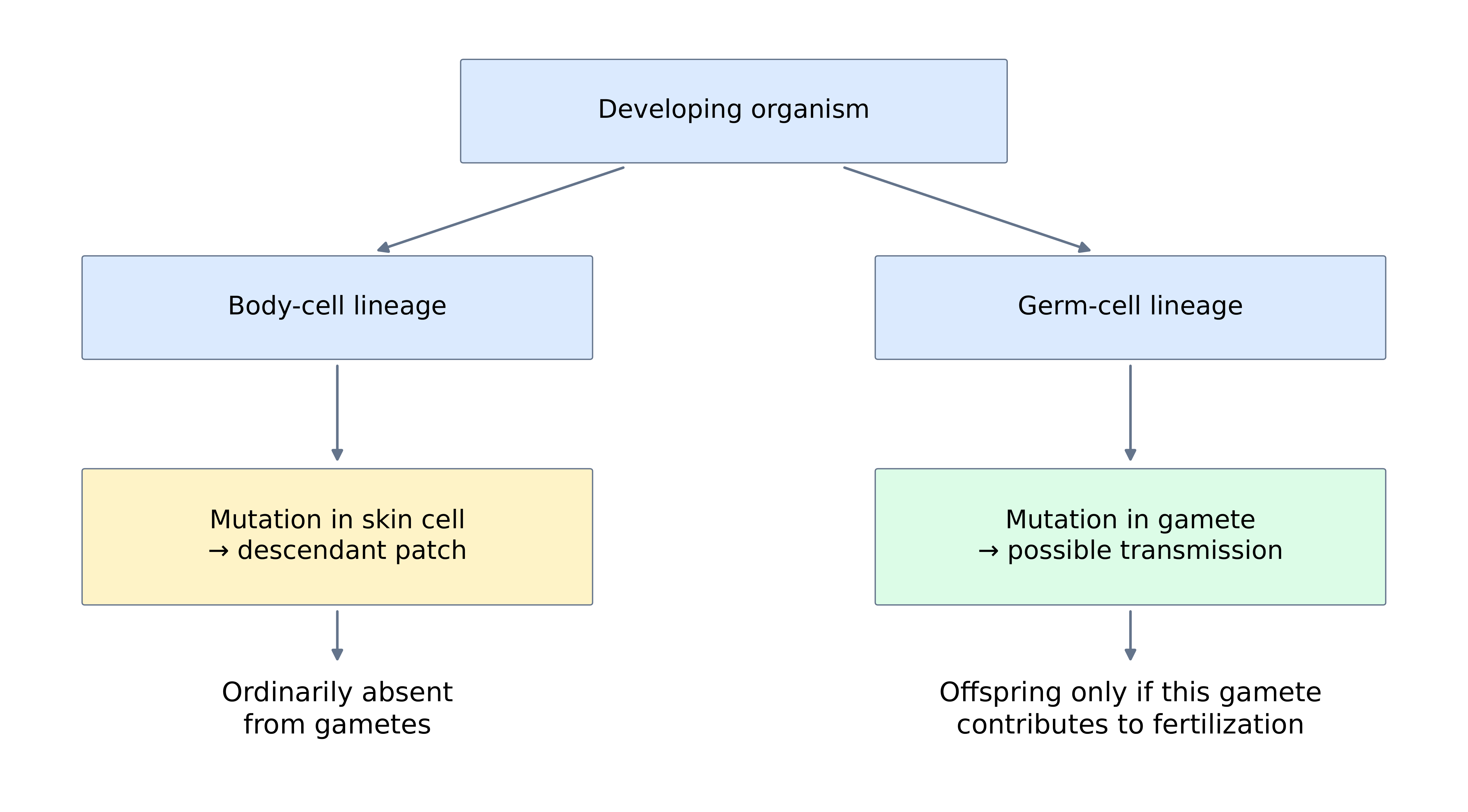
A somatic mutation occurs in a body-cell lineage. It can pass through mitosis to a patch of descendant cells, producing genetic mosaicism. In ordinary sexual reproduction, a mutation confined to skin cells does not enter the gametes and is not inherited by offspring.
A mutation in a germ-cell lineage can reach a gamete. It can then enter an offspring if that gamete contributes to fertilization. Not every germline mutation is transmitted: many gametes do not contribute, and survival and development also matter. A change inherited at fertilization can be present throughout many descendant tissues; a later embryonic change may be present only in some lineages.
Some somatic mutations affect control of cell division, DNA repair or cell survival. Descendant cells may gain a growth advantage, contributing to cancer development. One mutation is not automatically sufficient to cause cancer: several changes and tissue conditions can matter. A mutation affecting a protein unrelated to growth is not automatically a cancer mutation either.
Keep inheritance and effect separate. A harmful mutation can be somatic or germline. A germline mutation can be neutral. The word inherited does not mean beneficial, and a mutation arising during one person's life is not necessarily somatic if it occurs in a germ-cell lineage.

Many mutations have no detectable effect on reproductive success in a particular environment; many that affect important functions are harmful. A small proportion can provide an advantage in a given context. No fixed percentage applies to every gene, organism and environment.
A change affecting an enzyme may be harmful when its normal substrate is essential, yet useful under another condition. A variant allowing growth during antibiotic exposure may also carry a cost without the antibiotic. Benefit describes a relationship between a variant and its conditions, not a permanent label on the DNA change.
For mutation to contribute to evolution through sexual generations, it must enter the inherited variation of a population. Natural selection can then change allele frequencies when variants differ in reproductive success. Neutral variants can also change frequency through genetic drift. Mutation is essential over evolutionary time because it is the ultimate source of new alleles; that does not mean an individual needs a damaging mutation to stay healthy.
A commercial report identifying a variant is not, by itself, a diagnosis or a guarantee about a future trait. Ask which variants were tested, whether the association is supported in an appropriate population, how large the effect is, and what environmental or other genetic influences remain. A negative result for a small panel does not exclude every relevant variant.
Use absolute quantities when possible. In a comparison, a risk rises from 2 in 1,000 to 4 in 1,000. It doubles, but the absolute increase is 2 in 1,000, or 0.2 percentage points. Neither description means every carrier develops the condition. Expert interpretation matters because sequence detection, statistical association and individual prediction are different levels of evidence.
Loading subjects…