After DNA replication, each daughter double helix contains one pre-existing strand and one newly synthesized strand. Copying a molecule is different from…
English narration · English + 中文 subtitles burned in
24.1
Scope and prerequisites
A tiny biological trace may contain too little DNA to compare directly. A laboratory can copy selected DNA regions and separate the products, but neither a visible band nor a matching profile automatically identifies the person who committed an offence. The explanation begins with how a cell copies its own DNA.
This handout covers D1.1: faithful copying, semi-conservative replication, helicase and DNA polymerase, PCR, gel electrophoresis and DNA profiling.
Prerequisites: DNA nucleotides and complementary bases, hydrogen and covalent bonds, powers of two and percentages. The linked historical experiment is published research.
DNA copying supports continuity between cells and generations
During growth, an organism needs additional cells. Tissue replacement supplies new cells as others are lost. Reproduction also requires genetic information to pass to descendants. Before a dividing cell distributes its genome, DNA must be copied so the resulting cells can receive the required sequences.
Replication is semi-conservative: each new molecule keeps one old strand (blue) and one new strand (orange)
Replication produces DNA from a DNA template. The intended result is matching base sequences, not a new sequence adapted to the cell's needs. Very high accuracy preserves instructions, but copying is not infallible: errors that escape correction can contribute to mutations. Do not claim that every copied genome is guaranteed error-free.
Replication is different from transcription. Transcription makes RNA from a DNA template as part of gene expression; it does not duplicate the whole DNA molecule into two DNA molecules. Replication is also different from chromosome separation. Copying creates the DNA that will later be distributed; movement during cell division does not itself manufacture new strands.
24.3
Complementary pairing makes each parental strand a template
When a double helix opens, each exposed strand supplies an ordered sequence of bases. An adenine on the template pairs with thymine in the new strand; thymine specifies adenine, cytosine specifies guanine, and guanine specifies cytosine. Free DNA nucleotides are selected through these complementary relationships and incorporated into a new strand.
For an aligned template segment A–C–G–T–T–A, the new paired segment is T–G–C–A–A–T. These two aligned strands are complementary, not identical. A second copying event using the complementary strand can reconstruct the original sequence. Do not replace thymine with uracil: these are DNA products.
Semi-conservative replication 半保留复制 means that each daughter double helix contains one strand from its parent molecule and one newly synthesized strand. The original double helix does not remain together beside an entirely new double helix. Nor is every daughter strand a patchwork of old and new sections in this model.
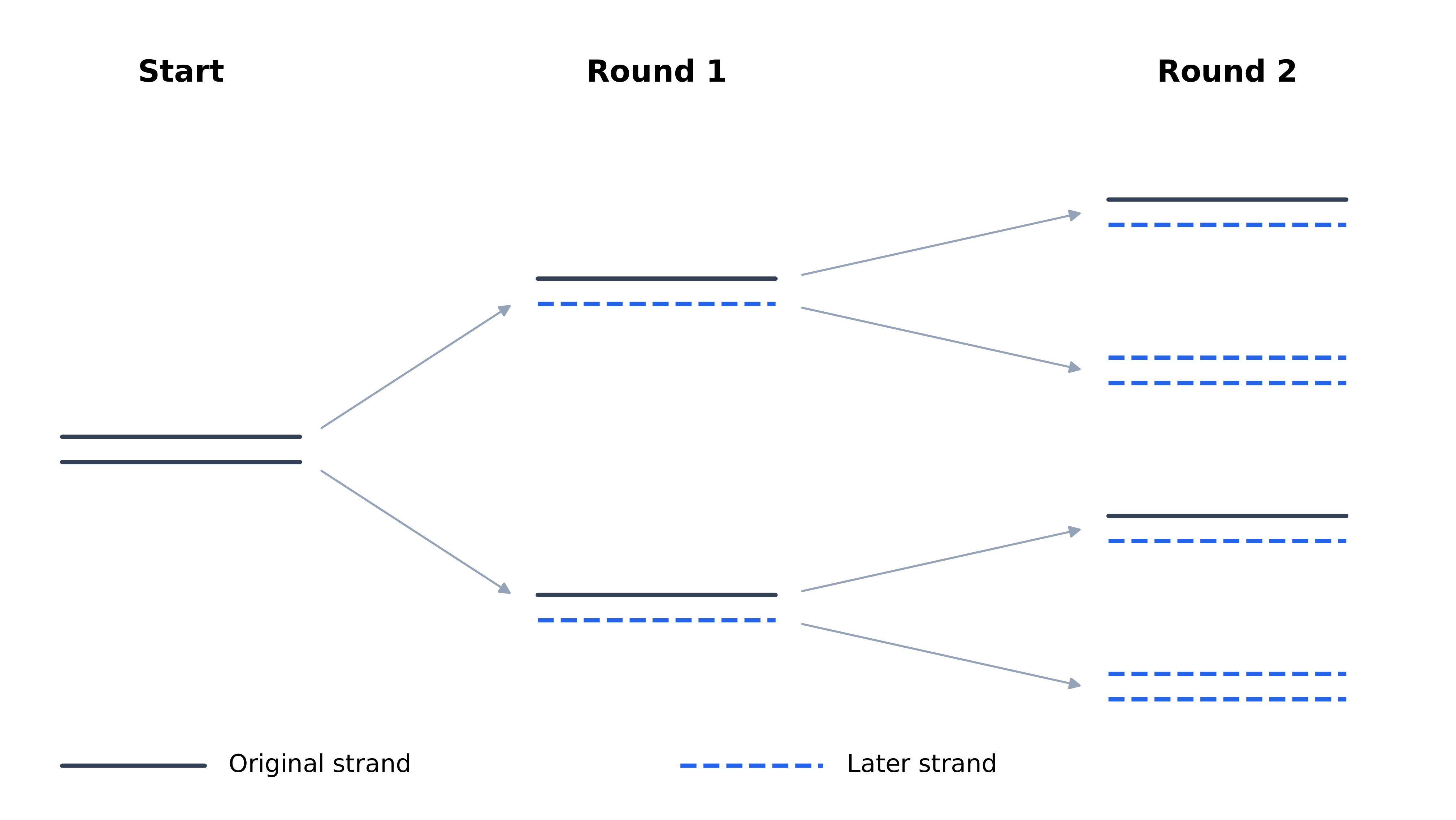
Each pair of parallel lines is one double-stranded molecule. Solid dark lines are the two original strands; dashed blue lines are later strands. Colour is not the only code.
Count molecules separately from original strands
Start with one double helix containing two labelled original strands. All subsequent nucleotides are unlabelled. Assume complete rounds, no strand destruction, no exchange of labelled material and no extra DNA entering the population.
Two different denominators
After one round there are two molecules. Each contains one original strand. After two rounds there are four molecules: two still contain an original strand, while two contain only newly made strands. After three rounds there are eight molecules, but still only two contain an original strand.
The fraction of molecules containing an original strand after three rounds is $2/8=25\%$. However, eight double helices contain sixteen individual strands, of which only two are original: $2/16=12.5\%$. The different percentages have different denominators. A strand made in round one becomes a template in round two, but it does not thereby become an original labelled strand.
Distinguish a model from experimental evidence
Meselson and Stahl grew bacteria using heavy nitrogen, then transferred them to a light-nitrogen supply. Their 1958 study separated extracted DNA by buoyant density in a caesium chloride gradient. After one generation the DNA had intermediate density; later intermediate and light components appeared, supporting conserved parental contributions to daughter molecules. Heavy nitrogen here was a stable isotope, not a radioactive tracer. This was density-gradient centrifugation, not separation of fragment lengths in a gel.
Meselson and Stahl: one hybrid band after one generation, then hybrid and light bands, as semi-conservative replication predicts
The authors explicitly discussed the limits of what their measurements established about molecular subunits. A classroom old/new-strand drawing expresses a mechanism and predicts observations; the drawing itself is not a photograph of enzyme action. See the original research paper, especially Figures 4–6 and the associated discussion.
Explore
Two original strands, more DNA molecules
After two complete rounds, 2 of 4 molecules retain an original labelled strand: 50%. Track each original strand across rounds and distinguish the fraction of molecules from the fraction of strands.
Helicase opens the template and polymerase builds new DNA
Helicase unwinds and separates the paired DNA strands by disrupting hydrogen bonds between complementary bases. It does not normally cut each sugar–phosphate backbone into nucleotides. Keeping those covalent backbones intact preserves the ordered templates.
Helicase breaks hydrogen bonds; polymerase makes covalent bonds
DNA polymerase DNA聚合酶 catalyses synthesis of a new DNA strand using a template and available DNA nucleotides. Complementary pairing guides which base is incorporated; the enzyme joins nucleotides into the new covalent sugar–phosphate backbone. Hydrogen bonding between paired bases and covalent bonding along a strand are different relationships.
A clear basic explanation therefore has a sequence: open the double helix, expose each template, pair appropriate nucleotides and build new strands. Saying only “the DNA splits and copies itself” omits both the template mechanism and the different enzyme roles.
24.5
PCR amplifies a selected DNA region through temperature cycles
The polymerase chain reaction, PCR, makes many copies of a selected region outside living cells. It can provide sufficient material for later analysis when the starting quantity is small. PCR is amplification; it is not itself a method for sorting fragments by size or identifying a person's complete genome.
A thermal cycler (PCR machine) makes many copies of a DNA sample
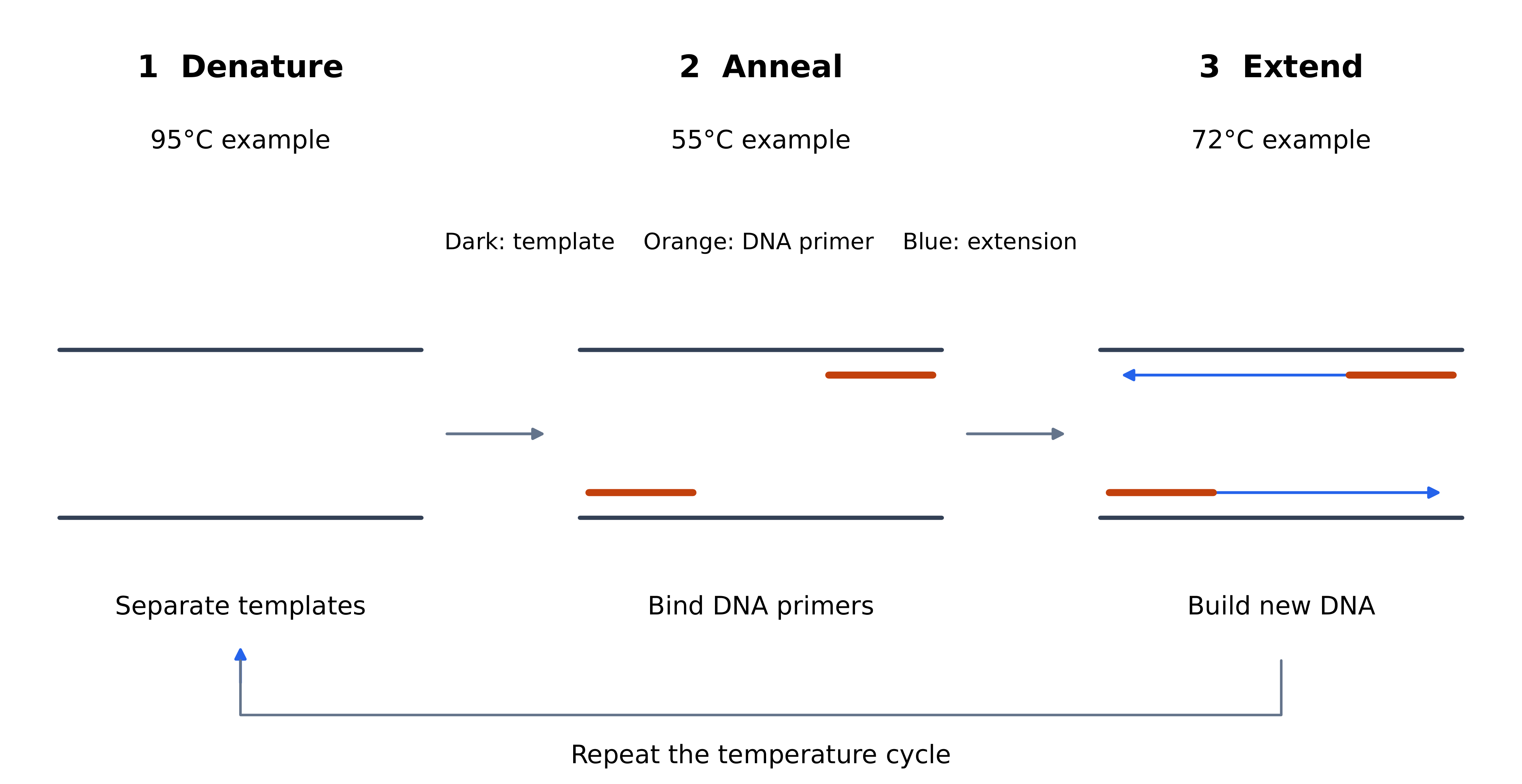
A reaction needs template DNA, two suitable short DNA primers, free DNA nucleotides, a thermostable DNA polymerase such as Taq, and an appropriate buffer including required ions. The primers pair with opposite templates at sites flanking the chosen region. Their sequences help determine what is amplified, so the same primer pair does not automatically copy every gene in a sample.
Stage
Main event
Denaturation
Heating separates paired DNA strands
Annealing
Cooling permits primers to pair with matching sites
Extension
Polymerase extends from the bound primers
A cycle uses about 95°C for denaturation, 55°C for annealing and 72°C for extension with a suitable Taq-based protocol. These are examples, not settings guaranteed to work for every primer and enzyme. Annealing depends on primer sequences; extension conditions depend on enzyme and product length. Manufacturer optimization guidance gives ranges and protocol-specific differences.
The temperatures illustrate one suitable protocol. Heating separates the templates in PCR; the reaction does not need helicase to perform that step.
Taq is useful because it tolerates repeated high-temperature stages. This does not mean its main extension stage occurs at the denaturation temperature, or that the enzyme must be added afresh after every cycle. Primers provide the starting points; free nucleotides provide material for the new DNA. They are not interchangeable ingredients.
Use an ideal doubling model with stated limits
Suppose five defined double-stranded target molecules are initially present and every target is copied once per cycle. Under this simplified ideal model, the target population doubles each cycle:
The polymerase chain reaction doubles the DNA each cycle
$$N=N_0\times2^n$$
Here $N_0$ is the starting number, $n$ the number of complete cycles and $N$ the resulting number. After ten cycles, $N=5\times2^{10}=5120$ target copies. Five additional ideal cycles multiply the current population by $2^5=32$, rather than adding five copies.
Real PCR does not double indefinitely. Reagents become limiting, products can interfere with the reaction, some templates fail to amplify and incorrect products can form. In the earliest cycles from longer genomic templates, not every new strand has both ends defined by the primer sites. Treat the equation as the stated ideal target-copy model, not an exact inventory of every early molecular product or a guaranteed experimental yield.
24.6
Gel electrophoresis separates DNA fragments mainly by size
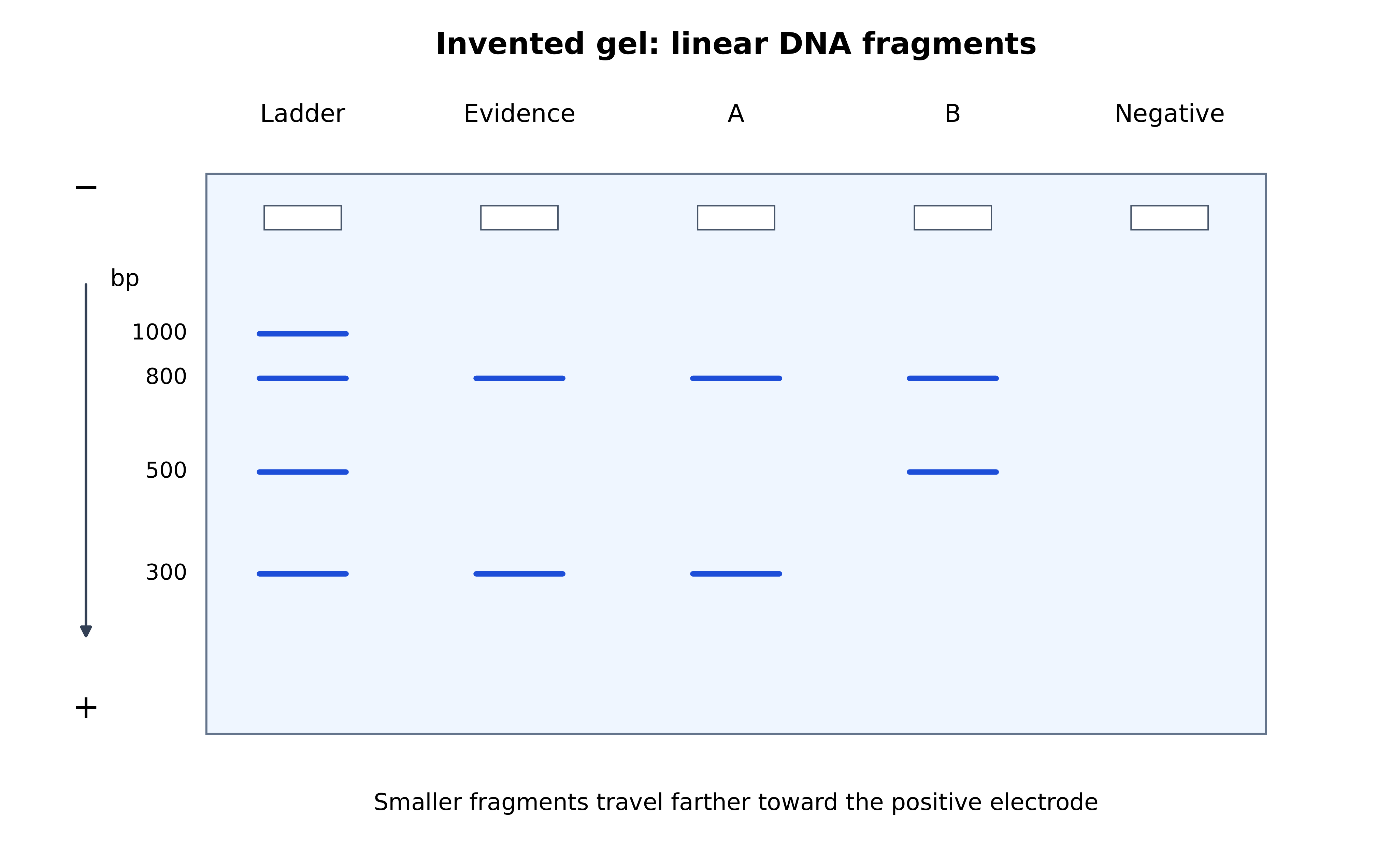
DNA's phosphate backbone carries negative charge. In a suitable agarose gel and buffer, DNA moves from wells near the negative electrode toward the positive electrode. The gel acts as a molecular sieve: smaller linear double-stranded DNA fragments generally travel farther than larger ones during the same run under comparable conditions.
Load a size ladder containing fragments of known lengths beside the samples. Compare sample-band positions with the ladder to estimate fragment lengths in base pairs. A band contains many fragments of similar size, made detectable by an appropriate stain or label; it is not one visible DNA molecule or one base.
All lanes share the same run. The evidence pattern matches comparison A at these illustrated fragment sizes; comparison B differs. The negative-control lane has no visible bands.
In this example, the evidence and comparison A have fragments corresponding to 800 and 300 base pairs. Comparison B has 800 and 500. The shared 800-base-pair band alone cannot establish that B matches the full pattern. Smaller fragments appear farther from the wells; 300 base pairs is not a longer fragment merely because its band travelled farther.
Distance travelled is not generally a simple linear measure of fragment length in base pairs. Use the ladder and a suitable calibration, often involving the logarithm of fragment size, rather than declaring that twice the distance means half the base pairs. DNA conformation also matters: comparisons among supercoiled plasmids, nicked circles and linear DNA require extra care beyond this linear-fragment model.
Controls help distinguish a result from a failed test
A negative amplification control contains the reaction materials but no intended template. A target-sized band in it raises concern about contamination or unintended amplification. It is not an extra matching person. A positive control tests whether a known suitable template can produce the expected product under the procedure.
If every sample and the positive control lack bands, “none of these people has DNA” is not a valid conclusion. Reagents, amplification, loading or detection may have failed. If the negative control contains product, investigate before treating the sample profiles as reliable. Clean controls support interpretation but cannot eliminate every possible sampling or handling error.
24.7
DNA profiles compare inherited markers rather than whole identities
DNA profiling compares selected variable regions. At a simple autosomal marker, a person normally has two inherited alleles, one from each biological parent. Length differences at suitable markers can be amplified and compared. Actual profiling uses validated multi-marker procedures; the small examples here teach the logic, not an operational forensic protocol.
A real gel under UV light: the left lane is a DNA ladder, and the glowing bands show how the fragments have separated by length
PCR supplies copies of selected marker regions. Separation reveals product sizes. The analysis then compares alleles across several markers. Equal fragment size does not prove identical base sequence throughout a fragment, and agreement at one marker does not prove that two samples came from the same person.
A paternity example tests inheritance at every marker
Person
Marker 1
Marker 2
Mother
12, 14
7, 9
Child
14, 16
9, 12
Candidate A
16, 18
10, 12
Candidate B
20, 22
10, 12
Reading the markers: one child allele must come from the mother, the other from the father (allele labels)
At marker 1 the child's 14 can come from the mother; 16 must come from the other parent under the stated simple inheritance model. At marker 2 the corresponding required paternal allele is 12. A can supply both required alleles and is consistent at these markers. B cannot supply 16 and is inconsistent at marker 1, assuming correct samples, accurate measurements and no relevant mutation.
Consistency at two markers does not prove paternity. More suitable, sufficiently independent variable markers reduce the probability of an unrelated person matching by chance. Related people can share more alleles than unrelated people. An exclusion or match also depends on quality controls, mixtures, mutation and the statistical model. Do not invent a universal false-match probability from the number of bands alone.
A forensic match is evidence, not a complete account of events
A matching profile can support the proposition that a person contributed DNA to a trace. It does not by itself establish when the material arrived, how it was transferred or whether the person committed an offence. Mixed contributors, contamination, degraded DNA and missing alleles can complicate interpretation.
Gel electrophoresis: DNA moves towards the + end, and shorter fragments travel further, sorting them by length
The NIST explanation of DNA mixtures shows why trace evidence needs careful interpretation. Document sample provenance and handling, compare appropriate controls and use other evidence. Increasing reliable marker measurements strengthens discrimination, but repeating the same contaminated sample is not equivalent to obtaining independent corroboration. Identical twins also show why DNA sequence similarity cannot be equated automatically with one unique identity in every context.
24.8
Practice
Explain why DNA replication is required in growth, tissue replacement and reproduction. Distinguish it from transcription and chromosome separation, and qualify the claim that copied DNA is always perfect.
An aligned template segment is C–A–T–G–G–A. Write the complementary DNA segment. Explain how pairing and semi-conservative replication preserve sequence information.
One double helix has two labelled original strands. After five complete rounds using unlabelled material, calculate the number of molecules, the number containing an original strand, and the percentages of molecules and of individual strands carrying original material. State assumptions.
A student says helicase breaks covalent backbones and polymerase supplies hydrogen bonds instead of making a new backbone. Correct both statements and identify the templates and building material.
List the essential PCR materials. Explain the purpose of a cycle at temperatures of 95°C, 55°C and 72°C, and why primers and Taq are needed. Explain why the temperatures are not universal constants.
An ideal PCR model starts with two defined double-stranded targets. Calculate the number after twelve complete doubling cycles and the factor produced by five more cycles. Give two reasons a real reaction may differ.
In the illustrated gel, identify the electrode toward which DNA moves, the smaller of the 800- and 300-base-pair fragments, and the comparison lane matching the evidence pattern. Explain why one equal-sized band cannot establish identity.
A sample has no visible bands and its positive control also fails. In another run the negative control has a target-sized band. Explain the separate problems and an appropriate response before interpreting profiles.
In the paternity table, identify the required paternal allele at each marker. Decide which candidate is inconsistent with the simple model and explain why the other is not thereby proven to be the father.
A trace and a reference match at one variable marker. Explain why more markers improve discrimination and identify two reasons a multi-marker match still does not establish guilt.
Compare the old/new-strand model, the historical heavy-nitrogen experiment, PCR and gel electrophoresis. For each state its purpose and what it cannot establish by itself.
24.9
Worked answers
New cells and descendants need appropriate DNA sequences. Replication makes DNA from DNA before distribution; transcription makes RNA for expression, and chromosome separation distributes existing copies. Complementary pairing and correction support high fidelity, but errors can escape, so perfect copying is not guaranteed.
G–T–A–C–C–T. Each exposed parental strand specifies its complementary bases; polymerase builds the new strand. Each daughter molecule retains one parental strand with one newly made partner. Complementary paired sequences are not identical left-to-right sequences.
Molecules $=1\times2^5=32$. Two retain one original strand, so $2/32\times100=6.25\%$ of molecules contain original material. There are 64 individual strands, of which two are original: $2/64\times100=3.125\%$. Assume complete rounds, intact original strands and no label exchange or additional labelled input.
Helicase disrupts hydrogen bonding between paired bases and separates the strands; their covalent backbones remain intact as templates. Polymerase incorporates complementary free DNA nucleotides into a new covalent backbone. Base pairing across strands and backbone bonding along strands have different roles.
Template, two suitable DNA primers, free DNA nucleotides, thermostable polymerase and suitable buffer/ions. Heating separates strands; cooling permits primer pairing; extension builds new DNA from those starting points. Taq tolerates repeated heating. Primer sequences and enzyme/product properties determine suitable conditions; 95/55/72°C is an example protocol.
$N=N_0\times2^n=2\times2^{12}=8192$ target copies. Five more ideal cycles multiply this by $2^5=32$. Incomplete amplification, reagent limitation, interfering products or incorrect priming can change the yield. The model assumes defined targets and complete doubling, not exact counting of all early genomic-template products.
Toward the positive electrode because DNA is negatively charged. The 300-base-pair fragment is smaller and travels farther in this comparable linear-fragment run. A matches the illustrated 800/300 pattern; B's 800/500 pattern differs. One band represents size agreement, not necessarily the same sequence or a unique person.
A failed positive control means the procedure has not demonstrated successful amplification/detection; the sample's blank cannot safely be treated as a valid negative. Product in the negative control raises contamination or unintended-amplification concerns. Investigate reagents, handling and controls and repeat appropriately before accepting the profiles.
The required paternal alleles are 16 at marker 1 and 12 at marker 2. B lacks 16 and is inconsistent under the stated error-free, no-mutation model. A can supply both, but other people may also have those alleles. More markers, appropriate statistics and reliable sampling are required for a strong inference.
More sufficiently independent variable markers reduce a chance match because agreement must extend across more inherited variation. A match still does not establish the time or mechanism of deposition or an offence. Contamination, transfer, mixtures or sample errors can matter; profile evidence must be interpreted with controls and the case's other evidence.
A strand model predicts semi-conservative inheritance but is not an observation of enzymes. The historical study tested parental contributions through DNA density, not gel fragment length; its authors discussed molecular interpretation limits. PCR amplifies selected regions without proving identity. A gel separates comparable fragments by size without reading their complete sequences or proving paternity/guilt.
24.10
Exam tips
Name the molecule and denominator: parent strand, new strand, double helix and individual strand are different counting units.
Explain each PCR temperature change, each ingredient and each control. Amplification, separation and profile interpretation are separate steps.
Read a gel from the wells and electrode labels; smaller comparable fragments travel farther. A marker match is not a whole-genome identity or proof of guilt.
More topics in International Baccalaureate · IB Diploma · Biology · SL