Why can a dune grass survive drying wind while a mangrove tree grows in salty, oxygen-poor mud? Both need water and oxygen, but the obstacles to obtaining them differ. Explain each feature through a chain: environmental condition → effect on the organism → mechanism → benefit and possible cost.
This unit covers all B4.1 SL and HL understandings: habitats, adaptations, abiotic limits and transects, reef-building conditions, climate and biomes, convergence, and named desert/rainforest plants and animals. There is no additional higher-level content in B4.1. Prerequisites are water movement, gas exchange and natural selection. Scope follows the IB Biology guide.
14.2
Describe a habitat at an appropriate scale
A habitat is the place where an organism, population, species or community lives. A useful description can combine a geographical location, ecosystem type and physical position. “A coastal dune in northwest Europe” gives more information than “on land”; “the exposed sand near the seaward edge” distinguishes a microhabitat from the sheltered dune interior. A whole ecosystem includes the organisms and their interactions with the physical environment; habitat describes the place occupied.
One dune, several scales: region, ecosystem type and two contrasting microhabitats.
Abiotic variables are non-living physical or chemical conditions, such as temperature, light, soil water, pH, salinity and dissolved oxygen. Biotic influences include competitors, food organisms and predators. The two interact: shade from a neighbouring plant is caused by a living organism but changes the abiotic light environment. Do not infer a single cause from a location label alone.
An adaptation 适应 is a heritable feature that contributes to survival or reproduction in a particular environment. Natural selection acts on variation across generations. Reversible changes within one individual, such as leaf rolling as water status changes, use an inherited response system; the plant does not evolve a new species-level adaptation during one dry afternoon. A convincing explanation identifies the inherited capacity and the immediate physiological response separately.
A dune grass reduces water loss while colonizing unstable sand
Marram grass, Ammophila arenaria, is a xerophyte 旱生植物 adapted to dry conditions in coastal dunes. Sandy soil drains rapidly, exposed wind removes moist boundary air, and moving sand can bury shoots. These are several challenges, not one vague “harsh environment”.
Marram grass binding a sand dune
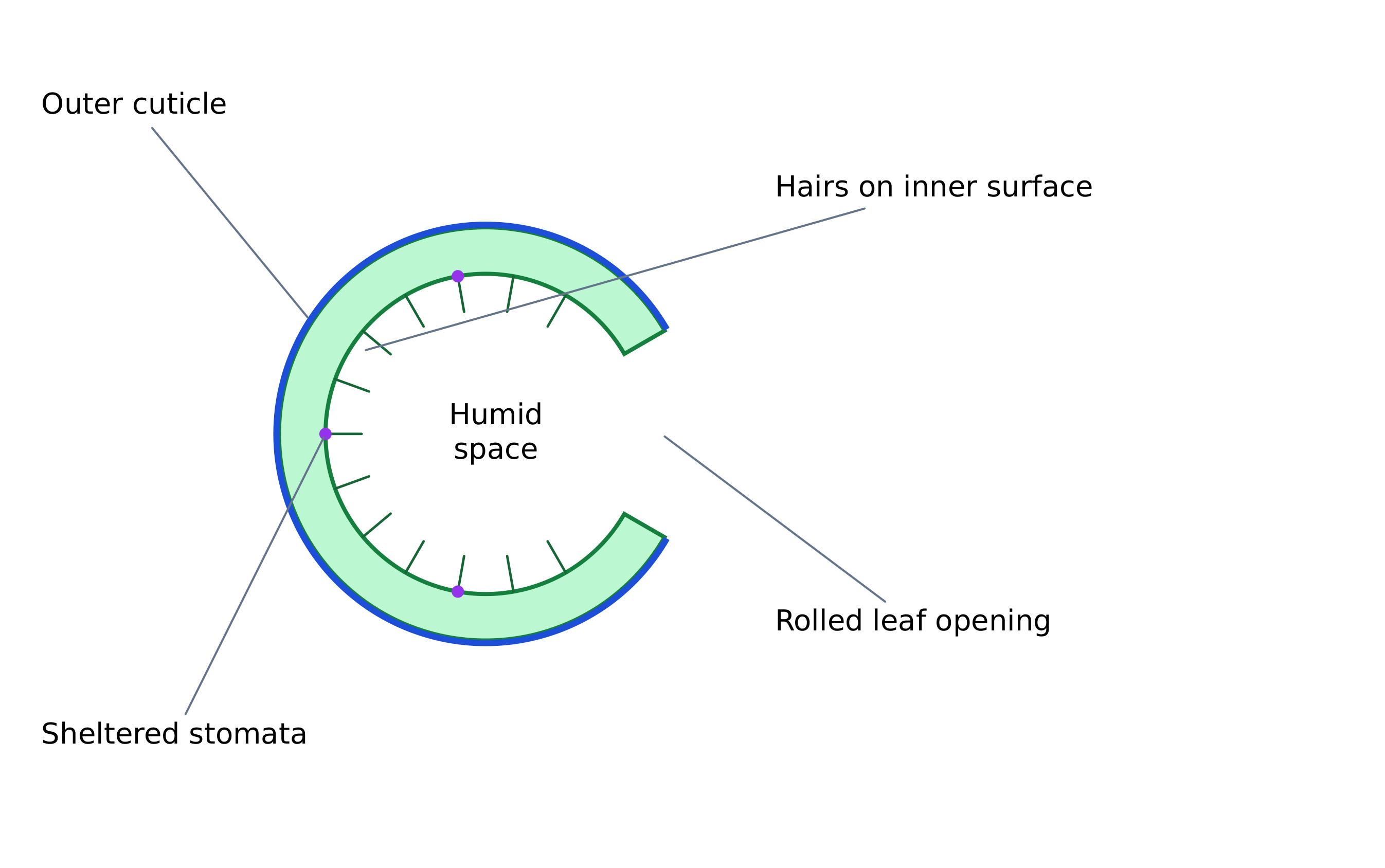
Its leaf can roll so that the surface bearing stomata faces an enclosed space. Hairs and grooves on this inner surface restrict air movement near stomata; humid air is retained, reducing the water-vapour gradient and slowing water loss. A cuticle reduces loss across the outer surface. The published anatomical study describes rolling associated with water loss from bulliform cells; favourable water status can permit unrolling. Do not say that rolling makes stomata disappear or prevents all transpiration.
The section separates tissues to explain water-loss mechanisms; it is not a traced microscope specimen.
Rhizomes spread below the surface, help anchor the plant and allow new shoots to emerge as sand accumulates. These traits help the plant occupy a dynamic substrate. Conserving water also has costs: reduced stomatal conductance can restrict carbon dioxide entry and photosynthesis, and rolling can change illuminated area. A feature is advantageous in context, not universally superior to every broad flat leaf.
In a comparison, water loss changes from 10 to 4 milligrams per square centimetre per hour, while an assimilation index changes from 12 to 6 units. Water loss falls by $60\%$, but assimilation falls by $50\%$.
A mangrove separates salt management from root aeration
Grey mangrove, Avicennia marina, occupies intertidal coastal habitats. Saline surroundings lower external water potential, making water uptake difficult even when the ground is wet. Waterlogged mud also has restricted oxygen supply because gas diffusion through water is slow and organisms consume oxygen. Salinity stress and oxygen shortage need different explanations.
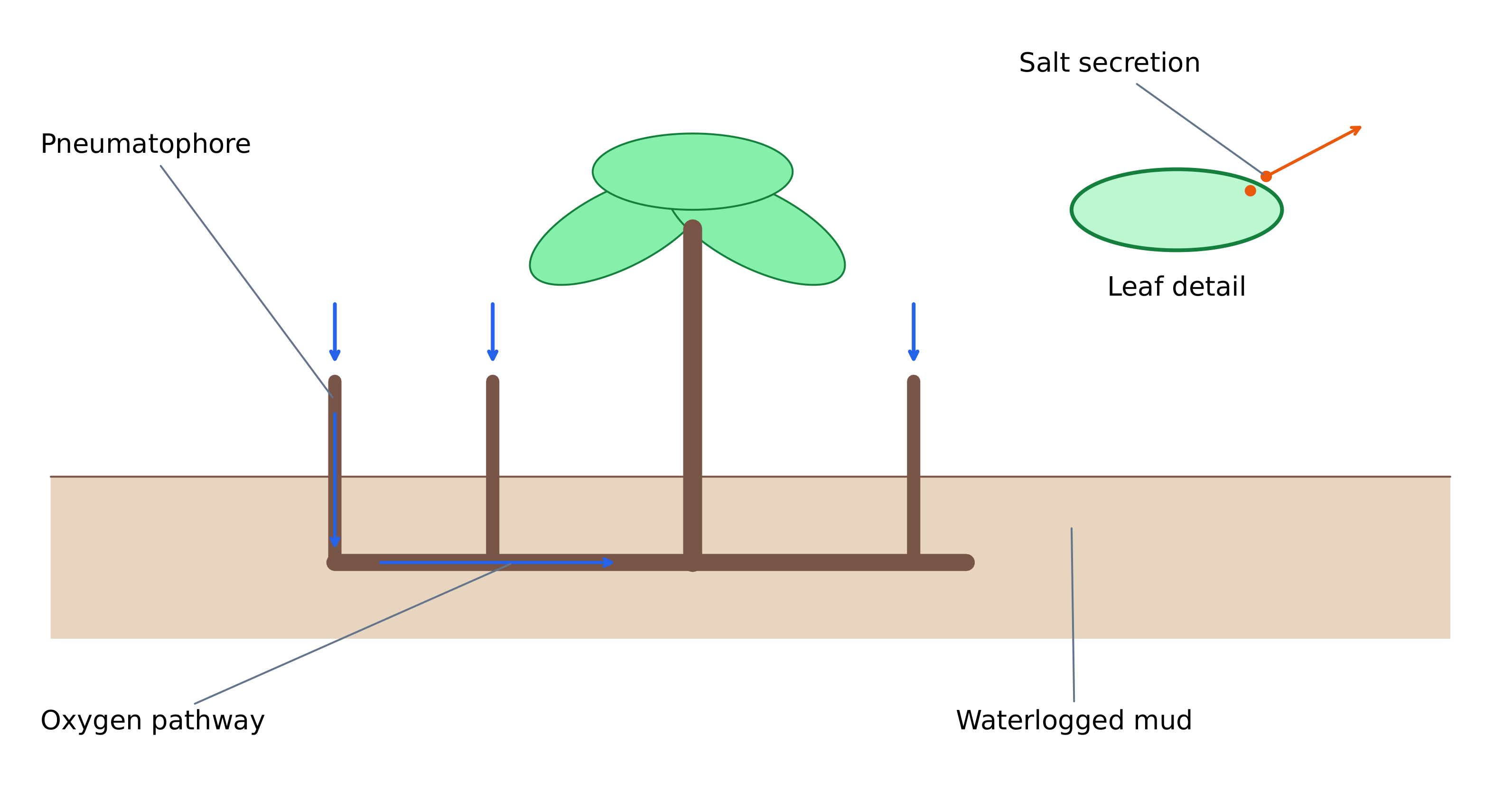
NParks describes its shallow lateral roots and upright pencil-like pneumatophores. When exposed above the mud and water, these breathing roots provide routes for atmospheric oxygen to enter through suitable surface pores and reach internal air spaces connected to below-ground tissues. Oxygen supports aerobic respiration. Pneumatophores do not photosynthesize enough oxygen to remove the need for gas exchange, and high tide can temporarily restrict atmospheric access.
Salt exclusion at roots limits entry, while salt glands on leaves can remove some salt that enters. The Smithsonian leaf account illustrates glands in A. marina. Salt handling requires selective transport and has limits; a mangrove is not freely drinking seawater without an osmotic challenge. Leaf structures that limit water loss complement salt management, rather than replacing the need to take up water.
Trace air entry above the mud separately from salt removal at leaves. Tide level changes which surfaces are exposed.
Different mangrove species use different root structures and proportions of exclusion/secretion. Do not attach every mangrove feature to every species. A prediction worth testing is that blocking exposed gas-entry surfaces reduces root oxygen availability under otherwise matched conditions; field observations alone would not isolate that mechanism from flooding duration and sediment differences.
14.5
Tolerance ranges constrain distribution without explaining it alone
A species can maintain survival and reproduction only within tolerable conditions. Below or above a limiting range, enzyme activity, membranes, water balance or other functions may fail. Within a range, performance can vary; the conditions permitting survival may be wider than those permitting successful reproduction. A limiting factor is a condition or resource that restricts a process under the circumstances, even if other requirements are suitable.
A camel is adapted to desert life: it stores fat in its humps and can survive a long time without waterWithin its optimal range a species thrives; toward the limits it is stressed, then cannot survive
For a plant, soil moisture can restrict uptake and photosynthesis; salinity can restrict water uptake despite wet soil. For a fish such as brown trout, Salmo trutta, water temperature and dissolved oxygen affect the balance between oxygen demand and supply. These variables can covary: warm water generally holds less dissolved oxygen at equilibrium, while metabolic demand can rise within a tolerable temperature range. Do not claim that a temperature alone predicts every trout's distribution.
An observed absence does not prove physiological intolerance. Suitable sites may lack dispersing individuals, contain competitors or predators, or have a history of disturbance. Conversely, an adult surviving briefly does not prove that a self-sustaining population can reproduce there. Distinguish physiological tolerance from the actual occupied distribution.
14.6
Transects test associations along an environmental gradient
Lay a transect across a measured gradient in a permitted natural or semi-natural habitat. A semi-natural site is influenced by people but dominated by wild species, rather than a planted crop or garden bed. Use fixed intervals or a stated stratified design, sample equal quadrat areas, record organisms consistently and measure the abiotic variable at each position. Repeat independent transects rather than treating adjacent quadrats on one line as independent whole habitats.
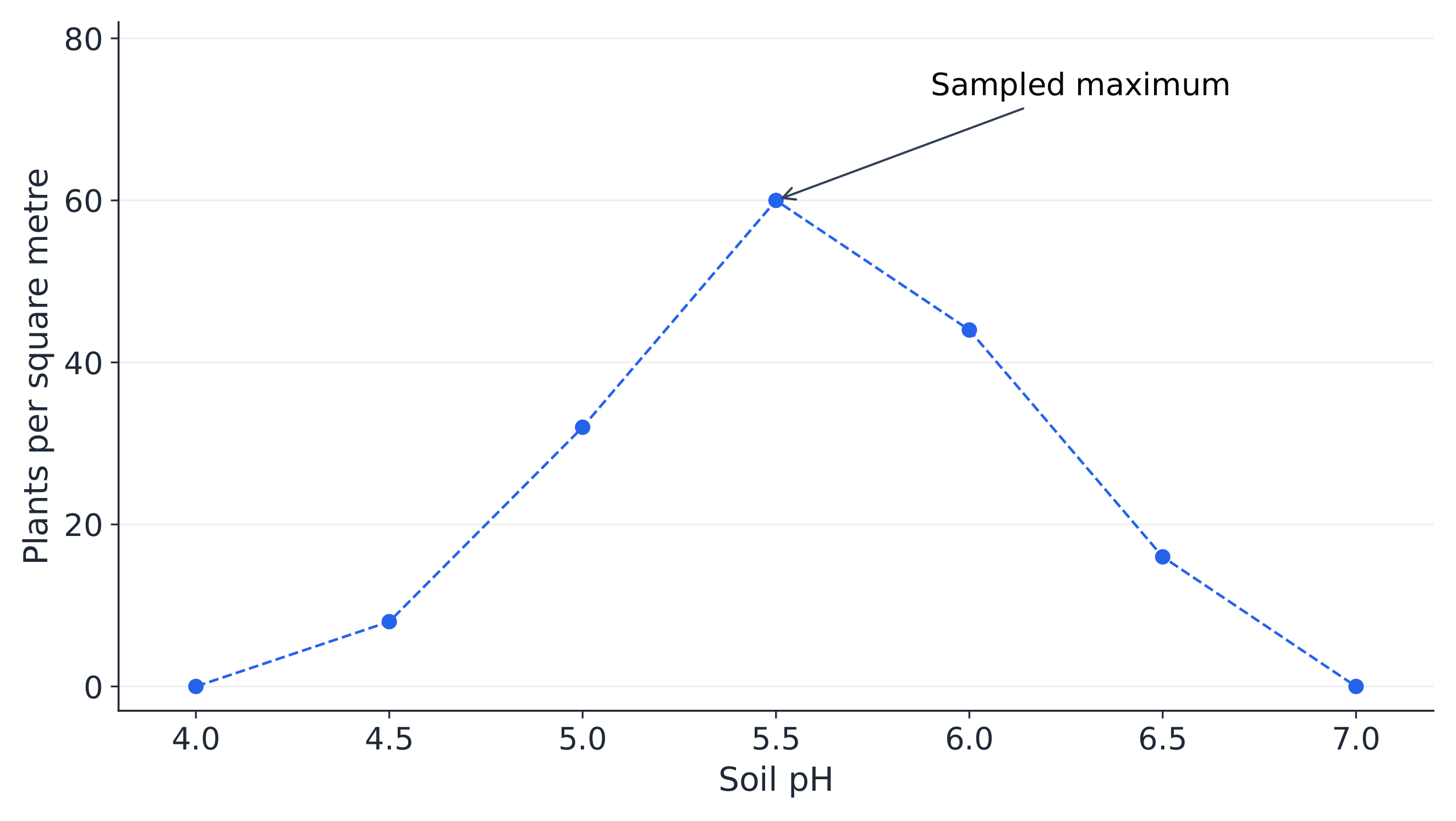
Teaching data for plant P are shown below. Each row represents one 0.25-square-metre quadrat; these are not real marram or mangrove measurements.
Distance along line / m
Soil pH
Plant P count
0
4.0
0
10
4.5
2
20
5.0
8
30
5.5
15
40
6.0
11
50
6.5
4
60
7.0
0
Exam tips
Name the species, variable and mechanism. Keep observed distribution separate from physiological limits, percentages from percentage points, and broad climate models from exact local predictions.
Points show field observations. Connecting them is a visual guide, not proof of a physiological tolerance curve.
Density at pH 5.5 is $15/0.25=60$ plants per square metre. The species was recorded from pH 4.5 to 6.5 among sampled positions, with the highest count at 5.5. Do not report 4.5 and 6.5 as exact lethal limits: only seven positions were sampled, and other factors may vary along the line. The rise followed by decline also warns against fitting one straight trend and concluding that weak linear correlation means no association.
Calibrate a pH sensor with appropriate standards; use a consistent soil-water preparation and record sampling depth. Measure moisture, light and vegetation cover as possible confounders. For light sensors, standardize height and orientation; for temperature, state time and depth. Repeat seasons if the claim concerns year-round distribution. A controlled comparison across pH treatments could help separate pH from covarying field conditions, but its results would still depend on the life stage and other conditions tested.
14.7
Shallow reef formation requires several compatible conditions
A coral is an animal. Many shallow tropical reef-building corals contain photosynthetic symbionts that provide organic products. Clear, illuminated water supports this partnership; excessive depth or turbidity reduces light. Settling sediment can also smother surfaces. Depth therefore acts partly through light, rather than because a coral recognizes a depth number.
A coral reef: warm, sunlit, shallow water makes it one of the most productive and biodiverse of all biomes
The NOAA reef-water account describes warm, clear, saline conditions. Many tropical reef builders grow well around 23–29 degrees Celsius, but species and exposure histories differ. This is not a universal survival interval for all corals: cold-water corals also exist. Sustained anomalous heat can disrupt symbiosis and lead to bleaching, which is loss of symbionts or their pigments; bleaching does not mean the animal has already died in every case.
Salinity should remain within the species' tolerable marine range; strong freshwater inputs can stress colonies. Water chemistry also affects calcium carbonate skeleton formation. Lower pH reduces carbonate availability in seawater and can make calcification more difficult; “lower pH” need not mean below pH 7. Reef accretion requires skeletal construction to exceed losses through erosion and dissolution. Light, temperature, salinity, clarity and carbonate chemistry must be considered together, along with substrate and biological interactions.
In a monitoring example, live coral cover falls from 30% to 18%. This is a 12-percentage-point decrease and a $12/30\times100=40\%$ relative decrease. It is not evidence that 40% of every colony died, and coincidence with a warm period does not isolate warming from storms, disease or survey differences.
14.8
Temperature and precipitation shape broad terrestrial biome patterns
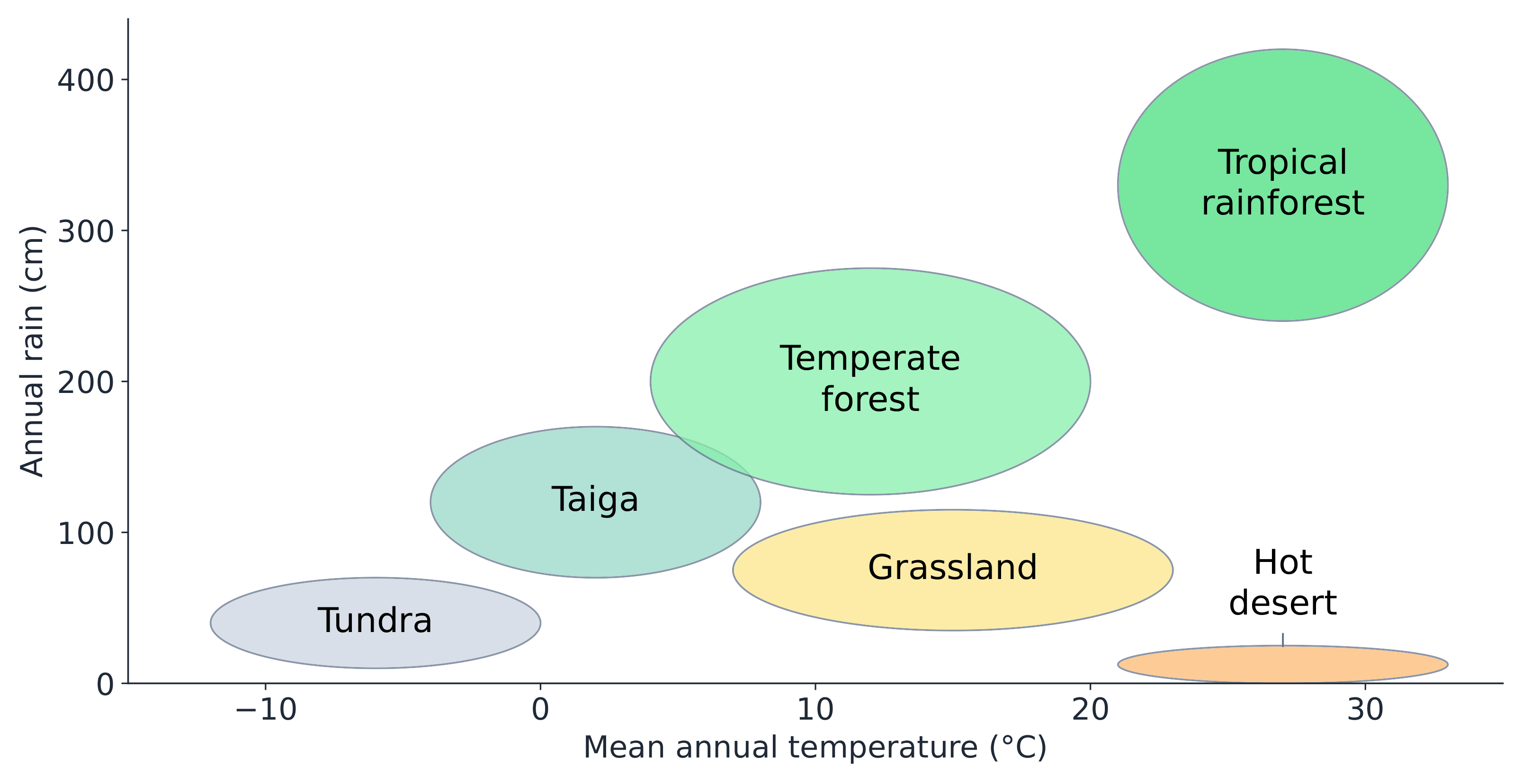
A biome is a broad grouping of ecosystems with characteristic communities and growth forms associated with similar abiotic conditions. Climate influences water supply, temperature limits and growing-season length. Similar climatic filters can favour similar functional traits in different evolutionary lineages: convergent evolution. Similar biome appearance does not require identical species on different continents or organisms with no shared ancestry at all.
Regions illustrate broad tendencies and overlap. They are not mapped boundaries or universal climate thresholds.
Biome
Climate and characteristic vegetation
Tropical forest
Warm conditions and substantial rainfall support tall forest; tropical rainforest has high rainfall and usually a long growing season.
Temperate forest
Moderate temperatures, seasonal changes and adequate water support forests; deciduous and evergreen forms occur.
Taiga / boreal forest
Long cold winters and short growing seasons; conifers are prominent, with needle leaves and many evergreen species.
Grassland
Water availability and seasonality constrain tree cover; fire and grazing can also maintain grass-dominated vegetation.
Tundra
Cold, short growing season and low-growing vegetation; widespread permafrost is important in many Arctic regions.
Hot desert
Very low water supply relative to evaporative demand, often high daytime temperatures; sparse drought-tolerant vegetation.
Mean annual temperature and total precipitation are a useful first model. Seasonality, freezing, soil, altitude, water drainage, fire, grazing and human land use can produce different local communities at similar annual averages. A wet annual total concentrated into a short season is not equivalent to steady rain every month. A schematic diagram predicts broad possibilities, not the exact ecosystem at every coordinate.
14.9
Named desert and rainforest species illustrate different solutions
Saguaro, Carnegiea gigantea, is a Sonoran Desert cactus. Its succulent stem stores water; pleated ribs allow expansion as stored water increases. Reduced leaves represented by spines limit the broad leaf surface, and a photosynthetic stem carries carbon fixation. Widespread shallow lateral roots exploit brief surface wetting. The National Park Service account describes its root and pleat arrangements. Water storage bridges dry intervals but costs tissue investment and does not make seedlings immune to drought or freezing.
A tropical rainforest: hot and wet all year, giving dense layered plant life and the richest biodiversity of any land biomeA desert: very low precipitation, so only sparse drought-adapted life survives
Fennec fox, Vulpes zerda, is a named desert animal. Large ears provide a high-area surface that can transfer heat when the temperature gradient permits; they also help detect prey. Nocturnal activity reduces exposure to peak daytime heat, and fur on the feet helps protect against hot sand. The Smithsonian species account describes these features. Large exposed surfaces do not guarantee cooling if surrounding conditions favour heat gain. Behaviour and insulation must be considered with geometry.
Kapok, Ceiba pentandra, provides a tropical forest tree example. A tall trunk and crown can place leaves in strong canopy light; large buttresses help support the trunk and distribute mechanical loads. NParks documents its mature buttresses. This is an explanation of support and light access, not a claim that every rainforest tree has the same roots or that a tall tree faces no wind risk.
Geoffroy's spider monkey, Ateles geoffroyi, uses long limbs and a prehensile tail during movement in trees. The tail can support gripping, leaving limbs available while feeding; the Los Angeles Zoo account describes its hairless gripping surface. Arboreal access helps exploit forest food and pathways.
14.10
Use surface-area models with explicit physical limits
Surface area to volume ratio 表面积体积比 compares exposed area with internal volume. For a cube of side $s$, area is $6s^2$, volume is $s^3$, and the ratio is $6/s$. A 1 cm cube has area 6 square centimetres, volume 1 cubic centimetre and ratio 6 per centimetre. A 3 cm cube has area 54, volume 27 and ratio 2 per centimetre. Tripling side length reduces the ratio to one third; it does not reduce total surface area.
As a cube (or cell) grows, its surface area : volume ratio gets smaller
For body models, $400/2000=0.20$ per centimetre is one tenth of 2.0 per centimetre. Under otherwise comparable conditions, lower exposed area per unit volume can reduce exchange per unit internal material. Actual heat and water exchange also depend on gradients, insulation, blood flow, shape and behaviour. A larger body is not universally better in a hot desert; reduced heat loss can be a disadvantage, and ears or specialized exchange surfaces can depart from simple cube scaling.
Explore
Bigger cubes have more area but less area per unit volume
Reproduce the reference's 3 cm cube with 54 cm² of surface and 27 cm³ of volume. Compare side lengths 1 and 3 cm: tripling the side multiplies area by 9 and volume by 27, so area per volume falls from 6 to 2 per cm. Geometry alone does not determine a heat- or water-loss rate.
surface area to volume ratio/ˈsɜːfɪs ˈeərɪə tə ˈvɒljuːm ˈreɪʃɪəʊ/
14.11
Practice
Explain mechanisms and limits, not just feature names.
Describe a dune habitat at geographical and microhabitat scales. Distinguish abiotic and biotic influences, including shade from vegetation.
Explain three marram features and a water–carbon trade-off. Distinguish inherited adaptation from reversible rolling in one plant.
Compare the challenges of saline water and oxygen-poor mud for A. marina. Trace the separate roles of pneumatophores and leaf salt glands.
Define tolerance and limiting factor. Why do field absence and short-term adult survival not establish the limits for a reproducing population?
Use the plant P table to find density at pH 6.0, recorded pH range and the sampled maximum. Explain why neither exact lethal limits nor absence of association follows from these data.
Plan replicated transects across a soil-pH gradient, including quadrat area, sensor checks, two confounders and a limitation of one transect.
Explain depth, clarity, temperature, salinity and pH in shallow tropical reef formation. Correct: “All corals require warm water, and lower pH always means acidic water below 7.”
Reef cover falls from 40% to 28%. Find percentage-point and relative decreases. State two limits of a causal interpretation.
Compare the climates of all six listed biomes. Why can annual temperature/rainfall averages fail to identify a local community? Explain convergence without requiring identical species.
Give a named desert plant and animal and a named rainforest plant and animal. Explain two features of each, including at least one cost or condition-dependent effect.
Calculate area, volume and ratio for 2 cm and 6 cm cubes. State the changes when side length triples and explain two limits of applying cubes to animals.
A model body has area 300 square centimetres and volume 1500 cubic centimetres. Compare its ratio with 1.0 per centimetre. Does this alone prove a lower body temperature?
Two leaf samples each have area 10 square centimetres and are measured for 15 minutes. They lose 0.030 g and 0.012 g water. Calculate loss rates in milligrams per square centimetre per hour and percentage reduction. Assimilation indices are 20 and 12 units: evaluate the trade-off and name controls.
14.12
Worked answers
A coastal dune in a named region describes geographical/ecosystem location; exposed seaward sand versus a sheltered interior identifies microhabitats. Wind, water availability and temperature are abiotic. Neighbouring plants are biotic but can change light, an abiotic variable. State both cause and measured condition.
Rolling shelters the stomatal surface; hairs/grooves retain humid air and reduce vapour gradients; cuticle limits surface loss. Rhizomes anchor/spread and support emergence after sand deposition. Restricted gas exchange can reduce carbon gain. The inherited response system is an adaptation; one plant's immediate rolling is a physiological response, not evolution during that afternoon.
Salt lowers external water potential; flooded mud restricts oxygen. Exposed pneumatophores permit air entry and internal oxygen movement for root respiration. Leaf glands remove some salt; root exclusion limits entry. These mechanisms are distinct, energy/resource costs and limits remain, and tides affect exposure.
Tolerance is the conditions permitting a specified function such as survival or reproduction; a limiting factor restricts performance in context. Field absence can reflect dispersal, competition or disturbance. An adult surviving briefly does not show successful breeding or persistence through the life cycle.
Density $11/0.25=44$ plants per square metre. Recorded pH range 4.5–6.5; sampled maximum pH 5.5, 60 per square metre. Sparse sampling and confounding prevent exact lethal-limit claims. The hump-shaped association need not have strong linear correlation.
Place multiple independent lines across the gradient with a stated selection method; sample equal areas at stated intervals, identify/count consistently and measure pH with calibrated equipment and consistent preparation/depth. Record moisture and light or other justified confounders. Adjacent positions on one line share conditions/history; repeat sites or seasons as the claim requires.
Depth and clarity affect light available to symbionts; sediment can smother. Suitable warmth supports tropical reef growth but excessive sustained heat stresses it. Salinity must be tolerable; lower pH can reduce carbonate availability/calcification even above 7. Cold-water corals exist. Reef growth requires skeletal construction to exceed losses; no single favourable factor guarantees it.
Decrease $40-28=12$ percentage points; relative decrease $12/40\times100=30\%$. Check comparable survey methods, disturbance/disease, exposure histories and replication. Cover is area fraction, not a percentage of every colony killed; association alone does not isolate a cause.
Tropical forest: warm/wet; temperate forest: moderate/seasonal with adequate water; taiga: long cold winter/short growing season; grassland: water/seasonality plus fire/grazing constrain forest; tundra: cold, short growing season; hot desert: low water relative to evaporative demand. Seasonality, soil, drainage, disturbance and land use modify annual-climate predictions. Similar selection pressures can favour similar functional traits in different lineages without identical species.
Saguaro: water-storing pleated stem and shallow spreading roots, with tissue investment/seedling limits. Fennec: ears for heat exchange/prey detection and nocturnal activity or protected feet; cooling depends on the gradient. Kapok: crown reaches light and buttresses support tall growth, without eliminating wind risk. Geoffroy's spider monkey: long limbs and a gripping tail facilitate arboreal movement/feeding; not every primate shares these features.
Side 2 cm: area 24 square centimetres, volume 8 cubic centimetres, ratio 3 per centimetre. Side 6 cm: area 216, volume 216, ratio 1 per centimetre. Tripling side multiplies area by 9 and volume by 27, reducing ratio to one third. Shape, insulation, gradients, circulation and behaviour alter actual animal exchange.
Ratio $300/1500=0.20$ per centimetre, one fifth of 1.0. It predicts less exposed area per unit volume in this model, not temperature by itself. Heat production, environmental temperature, insulation, evaporation and other fluxes also matter.
Time is 0.25 hour; masses are 30 and 12 mg. Rates $30/(10\times0.25)=12$ and $12/(10\times0.25)=4.8$ milligrams per square centimetre per hour. Water-loss reduction $(12-4.8)/12\times100=60\%$; assimilation reduction $(20-12)/20\times100=40\%$. Saving water costs carbon gain; test growth/reproduction. Match species/genotype, leaf age, light, temperature, humidity, airflow and time; replicate independently.