This handout covers D3.3: internal conditions, negative feedback, blood glucose, diabetes and human thermoregulation. Sections marked AHL are for Higher Level only.
Prerequisites: membranes, transport, hormones, cell respiration and blood circulation.
A person can move from a warm room to a cool street while their cells continue working. The external environment changes more than the conditions immediately surrounding those cells. Homeostasis 稳态 is regulation of the internal environment within suitable limits despite disturbances. Relevant human variables include core temperature, blood pH, blood glucose concentration and blood osmotic concentration.
Sweating cools the body — part of temperature homeostasis, with the skin as the effectorValues: the external environment swings, the internal environment stays within limits.
The internal environment includes blood plasma and tissue fluid around cells; it is not simply the air beside the skin. Enzymes and membranes work within ranges of temperature, pH and solute conditions. Excessive change can alter reaction rates, protein structure, ion gradients or cell volume. Regulation therefore supports coordinated metabolism, rather than keeping a number constant for its own sake.
A set point is a reference around which a variable is regulated. Use a suitable range and allow ordinary fluctuations, measurement error and time delays. A classroom reference of 5.0 mmol/L for blood glucose is a model value, not a universal target for every person and situation. Different measurement sites can also give different temperature readings.
Homeostasis requires continued exchange and energy use. A steady internal concentration can coexist with rapid entry and removal of substances. An unchanged glucose value does not mean that glucose is neither absorbed nor used.
Negative feedback opposes deviations in either direction
A negative feedback 负反馈 loop links detection, coordination, signalling and an effector response. A detector responds to the regulated variable; a coordinating process relates that information to a suitable reference; effectors change relevant fluxes. One tissue can perform more than one role. Pancreatic endocrine cells can detect glucose changes and alter hormone secretion without every correction first requiring a separate decision in the brain.
Negative feedback: a receptor detects a change and an effector corrects it, returning to normal
If glucose rises, a response that increases its removal from blood opposes the rise. If it falls, a response that increases supply to blood opposes the fall. As the deviation decreases, the corrective drive generally decreases. Negative refers to opposition to the disturbance, not a negative measured concentration or a harmful effect.
Positive feedback reinforces an initial change. For example, cervical stretch and oxytocin can amplify uterine contractions until delivery removes the major stimulus. Such amplification can complete a specific event, but by itself it does not stabilize a variable above and below a reference. Homeostatic control therefore commonly uses negative feedback.
Detection, hormone transport and cellular responses take time. A delayed response can allow a peak or a small overshoot before recovery. Neither a perfectly horizontal line nor instantaneous correction is required for homeostasis. Conversely, every return toward an initial value is not proof of one particular feedback mechanism: the disturbance may simply have ended.
Explore
Negative feedback opposes the change in glucose
Compare 7.0 and 4.2 mmol/L against the illustrative 5.0 mmol/L set point. Calculate +40% and −16% deviation, connect each sign with the opposing insulin or glucagon response, and distinguish balance from absent hormone secretion.
Insulin and glucagon coordinate glucose supply and use
The endocrine pancreas contains islets with beta cells and alpha cells. Rising blood glucose normally stimulates beta-cell secretion of insulin 胰岛素. The hormone travels in blood and acts on target cells with suitable receptors. It is a signal, not the enzyme that physically joins glucose molecules into glycogen.
Insulin lowers blood glucose and glucagon raises it, keeping it near a normal level
Insulin promotes glucose uptake in skeletal muscle and adipose tissue, including movement of GLUT4 transporters to the surface. It also promotes storage and reduces glucose output by the liver, including promotion of glycogen synthesis and suppression of glucose-producing pathways. These processes lower raised blood glucose. Do not give liver cells the same GLUT4 uptake mechanism as muscle: liver glucose transport and metabolic regulation differ.
Falling glucose normally promotes alpha-cell secretion of glucagon 胰高血糖素. In the liver, glucagon favours glycogen breakdown and glucose production from suitable non-carbohydrate substrates, increasing glucose supply to blood. Glycogen breakdown and glucose synthesis are different pathways. Muscle glycogen mainly supports the muscle's own metabolism; muscle is not simply a second liver exporting its glycogen as free blood glucose.
As glucose returns toward its suitable range, the original stimulus for the increased corrective secretion declines. Basal secretion can remain; “less insulin” does not necessarily mean no insulin. After a meal and during fasting, several hormones, nutrient inputs and activity interact. The two-hormone model explains key opposing actions without claiming that only two substances ever influence glucose.
A time course shows sequence and delay rather than unique causation
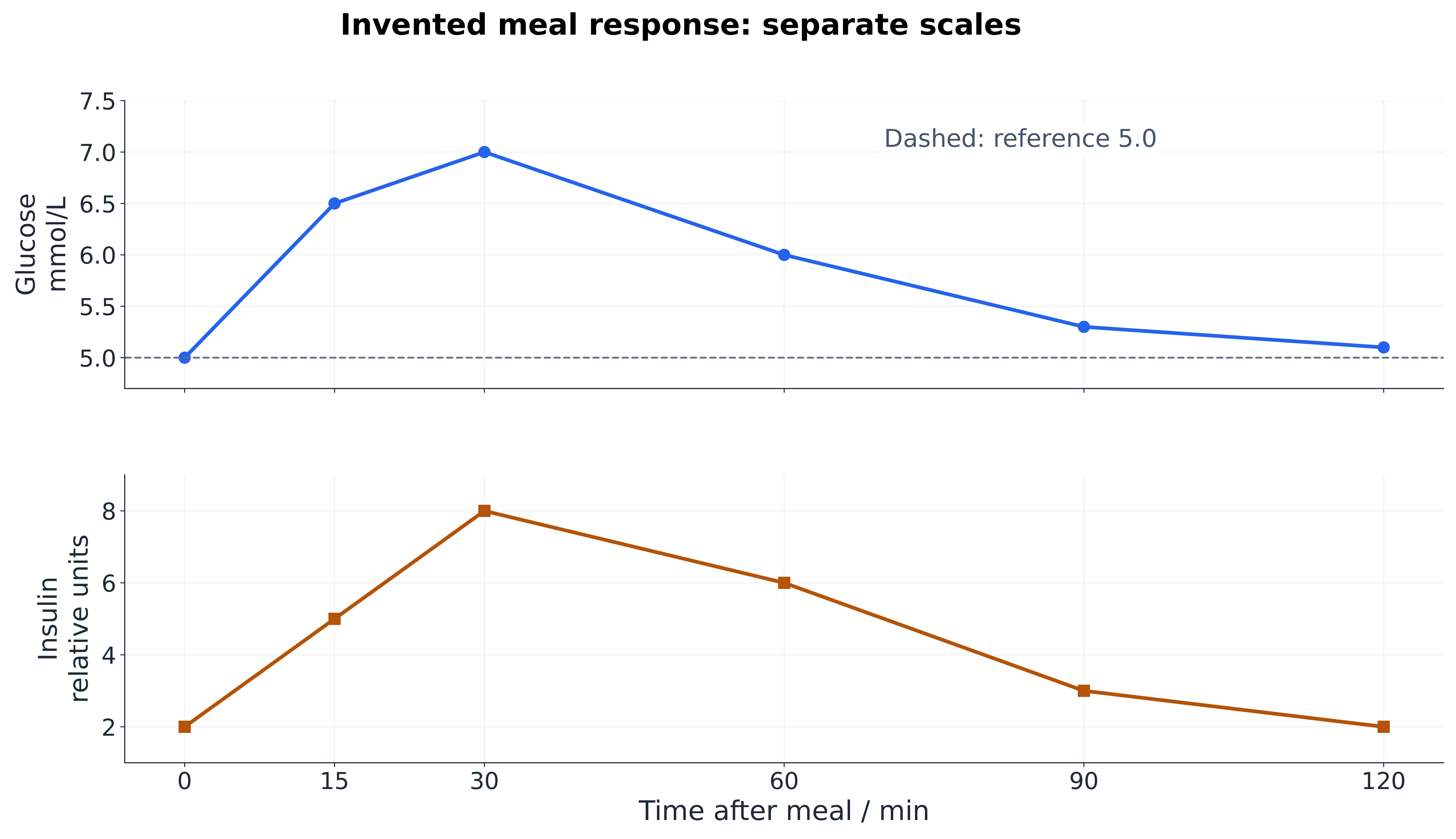
Consider this model record after a meal at time zero. Insulin is given in relative units; those numbers cannot be compared directly with mmol/L as though both measured the same substance.
Time / min
Glucose / mmol/L
Insulin / relative unit
0
5.0
2
15
6.5
5
30
7.0
8
60
6.0
6
90
5.3
3
120
5.1
2
Read each vertical scale separately. Insulin rises before the later decline in glucose; the observational sequence is consistent with the model, rather than a unique causal test.
Relative to the model 5.0 mmol/L reference, the peak change is $7.0-5.0=2.0$ mmol/L. Percentage deviation uses the reference as denominator: $(2.0/5.0)\times100=40\%$. From the peak to 120 minutes, the fall is $7.0-5.1=1.9$ mmol/L, or about 27.1% of the peak. These percentages differ because they answer different questions.
The largest observed value occurs at 30 minutes. The true peak might occur between observations, so report sampling interval and measurement uncertainty. A glucose-only trace does not directly measure insulin. Even with both traces, meal absorption, activity and other hormones can also influence the pattern. Manipulating one factor under controlled conditions supplies stronger causal evidence than timing alone.
For supplied or approved observational data, standardize timing, meal description, activity and measurement method. Independent participants provide biological replication; repeated readings from one participant do not become several independent people. Analyse supplied records rather than performing unapproved blood sampling or provoking abnormal glucose values.
37.6
Diabetes involves different failures of the regulatory system
In type 1 diabetes, immune-mediated destruction of pancreatic beta cells usually causes severe insulin deficiency. Inherited susceptibility and environmental influences contribute; eating sugar is not the simple cause. It can begin at any age. Management usually requires replacement insulin, monitoring and planned nutrition/activity. Lifestyle management supports health but does not replace missing insulin. General lifestyle measures do not reliably prevent the autoimmune disease; specific therapies can delay onset in some selected high-risk people. NIDDK overview of type 1 diabetes.
A blood glucose meter lets a person with diabetes check whether their blood glucose is within a target range
In type 2 diabetes, insulin resistance and inadequate beta-cell compensation cause persistently raised glucose. Insulin may initially be present at high concentrations, while secretion can become insufficient relative to need. Family history, age, inactivity and excess body fat can increase risk; no single characteristic determines an individual's outcome. Appropriate activity, nutrition and weight management can reduce risk or delay onset in susceptible groups. Treatment can include medicines and sometimes insulin; “type 2 never needs insulin” is false. NIDDK overview of type 2 diabetes.
Both types can cause long-term damage when glucose regulation is poor. Similar high-glucose readings do not establish the same underlying mechanism. A classroom graph cannot diagnose a person, and age alone cannot distinguish the types. Explain the physiological difference before linking a management method to the problem it addresses.
37.7
Thermoreceptors and the hypothalamus coordinate temperature regulation
Peripheral thermoreceptors in skin detect environmental and skin-temperature changes. Temperature-sensitive regions associated with the hypothalamus also respond to internal conditions. The hypothalamus coordinates neural and endocrine responses with information about temperature, rather than measuring the outside air alone.
Rapid neural pathways can alter sweating, skin-vessel diameter and skeletal-muscle activity. An endocrine pathway can change metabolic heat production over a longer timescale: hypothalamic signals regulate anterior-pituitary TSH secretion, TSH acts on the thyroid gland, and thyroid hormones including thyroxin influence metabolism. Thyroxin is secreted by the thyroid, not by the pituitary. It is not the immediate motor signal for every shiver or drop of sweat.
Two receptor inputs, two output routes: fast neural and slower endocrine
Effectors include sweat glands, smooth muscle in skin arterioles, skeletal muscle and adipose tissue. Their actions change heat production or exchange. Birds and mammals use physiological and behavioural regulation, but the detailed mechanisms here concern humans. Regulation is not perfect independence from the environment: capacity, water supply, clothing, humidity and activity constrain outcomes.
37.8
Human effectors change heat production, retention and loss
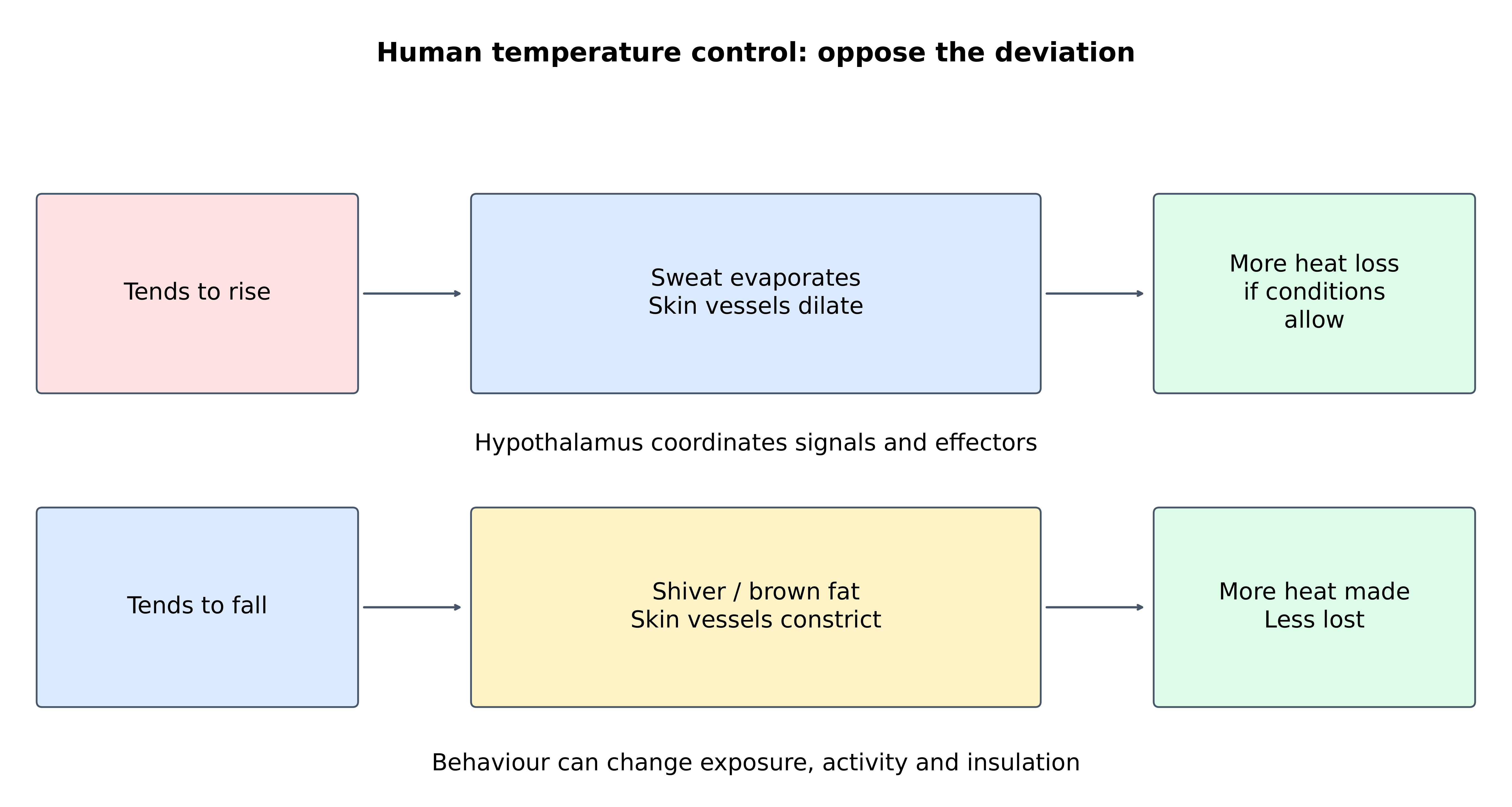
When core temperature tends to rise, vasodilation increases skin blood flow and can increase heat transfer to the surroundings. When it tends to fall, vasoconstriction reduces skin blood flow and conserves heat near the core. The vessels change diameter; capillaries do not move physically nearer to or farther from the skin surface.
Sweat can remove energy when it evaporates from the skin. Water that merely drips away has not provided the same evaporative cooling at that surface. High humidity limits evaporation by reducing the water-vapour gradient. Increased skin blood flow supports heat loss when conditions favour outward transfer; if surroundings are hotter than skin, dry heat exchange can instead bring energy into the body.
Shivering is involuntary repeated skeletal-muscle contraction. Increased metabolism generates heat; it is not purposeful movement to another location. Brown adipose tissue can generate heat through uncoupled respiration. A mitochondrial inner-membrane pathway permits proton return without using ATP synthase, so more of the released energy appears as heat rather than captured ATP. This does not mean respiration has stopped. Brown fat is important in infants and can also be active in adults.
Hair erection uses small muscles attached to follicles. In a furred mammal, raised hairs help trap an insulating air layer. Sparse human body hair makes this a relatively limited insulation mechanism; goosebumps do not equal the thick coat of another mammal.
Name both the effector and how its action changes energy transfer or production. Behaviour can act alongside physiology.
Seeking shade, reducing exertion or changing clothing can limit heat gain; adding insulation, moving to shelter or changing posture can conserve heat. Behaviour and physiology are complementary. Negative feedback reduces the corrective response as temperature approaches a suitable range; it does not require all effectors to switch fully on or off together.
37.9
Energy balance and measurement qualify temperature conclusions
A positive heat balance means internal thermal energy is increasing. In a short interval, heat generation is 160 J/s and heat loss is 120 J/s, giving net retention of $160-120=40$ J/s. If those rates stay constant for 10 minutes, energy retained is $40\times600=24\,000$ J, or 24 kJ.
A heat balance: 40 J/s retained gives 24 kJ in 10 minutes
This calculation alone does not give a temperature increase: body mass, effective heat capacity and changes in the exchange rates would also matter. A steady temperature can occur when heat production equals heat loss, even with large flows in both directions.
For a temperature record, state measurement site, device, timing, surrounding conditions and activity. Three repeat values 36.8, 37.0 and 37.2 degrees Celsius have mean 37.0, but repeated readings from one person are not independent participants. A skin reading can change without the same change in core temperature. Avoid treating every recorded difference as a biological effect without considering instrument resolution and method.
37.10
AHL: Excretion and osmoregulation are distinct kidney functions
Excretion removes metabolic waste, such as urea formed from amino-acid nitrogen. It differs from egestion of unabsorbed material from the digestive tract. Osmoregulation controls the osmotic concentration of body fluids. Kidneys contribute to both, so changing urine water content does not necessarily change the amount of a waste excreted by the same proportion.
A section through the kidney: blood is cleaned in the cortex and medulla, and urine collects in the renal pelvis before leaving down the ureter
Osmotic concentration counts dissolved particles, with units such as osmol/L. Under an ideal complete-dissociation model, 0.10 mol/L NaCl contributes about 0.20 osmol/L because each formula unit gives two ions. The same molar concentration of a non-dissociating solute gives fewer particles; real solutions can depart from this ideal model. Do not equate osmotic concentration with the concentration of one named ion.
A nephron includes a glomerular filter and a tubule. Blood continues through vessels while filtrate follows a separate tubular route. Urine ultimately enters the renal pelvis, ureter and bladder. The ureter is not the renal vein, and the bladder stores rather than produces urine. NIDDK explanation of kidney function.
37.11
AHL: Ultrafiltration and selective reabsorption act in sequence
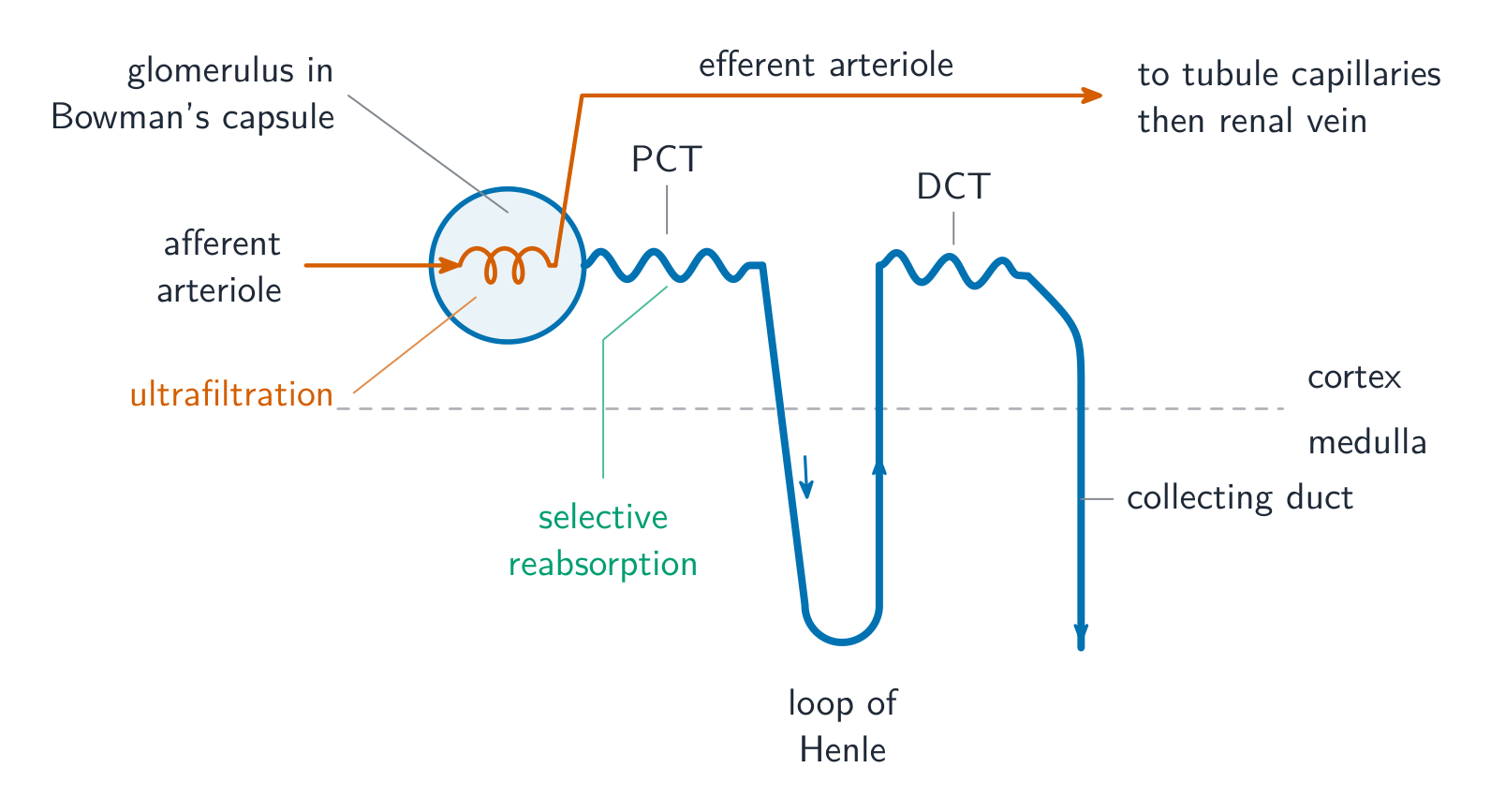
Hydrostatic pressure in glomerular capillaries favours passage of water and small solutes across a filtration barrier into Bowman's capsule. Cells and most large plasma proteins are retained in the blood. The resulting filtrate contains useful solutes such as glucose as well as unwanted substances; the filter does not decide which molecule is nutritionally useful. Filtration is pressure-driven, not a pump that actively transports every filtrate component.
The proximal convoluted tubule reabsorbs useful substances into blood. Microvilli provide area; mitochondria support transport requiring energy. Sodium gradients maintained by sodium–potassium pumps help drive cotransport of glucose and other solutes. Water follows appropriate osmotic gradients. These distinct mechanisms must not be collapsed into “every reabsorbed molecule is actively pumped”.
Filtration is blood to capsule; reabsorption is tubule to blood. Some substances are also secreted from blood into the tubule. The diagram is a functional model, not a scale section.
In ordinary conditions glucose is almost completely reabsorbed, but transport capacity is finite. A sufficiently large filtered load can leave glucose in urine; its presence is not proof that the kidney actively adds it as a waste. Urea is not simply all removed at the first filter either: tubular handling affects how much is finally excreted.
Ignoring tubular secretion for a specified substance, amount excreted equals amount filtered minus amount reabsorbed. For water in a daily model, 180 L filtered and 1.5 L urine imply $180-1.5=178.5$ L reabsorbed, about 99.17% of filtered water. The large filtered volume is repeated processing, not a claim that the person drinks 180 L each day.
37.12
AHL: The loop supports an osmotic gradient in the medulla
The loop of Henle extends into the medulla. Its ascending limb is relatively impermeable to water; sodium transport, including active transport in its thick segment, helps maintain a high osmotic concentration in the medullary tissue fluid. Water can leave the descending limb more readily. The different permeabilities and opposing flow directions support a medullary gradient.
This gradient makes water reabsorption from a suitably permeable collecting duct possible. Active sodium transport creates or supports conditions for passive water movement; ATP does not directly push water through aquaporins. Do not draw water leaving the ascending limb as freely as salt. Blood flow through the region must also exchange materials without immediately washing away the gradient.
The simplified explanation isolates key roles; urea recycling and other transport processes also contribute in real kidneys. The loop alone does not determine final urine concentration independently of collecting-duct permeability.
37.13
AHL: ADH changes aquaporin location in collecting-duct cells
A rise in blood osmotic concentration is detected by osmoreceptors in the hypothalamus. ADH, antidiuretic hormone, is synthesized in hypothalamic neurons and released into blood from the posterior pituitary. Saying “pituitary secretion” should not imply that the posterior pituitary synthesizes the hormone.
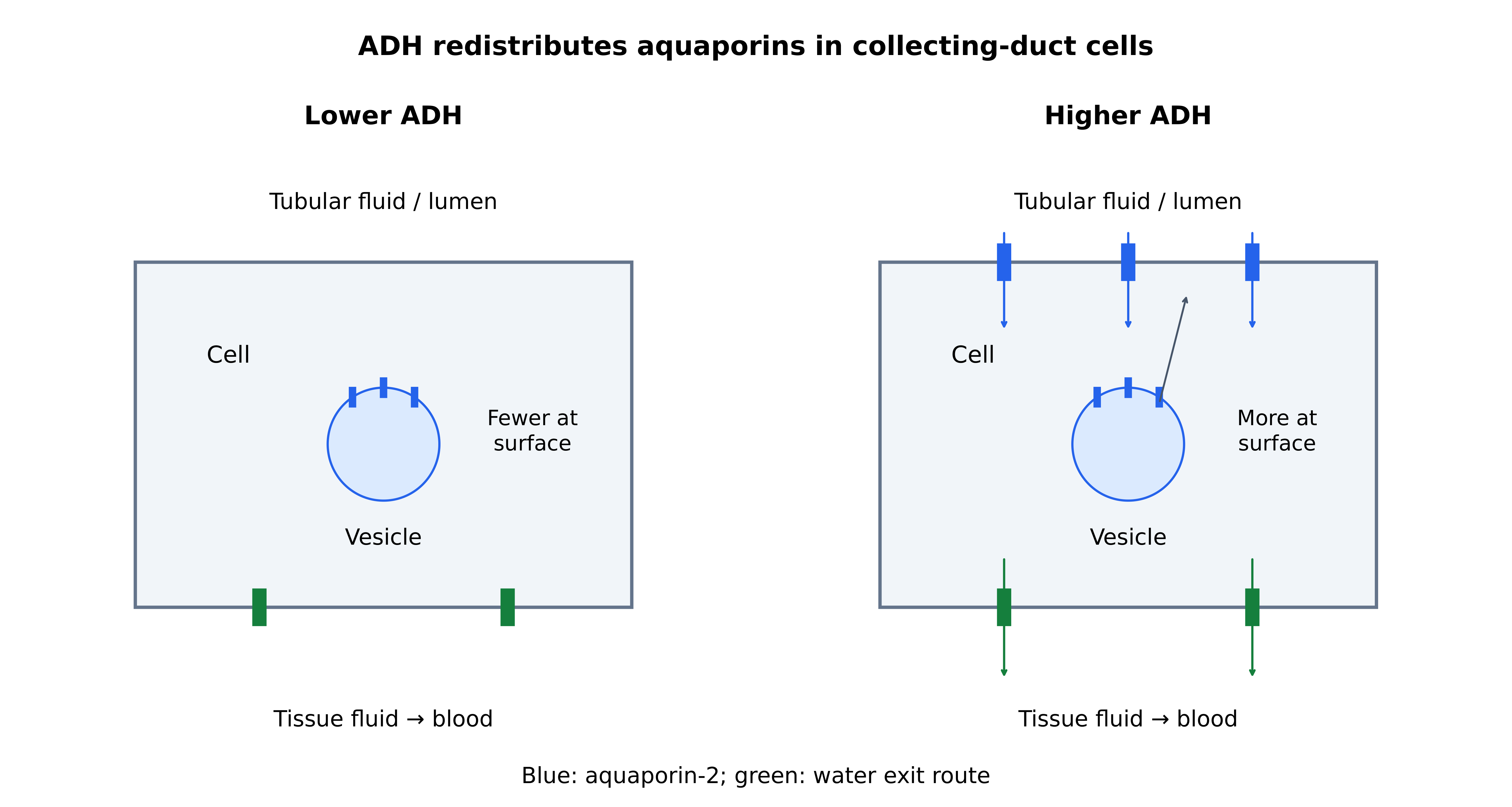
ADH acts on collecting-duct cells, promoting insertion of aquaporin-2 channels from intracellular vesicles into the membrane facing the tubular fluid. Water permeability rises. With a suitable medullary gradient, more water is reabsorbed into tissue fluid and returned to blood; urine volume falls and its osmotic concentration generally rises. This response opposes the original increase in blood concentration.
ADH changes permeability; the osmotic gradient supplies the direction of passive water movement. A second membrane route allows water to leave toward tissue fluid and blood.
When osmotic concentration falls, reduced ADH drive favours removal of these channels from the luminal membrane into vesicles. Less water is reabsorbed in this regulated segment and a larger volume of more dilute urine can result. Other signals, including blood-volume or pressure changes, also affect ADH; this model concerns the osmotic loop.
For a constant urea excretion of 0.60 mmol/hour, urine flow 0.120 L/hour gives urea concentration $0.60/0.120=5.0$ mmol/L. At 0.030 L/hour, concentration is 20 mmol/L. Fourfold concentration does not mean fourfold urea production: the same amount leaves in less water.
37.14
AHL: Organ perfusion changes with activity and total output
Changing arteriole resistance and cardiac output redistributes blood. Vigorous exercise increases skeletal-muscle flow substantially, while gut and kidney flow can decrease. Cerebral flow is regulated and does not simply rise in proportion to total cardiac output. Sleep differs from vigorous exercise, but sleep stage and tissue activity affect the detailed pattern.
Exercise sends most of a much larger output to muscle; brain flow stays the same in litres per minute
These allocations illustrate calculations, not fixed normal values for every person or type of exercise. Other organs includes skin and the heart's own circulation; heat-loss demands can influence skin flow.
Region
Sleep / L/min
Wakeful rest / L/min
Vigorous exercise / L/min
Skeletal muscle
0.90
1.00
16.00
Gut
1.10
1.25
0.60
Brain
0.70
0.75
0.75
Kidneys
1.00
1.10
0.40
Other organs
0.80
0.90
2.25
Total
4.50
5.00
20.00
Brain flow remains 0.75 L/min: $0.75/5.00=15\%$ at rest versus $0.75/20.00=3.75\%$ during exercise. Muscle flow rises sixteenfold, from 20% to 80% of output. A changing total separates absolute flow from percentage.
Kidney flow remains nonzero. Hormones, local flow control and tubular function interact; these allocations alone do not give filtration rate or urinary waste output.
37.15
Practice
Define homeostasis and identify four human variables it regulates. Explain why a constant concentration need not mean no movement or metabolism.
Describe a negative feedback loop for a variable initially above its reference and then below it. Contrast positive feedback and explain why “negative” is not a negative concentration.
Trace rising glucose through beta cells, insulin transport and target-cell effects. Distinguish muscle/adipose uptake from liver regulation and explain why insulin is not the glycogen-synthesizing enzyme.
Trace falling glucose through alpha cells and glucagon to liver responses. Why is muscle glycogen not simply exported as free glucose by the same route?
A glucose record rises from 4.8 to 6.0 mmol/L and later falls to 5.0. Calculate the increase, percentage deviation from the initial reference and percentage decrease from the peak.
Use the meal-response table to identify the largest observed glucose value and its time. Explain two limits to inferring that insulin uniquely caused the later decline.
Compare the physiological basis, risk factors and management principles of type 1 and type 2 diabetes. Correct “only children get type 1”, “sugar causes type 1” and “type 2 never needs insulin”.
Explain the roles of skin thermoreceptors, hypothalamus, anterior pituitary and thyroid in temperature regulation. Distinguish rapid neural responses from the endocrine route.
Explain vasodilation, vasoconstriction, shivering, sweating, brown-fat uncoupling and hair erection. Give one behavioural response and one environmental limit on heat loss.
An interval has heat generation 180 J/s and loss 130 J/s for eight minutes. Find energy retained. Can this alone give the temperature increase? Explain.
Three repeat temperature readings from one person are 36.8, 37.0 and 37.2 degrees Celsius. Calculate the mean and explain why these are not three independent participants. Name two method details needed for a fair comparison.
AHL: Compare excretion and osmoregulation; trace filtration, reabsorption and the loop's function. With water filtration 150 L/day and urine 1.2 L/day, calculate reabsorbed volume and percentage.
AHL: Explain osmotic feedback through ADH and aquaporins, naming synthesis/release sites. At urea excretion 0.60 mmol/hour, compare urine concentrations for flows 0.120 and 0.030 L/hour. Why is concentration not production rate?
AHL: Use the flow table to find brain/muscle fractions at rest/exercise, muscle absolute-flow ratio and absolute kidney-flow change. Why can allocation percentages alone not reveal urine production?
37.16
Worked answers
Regulation within suitable internal limits: temperature, blood pH, glucose and osmotic concentration. Balanced input and removal keep concentration steady despite continuing fluxes.
Above reference, effectors favour a decrease; below, an increase. Corrective drive declines as deviation declines. Negative feedback opposes change; positive feedback amplifies it, as in childbirth contractions. Neither requires a negative measured value.
Raised glucose stimulates beta-cell insulin release into blood. Receptor signalling increases muscle/adipose uptake and liver storage while reducing liver output. Liver does not use the same GLUT4 mechanism. Insulin regulates transport/enzymes rather than catalysing glycogen formation.
Alpha-cell glucagon release increases liver glycogen breakdown and glucose-producing pathways. Muscle glycogen mainly supports local use rather than direct glucose export. Corrective secretion declines as glucose recovers.
Increase $6.0-4.8=1.2$ mmol/L; $1.2/4.8\times100=25\%$. Later fall $6.0-5.0=1.0$ mmol/L; $1.0/6.0\times100\approx16.7\%$. State the different denominators.
Largest observed value: 7.0 mmol/L at 30 minutes; the true maximum may lie between samples. Timing/correlation do not isolate insulin from absorption, activity or other hormones. Glucose alone does not measure insulin.
Type 1: usually autoimmune beta-cell loss and insulin deficiency; any age, not simply sugar-caused; replacement insulin. Type 2: resistance plus inadequate compensation; genetic/modifiable risks; activity/nutrition can reduce risk, with medicines or insulin used in treatment. Neither age nor one glucose value identifies the mechanism.
Skin receptors and hypothalamic mechanisms supply temperature information; hypothalamic neural outputs rapidly alter effectors. Anterior-pituitary TSH stimulates thyroid thyroxin, changing heat generation more slowly. Pituitary does not secrete thyroxin.
Skin arteriole dilation raises skin flow; constriction conserves heat. Shivering generates heat; sweat evaporation removes it, limited by humidity. Brown-fat proton return bypassing ATP synthase releases more heat. Raised hairs trap insulating air, with little human benefit. Clothing/shelter/shade alter exchange; hotter surroundings can reverse dry heat transfer.
Net retention $=180-130=50$ J/s. Eight minutes is 480 s; energy $=50\times480=24\,000$ J = 24 kJ. Mass, effective heat capacity and changing rates are needed to infer temperature rise.
Mean $=(36.8+37.0+37.2)/3=37.0$ degrees Celsius. Repeats share one participant and assess within-person/method variation. Standardize site and device; also timing, activity and surrounding conditions.
AHL: Excretion removes metabolic waste; osmoregulation controls particle concentration. Glomerular pressure filters plasma into Bowman's capsule while retaining cells/most large proteins. PCT reabsorbs useful solutes/water; ascending-limb salt transport supports the medullary gradient. Reabsorbed water $=150-1.2=148.8$ L/day; $148.8/150\times100=99.2\%$. This is repeated processing, not drinking requirement.
AHL: Hypothalamic osmoreceptors detect concentration rise. ADH synthesized there is released from posterior pituitary; luminal aquaporin-2 insertion increases permeability, water reabsorption rises and urine volume falls. Low ADH favours retrieval into vesicles. $0.60/0.120=5.0$ versus $0.60/0.030=20$ mmol/L: fourfold concentration, unchanged excreted amount.
AHL: Brain: 15%/3.75%, both 0.75 L/min. Muscle: 20%/80%, sixteenfold absolute flow. Renal change $=0.40-1.10=-0.70$ L/min. Fractions do not measure filtration, reabsorption or waste load; urine output cannot be deduced.
37.17
Exam tips
Name variable, detector, signal, target and opposing response. State the percentage reference; distinguish hormone/enzyme, skin/core and heat/temperature.
AHL: Separate blood/filtrate, filtration/reabsorption, gradient/permeability, ADH synthesis/release and absolute flow/output fraction.