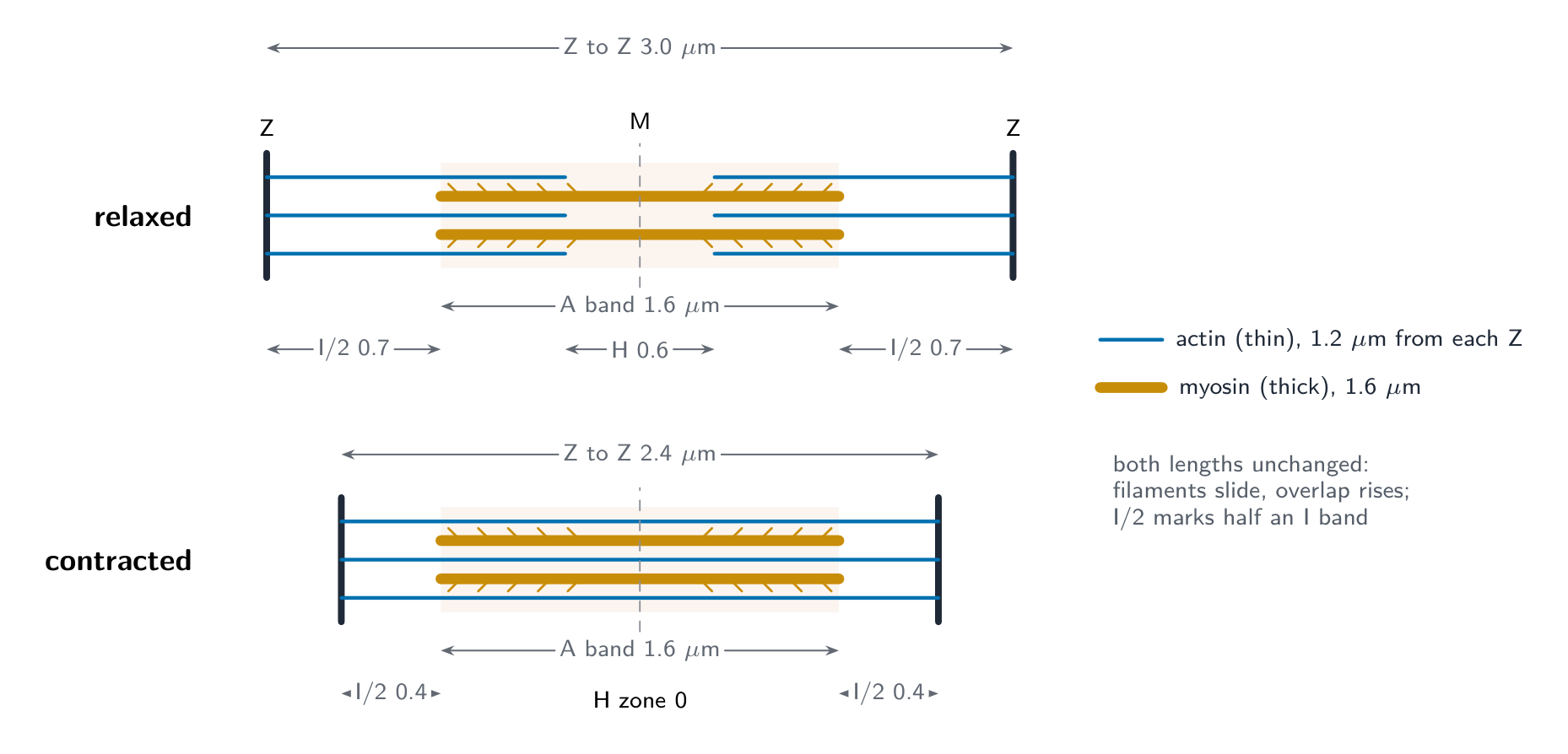
A sarcomere 肌节 becomes shorter during contraction although its thick and thin filaments keep approximately the same length.
English narration · English + 中文 subtitles burned in
17.1
Scope and prerequisites
B3.3 Muscle and motility is a Higher Level-only unit. It covers movement in motile and sessile organisms, sliding filaments, titin and antagonists, motor units, skeletal levers, the human hip and joint-angle measurement, intercostal action, reasons for locomotion and swimming adaptations of marine mammals.
Prerequisites: protein structure, ATP, cell membranes, differentiated muscle fibres and ventilation. Scope follows the IB Biology guide, first assessment 2025.
17.2
AHL: Movement does not always mean locomotion
A rooted tree stays in one place, but its growing shoots can change direction and materials move within its cells. A swimming protist can relocate its whole cell. Both illustrate biological movement at different scales. Locomotion is movement of an organism from one location to another; it is one form of movement rather than a requirement for every organism to walk or swim.
Movement at three scales
The motile protist Paramecium caudatum swims by coordinated beating of cilia. A sessile English oak, Quercus robur, remains rooted while shoots can bend during growth toward light. Growth, intracellular transport and chromosome movement do not require skeletal muscle. Sessile does not mean motionless at every scale.
Explain the task and mechanism: cilia push against water; muscle fibres develop tension; joints permit relative bone movement. “For movement” alone explains none of these mechanisms.
17.3
AHL: Sarcomeres shorten by sliding constant-length filaments
A sarcomere 肌节 is a repeating contractile unit between adjacent Z lines in a myofibril. Thin actin filaments attach toward the Z lines and overlap a central arrangement of thick myosin filaments. Myosin heads can interact with actin, forming a cross-bridge 横桥. Repeated interactions can move thin filaments relative to thick ones, bringing the Z lines closer during shortening.
In contraction the A band keeps its length; the I band and H zone shorten as actin slides over myosin
The A band corresponds to the thick-filament length and stays approximately constant in the sliding model. The I band contains thin filaments without thick-filament overlap; it narrows as overlap increases. The H zone is the central part of the A band without thin-filament overlap; it also narrows and may disappear. Increased overlap does not mean actin becomes a thicker molecule or that every myosin filament is shortened.
Compare filament ends and Z-line positions separately. The model illustrates shortening, not every possible state of a contracting muscle.
Each end region within the drawn Z-to-Z unit is half an I band. A full I band straddles a Z line, joining thin-only regions from adjacent sarcomeres. For identical repeating units in this model, its full width is $2(0.7)=1.4$ micrometres when relaxed and $2(0.4)=0.8$ when shortened. Do not label one end region as a complete I band. (OpenStax muscle structure)
In the model, the sarcomere changes from 3.0 to 2.4 micrometres while each thin filament remains 1.2 micrometres and the thick filament remains 1.6 micrometres. Percentage shortening is $(3.0-2.4)/3.0\times100=20\%$. The thick-filament-length change is zero. The two quantities answer different questions.
Compare images at the same calibrated scale and identify Z lines and band boundaries. Uniform filament shortening would contradict sliding. Static images support structural comparison, not direct observation of the ATP cycle. Contraction can produce tension without overall shortening under a load.
Explore
Shorter sarcomere, unchanged filament lengths
Compare 2.5 μm with 2.0 μm: 20% shortening. Use the same scale to track Z lines, overlap, the fixed A-band span and the changing I regions and H zone in a schematic model.
AHL: Calcium and ATP control the cross-bridge cycle
In a resting skeletal muscle fibre, regulatory proteins restrict myosin access to binding sites on actin. Excitation leads to release of calcium ions from the sarcoplasmic reticulum. Calcium binding to troponin changes the position of tropomyosin, permitting actin–myosin interaction. Calcium does not supply the energy for the power stroke or become a permanent part of an actin filament.
This is where the name “striated” comes from. Each repeating dark-light block is one sarcomere; the bands are the thick and thin filaments overlapping by different amounts. When the muscle contracts, the filaments slide past each other and each sarcomere gets shorter
A useful simplified sequence is:
An energized myosin head carrying ADP and phosphate can attach to exposed actin.
Strong binding and phosphate release are coupled to a conformational change, the power stroke; actin moves relative to the thick filament. ADP is released.
A new ATP molecule binds to myosin, allowing detachment from actin.
ATP hydrolysis re-energizes and repositions the head for another cycle when suitable sites are available.
Distinguish ATP binding from ATP hydrolysis. Binding is needed for detachment; hydrolysis supports preparation for subsequent force generation. Calcium removal by energy-dependent transport into the sarcoplasmic reticulum allows regulatory blocking to be restored. Loss of a nerve signal does not instantly remove every calcium ion or mean that relaxation requires no energy-related processes.
Many heads cycle asynchronously, helping maintain tension. Load, filament geometry and regulation influence activity; the model does not place every head in the same stage simultaneously.
17.5
AHL: Titin and antagonists contribute different restoring forces
Titin is a very large elastic protein associated with sarcomeres. It helps stabilize thick-filament position, resists excessive stretch and contributes passive restoring force after extension. Its role differs from that of a myosin head cycling on actin. Elastic recoil depends on prior deformation; titin does not actively push two bones apart like a second motor.
Muscles only pull: an antagonistic pair reverses movement at the elbow
Skeletal muscle develops tensile force. To reverse movement at many joints, an opposing muscle or muscle group can pull in the other direction. During elbow flexion, flexor activity can increase while extensors lengthen; reversing the pattern supports extension. Real movement often includes co-contraction for stability, so “one always completely switches off” is too simple.
When excitation declines and cross-bridge activation falls, a fibre can be lengthened by its load, antagonist activity or elastic forces. Distinguish loss of active tension from restoration of the whole joint position. A muscle does not normally push its tendon forward to reverse a previous pull.
Exam tips
Name the changing structure, ATP step and angle convention. Use perpendicular moment arms. Distinguish relaxation from opposing active movement, and link adaptations to mechanisms and tasks.
17.6
AHL: A motor unit links one neuron to several fibres
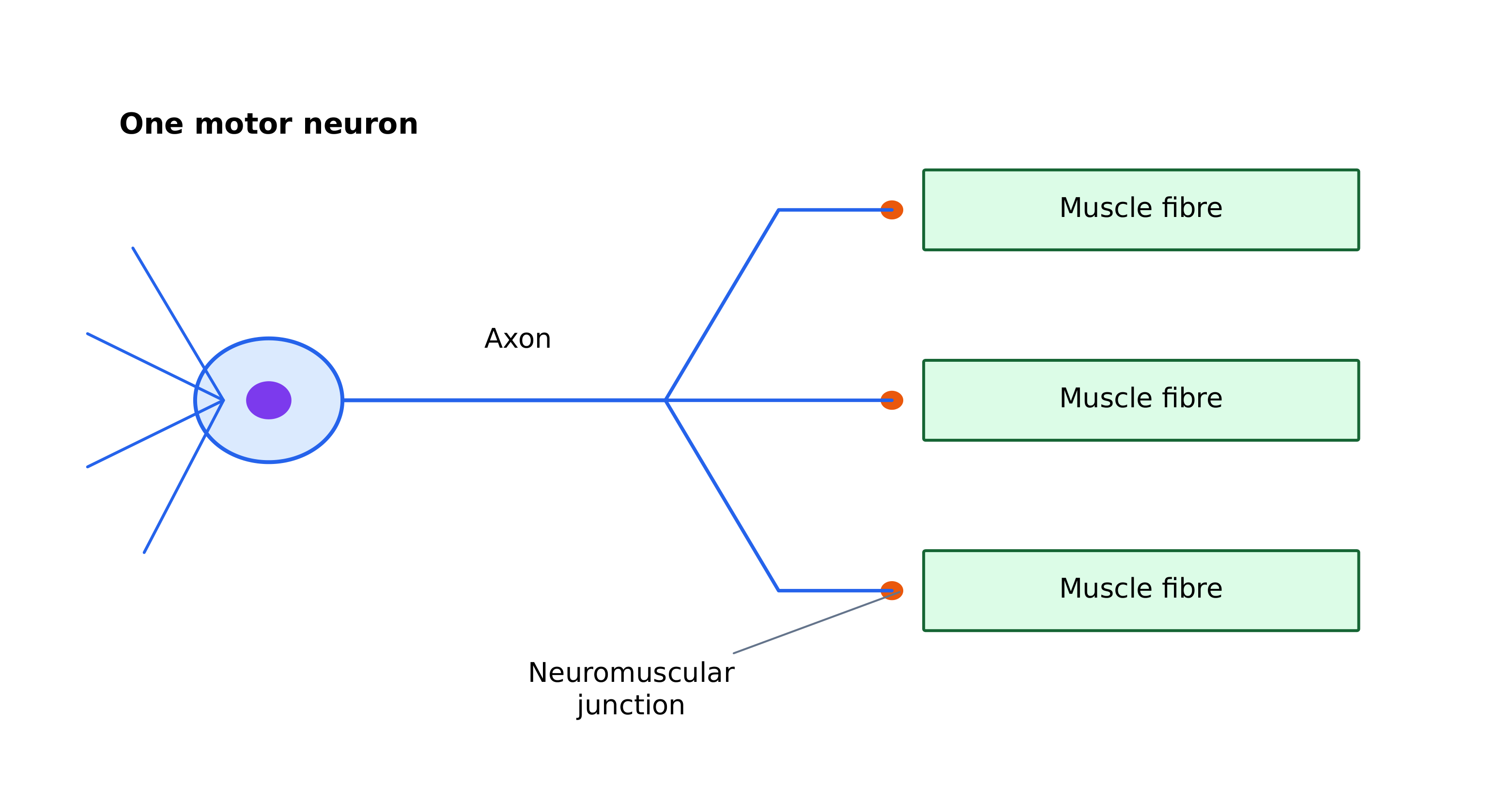
A skeletal muscle motor unit consists of one motor neuron and all the muscle fibres it innervates. The neuron's axon branches to neuromuscular junctions on those fibres. A muscle fibre is a long multinucleate cell; a motor unit is a neuron-plus-fibres functional group, not another name for one sarcomere or one myofibril.
The junctions belong to branches of the same neuron. Other motor units within the muscle are omitted.
At a neuromuscular junction, a nerve impulse promotes acetylcholine release. It crosses a synaptic gap and acts on muscle membrane receptors. Muscle excitation then triggers calcium release; the cell membranes do not merge.
Recruitment of additional motor units can increase whole-muscle force. Changing stimulation frequency also changes how twitches overlap and develop tension. Motor units with fewer fibres permit smaller increments and finer control, while larger units can add greater force increments, other conditions equal. Recruitment does not mean that each fibre must shorten by a larger percentage.
In an equal-force-per-fibre model, units A, B and C contain 4, 9 and 16 fibres. Activating A gives 4 force units; A plus B gives 13; all three give 29. The successive increments are 4, 9 and 16.
17.7
AHL: Skeletons anchor muscles and act as levers
A vertebrate endoskeleton lies within the body; an arthropod exoskeleton surrounds and supports it externally. Muscles attach to appropriate skeletal structures and generate forces across joints. Either arrangement can provide anchorage and lever systems; an internal skeleton is not the only way to transmit muscle force.
For the horizontal segment, a 100 N downward load at 0.40 m balances a 1,000 N upward effort at 0.04 m. Joint reaction and segment weight need separate treatment in a fuller model.
At a skeletal lever, a joint serves as a pivot, muscle tension supplies an effort and the limb or external object provides a load. Tendons transmit force from muscle to bone. The turning effect depends on force multiplied by the perpendicular distance from its line of action to the pivot. In a simplified static balance:
A model load of 20 N at 0.25 m creates a moment of 5.0 N metres. If the muscle's perpendicular moment arm is 0.025 m, its tension must be $5.0/0.025=200$ N when other moments are neglected. A small muscle moment arm can require much greater force than the load itself. This geometry can provide movement speed or displacement advantages, rather than demonstrating that the muscle is ineffective.
Use perpendicular moment arms, not automatically the full length of a bone or tendon. A real limb also has its own weight, changing geometry and dynamic forces. Tendons join muscles to bones; ligaments primarily connect bones across joints. Confusing these structures breaks the force pathway.
17.8
AHL: The human hip combines mobility with load support
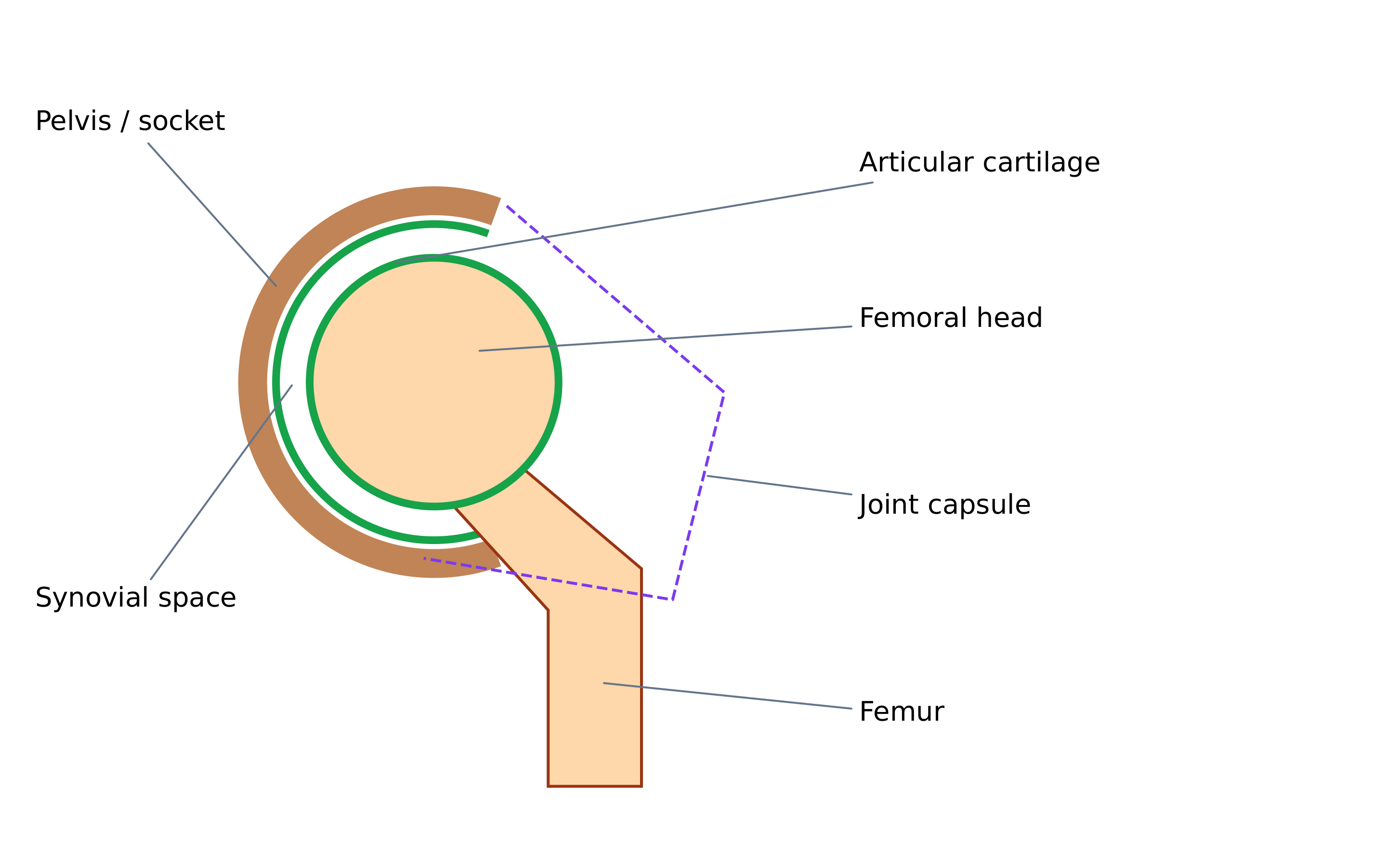
The hip is a synovial ball-and-socket joint. The rounded head of the femur fits into the acetabulum of the pelvis. This arrangement permits motion in several planes while supporting loads. It does not mean the femur can rotate without restriction in every direction.
Articular cartilage covers the articulating bone surfaces, distributes contact loads and helps reduce friction. Synovial fluid lubricates the joint, and the surrounding capsule encloses the joint space. Ligaments connect skeletal parts and limit excessive movement; tendons transmit muscle tension to the skeleton. Muscles crossing the joint create movements when their lines of action produce appropriate turning effects.
The diagram separates tissues to show their roles. It is not a medical image or a measurement of a person's joint.
Hip flexion/extension move the thigh forward/back relative to the pelvis; abduction/adduction move it away from/toward the midline. Internal/external rotation turn the femur around its long axis. Use the same anatomical reference position and explain the muscle groups' lines of action.
17.9
AHL: Measure joint range in named planes
A goniometer or computer analysis of images can estimate joint angles. Identify the joint centre and consistent landmarks along the adjoining segments. State the reference position and which included angle or anatomical movement angle is recorded. An included angle between segments can decrease while the named flexion angle increases, depending on the convention.
Each named axis is perpendicular to its movement plane. Sporting actions are simplified here; a real sequence can combine rotations.
Use approved existing images, models or comfortable voluntary movements under supervision. Do not force maximal range or use painful/exhaustive tasks. Align the viewing plane with the movement plane, keep camera position and landmarks consistent, and repeat measurements. A two-dimensional photo can distort a three-dimensional joint position; clothing, soft-tissue landmarks and observer choices add uncertainty.
In a dataset, comfortable flexion from a defined neutral position reaches 105 degrees and extension reaches 15 degrees in the opposite direction. The total measured arc in that plane is 120 degrees. Abduction 35 degrees and adduction 20 degrees give a 55-degree arc in a different plane; these values should not be added to make one “175-degree hip range”. Each describes a specified movement and method.
For a separate image example, the defined included angle changes from 150 to 95 degrees, a 55-degree change. Report the convention before calling this a final anatomical flexion angle. Repeated measurements 54, 56 and 55 degrees have mean 55 and range 2 degrees; this range describes repeat spread, not a proven absolute accuracy of plus or minus one degree.
External and internal intercostal layers have different fibre orientations. In the simplified ventilation comparison, contraction of the external intercostals raises ribs up and out during inspiration; expiratory parts of the internal intercostal layer can draw ribs down during active expiration. Their geometry allows opposing movements. Relaxation and elastic recoil account for much quiet expiration, so do not claim forceful internal intercostal contraction is required for every resting out-breath.
External and internal intercostals: opposite fibre directions, opposite actions
Contraction of one layer can stretch the opposing muscle system, storing elastic energy associated with proteins such as titin. This links antagonistic action with passive recoil, while neural control and the diaphragm coordinate breathing. At the chest, skeletal muscles generate movement of ribs; the subsequent pressure difference moves air. Rib movement itself is not oxygen diffusion into the blood.
17.11
AHL: Locomotion provides opportunities with costs
Foraging can move an animal to food: a dolphin can search for and pursue fish. Escape movement can reduce predation risk: a gazelle can run from a pursuing predator. Mate searching can bring reproductive partners together, as when male moths move toward pheromone sources. Migration can connect seasonally useful habitats: many humpback whale populations move between feeding and breeding regions. The NOAA humpback account describes this seasonal pattern; it is not a claim that every individual follows an identical journey.
What locomotion buys, and what it costs
Movement costs energy and may increase exposure to predators or hazardous conditions. Its benefits depend on context. A faster animal does not automatically obtain more food if extra travel costs exceed gains. In a comparison, route A yields 120 energy units of food at a travel cost of 35, leaving 85; route B yields 150 at a cost of 80, leaving 70. The route with the greater gross intake has the smaller net gain under this limited model. Handling costs, risk and nutrient composition are omitted.
17.12
AHL: Cetacean adaptations support swimming and periodic air breathing
A bottlenose dolphin provides a named marine mammal example. Its streamlined body reduces resistance to movement through water, while forelimbs modified as flippers support control and steering. Muscles in the posterior body drive movements of the horizontal tail flukes up and down, generating propulsion. Do not infer that a dolphin has fish gills or that every marine mammal has the same tail arrangement: seals and sea lions differ from cetaceans.
A humpback whale seen from above at the surface: its blowholes sit on top of the head, so it can breathe while barely breaking the surfaceBottlenose dolphin: features for swimming and for breathing air
The blowhole provides an airway opening on the upper head, allowing breathing when it reaches the surface; it closes during submergence. A dolphin remains a lung-breathing mammal and must periodically surface for air. External access and control of the airway support the transition between swimming submerged and breathing at the surface. The opening is not extracting dissolved oxygen from water while closed.
Connect streamlining to drag, flukes to thrust, flippers to control and the airway to air breathing. These adaptations evolved across generations; an individual does not acquire them because it decides to live in water.
17.13
Practice
Use the stated models and units.
Contrast movement and locomotion in Paramecium and a sessile tree. Must movement involve skeletal muscle?
Define sarcomere, A band, I band and H zone. Predict changes during shortening and identify unchanged lengths.
A sarcomere shortens from 2.5 to 2.0 micrometres; its thick filament stays 1.6 micrometres. Calculate percentage shortening of each. What makes an image comparison valid?
Explain a cycle of attachment, power stroke, ATP binding/detachment and hydrolysis/re-energization. Include calcium regulation and ATP's roles in relaxation.
Compare titin recoil with antagonist contraction. Why does removing excitation not necessarily restore a joint's original position?
Define motor unit and trace its signal to actin–myosin interaction. In an equal-force-per-fibre model, X, Y, Z contain 5, 8, 12 fibres. Calculate cumulative forces for X, X + Y, X + Y + Z, their increments and a model limit.
Compare arthropod and vertebrate muscle anchorage. A 30 N load acts at 0.20 m; muscle moment arm is 0.030 m. Calculate load moment and static tension; name an omitted force.
Explain the hip's bones, cartilage, synovial fluid, ligaments, tendons and muscles. Name three kinds of movement.
Flexion from neutral reaches 100 degrees; opposite extension reaches 20. Find the total arc. Why not add a separate 50-degree abduction/adduction arc? An included angle changes from 145 to 90 degrees: find the change and its interpretation limit.
Image readings are 53, 55, 57 degrees. Find mean and range. Plan camera/landmark controls; does repeat spread establish accuracy?
Explain intercostal orientation, antagonism and elastic energy. Distinguish active/quiet expiration and rib movement/gas diffusion.
Give named examples of foraging, escape, mate search and migration. Compare net gains: C intake 140/cost 45; D intake 180/cost 100. State two limitations.
Explain a bottlenose dolphin's streamlining, flippers, flukes and blowhole. Correct: “All marine mammals have identical tails and extract dissolved oxygen through their blowholes.”
17.14
Worked answers
Paramecium relocates its whole cell using cilia: locomotion. A rooted tree can move parts during growth and has internal transport without relocating the whole organism. Movement ranges across scales and can use mechanisms other than muscle.
Sarcomere: Z-line to Z-line unit. A band spans thick filaments; I band has thin filaments without thick overlap; H zone has thick filaments without thin overlap. During shortening, Z lines approach, overlap increases, I bands/H zone narrow, and the A band and individual filament lengths remain approximately constant.
Sarcomere shortening $(2.5-2.0)/2.5\times100=20\%$; thick-filament change zero. Calibrate scales and identify boundaries; band width is not filament length, and static images do not show ATP cycling.
Energized myosin attaches; force-generating conformational change moves actin; fresh ATP binds and permits detachment; ATP hydrolysis re-energizes the head. Calcium binds troponin, changing tropomyosin position and access to actin. Calcium reuptake and regulation restore resting conditions; detachment itself needs ATP binding. Heads cycle asynchronously.
Titin supplies passive recoil and resists overstretching; an antagonist actively pulls oppositely. Muscle pulls, not pushes. Joint position also depends on load, elasticity and coordination, including co-contraction.
One motor neuron plus its innervated fibres. Junction excitation leads to fibre excitation, calcium release and myosin access. Model forces: 5, 13, 25; increments: 5, 8, 12. Real force also depends on fibre properties, frequency and load.
Arthropod muscles act on an exoskeleton; vertebrate muscles act on an endoskeleton. Moment $30(0.20)=6.0$ N metres; tension $6.0/0.030=200$ N. Use perpendicular distances. Limb weight, other muscle forces and acceleration are omitted.
Femoral head fits the pelvic acetabulum. Cartilage reduces friction/distributes contact loads; synovial fluid lubricates; ligaments connect bones and restrain excess motion; tendons transmit muscle force to bone. Muscles generate joint moments. Flexion/extension, abduction/adduction and axial rotation are distinct movements.
Flexion/extension arc $100+20=120$ degrees. The other plane's 50-degree arc is a separate measurement. Included-angle change $145-90=55$ degrees; final anatomical flexion still needs the reference/convention.
Mean 55 degrees; range $57-53=4$ degrees. Standardize viewing plane, landmarks, joint centre, reference and camera; repeat/compare observers. Agreement can coexist with systematic perspective or landmark error.
The layers' different fibre orientations allow opposing rib movements; contraction can stretch the opposing layer and store elastic energy including in titin. External intercostals support inspiration; expiratory internal portions can support active expiration. Quiet expiration is largely relaxation/recoil. Rib motion changes thoracic volume/pressure, causing bulk airflow; gases diffuse separately across exchange surfaces.
Dolphin food pursuit; gazelle escape; moth pheromone-guided mate search; seasonal humpback movement between feeding/breeding habitats. C gives $140-45=95$ units; D gives $180-100=80$. Greater intake does not ensure greater net gain. Risk, handling cost, nutrient quality and other demands are not represented.
Streamlining reduces drag; flippers help control; up-and-down movement of horizontal flukes generates propulsion. The blowhole gives surface access for air breathing and closes underwater. A dolphin uses lungs, not gills. Cetacean tail design should not be generalized to all marine mammals such as seals.