Why it matters. In 1586 the Flemish engineer Simon Stevin published De Beghinselen der Weeghconst (The Elements of the Art of Weighing). On its title page is a loop of fourteen balls hanging over a triangular wedge. Stevin argued that the loop cannot keep turning by itself, so the balls on the two slopes must balance. From this he worked out how a pull along one direction can be split into parts along other directions, and how two pulls combine into one. Quantities with both a size and a direction are now called vectors, and engineers, pilots and game designers add them in exactly this way.
In this unit you will:
- write vectors in bold, as $\overrightarrow{AB}$ and as column vectors (Higher);
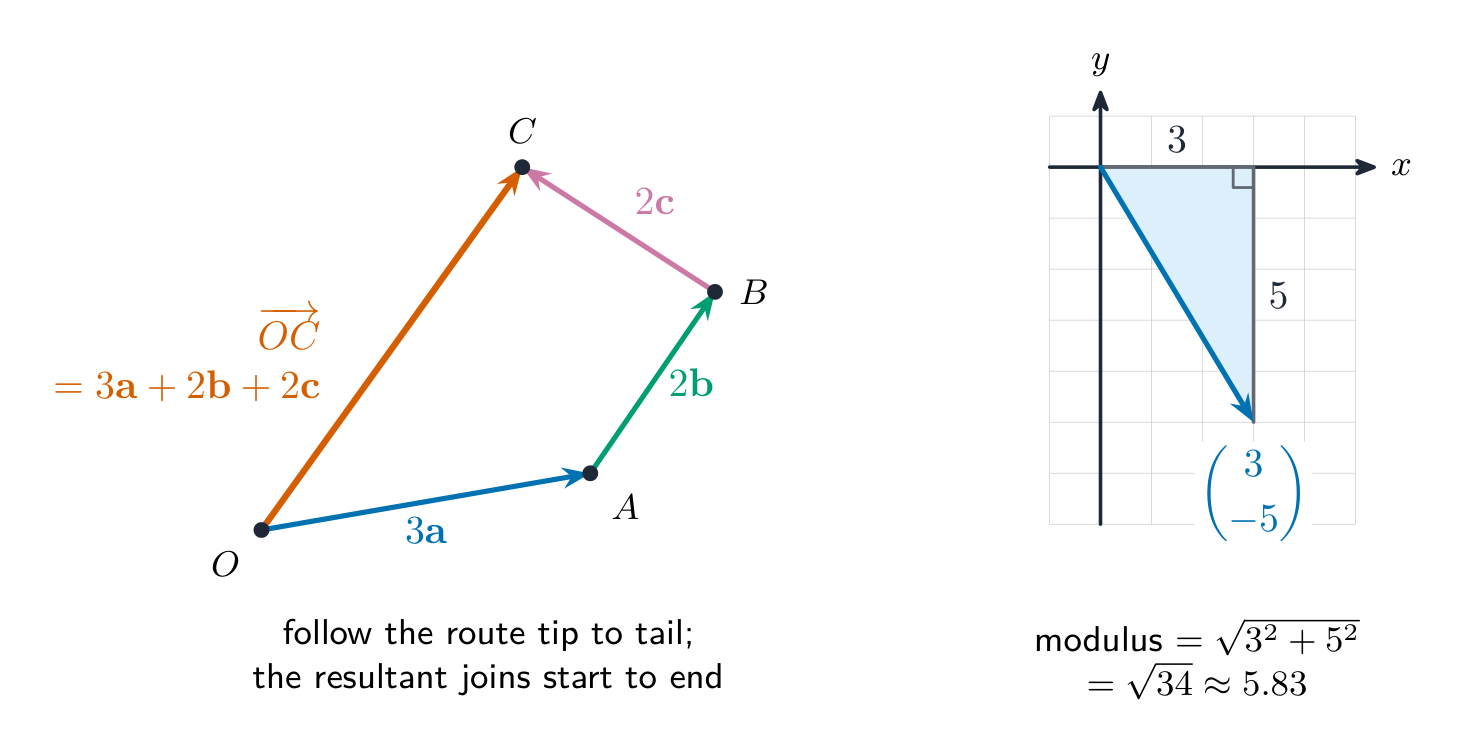
- add, subtract and multiply vectors, and find their magnitude (Higher);
- use vectors to prove facts about lines and shapes (Higher);
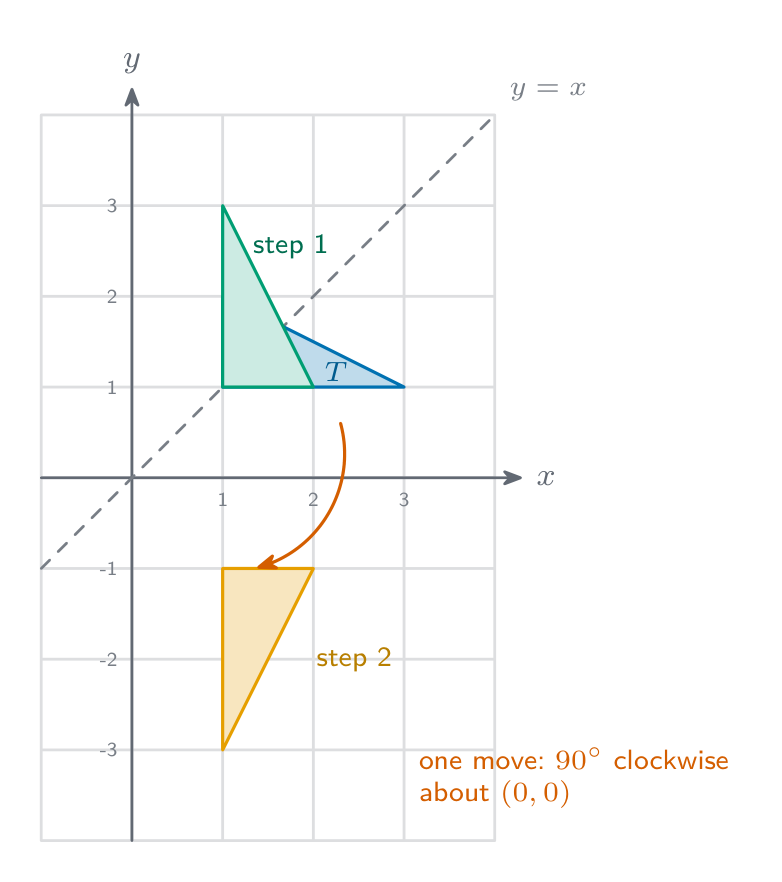
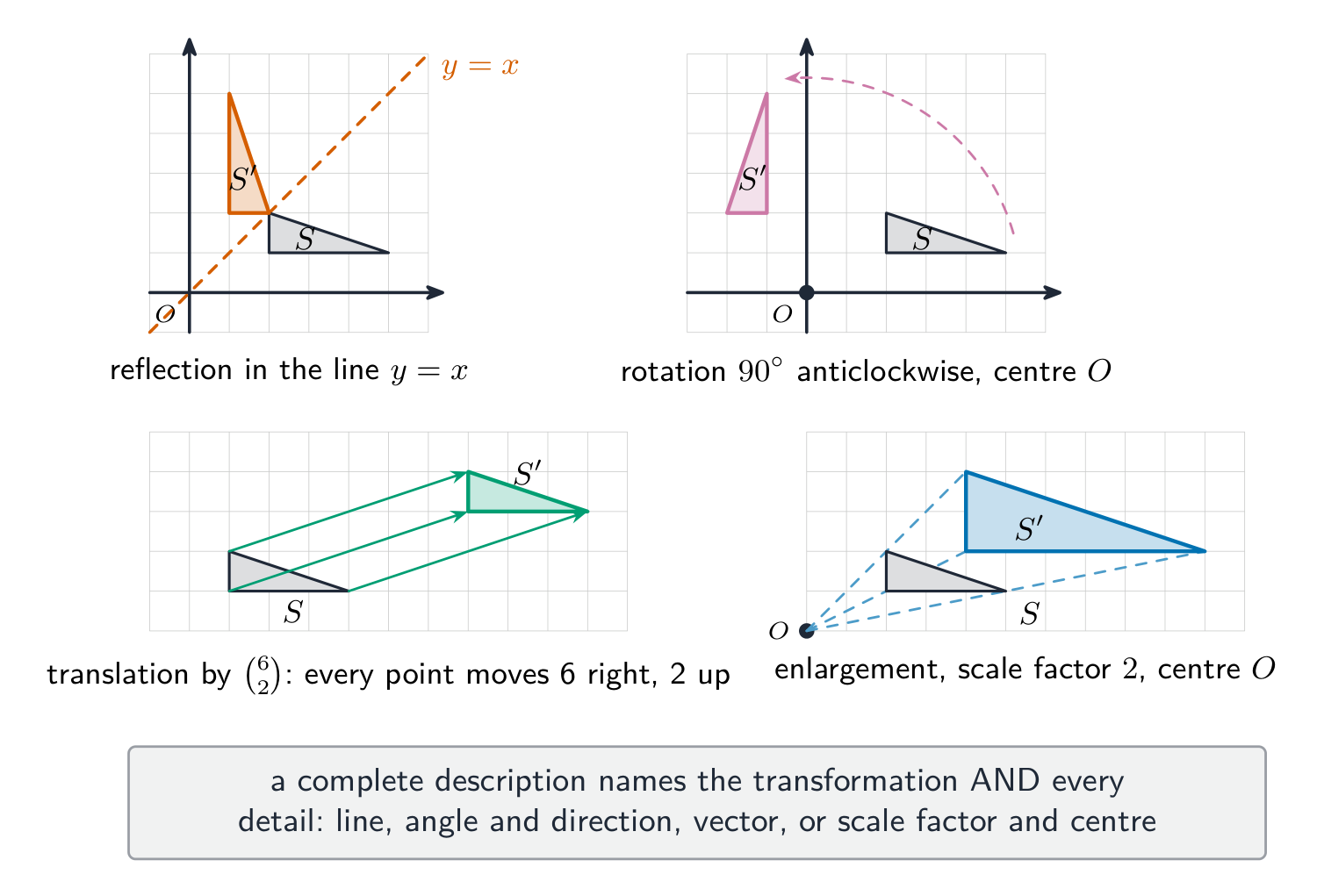
- carry out and fully describe reflections, rotations, translations and enlargements.
Pearson Edexcel International GCSE Mathematics A (4MA1), topic 5: Vectors and transformation geometry. Vectors are Higher only; transformations are on both tiers.
These results are not on the formula sheet, so learn them:
| Topic | Results |
|---|---|
| column vectors | $k\dbinom{x}{y} = \dbinom{kx}{ky}$; magnitude $\left\lvert\dbinom{x}{y}\right\rvert = \sqrt{x^2 + y^2}$ |
| routes | $\overrightarrow{AC} = \overrightarrow{AB} + \overrightarrow{BC}$; $\overrightarrow{BA} = -\overrightarrow{AB}$ |
| describing transformations | reflection: the mirror line; rotation: centre, angle, direction; translation: column vector; enlargement: centre, scale factor |