Skip to content

Practical Skills in Chemistry I

Edexcel International A-Level ChemistryTopic 3

3.1

The chemist's bench, in writing

A white solid, a colourless liquid, a gas that smells of swimming pools: WCH13 asks what you would do with them. Which test separates lithium from strontium, why the drying agent sits where it does, whether the metal was in excess, and why your enthalpy value is smaller than the data book's. Every question reaches back to the bench work of Units 1 and 2 — reactions you ran, measurements you took, and the judgement behind each step.

WCH13/01 Practical Skills in Chemistry I is the third IAS unit: 1 hour 20 minutes, 50 marks, all compulsory, a minimum of 6 mathematical marks. The specification names four assessed abilities — independent thinking in a practical context, use of scientific methods, numeracy (graphs, significant figures, accuracy and precision), and use of apparatus (selection, range and resolution, health and safety). Questions may go beyond the eight core practicals 核心实验 to unfamiliar situations built from the same techniques.

Vocabulary Train
English
core practical/kɔː ˈpræktɪkl/
3.1

The eight IAS core practicals

Core practical What it does Key skill
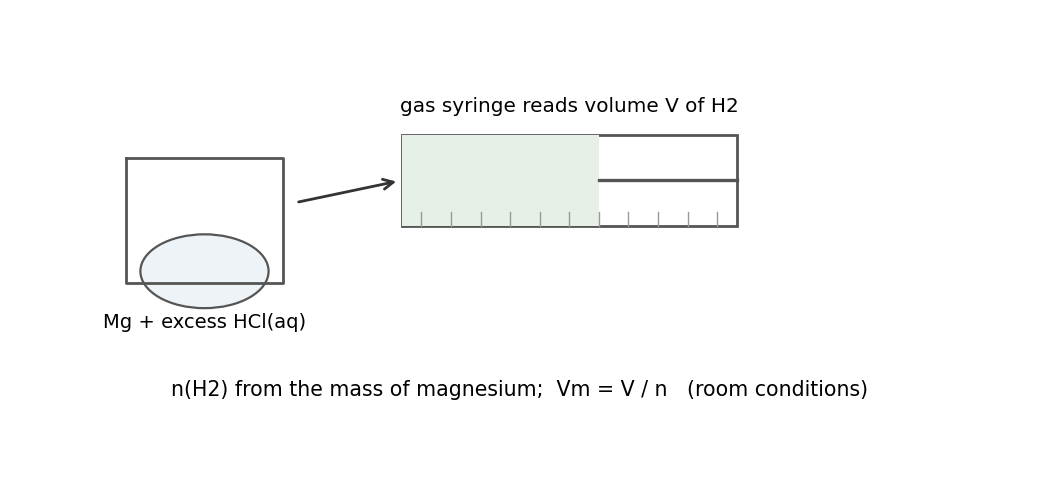
1 Molar volume of a gas Known mass of metal reacts with excess acid; gas collected and volume measured $V_m = V/n$ with the gas syringe read at room conditions
2 Enthalpy by Hess's law Temperature rises from two related reactions combined into a cycle $q = mc\Delta T$, then per mole; sources of error
3 Finding HCl concentration Titration 滴定 against a standard base with an indicator Burette technique, concordant titres, mean
4 Standard solution + NaOH Weigh a solid acid, make up to volume as a standard solution 标准溶液, titrate the unknown Quantitative transfer, volumetric flask
5 Halogenoalkane hydrolysis rates Time to precipitation with aqueous ethanol–silver nitrate at controlled temperature Timing a clock reaction 计时反应, comparing rates
6 Chlorination of 2-methylpropan-2-ol Tertiary alcohol + concentrated HCl gives 2-chloro-2-methylpropane Separating, drying and weighing an organic product
7 Oxidation of propan-1-ol Distil to keep propanal; reflux to reach propanoic acid Choosing distillation 蒸馏 vs reflux 回流 for the product wanted
8 Inorganic and organic unknowns The full qualitative scheme Observations stated as colours and precipitates
Reflux apparatus with a vertical condenser returning vapour, beside distillation apparatus with a sloping condenser collecting the product
Core practical 7: reflux for propanoic acid, distil off propanal as it forms.
Vocabulary Train
English
titration/taɪˈtreɪʃn/
standard solution/ˈstændəd səˈluːʃn/
clock reaction/klɒk rɪˈækʃn/
distillation/dɪstɪˈleɪʃn/
reflux/ˈriːflʌks/
3.2

Qualitative analysis: say what you see

Flame tests 焰色试验: clean a nichrome or platinum wire with concentrated hydrochloric acid, dip the sample, and hold it in the hottest non-luminous (roaring blue) flame. Lithium crimson, sodium yellow, potassium lilac, calcium brick-red, strontium red, barium pale green, copper blue-green. Two reds collide — lithium and strontium — so confirm chemically: add sulfate ions (dilute sulfuric acid or a soluble sulfate); strontium sulfate precipitates, lithium sulfate stays dissolved. Potassium is lilac, rubidium red-violet — say the exact words, not "purple".

Halide anions: acidify with dilute nitric acid, add silver nitrate — chloride white, bromide cream, iodide pale yellow precipitate 沉淀. Confirm with ammonia: AgCl dissolves in dilute NH₃(aq), AgBr only in concentrated NH₃(aq), AgI in neither.

Three halide precipitates — white AgCl, cream AgBr, pale yellow AgI — with the ammonia-solubility confirmation that separates them.
Three halide precipitates with the ammonia-solubility confirmation that separates them.

Organic functional groups: phosphorus(V) chloride on an alcohol or carboxylic acid steams — the gas is hydrogen chloride (misty fumes, not "hydrochloric acid"). Acidified dichromate(VI) turns orange to green when a primary or secondary alcohol (or an aldehyde) is oxidised. Combine tests with a molecular ion: two C₃H₈O isomers give Mr 60; the strongest peak at m/z 31 (CH₂OH⁺) marks the primary alcohol, at 45 (CH₃CHOH⁺) the secondary — propan-1-ol and propan-2-ol.

Vocabulary Train
English
flame test/fleɪm test/
precipitate/prɪˈsɪpɪteɪt/
3.1 3.2

Ions move — an experiment you can read

Filter paper soaked in tap water (deionised water barely conducts — it has almost no ions), with drops of silver nitrate and potassium chromate(VI): when the current flows, Ag⁺ ions migrate towards the cathode and CrO₄²⁻ towards the anode, meeting as a red precipitate — 2Ag⁺ + CrO₄²⁻ → Ag₂CrO₄. The demonstration is evidence that both salts are ionic 离子的. A green spot of copper(II) chromate splits: blue Cu²⁺ streams to the cathode, yellow chromate to the anode.

Vocabulary Train
English
ionic/aɪˈɒnɪk/
3.1

Synthesis: justify every stage

A gas synthesis train: generate chlorine, dry it, pass over heated iron, collect sublimed iron(III) chloride, absorb excess chlorine in sodium hydroxide.
A gas synthesis train: generate chlorine, dry it, react it over heated iron, collect the product, absorb excess gas.

The anhydrous iron(III) chloride synthesis pays a mark for each stage's reason. Concentrated HCl on potassium manganate(VII) is a redox 氧化还原 reaction: chloride ions lose electrons (2Cl⁻ → Cl₂ + 2e⁻) while manganate(VII) is reduced. Anhydrous calcium chloride dries the chlorine (a drying agent 干燥剂, not a "dehydrating agent"); ceramic wool holds it in place. The iron is heated only after half a minute so the air is flushed out first — otherwise iron meets oxygen before chlorine. Sodium hydroxide at the exit absorbs the excess toxic chlorine. The product sublimes into the receiver and is sealed quickly because it is deliquescent 潮解的 — it absorbs water to form hydrates, which is why a weighed product can be heavier than the calculated maximum.

Worked check. From 2.00 g of iron: $n = 2.00/55.8 = 0.0358$ mol. $M_r(\mathrm{FeCl_3}) = 55.8 + 3 \times 35.5 = 162.3$. Maximum mass $= 0.0358 \times 162.3 = 5.82$ g — and 5.80 is rejected for under-claiming the figures the data support.

Vocabulary Train
English
redox/rɪˈdɒks/
drying agent/ˈdraɪɪŋ ˈeɪdʒənt/
deliquescent/dɪlɪˈkwesənt/
3.1 3.2

Measurements: range, resolution, technique

Choose apparatus by what the measurement needs: a burette 滴定管 (±0.05 cm³ per reading, 50 cm³ range) for titres, a volumetric flask 容量瓶 for making up solutions, a gas syringe 气体针筒 for gas volumes, a thermometer graduated to 0.1–1 °C for temperature changes. Weigh by difference; read the bottom of the meniscus 凹液面 at eye level; take titres to concordant 一致的 agreement (within 0.10 cm³) before averaging — the rough titre never enters the mean. Quote significant figures the data support, and state uncertainty 不确定度 as ± half a division per reading, doubling for a difference of two readings.

A titration being carried out
A titration: read the burette to ±0.05 cm³ and record every reading to that resolution
A gas syringe collecting hydrogen from magnesium and acid; molar volume follows from the mass of magnesium and the volume read.
A gas syringe collecting hydrogen from magnesium and acid for the molar-volume calculation.
Explore

Measurement ranges and the quotient estimate

50 ± 1 mm has a 2% uncertainty. Compare it with a 100 ± 3 mm reading: the summed quotient estimate is 5%, while exact endpoint calculations reveal a slightly asymmetric range.

Vocabulary Train
English
gas syringe/ɡæs sɪˈrɪndʒ/
burette/bjʊəˈret/
volumetric flask/ˌvɒljuːˈmetrɪk flæsk/
meniscus/ˈmenɪskəs/
uncertainty/ʌnˈsɜːtənti/
concordant/kənˈkɔːdənt/
3.2

Calorimetry and its honest errors

Magnesium displaces 置换 zinc: measure the temperature change of a known mass of solution and convert to an enthalpy change 焓变 per mole.

Worked check (the 2025 data). $n(\mathrm{Zn^{2+}}) = 0.0500 \times 1.00 = 0.0500$ mol; $n(\mathrm{Mg}) = 2.20/24.3 = 0.0905$ mol — magnesium is in excess. $\Delta T = 55.2 - 19.4 = 35.8$ °C.

$$q = mc\Delta T = 50.0 \times 4.18 \times 35.8 = 7482\ \text{J}$$
$$\Delta H = -q/n = -7.482/0.0500 = -150\ \text{kJ mol}^{-1}$$

Divide by the moles of the limiting reagent in the solution (the zinc ions), not by the magnesium. A smaller experimental value than the data book means heat loss 热量损失 — the classic answer. Improvements the scheme credits: an insulated container (polystyrene cup), a lid, temperature readings every 30 seconds or a data logger, a lower concentration so less heat is lost per second, and a cooling-curve graph extrapolated back to mixing time. "Use a pipette" and "repeat and average" are explicitly ignored here — better glassware does not stop heat loss.

A cooling curve: temperature recorded until steady, mixed, then tracked and extrapolated back to the time of mixing for the true ΔT.
A cooling curve extrapolated back to the time of mixing for the true temperature change.
Explore

Solution and reaction: opposite heat changes

$q_{solution}=mc\Delta T,\quad q_{reaction}=-q_{solution}$

Connect opposite heat changes in the solution and reaction, using the page’s worked quantities to turn a temperature change into an energy estimate.

Vocabulary Train
English
enthalpy change/enˈθælpi tʃeɪndʒ/
displace/dɪˈspleɪs/
heat loss/hiːt lɒs/
3.2

What written practice cannot do

This paper examines written practical understanding. Full marks do not show that you titrated to a sharp endpoint, transferred a solid quantitatively, or handled concentrated HCl behind a screen — those manipulations are built in class through the eight core practicals and their companions.

3.2

Check yourself

  1. Describe a flame test on an unknown solid, including how the wire is cleaned.
  2. State the precipitate colours for chloride, bromide and iodide with silver nitrate, and how ammonia confirms each.
  3. Lithium and strontium both flame red. Give a chemical test that distinguishes their nitrates, with observations.
  4. In the filter-paper migration experiment, why must the paper be soaked in tap rather than deionised water, and which ion in tap water could give a white precipitate near the silver nitrate?
  5. Write the half-equation for chlorine formation from concentrated hydrochloric acid and potassium manganate(VII), and justify "redox".
  6. 2.00 g of iron gives iron(III) chloride. Calculate the maximum mass, and explain why a real product could weigh more.
  7. 50.0 cm³ of 1.00 mol dm⁻³ ZnSO₄ reacts with 2.20 g Mg. Show which reagent is in excess.
  8. Temperatures 19.4 °C and 55.2 °C for 50.0 g of solution (c = 4.18 J g⁻¹ °C⁻¹). Calculate ΔH with sign and unit.
  9. Give three scheme-credited improvements to the calorimetry, and one common suggestion the scheme ignores.
  10. A C₃H₈O isomer's mass spectrum peaks strongly at m/z 45 rather than 31. Which isomer is it, and what ion is m/z 45?

Answers: 1 clean the wire with concentrated HCl and heat; dip the sample into the hottest blue (non-luminous) flame and note the colour; 2 chloride white AgCl, bromide cream AgBr, iodide pale yellow AgI; AgCl dissolves in dilute ammonia, AgBr only in concentrated, AgI in neither; 3 add dilute sulfuric acid (or a soluble sulfate): a white precipitate (SrSO₄) means strontium, no precipitate means lithium; 4 deionised water has almost no ions so it does not conduct; chloride ions (or hydrogencarbonate) could form white AgCl on the silver side; 5 2Cl⁻ → Cl₂ + 2e⁻; chloride ions lose electrons (oxidised, oxidation number −1 → 0) while manganate(VII) gains them (reduced); 6 $n = 2.00/55.8 = 0.0358$ mol; $0.0358 \times 162.3 = 5.82$ g; the deliquescent product absorbs water forming hydrates, adding water's mass; 7 Zn²⁺ $= 0.0500$ mol, Mg $= 2.20/24.3 = 0.0905$ mol — Mg in excess; 8 $\Delta T = 35.8$ °C; $q = 50.0 \times 4.18 \times 35.8 = 7482$ J; $\Delta H = -7.482/0.0500 = -150$ kJ mol⁻¹; 9 insulated (polystyrene) container; lid; temperature every 30 s or data logger; lower concentration; cooling-curve graph — ignored: pipette/burette, more accurate balance, repeats; 10 propan-2-ol; m/z 45 is CH₃CHOH⁺ (C₂H₅O⁺).

Was this helpful?

More topics in Edexcel International A-Level Chemistry

Log in or create account

IGCSE, A-Level & AP