Writing part two gives a choice: an article for a magazine, about one hundred words, or a story starting from a given sentence. The memory hook: the article…
English narration · English and 中文 subtitles you can switch
5.1
What this topic covers
Writing Part 2 gives you a choice 二选一: an article 文章 for a magazine or website (~100 words, with a title question like "What's your favourite place?"), or a story starting from a given sentence.
Both are about 100 words, and both are marked the same way: 0–5 each for Content (did you do what the task asked?), Communicative Achievement (does it read like a real article or story for its reader?), Organisation (paragraphs, linking, order) and Language (range and accuracy). That is 20 marks for this task, the same as the email in Part 1.
Memory hook: the article answers the reader; the story moves the reader. Pick the one you can write better today — there is no prize for choosing the harder one.
Choose fast: 30 seconds of deciding, not five minutes. The clock is a budget.
Structure: title question → your answer → two reasons or examples → a closing line, all with personality 个性.
The shape of a lively article: hook the reader, keep them, leave them thinking
Open by answering directly: My favourite place is the school roof at sunset. Then two reasons: what you see, how it feels. Close with an invitation: Go there once. You'll see.
⚠ An article is not an essay 议论文. It's a magazine page: direct, personal, a little lively. You-questions are welcome: Have you ever watched the sky turn pink?
The examiners reward a voice 声音: an opinion, an example, a small joke. That is what Communicative Achievement means for an article: correct and boring keeps the reader at a distance; correct and alive talks to them.
A model article. Task: Articles wanted! What's the best season in your city? Why? Write your article in about 100 words.
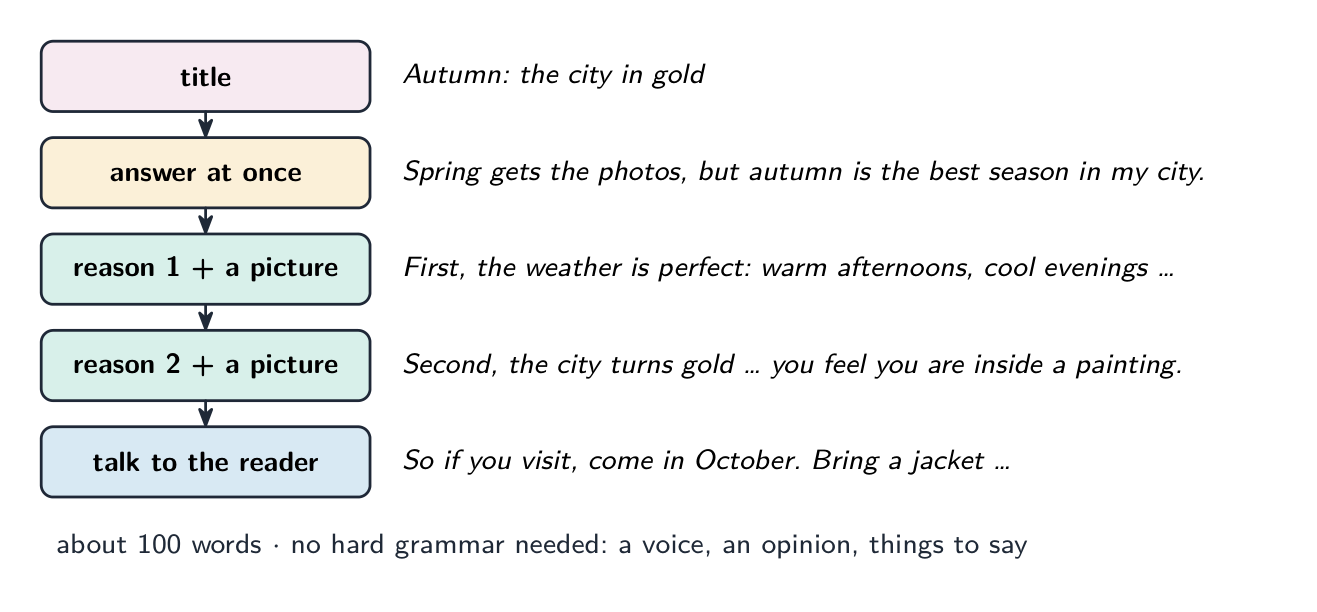
The article's shape, read off the model: answer at once, two pictured reasons, then talk to the reader
Autumn: the city in gold
Spring gets the photos, but autumn is the best season in my city, Beijing. First, the weather is perfect: warm afternoons, cool evenings and, at last, blue skies after the summer rain. Second, the city turns gold. The trees in the parks change colour, and on a Saturday you can walk through the Fragrant Hills and feel you are inside a painting. Autumn is also the season for hot roasted chestnuts, which you can smell from the end of the street. So if you visit, come in October. Bring a jacket, an empty stomach and a camera with plenty of space!
101 words. Line one answers the question; First and Second carry two reasons, each with a picture the reader can see; the last line talks straight to the reader.
The same task, weaker:
Nowadays, with the development of society, more and more people like seasons. In my opinion, the best season is autumn. Because the weather is good. Autumn is good season. In conclusion, autumn is the best season.
Criterion
What the examiner sees
Content
It answers the question, but the only reason (the weather is good) is never explained.
Communicative Achievement
It reads like a memorised essay, not a magazine page; nothing is said to the reader.
Organisation
Because the weather is good. is half a sentence; the conclusion just repeats line two.
Language
Autumn is good season needs a; the words are few and repeated (good, season ×4).
36 words, so far too short as well. Notice that the strong version uses no difficult grammar at all; it simply has things to say.
The task gives the first sentence: "The door opened slowly, and I couldn't believe my eyes."
The given sentence is a springboard 跳板: continue it, don't restart it. It sets tense (past), place and mood — inherit 继承 all three.
The story machine from A2 Part 7 works here: background (past continuous), events (past simple), one feeling per paragraph, connectors to move time.
End with a turn 转折 or a feeling: I never found out who left the key. I never needed to.
A model story. Task: Your story must begin with this sentence: "When I opened the box, I found something I had lost three years ago." Write your story in about 100 words.
When I opened the box, I found something I had lost three years ago. It was my grandfather's old watch. He had given it to me on my twelfth birthday, and a few weeks later it disappeared. I had looked everywhere — under my bed, in my school bag, even in the washing machine. Now here it was, in a box of old toys that Mum was giving away. The glass was dusty, but when I wound it, it started ticking again. I put it on my wrist immediately. This time, I promised myself, I would never take it off — except in the shower.
103 words. The past perfect (had given, had looked) carries the flashback; the past simple (was, started, put) carries the scene; the last line is the turn — and a small joke.
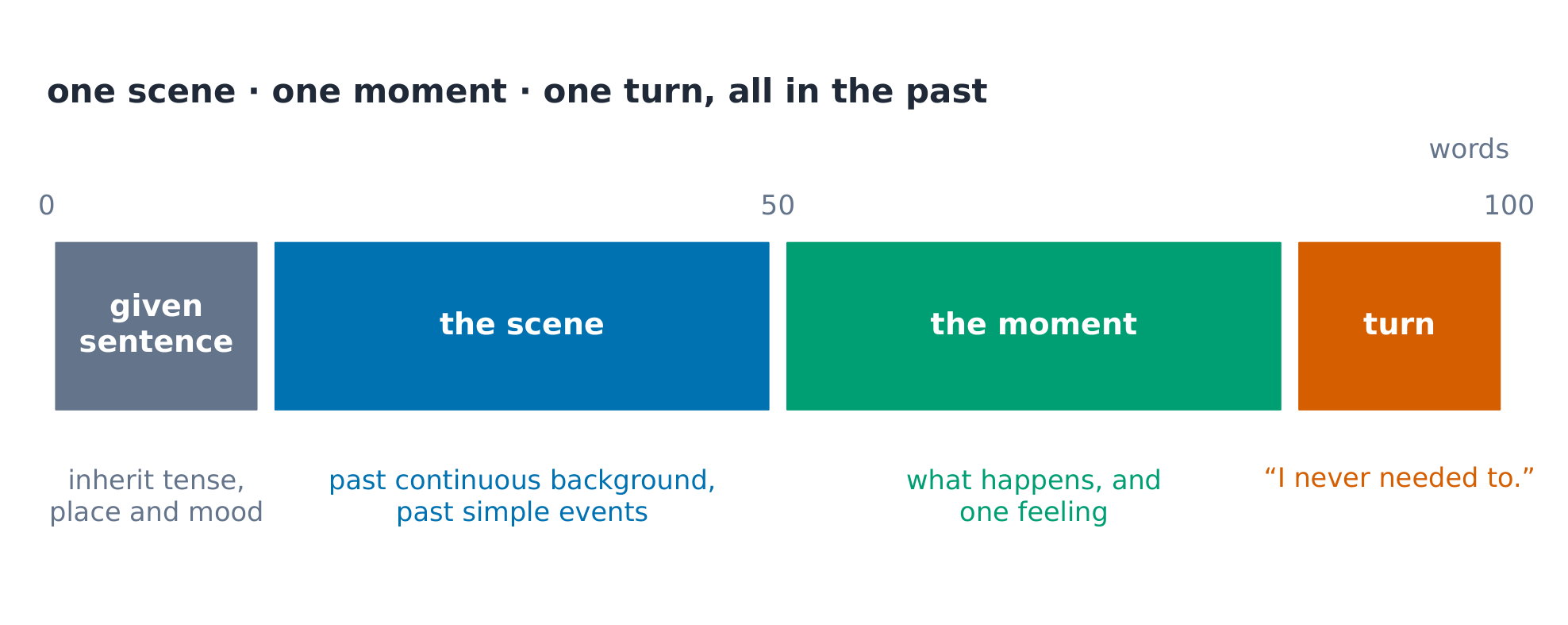
⚠ 100 words is short. One scene, one moment, one turn. A story that tries to fit a whole week reads like a timetable.
Past perfect for the flashback, past simple for the sceneWhere 100 words go: one scene, one moment, one turn
⚠ Don't write the 八股. The template essay — Nowadays… With the development of… In conclusion… — is instantly recognisable and quietly penalised 扣分. Write like a person with a favourite place.
⚠ Choose one task and commit. Only one answer is marked, so half an article plus half a story is two half-answers. Pick, write, check.
⚠ The article needs the title question answered in line one. Don't warm up for three sentences; the reader (and the examiner) is impatient.
⚠ The story must stay in the past. The given sentence is past tense; the story follows it. Drift is the mark-loser, as always.
Write one of each, about 100 words, in 35 minutes. Then check yours against the four criteria: Content, Communicative Achievement, Organisation, Language.
Article.Articles wanted! What's the best way to spend a free afternoon in your town? Tell us where to go, what to do and why. Write your article in about 100 words.
Plan: answer in line one → place and activity, with one picture the reader can see → why it is worth it → a line to the reader.
Story.Your story must begin with this sentence: "I knew it was going to be a strange day when I saw the dog on the bus."
Plan: who, where (one sentence of background, past continuous) → what the dog did (two or three events, past simple) → how it ended (a turn or a feeling).
Swap and score. Give your writing to a partner. They give 0–5 for each criterion and write one sentence of advice per criterion. Then rewrite only the weakest part.
5.6
Check yourself
Answer first, then read the explanation.
Article or story? — The one you write better today. No prize for difficulty.
The four marking criteria? — Content, Communicative Achievement, Organisation, Language, 0–5 each.
The article's first line — answers the title question directly.
The story's given sentence — inherit its tense, place and mood.
Nowadays, with the development of… — ✗ → write like a person, not a template.
Length — about 100 words, one scene, one turn. A week in 100 words reads like a timetable.
Vocabulary card meanings
choice (either/or): A selection between exactly two options.
personality: The traits that make one person unlike another.
voice: A writer's own personal way of saying things.
springboard: A starting push toward a harder task.
inherit: To receive something passed on by an earlier owner.
turn (twist): A change of direction in a plot or an argument.
template essay (bāgǔ): A rigid essay shape that repeats an empty pattern.
penalised: Given a lower mark because a rule was broken.
Interactive lessons on this topic
Work through it step by step, with instant-check exercises.