Scope and prerequisites
ACT framework, February 2026 revision. Original classroom cases are not an official form; preserve the scored/field-test boundaries of each source form.
- Separate directly stated details from supported inferences
- Track causes, contrasts and chronological relationships
- Reject conclusions requiring information outside the passage
Prerequisites: Explicit detail 细节; inference 推断; cause versus chronology.
Explain and choose the method
Read an ACT passage for both its overall movement and its details. Build a paragraph map using a few words per paragraph, then return to the relevant lines when answering. A detail item asks what the text states; an inference item requires a conclusion supported by those details. Neither licences filling gaps with outside knowledge or a familiar story.
Relationship questions may compare characters, explain a cause, establish sequence or connect a local detail to the whole. Distinguish chronology from cause: after does not by itself mean because. Track changes over time and the particular evidence 证据 making a contrast meaningful. If the text qualifies a claim, keep that qualification in the answer.
Compare options for scope and certainty. All, never, only and proves may exceed a passage saying some, often or suggests. A plausible motive is weaker than a motive supported by reported action or speech. Narrative uncertainty can be deliberate; do not resolve it more definitely than the narrator does.
The original extract is a short targeted case. Complete enhanced Reading practice also needs sustained long passages, paired texts and graphic information under the correct component timing. Use paragraph mapping here without treating this exercise as a full-length 36-item form or a scaled-score predictor.
A detail is directly stated; an inference joins clues. “The neighbour waited without complaint” does not tell us the neighbour felt no impatience. The narrator's discomfort is explicit, while the neighbour's private feelings remain unavailable.
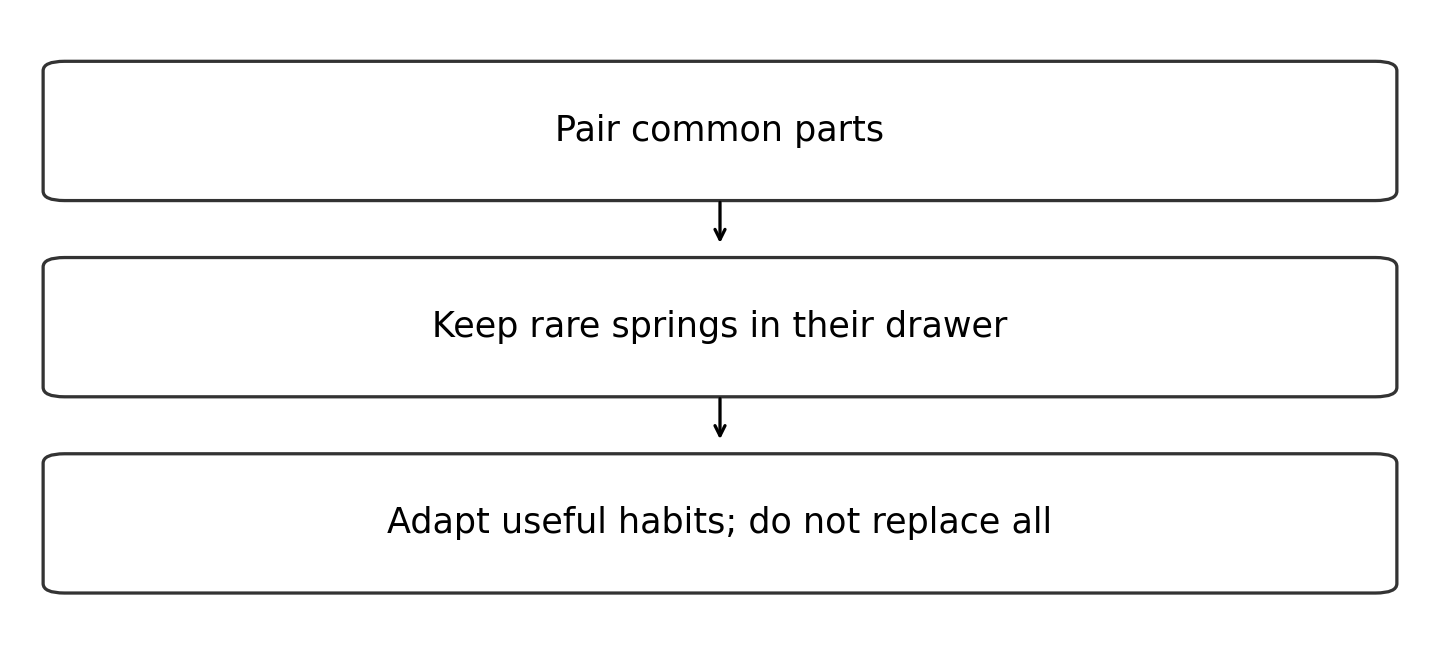
Existing worked example: Original extract: “At first, Mina sorted the workshop’s spare parts by size, as the previous keeper had done. She could find a large bolt quickly, but visitors still waited while she searched for the matching washers. After watching a mechanic collect both parts for a repair, she placed commonly paired pieces together. The shelves looked less symmetrical. The waiting line, however, moved faster. Mina kept one drawer in the old arrangement because its rarely used pieces had no regular partners.” Explicit: she retained one drawer in the old arrangement. Supported inference: she valued practical retrieval over a fully symmetrical display. Cause: the observed pairing exposed a weakness in sorting by size alone. Unsupported: she disliked the previous keeper, or the new scheme improved every drawer.
Complete original context
Original literary passage — The spare key
When I returned to the workshop after my uncle retired, the key felt too small for the responsibility attached to it. He had left the drawers neatly labelled, as though the labels might continue his explanations in his absence. I turned on the overhead light and read “washers”, “pins”, “springs”. Each word named an orderly compartment. The workbench, however, carried a shallow circular mark where his tea cup had stood, and no label could explain why that empty circle held my attention longer than the stocked shelves.
A neighbour arrived with a bent gate latch. I found a replacement pin quickly, then spent several minutes searching for the washer that would keep it in place. My uncle had sorted objects by size. He could see a repair in his mind before he opened a drawer; I could not. The neighbour waited without complaint, which made the delay feel more noticeable rather than less. At last I found the washer, fitted the pin and watched the latch swing freely. The repair was simple. Finding its parts had not been.
That evening I placed commonly paired pieces in small trays. The shelves lost some of their symmetry. I imagined my uncle raising an eyebrow, then remembered how often he had moved a tool after noticing where his hand expected it to be. His neat labels had been the result of change, not a prohibition against it. I left the rare springs in their old drawer because they had no regular partners. There was no reason to change them merely to prove that the workshop was mine.
A week later my uncle visited. He opened a tray and asked where the larger washers had gone. I showed him the remaining size-labelled drawer. “So you have kept both systems,” he said. I could not tell whether his smile meant approval or amusement at my earnestness. He tested a latch, set it down, and asked for tea. I placed his cup on the old mark without thinking. Only after he left did I notice that I had made room beside it for my own.
I had expected taking charge to mean replacing his habits with mine. Instead, I was learning which habits solved a problem and which had depended on a skill I had not yet acquired. The workshop did not need a dramatic beginning. It needed a washer that could be found, a safe repair, and enough empty space for the next person to work.
Independent practice and checked reasoning
Transfer 1
Why does the narrator start pairing parts? Identify the observed problem and the change's stated result or purpose.
Reasoning: A simple latch repair is delayed by searching separately for the matching washer. Pairing commonly used parts addresses retrieval for someone without the uncle's mental model. The passage does not supply a measured post-change speed, so describe the purpose rather than inventing a quantified result.
Transfer 2
What remains in the old arrangement, and why? Does the narrator replace every old habit?
Reasoning: Rare springs remain in their old drawer because they have no regular partners; the larger-washer size drawer also remains. The narrator keeps useful parts of both systems, contradicting total replacement.
Transfer 3
Interpret the two cup marks at the end. Distinguish a supported reading from an unsupported claim that the uncle demanded a permanent desk.
Reasoning: Making space beside the old mark suggests the narrator can develop a role while preserving a relationship with the uncle. The narrator places the cup without thinking; no demand for a desk is reported. Other readings grounded in continuity and change are acceptable if they acknowledge the inference.
Limits and next use
A character’s action may support a priority without proving an unreported emotion or universal benefit.
All tasks here are public original practice with authored guidance. They are not official questions or fresh diagnostics. Existing protected tests and mocks remain separate.