Scope and prerequisites
ACT framework, February 2026 revision. Original classroom cases are not an official form; preserve the scored/field-test boundaries of each source form.
- Build a model connecting quantities, rates and geometric measures
- Interpret parameters and test the model’s assumptions
- Evaluate predictions and adjust a parameter using new evidence 证据
Prerequisites: Fractions; unit conversion; percentage base.
Explain and choose the method
Define variables with units and translate each part of the situation. A fixed fee plus a rate 速率 gives C=b+md; direct proportion C=md applies only when the intercept is zero. Ratios compare quantities in a chosen order, and successive percentage changes multiply their changing bases. A model should preserve those relationships before any arithmetic begins.
Convert units by multiplying factors that cancel. For scale models, length factors square for area and cube for volume when every dimension is scaled. Combining a geometric formula with a unit price can model material cost; for example, paint area times cost per square metre gives currency, while using wall volume would have the wrong physical meaning.
Interpret and test the model. Ask whether a constant rate is plausible across the domain, whether a fixed charge is already included and whether an estimated area excludes doors or overlap. Compare a prediction with observed data and identify which assumption or parameter may need revision. A model’s neat algebra does not establish that it fits reality.
Improve a model by adjusting the parameter supported by evidence. If every predicted bill is exactly two units low, revising the fixed fee may fit better than changing the per-distance slope. A trend in errors with distance points toward the rate instead. Keep modelling as an overlapping activity across content areas, not a separate extra block of official questions.
A rate compares quantities with their units. $v=d/t=(90\,\mathrm{km})/(1.5\,\mathrm{h})=60\,\mathrm{km/h}$. Convert using cancelling units: $v=(60\,\mathrm{km/h})(1000\,\mathrm{m/km})/(3600\,\mathrm{s/h})=50/3\,\mathrm{m/s}$. Do not convert only the numerator of a compound rate.
Existing worked example: Original delivery model C=8+3d, d in kilometres, predicts 23 units for 5 km. Bills are consistently 2 units higher at several distances, supporting a revised intercept 10 while keeping slope 3. A wall 4 m by 2.5 m has area 10 m²; subtracting a 2 m² doorway gives 8 m² to paint. At 6 units/m², cost is 48. A 1:50 plan of a 4 m wall shows 8 cm.
Complete original context
Every transfer question states all data it needs.
Independent practice and checked reasoning
Transfer 1
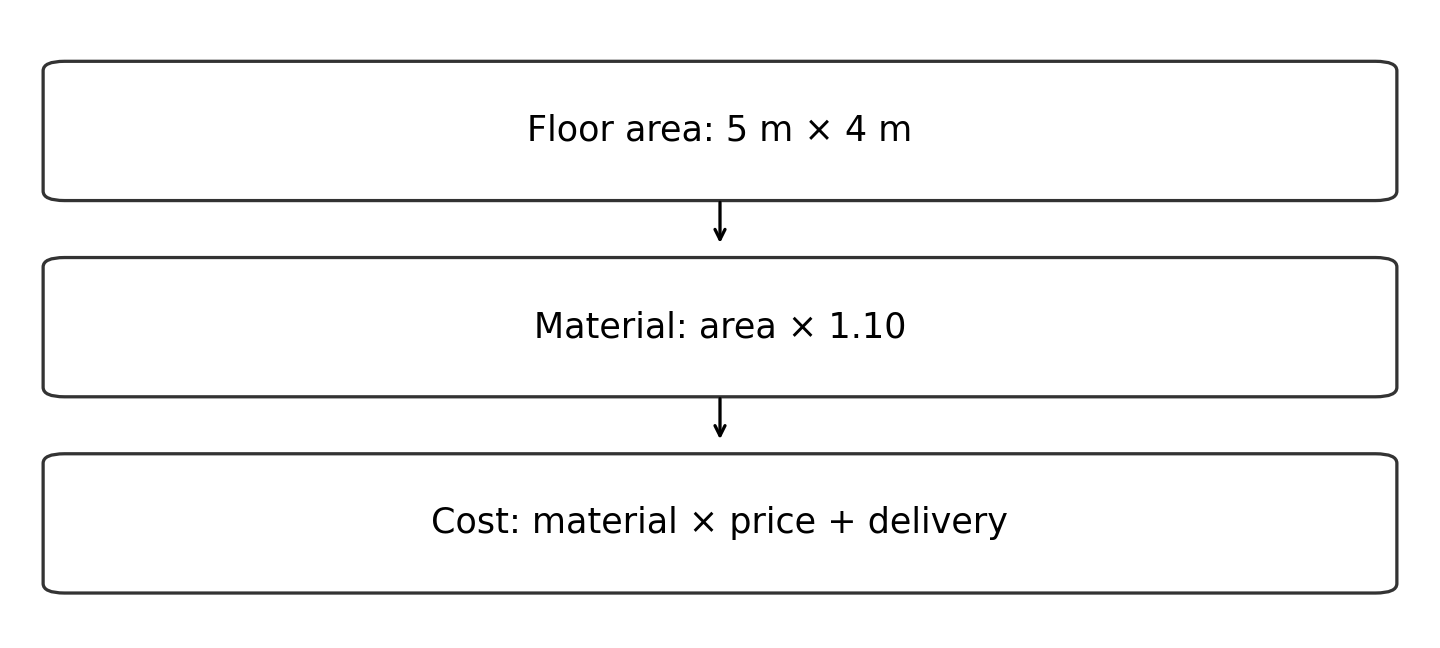
A room is 5 m by 4 m. Allow extra flooring equal to 10% of the room area for wastage, costs 35 yuan per square metre, and delivery adds 60 yuan. Build a cost model and find the total. A 1:50 plan shows the room; give its dimensions in centimetres.
Reasoning: Area $A=LW=(5\,\mathrm{m})(4\,\mathrm{m})=20\,\mathrm{m^2}$. Required material $Q=1.10A=22\,\mathrm{m^2}$. Cost $C=pQ+d=(35\,\mathrm{yuan/m^2})(22\,\mathrm{m^2})+60\,\mathrm{yuan}=830\,\mathrm{yuan}$. Plan dimensions are $500/50=10$ cm and $400/50=8$ cm. Wastage is on area, not on both side lengths.
Transfer 2
A delivery model $C=6+4d$ yuan is consistently 5 yuan below observed bills at distances 2,4,6 km. Propose a first revision. Explain what pattern instead would suggest a slope error.
Reasoning: A constant residual 残差 suggests raising the intercept by 5 to $C=11+4d$. A residual systematically growing with distance would suggest checking the per-kilometre rate. Neither pattern alone proves the reason; check fee definitions and other conditions.
Limits and next use
Do not treat an intercept model as direct proportion or adjust every parameter when evidence identifies one systematic error.
All tasks here are public original practice with authored guidance. They are not official questions or fresh diagnostics. Existing protected tests and mocks remain separate.