Scope and prerequisites
ACT framework, February 2026 revision. Original classroom cases are not an official form; preserve the scored/field-test boundaries of each source form.
- Evaluate and convert between function rules, tables and graphs
- Track input order and domain through composition 复合函数
- Find an inverse after choosing a one-to-one 一一对应 domain
Prerequisites: Function notation; substitution; equation solving.
Explain and choose the method
A function gives one output for each allowed input. A graph passing a vertical line at two different output points is not a function of x. Domain lists allowed inputs; range lists attained outputs. Convert a table to a rule only when the relationship is supported, and interpret each variable’s role.
In f(g(x)), the inner function g acts first and its output must be in f’s domain. For f(u)=1/(u-1) and g(x)=x²+1, composition gives 1/x² and excludes x=0. Domain checking belongs to the original functions as well as the simplified result.
An output change f(x)+k shifts vertically by k; f(x-h) shifts right by h. An outside multiplier changes output scale, while an inside multiplier changes how quickly the input reaches old points. Identify a known point to verify the transformation 转化 instead of guessing direction from a sign.
An inverse exchanges input and output and requires a one-to-one relationship on the chosen domain. Solve y=f(x) for x, then exchange names. A quadratic must usually be restricted to one side of its vertex. The inverse function f⁻¹ is not the reciprocal 1/f. Check composition in both directions on the allowed domain.
Composition applies the inside rule first. If $f(u)=1/(u-2)$ and $g(x)=x^2+2$, $f(g(x))=1/x^2$, with $x\ne0$. An inverse reverses input and output on a one-to-one domain. Restrict $h(x)=(x-1)^2$ to $x\ge1$ before taking $h^{-1}(x)=1+\sqrt{x}$.
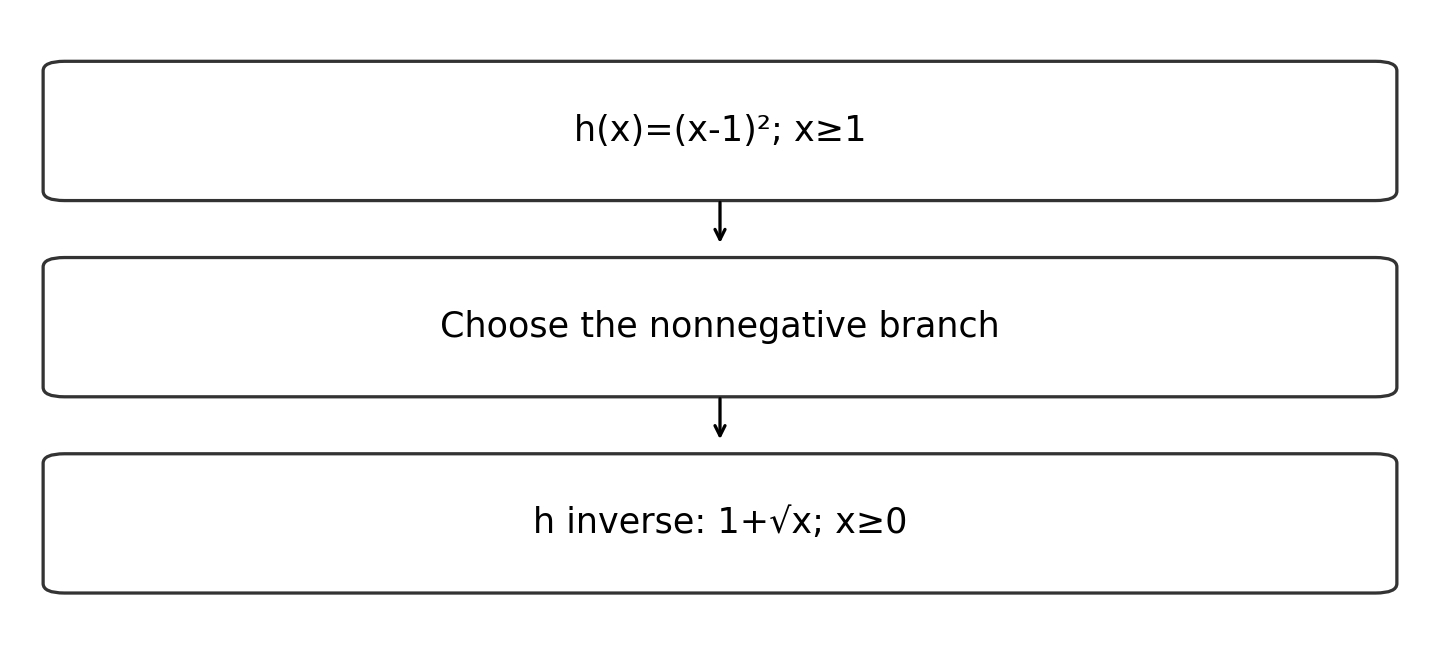
Existing worked example: f(x)=2x+3 and g(x)=x² give f(g(x))=2x²+3, but g(f(x))=(2x+3)². For h(x)=(x-2)² restricted to x≥2, the inverse is 2+√x with domain x≥0. A vertical shift of h by 4 has vertex (2,4); the unrestricted quadratic would not have a single-valued inverse.
Complete original context
Every transfer question states all data it needs.
Independent practice and checked reasoning
Transfer 1
Let $f(u)=1/(u-3)$ and $g(x)=x^2+3$. Find $f(g(x))$ with domain. Find $g(f(4))$ and explain why these compositions differ.
Reasoning: $f(g(x))=1/(x^2+3-3)=1/x^2$, excluding $x=0$. For the other order, $f(4)=1$ and $g(1)=4$. Composition order changes both operation and possibly domain; $f(g(4))=1/16$ is different.
Transfer 2
Restrict $h(x)=(x+2)^2$ to $x\le-2$. Find its inverse, including domain and range. Explain why the positive-root branch is wrong.
Reasoning: Solve $y=(x+2)^2$ with $x+2\le0$ to get $x=-2-\sqrt y$. Thus $h^{-1}(x)=-2-\sqrt x$, domain $x\ge0$, range $y\le-2$. The plus branch returns values outside the chosen original domain.
Transfer 3
The graph of $f(x)=x^2$ is changed to $g(x)=3f(x+4)-2$. Find its vertex and range, checking one mapped point.
Reasoning: $g(x)=3(x+4)^2-2$ has vertex $(-4,-2)$ and range $y\ge-2$. Old point $(1,1)$ maps to $(-3,1)$ because $3(1)-2=1$; substitution confirms $g(-3)=1$.
Limits and next use
Preserve composition order and the restricted inverse branch. Superscript -1 in function notation does not mean a reciprocal.
All tasks here are public original practice with authored guidance. They are not official questions or fresh diagnostics. Existing protected tests and mocks remain separate.