Skip to content

S.1-2 · Key speaking: interview and collaborative discussion

Cambridge English A2 Key (KET) · Topic 7

Video lesson for this topic Open the video page
4:20

A2 Key · Speaking: the interview and the discussion

The speaking test is eight to ten minutes, with a partner and two examiners, and it is the friendliest part of the exam: a conversation, not an interrogation.…

English narration · English and 中文 subtitles you can switch

7.1

What this topic covers

The A2 Key Speaking test: 8–10 minutes, with a partner 搭档, and two examiners. One examiner (the interlocutor) asks the questions; the other (the assessor) only listens and marks. It is the friendliest part of the exam — a conversation, not an interrogation 审问.
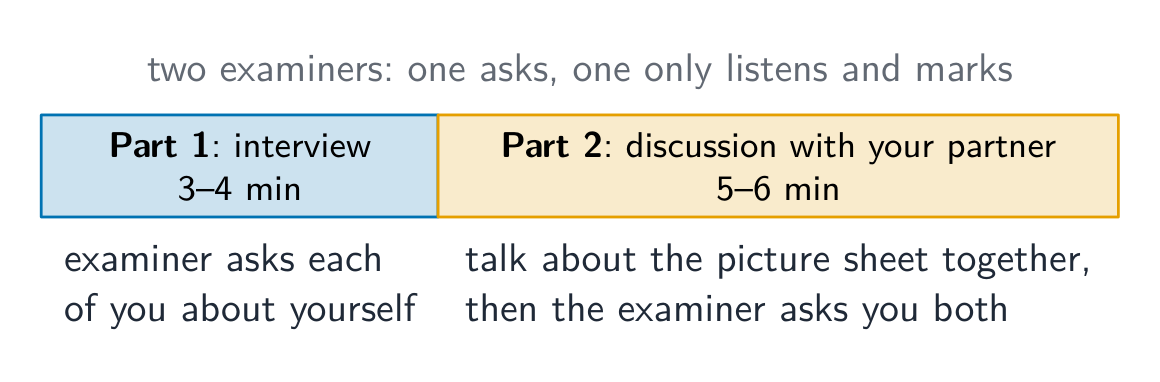
A time bar: Part 1, the interview, 3 to 4 minutes; Part 2, the discussion with your partner, 5 to 6 minutes
The Speaking test
Part Time What happens
Part 1: the interview 3–4 min The examiner asks each of you about yourself: name, age, where you live, then two everyday topics such as school, food or free time. It ends with a longer answer: Please tell me something about…
Part 2: the discussion 5–6 min You and your partner look at a sheet of pictures (e.g. five holidays) and talk together about which ones you like and why. Then the examiner asks each of you a few questions about the pictures and the topic.
  • No joint decision. Part 2 asks Do you like these different…? Say why or why not. You do not have to agree or choose one together — that is a B1 Preliminary task. You just share your likes and dislikes, with reasons, and react to your partner's.
  • How it is marked: the assessor gives marks for Grammar and Vocabulary, Pronunciation and Interactive Communication; the interlocutor gives one overall mark (Global Achievement). So all three matter: correct everyday English, clear sounds, and real talking to each other.
  • Memory hook: Part 1 is a friendly chat 聊天 with the examiner; Part 2 is chatting about a photo album with a classmate. Both are conversations you already have — just in English, with marks.
  • The examiners want: clear answers, interaction 互动 with your partner, and everyday vocabulary. They do not want speeches.
Vocabulary Train
English
partner/ˈpɑːtnə/
interrogation/ɪnˌterəˈɡeɪʃn/
friendly chat/ˈfrendli tʃæt/
interaction/ˌɪntəˈrækʃn/
7.2

Part 1: the interview

Answer in full sentences, two or three of them per question.

Two people facing each other across a table, one asking questions and the other answering
The speaking test starts with simple questions about you: answer, then add one detail
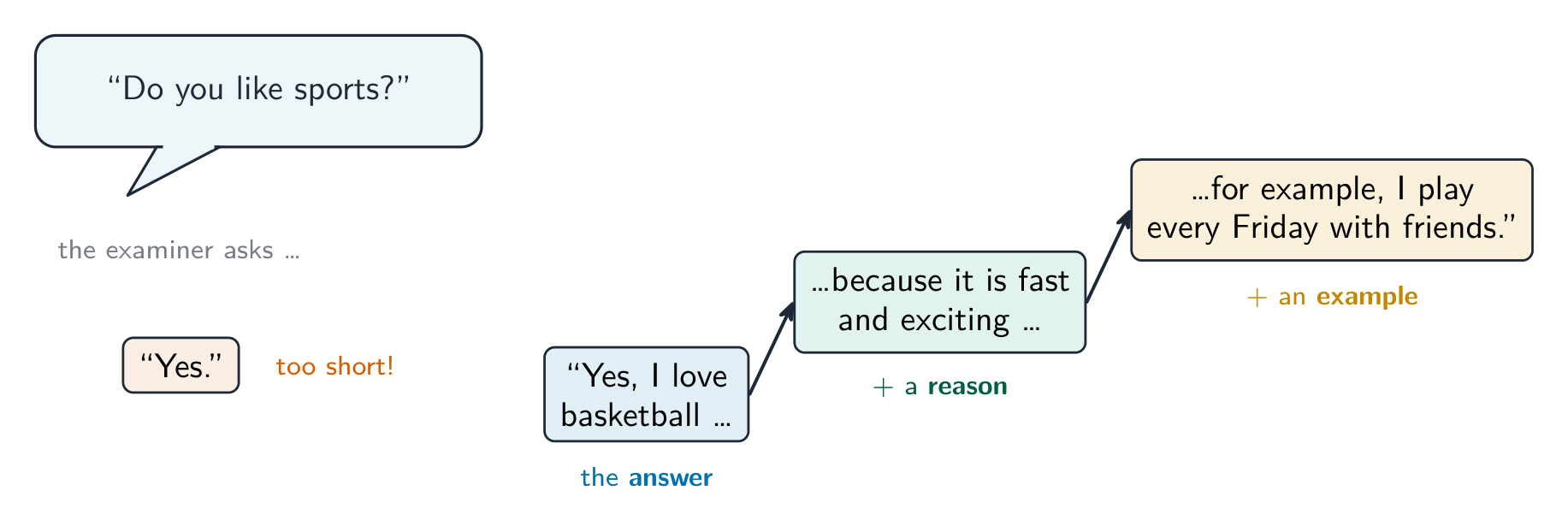
The examiner asks Do you like sports; the answer Yes alone is too short, but answer plus a reason plus an example climbs like stairs to a full turn
Answer, then add more: a reason and an example make a full turn
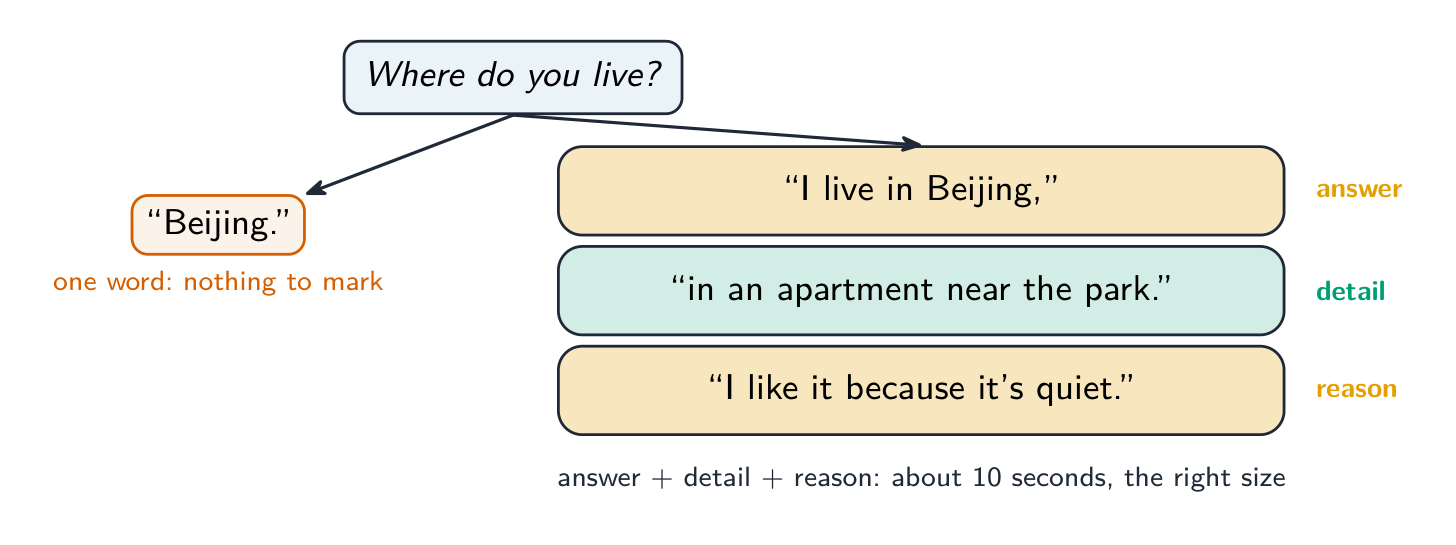
  • Where do you live? — ✗ "Beijing." → "I live in Beijing, in an apartment near the park. I like it because it's quiet." Answer + detail + reason.
  • Memory hook: every answer is a sandwich 三明治: the answer, a detail, a reason. I like football. I play every weekend. It's fun with my friends.
  • Prepare the classics aloud: your name (spelled), your school, your family, your hobbies, your favourite food, your weekend. These are rehearsed 排练过 answers — say them until they're warm.
The question 'Where do you live?' with a one-word reply 'Beijing.' marked nothing to mark, beside a three-layer sandwich: the answer 'I live in Beijing,', the detail 'in an apartment near the park.' and the reason 'I like it because it's quiet.'
The answer sandwich: answer, detail, reason

Phase 1 is short; phase 2 wants more. The first questions (What's your name? How old are you? Where do you live?) need one clear sentence. The topic questions need the sandwich. The last one — Please tell me something about your favourite place — needs three or four sentences:

My favourite place is my grandmother's flat. It's small, but it has a big window, and you can see the river. On Sundays we cook dumplings together there. I always eat too many, and she always says I'm too thin.

Four sentences: the place, what it looks like, what you do there, a little joke. That is about 40 words — roughly 20 seconds of speaking, which is exactly the right size.

Weak or strong? The question is What do you usually eat for breakfast?

Answer What the assessor hears
"Eggs." One word; no grammar or vocabulary to give marks for.
"I eat eggs. Eggs is good. I like eggs." Three sentences, but one error (eggs is) and no new information.
"I usually have eggs and some bread. My mum makes them before school, so it's quick." Answer, detail, reason; correct have, a linker (so).
Vocabulary Train
English
sandwich/ˈsændwɪtʃ/
rehearsed/rɪˈhɜːst/
7.3

Part 2: the discussion

A sheet of pictures (e.g. five birthday presents), a question, and your partner. You must talk to each other, not just to the examiner.

  • The examiner says something like: Here are some pictures of different presents. Do you like these different presents? Say why or why not.
  • Start: Do you like the camera? / I like the camera, because I take lots of photos — what about you?
  • Agree, disagree, add: Me too! / Really? I don't like it, because… / That's true, but…
  • ⚠ Never give a monologue 独白. The marks are in the interaction: ask your partner's opinion, answer theirs, build on it.
  • ⚠ Disagreeing is free marks. "Really? I don't like books very much, because they're boring for me" shows more English than yes-saying. The exam is one place where polite disagreement pays.
  • ⚠ Talk about several pictures, not one. Five pictures and two minutes: give each one a sentence or two, then move on: What about the bike?
A Part 2 style card: five presents to talk about with your partner

Worked exchange.

  • A: Do you like the headphones?
  • B: Yes, I love them, because I listen to music every day on the bus. What about you?
  • A: Not really. They're very expensive. I like the bike, because it's good for your health.
  • B: Me too, but I can't ride a bike in my city — there's too much traffic. What about the plant?
  • A: I don't like it very much. It's a bit boring. And I always forget to water plants!

Every turn answers, gives a reason with because, and passes the talk back with a question. Nobody chooses a winner — that's fine. Now cover it and talk about the card with a partner.

After the discussion, the examiner asks each of you. Typical follow-up questions:

  • Which of these presents do you like best? — I like the camera best, because I can take photos of my friends.
  • Do you like getting books as presents? — Not really. I prefer things I can use outside.
  • What present did you get for your last birthday? — I got a football from my uncle. I play with it every day.

These are short Part-1-style questions again: answer, detail, reason.

Vocabulary Train
English
monologue/ˈmɒnəʊlɒɡ/
plant (zhíwù)/plænt/
7.4

Watch out: traps for Chinese speakers

  • ⚠ One-word answers are the mark-killer. "Yes." "Beijing." "Football." — three answers, zero sentences. The sandwich, every time.
  • ⚠ Don't recite 背诵 a memorised speech. Examiners hear it instantly and redirect. Prepare building blocks, not paragraphs.
  • ⚠ Look at your partner in Part 2, not at the examiner. The discussion is with them; the examiner is just listening in.
  • ⚠ Don't freeze on an unknown word. Describe around it 迂回表达: "It's a thing for… you use it to…" — paraphrasing is a marked skill, not a failure.
  • ⚠ Speak clearly and loudly enough: audibility 可听度 comes first. Pronunciation is one of the marked criteria, but it means easy to understand, not a perfect British accent. A clear, loud answer with a Chinese accent beats a quiet mumble every time.
  • ⚠ Don't say "I'm sorry, my English is poor." It wastes your time and the examiner already knows your level. Just answer.
Vocabulary Train
English
recite/rɪˈsaɪt/
describe around it/dɪˈskraɪb əˈraʊnd ɪt/
audibility/ˌɔːdəˈbɪlɪti/
7.5

Say it aloud

Rehearse the interview classics, then run a two-minute discussion with a partner.

  • Tell me about your family. — There are four of us. My sister is twelve. We fight about the TV, and I usually win.
  • What do you do at the weekend? — I play basketball with my classmates. It's fun, and I'm getting taller. Both matter.
  • Please tell me something about your school. — (three or four sentences: where it is, what you like, what you don't like, one detail.)
  • Part 2 with a partner: five presents for a teacher — a book, a bike, a camera, a game, a plant. Do you like these presents for a teacher? Say why or why not. Give every picture at least one turn. Disagree politely. The plant has feelings too.
  • Then answer the examiner: Which present do you like best for a teacher? Why?
7.6

Check yourself

Answer first, then read the explanation.

  1. Where do you live? — Answer + detail + reason. The sandwich, every time.
  2. In Part 2, must you and your partner choose one picture together? — No. You say which ones you like and why; choosing together is a B1 Preliminary task.
  3. Part 2: your partner says the book is boring. — Respond to them: Really? I like it, because… / Me too, and… Interaction is the mark.
  4. You don't know the word for 植物 — describe around it: a green thing for your desk — you give it water. Paraphrasing is a skill, not a failure.
  5. A memorised two-minute speech — the examiner redirects instantly. Blocks, not speeches.
  6. Which three things does the assessor mark? — Grammar and Vocabulary, Pronunciation, Interactive Communication.
  7. Please tell me something about your favourite food. — Three or four sentences, not one: the food, when you eat it, why you like it, a detail.
  8. Quiet mumble vs clear voice — audibility first. Speak up.

Vocabulary card meanings

partner: The person you work with in a pair. interrogation: A harsh series of questions, unlike an easy conversation. friendly chat: An easy, informal conversation. sandwich: Food made of a filling between two pieces of bread. rehearsed: Practised aloud before the real performance. monologue: A long speech spoken by one person alone. recite: To say a text from memory, word for word. describe around it: Explaining an idea with other words when the exact word will not come. audibility: How clearly a voice can be heard. plant (zhíwù): A living thing that makes its own food and usually has leaves, including kinds that grow in water rather than in soil.

Interactive lessons on this topic

Work through it step by step, with instant-check exercises.

More topics in Cambridge English A2 Key (KET)

Log in or create account

IGCSE, A-Level & AP