International: the ledger that always closes
導入済み| English | 意味 |
|---|---|
| balance of payments/ˈbæləns ɒv ˈpeɪmənts/ | balance of payments |
| current account/ˈkʌrənt əˈkaʊnt/ | The part of the balance of payments recording trade in goods and services, primary income and secondary income. |
| purchasing power parity/ˈpɜːtʃɪsɪŋ ˈpaʊə ˈpærɪti/ | purchasing power parity |
| exchange rate/eksˈtʃeɪndʒ reɪt/ | The price of one currency expressed in units of another currency. |
A deficit is a decision, not a sin
- Aurora imports a fifth of its GDP and its currency floats. The balance of payments 国际收支平衡表 is where its domestic choices settle against the world's — and it always, always balances.
- This lesson reads the ledger, then the two parity ideas that try to price a currency.
The ledger that closes by definition
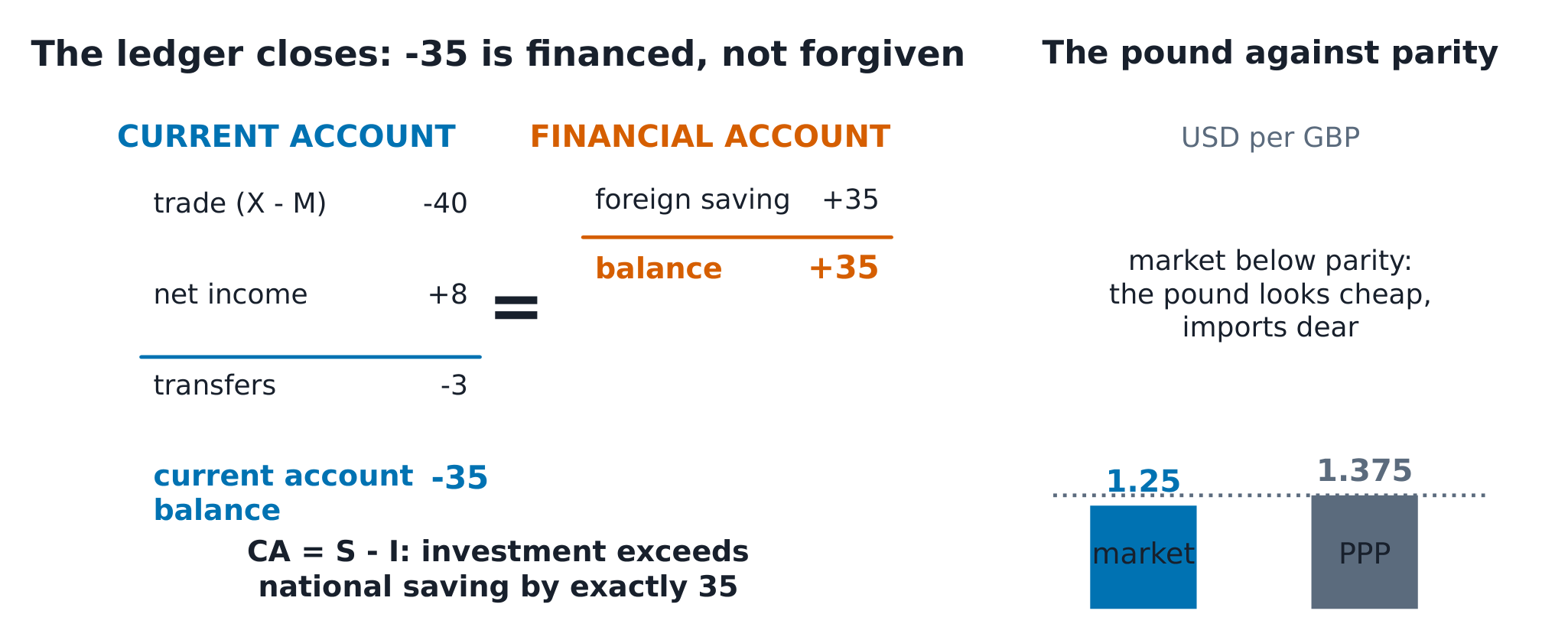
- The current account 经常账户: trade in goods and services ($X - M = 160 - 200 = -40$), net income +8, net transfers −3 → −35.
- The financial account: +35 — foreign saving flowing into Aurora. The two sum to zero by construction: a current-account deficit IS foreign finance.
Which account does each flow belong to?
Place each cross-border flow on the balance of payments, and read the exchange-rate consequences of policy moves.
X 160, M 200, net income +8, transfers -3. The current account balance?
Difficulty 2/5 · 140 coins + a small bonus on first completion today
$(160-200) + 8 - 3 = -35$. The financial account is +35 - foreign saving - and the BOP sums to zero.
Aurora's balance of payments can be in deficit if the current account is -35.
Difficulty 1/5 · 100 coins + a small bonus on first completion today
The current account of -35 is mirrored by a financial account of +35; the TOTAL sums to zero by definition. The deficit language applies to components, never the whole.
The identity with content
- $CA = S - I$: the −35 means domestic investment exceeds national saving by exactly £35bn.
- So the real question is not the sign but the use: investment that raises future output is a different animal from consumption borrowed from abroad.
CA = -35 means what about saving and investment?
Difficulty 1/5 · 100 coins + a small bonus on first completion today
$CA = S - I$: a deficit is foreign saving financing domestic investment. The sign is a fact; the use of the funds is the judgement.
Parity as an anchor
- Purchasing power parity 购买力平价: the same basket costs 800 in pounds at home and 1,100 in dollars abroad → parity rate $1{,}100/800 = \mathbf{1.375}$ USD/GBP.
- The market rate of 1.25 sits BELOW parity: the pound looks cheap, Aurora's exports competitive — exactly the force that should narrow the trade gap. Slowly: baskets differ, transport is real.
The basket costs 800 in pounds and 1,100 in dollars. The PPP rate, in USD per GBP (three decimals)?
Difficulty 2/5 · 140 coins + a small bonus on first completion today
$1{,}100/800 = 1.375$. The market rate of 1.25 sits below parity - the pound looks cheap.
Match each idea to its job.
Difficulty 2/5 · 140 coins + a small bonus on first completion today
Anchors, models and identities - each answers a different question about the same currency.
Interest parity as a model
- Uncovered interest parity: Aurora 5%, the world 4% → the pound is expected to depreciate about 1%: $1.25 \times 1.04/1.05 = \mathbf{1.238}$ ✓.
- A saver comparing the two currencies is, by the model, indifferent once the expected move is priced. UIP famously FAILS in the short run — carry trades harvest that failure — which is the point: it is a model with stated limits, like everything in this course.
Aurora 5%, the world 4%, spot 1.25. The UIP expected future rate (three decimals)?
Difficulty 2/5 · 140 coins + a small bonus on first completion today
$1.25 \times 1.04/1.05 = 1.238$ - about a 1% expected depreciation, offsetting the 1% rate advantage.
External balance meets domestic policy
- A tightening raises Aurora's rates → capital inflow → the pound rises → exports dearer → the current account widens. The exchange rate is a transmission channel, not a scoreboard.
- A depreciation does the reverse — good for exporters, expensive for importers of food and energy: the same move is a gain and a tax at once.
Aurora tightens monetary policy. What does the external ledger do?
Difficulty 1/5 · 100 coins + a small bonus on first completion today
Higher rates attract capital (financial account inflow), appreciate the currency, and dent net exports - the exchange rate is a transmission channel.
A depreciation of the pound is bad news for everyone in Aurora.
Difficulty 1/5 · 100 coins + a small bonus on first completion today
Exporters gain competitiveness while importers of food and energy pay more - the same move is a boost and a tax. Name the side you mean.
Three international slips
- Adding current and capital accounts and reporting "a deficit". The balance of payments sums to zero by definition.
- Calling depreciation bad for everyone. Exporters gain; importers pay. Name the side.
- Treating PPP as a forecast. It is a decades-long anchor; UIP is the short-run model, and both carry their limits.
Recap
- CA = trade + income + transfers; the financial account mirrors it; $CA = S - I$.
- PPP is the long-run anchor; UIP the short-run model — each with stated limits.
- The exchange rate transmits policy; the ledger closes by definition.