Your learning plan · Continue · Review →
把 sentences (do something to the object)
導入済み保存した位置はこのブラウザに留まります。再開してもImplementedの完了や回答にはなりません。
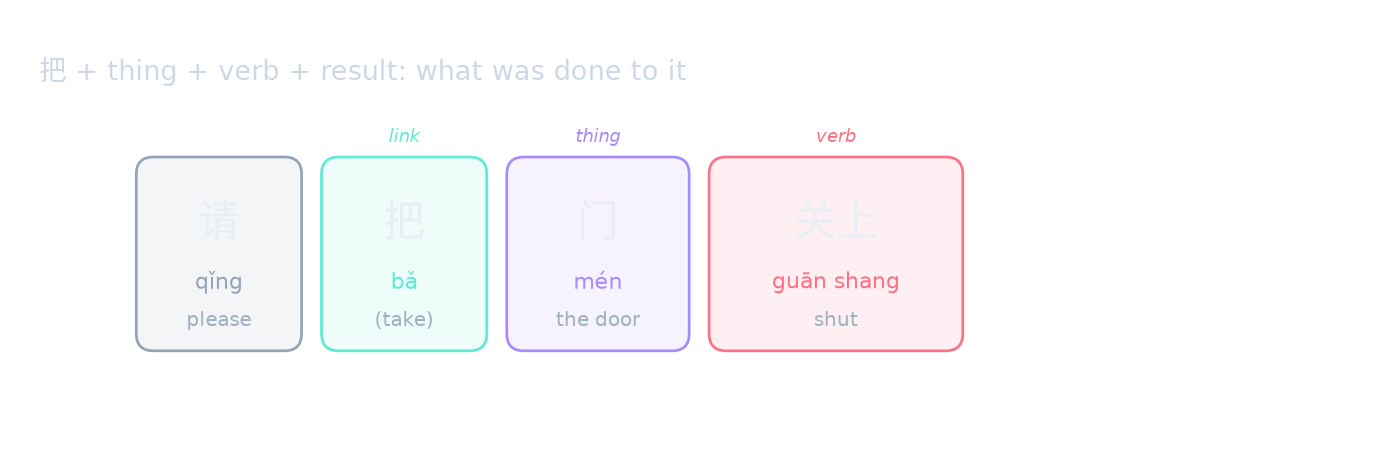
Close the door, please
- It is cold, and your little brother has left the door wide open again.
- please请to stand as a goalkeeper把门to close (a door)关上。 — "Please shut the door." (把: marks the object)把 brings the object forward and says what happens to it.
Subject + (把: marks the object)把 + Object + Verb + result
- (把: marks the object)把 + object comes before the verb; the verb must have something after it: a result, a direction, (completed / change)了, or a place.
- I / me我(把: marks the object)把school assignment作业to make做to finish完(completed / change)了 — "I've finished the homework." he他(把: marks the object)把the book书put放on在the table桌子(on)上 — "He put the book on the table."
he他把the book书put放on在the table桌子(on)上。
Complete: “I've finished the homework.” 我____作业做完了。
難易度 1/5 · 100 コイン + 今日初回完了時に小ボーナス付与
把 + object + verb + result.
Moving, changing, finishing
- Moving something: please请(把: marks the object)把the rubbish垃圾to take out拿出to go去。 — "Please take the rubbish out."
- Changing something: I / me我(把: marks the object)把this这个sentence句子翻译成English (language)英文(completed / change)了。 — "I translated this sentence into English."
please请把the rubbish垃圾take拿out出去。
Build: “Please take the rubbish out.”
難易度 3/5 · 200 コイン + 今日初回完了時に小ボーナス付与
把 + object + verb + direction.
The verb cannot stand alone
- I / me我(把: marks the object)把cooked rice饭variant of 吃吃 is incomplete. Add a result or (completed / change)了: I / me我(把: marks the object)把cooked rice饭variant of 吃吃to finish完(completed / change)了.
- The affected object is normally identifiable in the situation. These examples use a known book or door; indefinite objects can also occur with an appropriate context.
Which sentence is complete and correct?
難易度 1/5 · 100 コイン + 今日初回完了時に小ボーナス付与
The verb after 把 needs a result or 了.
Negatives and don't别
- not / haven't没 / not不 / don't别 go before (把: marks the object)把: I / me我not / haven't没(把: marks the object)把key钥匙to bring带来。 — "I didn't bring the keys." don't别(把: marks the object)把your phone手机forget忘on在home家里! — "Don't leave your phone at home!"
- Feeling and knowing verbs (to like喜欢, to know知道) do not take (把: marks the object)把.
don't别把your phone手机forget忘at在home家里!
我把钥匙没带来 is the correct word order.
難易度 1/5 · 100 コイン + 今日初回完了時に小ボーナス付与
没 goes before 把: 我没把钥匙带来.
Recap
- Subject + (把: marks the object)把 + specific object + Verb + something (result, direction, place, (completed / change)了).
- Negative words go before (把: marks the object)把. Not with feeling or knowing verbs.
Read the full reference: HSK 3 grammar — Sentence patterns.
It is cold, and your little brother has left the door wide open again. Close the examples. Say a Mandarin response, then write it in Chinese. Explain briefly in English what the lesson’s pattern adds. Compare with the model, then change one detail and try again.
This is supported productive practice. Compare meaning and structure; your answer need not copy the model. A partner or teacher must hear the spoken response to comment on pronunciation.