Your learning plan · Continue · Review →
Present simple — habits and facts
導入済み保存した位置はこのブラウザに留まります。再開してもImplementedの完了や回答にはなりません。
Describe a routine or a current state
- Outcome: describe a usual routine or state, choose the right verb frame, and ask a fitting question. Start with A1 present simple and pronouns and possessives.
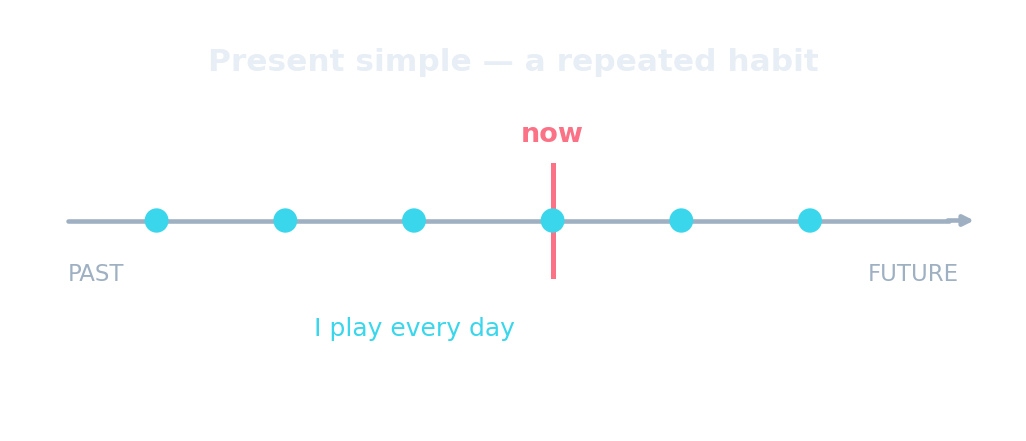
- Starting check: are both I walk to work and I am a student present simple? Yes. The diagram illustrates one continuing habit; it does not show every use of the tense or promise that a routine lasts forever.
I study every day; my desk has never asked for a holiday.
Choose the verb before the pattern
- With verbs like work, use I work, you work, we work, they work. For this plain statement, do not write I am work or I working.
- Be has its own present forms: I am ready. She is a nurse. They are here. These are present simple too. I know the address now describes a current state; the tense is not limited to repeated actions.
Which sentence uses the present simple correctly?
難易度 1/5 · 100 コイン + 今日初回完了時に小ボーナス付与
I play football every day uses the ordinary-verb statement frame with I. I am play and I playing do not fit that frame. Be can be present simple in another sentence, such as I am ready; this is not a ban on am in every present-simple sentence.
Choose the ordinary-verb statement with I. Keep walk in its base form.
難易度 1/5 · 100 コイン + 今日初回完了時に小ボーナス付与
I walk to college uses the requested ordinary-verb frame. Am walk and bare I walking do not fit. Be is still correct in a different frame such as I am a student. Next try: replace walk with cycle.
One person: she works; Rae works
- In an affirmative statement, most verbs add -s with he, she, it or one name: Rae walks. A plural subject uses Rae and Jo walk. Everyone knows treats everyone as singular.
- Learn common spellings: watch → watches, study → studies, play → plays. Learn special forms too: have → has, do → does, go → goes. Be uses am/is/are; do not try to build its forms by adding -s to be.
He / she / it — how does the verb add -s?
Practise the common third-person spellings in these examples; also learn special forms such as has and am/is/are separately.
Complete with the correct form: He ___ (live) in Beijing.
難易度 1/5 · 100 コイン + 今日初回完了時に小ボーナス付与
He lives in Beijing uses the third-person singular form lives. With I or a plural subject use live. Be has its own forms; the -s pattern here applies to live.
One person is named in an affirmative routine: Lea ___ tennis on Fridays. Choose the form of play.
難易度 1/5 · 100 コイン + 今日初回完了時に小ボーナス付与
Lea plays uses the third-person singular form with one name. Play fits I or a plural subject; playing needs another complete construction. Next try: change Lea to Lea and Jo.
Keep the negative frame complete
- For an ordinary verb, use don't/doesn't + base verb: I don't drive. She doesn't drive. In this frame, doesn't drives repeats the third-person ending incorrectly.
- With be, put not after the form of be: She is not late. They aren't ready. Do not turn these into She doesn't is late or They don't are ready.
Is this sentence correct? “She doesn't likes tea.”
難易度 1/5 · 100 コイン + 今日初回完了時に小ボーナス付与
After doesn't, use the base verb: “She doesn't like tea.”
Use doesn’t + a base verb for this negative: My uncle ___ coffee.
難易度 1/5 · 100 コイン + 今日初回完了時に小ボーナス付与
Doesn’t drink keeps the ordinary verb in its base form after doesn’t. The other options add an ending that does not fit this negative frame. Next try: make a positive sentence and choose the matching form.
Questions use different frames
- With an ordinary verb, use Do/Does + subject + base verb: Do you cycle? Does Rae have a bike? Replies match that frame: Yes, I do. No, she doesn't.
- With be, ask Are you ready? Is Rae a nurse? Replies can be Yes, I am or No, she isn't. Who works here? asks which person does the action; this subject question does not add question-making do.
Put the supplied words in order to make a complete do-question.
難易度 3/5 · 200 コイン + 今日初回完了時に小ボーナス付与
The supplied words form Do you like music? It uses Do + you + base-form like. Other present-simple questions use different frames: Are you ready? uses be, and Who works here? is a subject question. Do/Does is not the start of every yes/no question.
Translate into English: 我每天早上喝咖啡。
難易度 3/5 · 200 コイン + 今日初回完了時に小ボーナス付与
I drink coffee every morning is one option. Every morning I have coffee preserves the same routine and time. I have coffee every day gives a daily routine but leaves out the source’s morning detail.
For a question with be, put is before the subject. Choose the question asking whether the room is ready.
難易度 1/5 · 100 コイン + 今日初回完了時に小ボーナス付与
Is the room ready? uses the be-question frame. Adding does before is mixes frames, and do alone does not supply be here. Next try: give a short yes reply using is.
Frequency needs a context
- Usually means most of the time; sometimes means on some occasions. Neither word supplies an exact percentage. In ordinary routine descriptions, always can mean on every occasion in that routine, and never on none of them. Keep the setting clear rather than making a claim about all possible situations.
- Common positions include I usually walk and She is usually early. Sometimes I walk is natural too. If you need an exact count, report observations such as four of the five recorded visits, rather than turning a frequency word into a calculation.
Match these frequency words to their ordinary meanings in a stated routine. Do not assign fixed percentages.
難易度 2/5 · 140 コイン + 今日初回完了時に小ボーナス付与
These are contextual routine meanings. Usually and sometimes do not mean fixed 90% and 50% values. Always and never need the relevant situation or period; conversational wording may be loose. To give an exact count, provide observations instead of inventing numbers from the adverb.
Choose the standard complete question about whether she has a car, using does.
難易度 1/5 · 100 コイン + 今日初回完了時に小ボーナス付与
Does she have a car? uses does with she and base-form have. Does she has/haves repeats or invents a verb ending after does. Is she a driver? is a different be-question, not a reason to put does before is.
- Choose between the ordinary-verb frame and be: She works / She is ready; Does she work? / Is she ready? After does/doesn't, use the base form of the ordinary verb.
- A habit statement does not report what someone is doing at this instant. She usually cycles does not establish today's journey. Use frequency words for their contextual meanings, not fixed percentages.
Write one English sentence about a friend or family member’s usual routine. Use one person as your subject and choose an appropriate present simple verb form.
難易度 3/5 · 200 コイン + 今日初回完了時に小ボーナス付与
My brother has breakfast at home is a possible routine sentence. He usually cooks dinner also fits. The subject and chosen verb frame determine the form; present-simple be, has and does are not all made by adding -s to a base word.
Three worked contrasts
- A job and an action: Rae is a nurse. Rae works at a clinic. Ask Is Rae a nurse? about her role, and Does Rae work at this clinic? about where she works. Does Rae is a nurse? mixes the two frames.
- A statement and a negative: My brother has breakfast at home uses the special affirmative form has. My brother doesn't have breakfast at home uses base-form have after doesn't. The negative changes the fact; it does not require doesn't has.
- A pattern and an observation: Jo usually walks to class describes a usual pattern. It does not prove Jo walked today or give exactly nine journeys out of ten. Jo walked on four of the five recorded days gives data for that recorded period, not a lifetime rule.
Interpret fresh routines
- Read each new situation before choosing a form or conclusion. Keep the person, state, routine and frequency meaning together. A grammatical sentence can still add a fact the message did not give.
- Try part of the practice today and the rest in another session. About 45–60 minutes across study, decisions and writing is a planning suggestion, not a test time or a measured level. Write the English routine message before opening its model; compare and revise one mismatch.
Choose the standard statement about one teacher’s usual journey.
難易度 1/5 · 100 コイン + 今日初回完了時に小ボーナス付与
Our teacher is one person, so walks fits this affirmative statement. Walk lacks agreement here, and walking alone does not complete the verb frame. Next try: write the version with two teachers.
Choose the standard statement about two named friends.
難易度 1/5 · 100 コイン + 今日初回完了時に小ボーナス付与
Ana and Jo is a plural subject, so play fits this ordinary present-simple statement. Plays is singular here; playing alone leaves the frame incomplete. Next try: describe only Ana.
A note identifies one person’s job. Choose the complete present-simple sentence.
難易度 1/5 · 100 コイン + 今日初回完了時に小ボーナス付与
Omar is a cook uses the singular form of be. Be and does is do not fit this statement. Next try: turn the statement into a be-question.
An office note says the visitors are ready. Choose the matching complete statement.
難易度 1/5 · 100 コイン + 今日初回完了時に小ボーナス付与
Plural visitors takes are in this be statement. Is gives singular agreement, and do ready does not supply the required be frame. Next try: describe one visitor.
Choose a standard negative about Lea’s usual travel.
難易度 1/5 · 100 コイン + 今日初回完了時に小ボーナス付与
Doesn’t agrees with Lea and takes base-form drive. Don’t does not fit the requested standard singular-subject model, and drives repeats the ending after doesn’t. Next try: make it affirmative.
A group is not ready. Choose the complete negative be sentence.
難易度 1/5 · 100 コイン + 今日初回完了時に小ボーナス付与
They aren’t ready uses are not with the plural subject. The other options mix do/does with a missing or extra be form. Next try: ask whether they are ready.
Choose a complete standard question about whether one child has a bike.
難易度 1/5 · 100 コイン + 今日初回完了時に小ボーナス付与
Does the child have a bike? pairs singular the child with does and base-form have. Has repeats the third-person form after does; do does not fit this singular-subject model. Next try: ask about two children.
Choose the complete be-question asking whether the doors are open.
難易度 1/5 · 100 コイン + 今日初回完了時に小ボーナス付与
Are the doors open? uses plural are before the subject. Do the doors are mixes frames, and is does not agree with doors here. Next try: ask about one door.
Someone asks, “Does Rae work here?” You know that she does. Choose the matching short reply.
難易度 1/5 · 100 コイン + 今日初回完了時に小ボーナス付与
Yes, she does matches the does-question. Yes, she is would answer a suitable be-question, not this short-reply frame. Next try: give the negative short reply.
Someone asks, “Is the café open?” You know it is closed. Choose the matching short reply.
難易度 1/5 · 100 コイン + 今日初回完了時に小ボーナス付与
No, it isn’t matches this be-question and the stated closed condition. Doesn’t and don’t belong to other negative frames. Next try: give a full sentence saying the café is closed.
Choose the standard present-simple statement about everyone in a group knowing a password.
難易度 1/5 · 100 コイン + 今日初回完了時に小ボーナス付与
Everyone takes singular agreement, so knows fits. Know lacks that agreement here, and knowing alone does not complete the statement. Next try: replace everyone with all the members.
Choose the standard statement about one person’s breakfast routine.
難易度 1/5 · 100 コイン + 今日初回完了時に小ボーナス付与
Has is the special third-person singular form of have. Have and haves do not fit this affirmative singular-subject statement. Next try: make a negative using doesn’t have.
A club note says, “Mia usually walks here.” What does usually establish?
難易度 1/5 · 100 コイン + 今日初回完了時に小ボーナス付与
Usually gives a common pattern without an exact count or a report of this instant. The other options add unsupported numbers or a current action. Next try: ask about today’s journey separately.
A diary summary says, “I sometimes take the train.” Which conclusion is supported?
難易度 1/5 · 100 コイン + 今日初回完了時に小ボーナス付与
Sometimes reports some occasions without fixing the share at half. It also does not mean every journey. Next try: name the records needed for an exact proportion.
For the visits described in a log, “I never drive there” uses the ordinary routine meaning. What does it say about those visits?
難易度 1/5 · 100 コイン + 今日初回完了時に小ボーナス付与
Never means not at all in the stated visit context. It does not supply a half share or mean every visit. Keep the context rather than extending the claim to every possible journey. Next try: describe how the message changes with sometimes.
A routine note says, “Every school day, I always bring my pass.” Which meaning fits this stated routine?
難易度 1/5 · 100 コイン + 今日初回完了時に小ボーナス付与
Always gives every occasion within the described school-day routine. Half and never contradict that meaning. This routine description does not require an invented lifetime claim. Next try: say it less strongly with usually.
Choose the complete sentence using the frequency adverb with be.
難易度 1/5 · 100 コイン + 今日初回完了時に小ボーナス付与
She is usually early includes be and the adverb usually. Usually early without is leaves this statement incomplete; usual is an adjective and does not replace the adverb here. Next try: make a complete negative be sentence.
A friend’s usual routine is cycling to work. You have no report about today. Which statement stays within the information?
難易度 1/5 · 100 コイン + 今日初回完了時に小ボーナス付与
The first statement keeps the usual pattern. The other two assert a current or completed journey that the information did not establish. Next try: ask for today’s travel update.
Choose the complete standard subject question asking which person runs a club.
難易度 1/5 · 100 コイン + 今日初回完了時に小ボーナス付与
Who runs the club? uses who as the subject with runs. The other options add do/does while leaving runs, breaking this question frame. Next try: answer with a person’s name.
A notice says, “The shop is open at nine on weekdays.” Which judgment fits its grammar?
難易度 1/5 · 100 コイン + 今日初回完了時に小ボーナス付与
Is is a present-simple form of be. An ordinary-verb rule does not ban it, and does is mixes frames. Next try: ask whether the shop is open at nine.
A club usually opens at six, but today’s opening has not been checked. You want to visit today. Which message avoids adding an unsupported fact?
難易度 1/5 · 100 コイン + 今日初回完了時に小ボーナス付与
The usual pattern does not confirm today’s opening. The second message preserves that pattern and asks for today’s state. The other choices turn usually into a guarantee. Next try: write a reply only after the opening is confirmed.
Facts: your cousin Rae is a nurse. She usually cycles to work and sometimes takes a bus. She does not work on Sundays. Write three or four English sentences describing her role and routine. Do not add exact percentages or claim what she is doing right now. Compare and revise.
Compare your English with the facts and checklist. Repair a real form or meaning mismatch, or explain why none is present. Several answers can fit. Written self-review does not automatically mark correctness or establish proficiency.
Retrieve and check later
- Tomorrow, try the two review decisions and the new college message before rereading. Write a statement, a negative and a question using their own complete frames; keep usual patterns separate from exact counts or a report of today.
- Continue with present continuous to contrast routines with progress and temporary situations. These written decisions and self-review support study; they do not certify speaking/listening proficiency or independent mastery.
Usage checked 2026-10-20: British Council, present simple, How often and Cambridge, present simple. Examples and tasks are original; independent language/key and learner review pending.
Review later: choose the standard negative for one person’s breakfast routine.
難易度 1/5 · 100 コイン + 今日初回完了時に小ボーナス付与
Doesn’t takes base-form have in this frame. The other options keep has after an auxiliary or use the wrong standard agreement. Next try: write its affirmative form with has.
Review later: “We usually meet on Fridays” is the only information given. Which conclusion stays within it?
難易度 1/5 · 100 コイン + 今日初回完了時に小ボーナス付与
Usually describes a pattern, not an exact count or confirmation of today’s event. The other choices add facts. Next try: ask whether this Friday’s meeting is happening.
Return later without rereading. Facts: your friend Lea is a college student. She usually starts classes at nine and never drives to college. Write three English fact sentences, then ask whether she has classes on Saturdays. The Saturday answer is unknown. Compare and revise.
Compare your English with the facts and checklist. Repair a real form or meaning mismatch, or explain why none is present. Several answers can fit. Written self-review does not automatically mark correctness or establish proficiency.