| English | 意味 |
|---|---|
| Health psychology/helθ saɪˈkɒlədʒi/ | 健康心理学 |
| Eustress/ˈjuːstrəs/ | 好ストレス |
| distress/dɪˈstres/ | 悪ストレス |
| acute/əˈkjuːt/ | 急性 |
| chronic/ˈkrɒnɪk/ | 慢性 |
| Alarm/əˈlɑːm/ | 警戒期 |
| resistance/rɪˈzɪstəns/ | 抵抗期 |
| exhaustion/eɡˈzɔːstʃn/ | exhaustion:衰竭期 |
| General adaptation syndrome/ˈdʒenərəl ˌædæpˈteɪʃn ˈsɪndrəʊm/ | 一般適応症候群 |
| Problem-focused coping/ˈprɒbləm ˈfəʊkəst ˈkəʊpɪŋ/ | Problem-focused coping:問題焦点対応 |
| Emotion-focused coping/ɪˈməʊʃn ˈfəʊkəst ˈkəʊpɪŋ/ | Emotion-focused coping:感情焦点対応 |
| Tend-and-befriend theory/tend ænd bɪˈfrend ˈθɪəri/ | Tend-and-befriend theory:養育・同盟理論 |
A psychological state with a physical bill
- Stress is felt in the mind and paid for in the body.
- It raises susceptibility to illness through measurable physiological routes.
- Health psychology 健康心理学 studies exactly that crossing point.
Two kinds of stress
- Eustress 良性压力 is motivating; distress 消极压力 is debilitating.
- The same event can be either, depending on how it is appraised.
- Stressors can also be acute 急性 (short) or chronic 慢性 (sustained), and chronic stress does the greater physical damage.
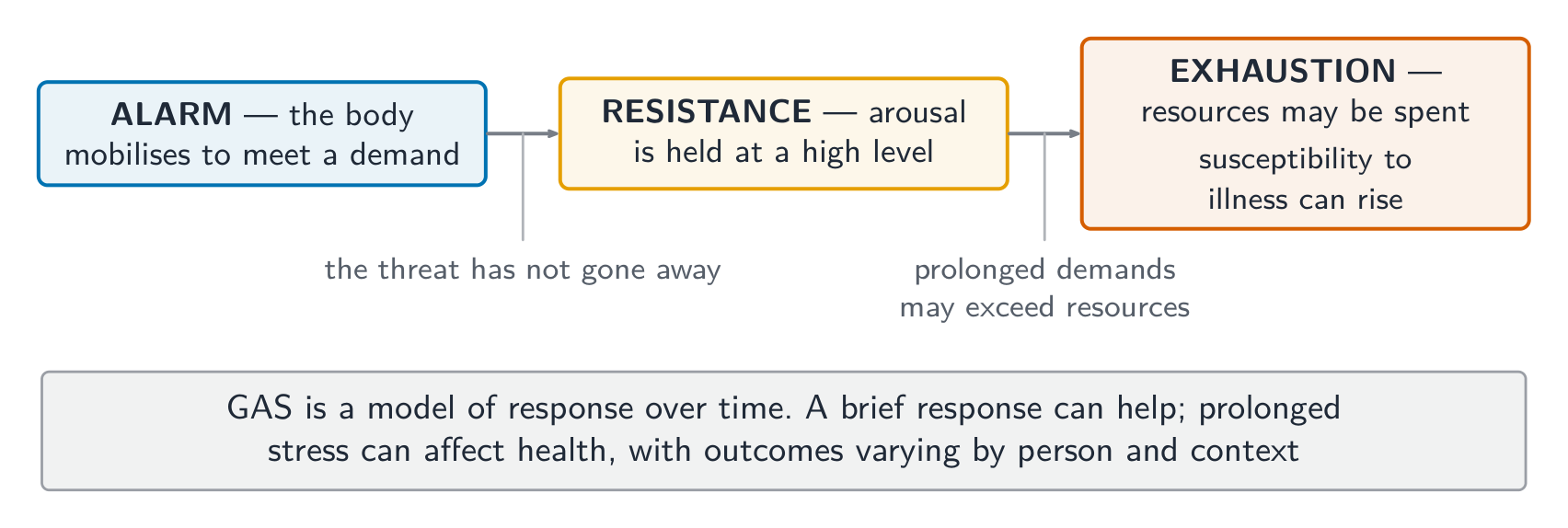
The GAS model traces alarm 警觉期, resistance 抵抗期 and exhaustion 衰竭期; outcomes depend on duration and circumstances
Stress experienced as motivating rather than debilitating is called ____.
難易度 1/5 · 100 コイン + 今日初回完了時に小ボーナス付与
Eustress motivates; distress debilitates. The same event can be either.
Select all that are true of chronic stress.
難易度 2/5 · 140 コイン + 今日初回完了時に小ボーナス付与
Chronic stress is the kind that reaches exhaustion; eustress is a separate distinction.
The general adaptation syndrome
- General adaptation syndrome 一般适应综合征 (GAS) describes stress in three stages.
- Alarm mobilises the body; resistance sustains the response; exhaustion arrives when resources run out.
- The damage happens in the third stage, which is why chronic stress is the dangerous kind.
Follow the stress response to its cost
The damage is done by stage two, not stage one: a short alarm is adaptive, and prolonged resistance is not.
Put the stages of the general adaptation syndrome in order.
難易度 3/5 · 200 コイン + 今日初回完了時に小ボーナス付与
Damage occurs at exhaustion, which is why chronic stress is the dangerous kind.
Neither coping style is "the right one". Problem-focused coping suits a stressor you can change; emotion-focused coping suits one you cannot. An answer that ranks them without naming the stressor's controllability has missed the criterion.
Tend-and-befriend is an alternative to the fight-or-flight account of stress response.
難易度 1/5 · 100 コイン + 今日初回完了時に小ボーナス付与
It describes responses that involve tending to needs and seeking social contact.
Tend-and-befriend
- Tend-and-befriend theory 照料-结盟理论 proposes an alternative to fight-or-flight.
- Some people respond to stress by tending to their own and others' needs, and by seeking social contact.
- The CED includes it because fight-or-flight does not describe every stress response observed.
Problem-focused coping is the better fit when the stressor is...
難易度 1/5 · 100 コイン + 今日初回完了時に小ボーナス付与
A stressor you can change calls for solving it; one you cannot calls for managing the reaction.
Two ways to cope
- Problem-focused coping 问题聚焦应对 treats the stressor as a problem to be solved.
- Emotion-focused coping 情绪聚焦应对 manages the emotional reaction instead.
- Neither is better in general: problem-focused suits a controllable stressor, emotion-focused an uncontrollable one.
Two students face the same exam. One makes a revision plan — problem-focused, and the stressor is controllable. The other, facing a family illness she cannot change, uses emotion-focused coping instead. Different stressors, different correct strategies.
Health psychology links stress to physical illness. Eustress motivates and distress debilitates; stressors are acute or chronic. GAS runs alarm → resistance → exhaustion, tend-and-befriend is an alternative to fight-or-flight, and coping is problem-focused or emotion-focused depending on controllability.
Write from exhaustion at week 12
- A new job produces alarm in week 1, resistance through week 6, and exhaustion at week 12 if the demand never falls.
- Name the sequence and one alternative to fight-or-flight.
A new job brings alarm in week 1, resistance through week 6, and exhaustion at week 12. What sequence is this, and what is tend-and-befriend?
The stages are ordered. A demand that never eases can exhaust the resistance stage.
What is week 12 in this account?
難易度 1/5 · 100 コイン + 今日初回完了時に小ボーナス付与
Alarm is week 1. Exhaustion is the later stage at week 12.