| English | 意味 |
|---|---|
| nuclear fission/ˈnjuːklɪə ˈfɪʃn/ | 核分裂 |
| nuclear fusion/ˈnjuːklɪə ˈfjuːʒn/ | 核融合 |
A pinch of matter, an ocean of energy
- The Sun turns four million tonnes of its matter into pure energy every second.
- A nuclear reactor powers a city from a few kilograms of fuel.
- The secret is mass turning into energy, through Einstein's $E = mc^2$.
- Because $c^2$ is enormous, a tiny mass releases a colossal amount of energy.
Mass becomes energy
- Einstein's relation $E = mc^2$ says mass and energy are two forms of the same thing.
- In a nuclear reaction, a little mass disappears and reappears as a burst of energy.
- Because $c^2 \approx 9\times10^{16}$, even a gram of mass would give a huge energy.
- Nuclear reactions release millions of times more energy per atom than chemical ones.
質量とエネルギーを結びつける方程式はどれか?
難易度 1/5 · 100 コイン + 今日初回完了時に小ボーナス付与
アインシュタインの $E = mc^2$ が質量とエネルギーを結びつける。
なぜ核反応は化学反応よりもはるかに多くのエネルギーを放出するのか?
難易度 1/5 · 100 コイン + 今日初回完了時に小ボーナス付与
$c^2$ が非常に大きいため、微小な質量の変換でも莫大なエネルギーが生じる。
Fission: splitting big nuclei
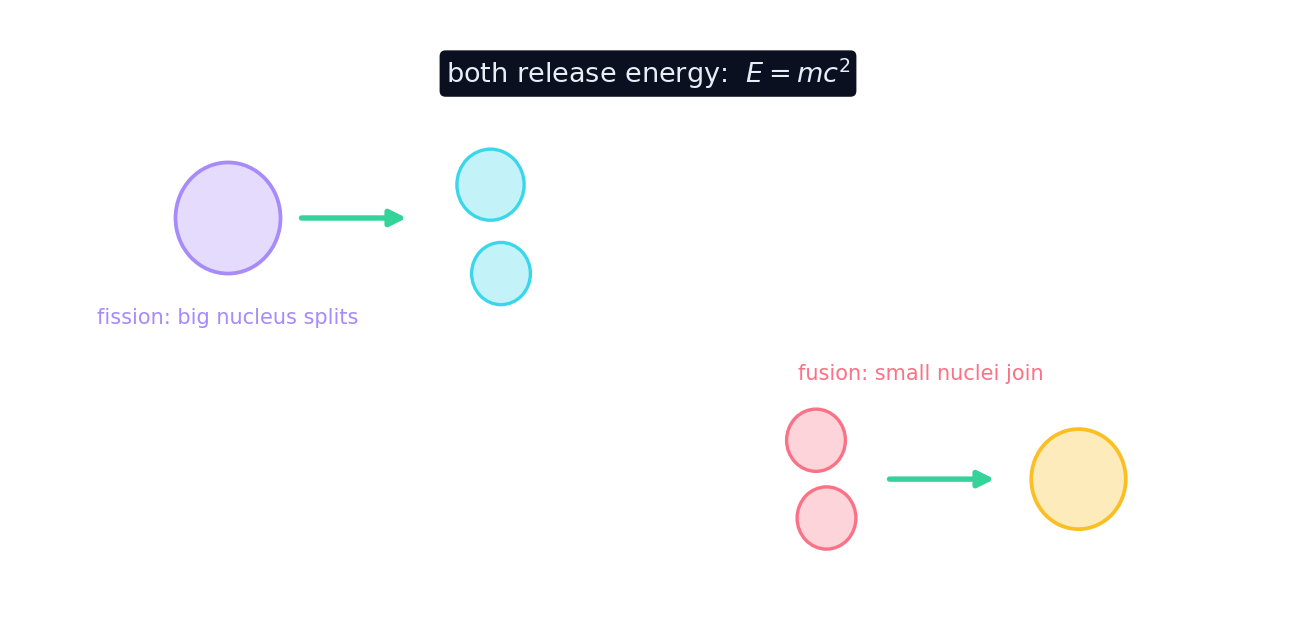
- Nuclear fission 核裂变 splits a large, heavy nucleus (like uranium) into smaller pieces.
- The fragments have slightly less total mass; the lost mass becomes energy.
- Each split also releases neutrons that can split more nuclei — a chain reaction.
- Fission powers nuclear reactors and atomic bombs.
核分裂とは:
難易度 1/5 · 100 コイン + 今日初回完了時に小ボーナス付与
核分裂は、大きな重原子核を较小的な破片に分裂させることである。
Fusion: joining small nuclei
- Nuclear fusion 核聚变 joins small, light nuclei (like hydrogen) into a bigger one.
- Again a little mass is lost and released as energy — even more per kilogram than fission.
- Fusion powers the Sun and the stars, welding hydrogen into helium.
- It needs extreme heat and pressure, which is why fusion power on Earth is so hard.
核分裂、融合、あるいは崩壊か?
各核反応を分類せよ。
核融合は ____ と恒星の動力源となっている。
難易度 1/5 · 100 コイン + 今日初回完了時に小ボーナス付与
太陽は水素をヘリウムに融合させ、そのエネルギーを放出している。
核反応に関する 正しい 記述をすべて選択せよ。
難易度 2/5 · 140 コイン + 今日初回完了時に小ボーナス付与
核分裂は分裂し、核融合は結合し、どちらも質量減少に伴ってエネルギーを放出する。核融合もエネルギーを放出する。
Both fission (splitting) and fusion (joining) release energy, because in each the products have slightly less mass than the starting nuclei. The "lost" mass isn't destroyed — it becomes energy via $E = mc^2$. Don't assume only splitting releases energy; fusion of light nuclei releases even more.
核分裂も融合も、生成物の質量がわずかに少なくなるためエネルギーを放出する。
難易度 1/5 · 100 コイン + 今日初回完了時に小ボーナス付与
失われた質量は、両方の過程で $E = mc^2$ を通じてエネルギーに変換される。
The Sun fuses hydrogen into helium. Where does its enormous energy come from?
- The helium nucleus has slightly less mass than the hydrogen that made it.
- That tiny lost mass becomes energy via $E = mc^2$ — and with $c^2$ so large, it is immense.
Nuclear reactions convert mass into energy via $E = mc^2$, releasing millions of times more energy per atom than chemical reactions. Fission splits heavy nuclei (reactors, bombs); fusion joins light nuclei (the Sun). In both, the products have slightly less mass, and that mass becomes energy.