| English | 意味 |
|---|---|
| ideal gas law/aɪˈdɪəl ɡæs lɔː/ | 理想気体法則 |
Pump up a tyre — it gets hot and hard
- Push a bike pump and the barrel warms up while the tyre grows firm.
- You squeezed the gas into less space, and its pressure and temperature climbed.
- One tidy equation ties pressure, volume, temperature and amount of gas together.
- It is the ideal gas law 理想气体定律, the workhorse of thermodynamics.
The equation
- The ideal gas law is $PV = nRT$.
- $P$ is pressure, $V$ volume, $n$ the amount of gas (in moles), $T$ the kelvin temperature.
- $R$ is the universal gas constant, the same for every ideal gas.
- Know any three of $P, V, T$ (for fixed $n$) and the fourth is fixed.
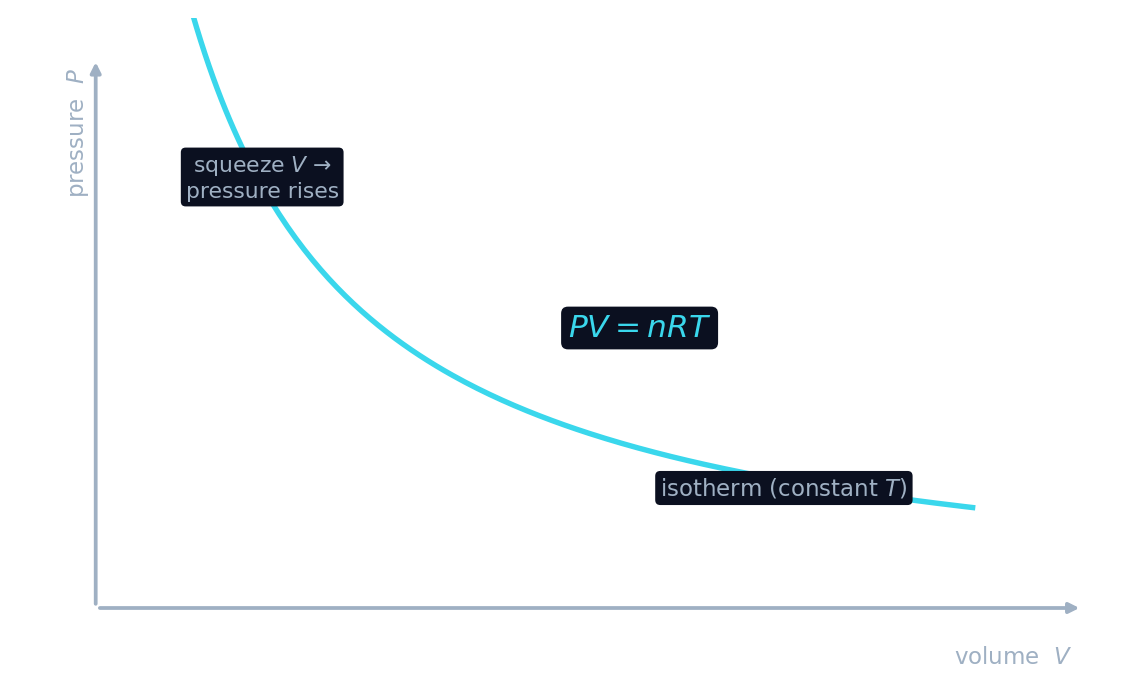
気体を圧縮する
体積を変化させ、等温線上で圧力がどう応答するかを見る — PVは一定である。
理想気体の状態方程式はどれか?
難易度 1/5 · 100 コイン + 今日初回完了時に小ボーナス付与
$PV = nRT$は圧力、体積、物質量、温度を結びつける。
$PV = nRT$において、記号$n$は____単位で測られた気体の量である。
難易度 1/5 · 100 コイン + 今日初回完了時に小ボーナス付与
$n$は気体のモル数を表す。
The relationships inside it
- At constant temperature, $P$ and $V$ are inversely related: squeeze $V$, and $P$ rises.
- At constant volume, $P$ rises in proportion to the kelvin temperature.
- At constant pressure, volume rises in proportion to temperature.
- Each is a special case of the one master equation $PV = nRT$.
温度$100\ \text{kPa}$、体積$2\ \text{m}^3$の気体を、温度一定で体積$0.5\ \text{m}^3$まで圧縮する。新しい圧力はいくつ($\text{kPa}$)か?
難易度 2/5 · 140 コイン + 今日初回完了時に小ボーナス付与
$P_1V_1 = P_2V_2 \Rightarrow 200 = 0.5 P_2 \Rightarrow P_2 = 400\ \text{kPa}$.
温度一定の場合、気体の体積を半分にすると、その圧力は:
難易度 1/5 · 100 コイン + 今日初回完了時に小ボーナス付与
$PV$は一定なので、$V$を半分にすると$P$は倍になる。
温度$300\ \text{K}$で圧力$200\ \text{kPa}$の気体が剛体容器中にある。温度$600\ \text{K}$まで加熱したとき、新しい圧力はいくつ($\text{kPa}$)か?
難易度 2/5 · 140 コイン + 今日初回完了時に小ボーナス付与
体積一定の場合、$P \propto T$:ケルビン温度を倍にすると圧力も倍になり$400\ \text{kPa}$となる。
When it works
- The law is exact for an ideal gas — particles with no size and no forces between them.
- Real gases follow it closely at ordinary pressures and well above their boiling point.
- It breaks down near condensation, where particle forces matter.
- For AP problems, treat gases as ideal unless told otherwise.
理想気体の状態方程式における温度はケルビンでなければならない。
難易度 1/5 · 100 コイン + 今日初回完了時に小ボーナス付与
この法則はケルビンで比例関係にある;$^\circ\text{C}$を使うと誤った比になる。
Always put temperature in kelvin in $PV = nRT$. Using $^\circ\text{C}$ gives nonsense — for example, "doubling from $10\,{}^\circ\text{C}$ to $20\,{}^\circ\text{C}$" is not doubling the temperature ($283\ \text{K}$ to $293\ \text{K}$ is only a $3.5\%$ rise).
A gas at pressure $100\ \text{kPa}$ and volume $2\ \text{m}^3$ is squeezed to $0.5\ \text{m}^3$ at constant temperature. Find the new pressure.
- At constant $T$, $P_1 V_1 = P_2 V_2 \Rightarrow 100 \times 2 = P_2 \times 0.5$.
- $P_2 = \dfrac{200}{0.5} = 400\ \text{kPa}$ — four times larger, as the volume shrank fourfold.
The ideal gas law is $PV = nRT$ (temperature in kelvin). At constant $T$, $P$ and $V$ are inversely related ($P_1V_1 = P_2V_2$); at constant $V$ or $P$, the others rise with temperature. It holds well for real gases away from condensation.