| English | 意味 |
|---|---|
| production possibilities curve/prəˈdʌkʃn ˌpɒsəˈbɪlɪtiz kɜːv/ | 生産可能性曲線 |
| efficient/ɪˈfɪʃənt/ | 効率的 |
| opportunity cost/ɒpəˈtjuːnɪti kɒst/ | 機会コスト |
| law of increasing opportunity cost/lɔː ɒv ɪnˈkriːsɪŋ ɒpəˈtjuːnɪti kɒst/ | 機会コスト増加の法則 |
| economic growth/ˌiːkəˈnɒmɪk ɡrəʊθ/ | 経済成長 |
Draw the edge of the possible
- Give an economy just two goods to make — say food and phones.
- Draw every combination it could make when nothing is wasted.
- The outer boundary of those combinations is the production possibilities curve 生产可能性曲线 (PPC).
- It turns the whole idea of scarcity into one picture you can point at.
On, inside, or outside
- Points on the curve are efficient 有效率 — every resource is being used.
- Points inside are inefficient — some workers or factories sit idle.
- Points outside are currently unattainable — a direct picture of scarcity.
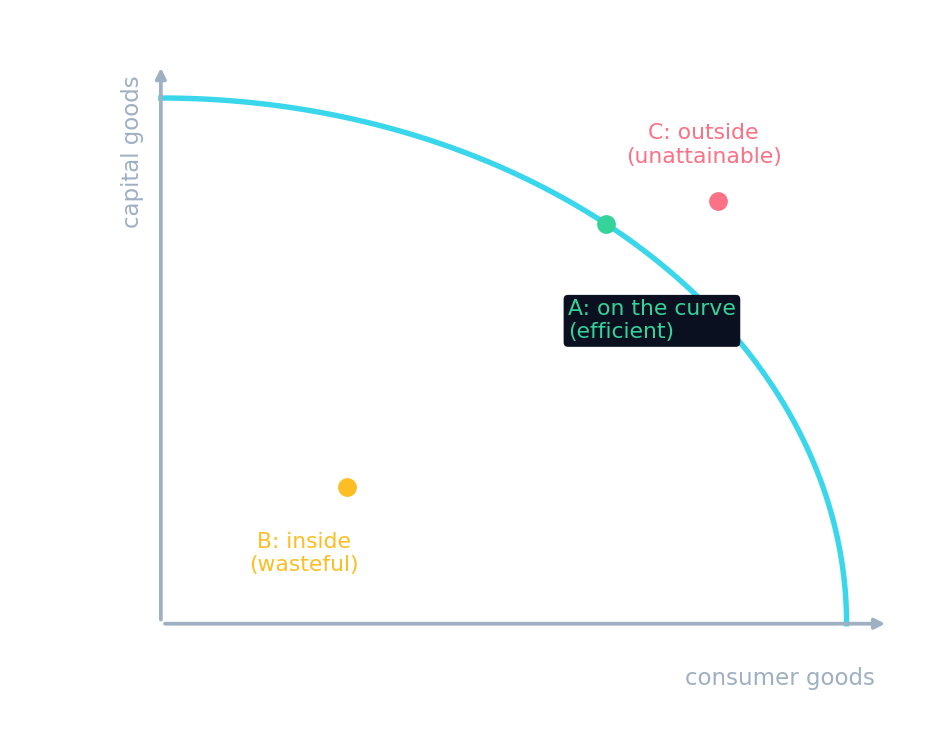
ある国がPPCの内部の点で生産している場合、これは意味する:
難易度 1/5 · 100 コイン + 今日初回完了時に小ボーナス付与
曲線内部では資源が闲置しており、経済は両方の商品をより多く生産できる。
現在の資源だけでは、経済はPPCの外側の点での生産是不可能的。
難易度 1/5 · 100 コイン + 今日初回完了時に小ボーナス付与
曲線外部の点は現在達成不可能であり、それらに到達するには経済成長が必要である。
Why the curve bows outward
- Move along the curve to make more phones, and you must make less food — that sacrifice is the opportunity cost 机会成本.
- The curve usually bows outward, showing the law of increasing opportunity cost 机会成本递增规律.
- Resources are not equally good at both jobs, so each extra phone costs more and more food.
- A straight-line PPC would instead mean a constant opportunity cost.
生産可能性曲線を探索する
ある商品の生産を増やすことは、他の商品の一部を手放すことを意味する — このトレードオフが機会費用であり、外側への湾曲は限界機会費用逓増の法則である。曲線に沿ってドラッグ操作を行い、経済成長によってフロンティア全体を外側に押し広げよ。
通常のPPFが外側へ湾曲(原点に対して凹)するのはなぜか?
難易度 1/5 · 100 コイン + 今日初回完了時に小ボーナス付与
ある商品に資源を投入するほど、追加単位の生産に伴う他商品の損失は大きくなり、限界機会費用逓増の法則が成立する。
Read an opportunity cost off the curve
- Pick two points and compare them — the cost is what you gave up.
- Worked example. At point A the economy makes 100 food, 0 phones. At point B it makes 80 food, 30 phones.
- Moving A → B, it gains 30 phones by giving up 20 food.
- So the opportunity cost of one phone is $20 \div 30 = 0.67$ units of food.
点Aでは経済は食料100と携帯電話0を生産し、点Bでは食料80と携帯電話30を生産している。携帯電話1台あたりの機会費用(食料単位)はいくつか?
難易度 2/5 · 140 コイン + 今日初回完了時に小ボーナス付与
20の食料を諦めて30台の携帯電話を手に入れるため、各携帯電話の価格は$20/30 = 0.67$の食料となる。
Growth pushes the whole curve out
- Economic growth 经济增长 shifts the entire curve outward.
- It comes from more resources, better technology, or improved skills.
- Now combinations that were once impossible become reachable.
- Producing inside the curve is not growth — it is just using what you already have more fully.
技術向上は曲線全体を ______ (どの方向へ?)シフトさせる。
難易度 1/5 · 100 コイン + 今日初回完了時に小ボーナス付与
成長は可能範囲を広げ、フロンティアを外側に移動させる。
PPFを外側へシフトさせる要素をすべて選択せよ。
難易度 2/5 · 140 コイン + 今日初回完了時に小ボーナス付与
成長には、より多く、または質の高い資源が必要である。曲線上に移動するだけでは単なる非効率の解消であり、成長ではない。
The PPC shows the most an economy can make of two goods. On = efficient, inside = wasteful, outside = unattainable. Its outward bow is the law of increasing opportunity cost, and economic growth shifts the whole curve outward.