| English | 意味 |
|---|---|
| macroeconomics/ˌmækrəˌriːkəˈnɒmɪks/ | マクロ経済学 |
| scarcity/ˈskeəsɪti/ | 希少性 |
| resources/rɪˈzɔːsɪz/ | 資源 |
| factors of production/ˈfæktəz ɒv prəˈdʌkʃn/ | 生産要素 |
| land/lænd/ | 土地 |
| labour/ˈleɪbə/ | 労働 |
| capital/ˈkæpɪtl/ | 資本 |
| entrepreneurship/ˌɒntrɪprəˈnjʊəʃɪp/ | 起業家精神 |
The whole economy in one idea
- Macroeconomics 宏观经济学 zooms out — it studies total output, total jobs, and the average level of prices.
- Yet it rests on the same bedrock as every branch of economics.
- No country, however rich, can produce everything at once.
- That single fact — scarcity 稀缺 — is where the whole subject begins.
Macroeconomics studies:
難易度 1/5 · 100 コイン + 今日初回完了時に小ボーナス付与
Macro zooms out to the whole economy; micro focuses on individual markets.
Scarcity forces choice
- Scarcity means our wants are unlimited while our resources 资源 are limited.
- So every society must choose: what to produce, how, and for whom.
- Because resources are scarce, every choice gives something up.
- Even a wealthy nation faces scarcity — it cannot do everything at once.
Scarcity exists because:
難易度 1/5 · 100 コイン + 今日初回完了時に小ボーナス付与
Scarcity is the gap between unlimited wants and limited resources.
A wealthy country does not face scarcity.
難易度 1/5 · 100 コイン + 今日初回完了時に小ボーナス付与
Scarcity is universal — even a rich country cannot produce everything at once.
The four factors of production
- Land 土地 — natural resources like soil, water, and minerals.
- Labour 劳动 — human physical and mental effort.
- Capital 资本 — machines, tools, and factories made to produce other goods.
- Entrepreneurship 企业家才能 — the initiative to combine the others and bear risk.
Which factor of production?
Every resource is a factor of production — land, labour, capital, or entrepreneurship. Sorting them is the first step in thinking about scarcity.
Select all four factors of production.
難易度 2/5 · 140 コイン + 今日初回完了時に小ボーナス付与
Land, labour, capital and entrepreneurship are the four factors.
Machines, tools, and factories used to make other goods are the factor called ______.
難易度 1/5 · 100 コイン + 今日初回完了時に小ボーナス付与
Capital is human-made goods used to produce other goods.
Match each resource to its factor of production.
難易度 2/5 · 140 コイン + 今日初回完了時に小ボーナス付与
Nature is land, human effort is labour, made tools are capital, risk-taking is entrepreneurship.
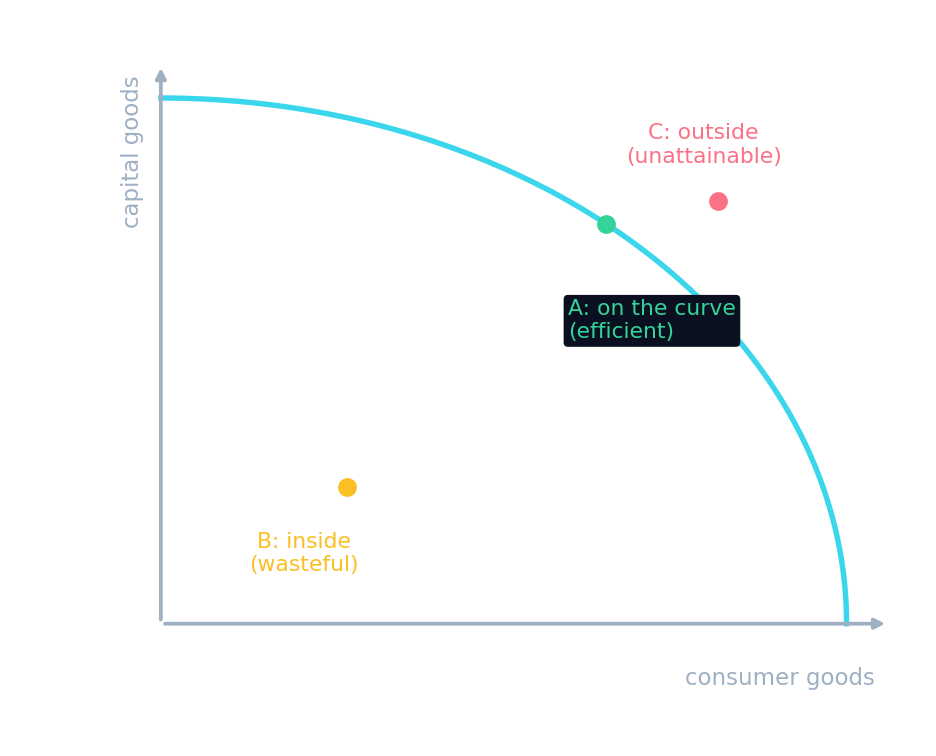
A country has only so many workers, machines, and hectares of land.
- Use them to build hospitals, and fewer are left for roads.
- Use them for consumer goods now, and fewer capital goods are made for the future.
- Every use of a scarce resource closes off another use — that is scarcity at work.
Macroeconomics studies the economy as a whole, but starts from scarcity: unlimited wants, limited resources. Scarcity forces every society to choose what, how, and for whom. Economists group resources into four factors of production — land, labour, capital, and entrepreneurship.
Write from a scarcity gap of 120
- People want 200 units of output.
- Resources can produce 80.
People in a country want 200 units of output, but resources can produce only 80. What is the scarcity gap, and does being a rich country remove scarcity?
200 minus 80 is 120.
What is the scarcity gap?
難易度 1/5 · 100 コイン + 今日初回完了時に小ボーナス付与
Wants of 200 minus output of 80 leave a gap of 120. Other options — 80 (the amount that can be produced); 0 (because a rich country has no scarcity).